
National Solidarity Fund in Mauritius | Contributions, Benefits & Eligibility

Anushka
Content Writer
Anushka Basu is a business content writer specialised in global business market insights. She aims to simplify complex regulatory, financial, and business concepts into… Read more

Tulika Saxena
AVP, Sales & Marketing | IIM Nagpur
Tulika Saxena specializes in business finance, sales strategy, and market positioning. Leads growth and partnerships, ensuring seamless business setup experiences and client success across… Read more


Key Fact: The National Solidarity Fund is a statutory body established under the National Solidarity Fund Act 1991. It provides financial assistance under specific schemes, including support for severe personal hardship and redundant workers.
Table of contents
- Introduction
- What Is the National Solidarity Fund in Mauritius?
- National Solidarity Fund vs National Savings Fund | What Is the Difference?
- Who Contributes to the National Savings Fund in Mauritius?
- How Are Employee Contributions Calculated?
- Do Expatriates Contribute to the National Savings Fund?
- What Assistance Does the National Solidarity Fund Provide?
- Can the National Solidarity Fund Assist Redundant Workers?
- Are National Savings Fund Contributions Refunded?
- What Are Employers’ Responsibilities?
- How Can Employees Check Their Contributions?
- How Can Someone Apply for National Solidarity Fund Assistance?
- What Documents May Be Required?
- What Happens If Contributions Are Not Properly Managed?
- How Can Arnifi Help?
- FAQs
- Conclusion
- References
Introduction
The National Solidarity Fund (NSF) in Mauritius is a statutory fund created to provide financial assistance in specified circumstances. It is different from the National Savings Fund, which forms part of the employee contribution framework and provides a lump-sum payment under applicable conditions. Because both are sometimes abbreviated as “NSF,” businesses and employees should distinguish between them when discussing contributions, benefits and eligibility.
For employers, this distinction is particularly important when handling payroll and statutory contributions. For individuals, it matters when determining whether they are seeking assistance under the National Solidarity Fund or are referring to contributions made under the National Savings Fund.
What Is the National Solidarity Fund in Mauritius?
The National Solidarity Fund was established as a body corporate under the National Solidarity Fund Act 1991. The Fund’s statutory objectives include providing financial assistance in specified circumstances and supporting people experiencing particular forms of hardship.
The Fund’s principal areas include:
- Financial assistance for eligible medical or surgical circumstances
- Assistance to redundant workers
- Assistance to individuals who have undergone severe personal hardship, subject to the applicable approval and eligibility requirements
The Ministry of Social Integration, Social Security and National Solidarity administers information and services relating to the Fund.
National Solidarity Fund vs National Savings Fund | What Is the Difference?
| National Solidarity Fund | National Savings Fund |
| Statutory fund established under the National Solidarity Fund Act | Employee contribution and lump-sum framework |
| Provides assistance under specified hardship-related schemes | Provides a lump-sum payment under applicable conditions |
| Covers areas such as hardship and assistance to redundant workers | Contributions are made by employers and employees |
| Eligibility depends on the relevant assistance scheme | Payment is linked to retirement, death and other prescribed circumstances |
This distinction is important because official government material uses the National Savings Fund for the employee contribution and refund mechanism. The National Solidarity Fund itself is primarily concerned with its statutory assistance functions.
Who Contributes to the National Savings Fund in Mauritius?
The employee contribution framework in Mauritius is separate from the National Solidarity Fund’s assistance schemes. Official government guidance states that contributions are made by employers and employees in the relevant employment framework and are calculated on basic wages or salary, subject to prescribed limits.
The government currently states:
- Employer contribution: 2.5%
- Employee contribution: 1%
- Combined contribution: 3.5%
- Contributions are based on basic wage or salary
- Prescribed ceilings apply
- The relevant framework covers employees between 18 and retirement age, subject to applicable rules
Employers should verify the current statutory rates, ceilings and employee categories before processing payroll because contribution requirements can change.
How Are Employee Contributions Calculated?
The contribution calculation is based on the basic wage or salary, rather than simply applying the relevant percentage to every component of gross remuneration. Prescribed floors and ceilings can also affect the calculation.
| Item | Current government guidance |
| Employer contribution | 2.5% of basic wage or salary |
| Employee contribution | 1% of basic wage or salary |
| Combined contribution | 3.5% |
| Calculation basis | Basic wage or salary |
| Limitation | Prescribed ceiling applies |
The exact payroll calculation should be checked against the applicable legislation and current government guidance before implementation.
Do Expatriates Contribute to the National Savings Fund?
Yes. Expatriate employees can be covered by the National Savings Fund contribution framework, subject to the exclusions and conditions prescribed by law.
The Ministry of Social Integration, Social Security and National Solidarity states that, from 1 January 2014, contributions for expatriate employees are payable from the first day of employment. An exception applies to employees working in export manufacturing enterprises, for whom contributions become payable after two years of residence in Mauritius.
The National Savings Fund Act also includes non-citizens within the definition of an employee, subject to specified exclusions.
Employers hiring foreign employees should therefore check the employee’s category, sector and applicable statutory conditions before applying the payroll treatment.
What Assistance Does the National Solidarity Fund Provide?
The National Solidarity Fund’s assistance function covers specific circumstances rather than providing an automatic payment to everyone who contributes to an employee fund.
Current government information identifies assistance relating to:
Medical Assistance
Financial assistance may be available in qualifying medical or surgical circumstances, subject to the relevant conditions and approval requirements.
Destitute Assistance
Support may be available to eligible individuals experiencing severe financial hardship under the applicable scheme.
Needy Students
The Fund assists in schemes intended to support eligible students experiencing financial difficulty.
Tragic Accident
Assistance may be available in qualifying circumstances involving tragic accidents, subject to scheme requirements.
Repatriation of Mortal Remains
Support may be available in eligible circumstances involving the repatriation of mortal remains.
Multiple Birth
The Fund also assists in the applicable multiple-birth scheme.
The specific eligibility criteria, application process and supporting documents depend on the scheme concerned. The official Fund page provides application forms for schemes under its administration.
Can the National Solidarity Fund Assist Redundant Workers?
Yes. Assistance to redundant workers forms part of the statutory objectives of the National Solidarity Fund. The Fund may also assist individuals who have undergone severe personal hardship, subject to the applicable conditions and approvals.
This assistance should not be confused with an automatic employment benefit. Eligibility depends on the requirements of the relevant scheme and the circumstances of the applicant.
Are National Savings Fund Contributions Refunded?
The National Savings Fund provides a lump-sum payment to eligible employees under prescribed conditions. Government guidance identifies circumstances including retirement, qualifying medical retirement, redundancy, death and, for expatriate workers, expiry of the employment contract followed by return to their country. Accrued interest may apply in accordance with the applicable rules.
This means:
- It is not the same as a contributory retirement pension
- The contribution refund is a lump-sum mechanism
- Accrued interest may apply
- Different rules can apply depending on retirement or death
- Employees should distinguish the refund from assistance provided by the National Solidarity Fund
What Are Employers’ Responsibilities?
Employers handling employee contributions should ensure that payroll and statutory records accurately reflect the applicable obligations. Key responsibilities include:

Employers should also review their treatment of foreign employees and other categories where specific provisions may apply.
How Can Employees Check Their Contributions?
Employees who want to confirm whether contributions are being made can review their payroll records and seek information from the relevant social security authorities.
They should:
- Check payslips for applicable deductions
- Compare deductions against employment records
- Keep copies of payslips and contribution information
- Raise discrepancies with the employer
- Contact the relevant social-security office where necessary
Government guidance also indicates that employees can contact social-security offices to obtain information regarding contributions and raise concerns where an employer has not contributed as required.
How Can Someone Apply for National Solidarity Fund Assistance?
Applications depend on the specific assistance scheme. The National Solidarity Fund’s official government page provides application forms and information for schemes administered by the Fund.
A typical application process involves:
- Identifying the relevant assistance scheme
- Checking the eligibility requirements
- Obtaining the applicable application form
- Preparing supporting documents
- Submitting the application through the prescribed process
- Undergoing the relevant assessment
- Receiving assistance if the application satisfies the applicable requirements
Contributing to an employee fund does not automatically make a person eligible for every National Solidarity Fund assistance scheme.
What Documents May Be Required?
Documentation depends on the assistance being requested. Applicants may be asked for:
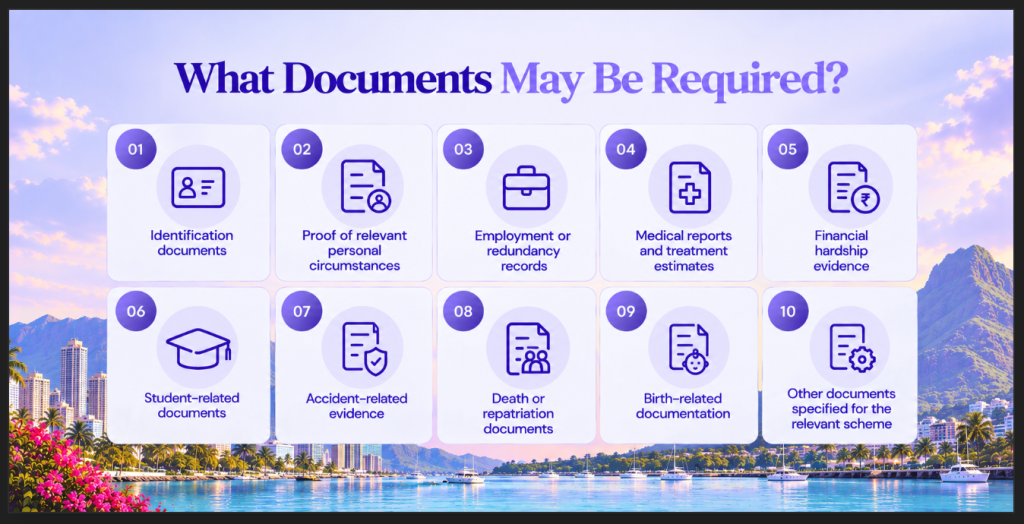
Applicants should use the current requirements for the particular scheme rather than relying on a universal document checklist.
What Happens If Contributions Are Not Properly Managed?
Incorrect contribution calculations, unpaid contributions or incomplete statutory records can create compliance issues for employers. The Ministry states that employees can report non-contribution to the relevant authorities, after which an enquiry may be conducted, and prosecution may follow where applicable.
Potential issues can include:
- Incorrect employee deductions
- Underpayment of employer contributions
- Reporting discrepancies
- Incomplete employee records
- Recovery of unpaid contributions
- Further administrative or compliance action
Employers should verify the applicable legislation before assuming that a particular penalty or enforcement measure applies.
How Can Arnifi Help?
Arnifi can support businesses with Mauritius company setup, corporate administration and related compliance processes.
Support may include:
- Assistance with Mauritius company setup
- Coordination of accounting and payroll support
- Assistance with statutory compliance requirements
- Support with maintaining corporate records
- Guidance on administrative requirements for international businesses
- Ongoing corporate-compliance support
The appropriate statutory authority remains responsible for administering the relevant government schemes and obligations.
FAQs
What is the National Solidarity Fund in Mauritius?
The National Solidarity Fund is a statutory fund established under the National Solidarity Fund Act 1991. It assists in specified schemes, including support relating to severe personal hardship and redundant workers.
Who has to contribute to the National Solidarity Fund?
The employee contribution commonly referred to as “NSF” is actually associated with the National Savings Fund. Government guidance currently states that employers contribute 2.5% and employees 1% of basic wages or salary, subject to prescribed limits.
Are National Solidarity Fund contributions refundable?
The National Savings Fund contributions are refunded as a lump sum with accrued interest on retirement or death, subject to applicable rules. This should not be confused with assistance provided by the National Solidarity Fund.
What assistance does the National Solidarity Fund provide?
The Fund assists in specific schemes covering areas such as medical circumstances, severe hardship, needy students, tragic accidents, repatriation of mortal remains and multiple births, subject to the applicable eligibility conditions.
Conclusion
The National Solidarity Fund in Mauritius is a statutory fund established to provide financial assistance in specified circumstances. It should, however, be distinguished from the National Savings Fund, which forms part of the employee contribution framework and provides a lump-sum refund under applicable conditions.
For employers, understanding this distinction is important when managing payroll, statutory contributions and employee records. For individuals, eligibility for National Solidarity Fund assistance depends on the particular scheme and its conditions rather than simply on making employee contributions.
Businesses should use the latest official government guidance when determining contribution rates, ceilings, eligibility requirements and application procedures. Accurate payroll records and properly maintained documentation can also help employers manage their ongoing obligations more effectively.
References
- Mauritius Ministry of Social Integration, Social Security and National Solidarity – National Solidarity Fund
- Mauritius Government – Social Security Services and Contributions
- Laws of Mauritius – National Solidarity Fund Act
- Mauritius Ministry of Social Integration, Social Security, National Solidarity – NSF FAQs
Top UAE Packages
Related Articles



Top UAE Packages
Get in Touch
