
Documents Required for Mauritius Company Registration

Zahira Shaik
SEO Content Writer
Zahira Shaik is an SEO Content Writer and Published Author specializing in research-based content. She excels at analyzing market trends, regulations, and industry developments… Read more

Tulika Saxena
AVP, Sales & Marketing | IIM Nagpur
Tulika Saxena specializes in business finance, sales strategy, and market positioning. Leads growth and partnerships, ensuring seamless business setup experiences and client success across… Read more


Key Fact: The Corporate and Business Registration Department (CBRD) is responsible for incorporating companies in Mauritius. Providing all your KYC and beneficial owner documents in full and verified form will ensure that your application goes through as per the usual time frame without any regulatory queries.
Table of contents
- What Documents Are Required to Register a Company in Mauritius?
- Importance of Proper Documentation
- Basic Personal Documents Required
- Company Incorporation Documents
- Compliance and Regulatory Documents
- Additional Documentation for Specific Structures
- Post-Incorporation Documentation and Ongoing Compliance
- Common Documentation Mistakes
- Best Practices for Document Preparation
- How Arnifi Supports Documentation and Registration
- Frequently Asked Questions
- Conclusion
- Governing Bodies and Authority Resources
Guidebooks tend to lay a lot of emphasis on the process of registration itself. In reality, however, the quality of documentation is what makes or breaks a smooth application process for you.
If you are an onshore entrepreneur, a multinational enterprise planning its expansion into the international market, or a remote founder working across borders such as India, the UAE, and Mauritius, this guidebook will help you with all the personal, company, regulatory, and bank documents needed for incorporation in Mauritius.
What Documents Are Required to Register a Company in Mauritius?
Verification documentation is a requirement in order to form a corporate body in Mauritius.
In doing so, the CBRD uses these documents to ascertain legal identity and to verify that ultimate beneficial ownership and compliance with international AML/CFT standards are fully adhered to. Documentation that is incomplete, inaccurate, or out-of-date will result in the issuance of CBRD notices for further information.
Importance of Proper Documentation
1. Smooth Approval
By ensuring that your corporate submission includes well-vetted and appropriately formatted documentation, the approval process by the regulatory officials from the CBRD and the FSC will not be complicated by back-and-forth communication.
2. Legal and Identity Verification
The appropriate documentation serves the role of identifying directors and shareholders, the lines of corporate holdings, and even the management structure.
3. Avoiding Registration Delays
Any inconsistency in the names, illegible identity scans, unsigned forms, or expired address proof will automatically result in rejection.
Basic Personal Documents Required
Every individual listed as a director, shareholder, or ultimate beneficial owner (UBO) must provide personal Know Your Customer (KYC) documentation.
1. Identification Proof
- Passport Copies: Clear, high-resolution color copies of the bio-page (valid for at least 6 months).
- National Identity Cards: Applicable for resident directors or shareholders.
- Requirements for Directors and Shareholders: Mandatory for every natural person holding a directorship or voting shares in the proposed company.
2. Proof of Address
- Accepted Documents: Recent utility bills (electricity, water, gas), bank statements, or official government-issued address records showing the individual’s full name and residential address.
2026 Practical Note for Remote Founders: Proofs of address have to be obtained within a validity period of only three months. The coordination of proof of address within three months with the help of utility bills or bank statements from different places in the world where team members may belong (such as India, UAE, and Mauritius) can become problematic.
3. Date of Birth Details
- Date of birth (DOB) details must strictly match across all passport bio-pages, government records, and application forms. Mismatched or omitted DOB entries require formal resubmissions.
Company Incorporation Documents
Apart from personal KYC records, specific statutory documents must be created to define the company’s legal framework and location.
1. Company Name Approval
- Unique Name Selection: Proposed names must undergo an online availability check via the CBRD registry portal.
- Mauritius Naming Requirements: Names must comply with statutory restrictions (e.g., avoiding reserved or misleading terms) and receive formal approval before main incorporation filing.
2. Company Constitution
- Purpose: Functions as the governance charter within the organization, which includes details of shareholders’ rights, board powers, dividend payments, and meeting procedures.
- Filing Status: Even though companies can function with the default shareholder rights provided by the Companies Act 2001, it is a common practice to have an organization’s own Company Constitution filed.
3. Director and Shareholder Details
A comprehensive registry schedule detailing each individual’s or entity’s:
- Full legal name
- Nationality and country of domicile
- Residential or registered office address
- Primary occupation
- Date of birth / Date of incorporation
4. Registered Office Address
- Requirement: A physical, non-P.O. Box address situated within Mauritius.
- Purpose: Acts as the official location for statutory notices, legal service, and regulatory correspondence from government authorities.
Compliance and Regulatory Documents
1. Declaration of Compliance
Signed by an authorized professional (a director, corporate secretary, or registered agent) confirming that all statutory prerequisites for incorporation under the Mauritius Companies Act 2001 have been fully satisfied.
2. Consent Forms
Formal, signed written consents from every appointed director and shareholder acknowledging and accepting their respective roles and legal obligations within the company.
3. Beneficial Ownership Disclosure
In terms of transparency requirements in Mauritius, corporations are mandated to declare all their Ultimate Beneficial Owners (UBOs), individuals who own 25 percent or more of the corporation or exert control over the corporation. The information meets the FATF international money laundering standards.
4. Parent Company and Group Information
When the Mauritius entity is set up as a subsidiary of a foreign parent company (such as an Indian private limited company or a UAE entity), additional corporate records are required:
- Certificate of Incorporation of the parent entity
- Certificate of Good Standing / Incumbency
- Corporate resolutions authorizing the incorporation of the Mauritius subsidiary
- Group ownership structure chart clearly mapping out the UBO hierarchy
Additional Documentation for Specific Structures
Depending on whether your business conducts onshore operations or operates globally, additional corporate requirements apply.
1. Global Business Companies (GBCs)
Entities oriented toward international operations and cross-border investment often apply for a Global Business License issued by the Financial Services Commission (FSC). Required documents include:
- Detailed Business Plan outlining primary activities, target markets, and investment routes
- Three-to-five-year financial projections
- Proof of substance in Mauritius (e.g., local employment, local expenditure, management, and control details)
2. Authorised Companies
Entities intended to conduct business, management, and control strictly outside Mauritius must apply for an Authorised Company status. Requirements include:
- Declarations confirming business activities are conducted exclusively outside Mauritius
- Detailed profiles of foreign beneficial owners and global operations
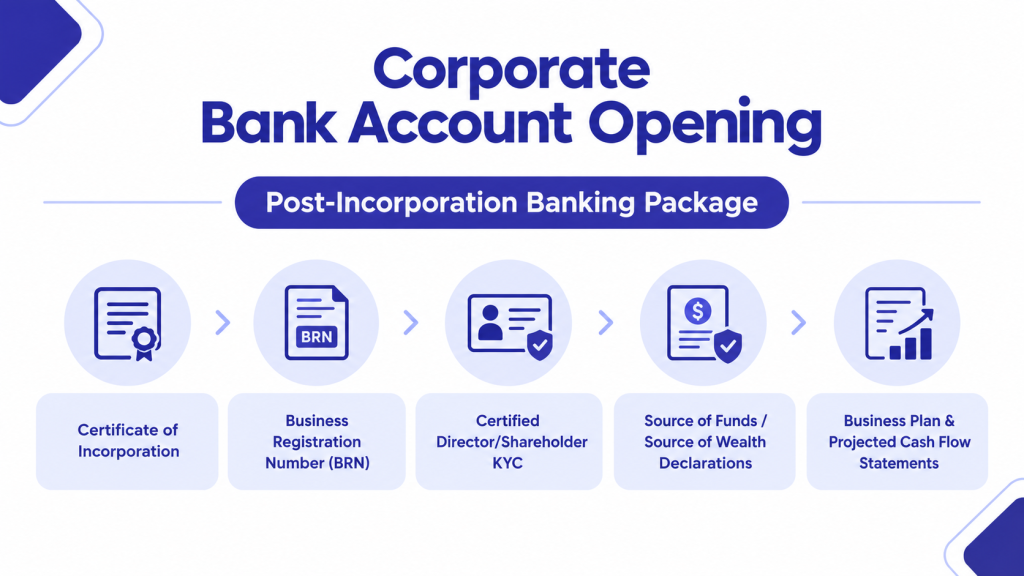
3. Corporate Bank Account Opening
Following successful registration with the CBRD, opening a corporate banking account in Mauritius requires submitting post-incorporation packages to financial institutions, including:
Post-Incorporation Documentation and Ongoing Compliance
Completing incorporation is only the first step. Maintaining ongoing corporate compliance in Mauritius requires maintaining an audit-ready records system.
1. Keep Annual Return Documents Ready
Companies must file annual returns accompanied by updated shareholder registers and financial statements (or financial summaries, depending on the entity category) with the CBRD.
2. Maintain Current Director and Shareholder Records
Any change in share capital, transfer of shares, or appointment/resignation of directors requires immediate updating of internal statutory registers.
3. Keep Beneficial Ownership Information Updated
UBO records must remain current at all times. Any change in ultimate control or ownership percentages must be updated internally and reported to the registry.
4. Prepare for Authority Requests
Mauritius regulatory bodies conduct periodic compliance checks. Companies must retain complete accounting records, corporate registers, and client due diligence files at their registered office for a minimum prescribed period (typically 7 years).
5. India–Mauritius and UAE–Mauritius Structures
Entities integrated into India–Mauritius or UAE–Mauritius cross-border trade corridors face dual-jurisdiction recordkeeping requirements. Companies must keep consistent records to demonstrate substance, tax residency compliance, and clear ownership chains for tax authorities in both jurisdictions (e.g., Central Board of Direct Taxes in India or Federal Tax Authority in the UAE).
6. 14-Day Change Reporting
As per the Mauritius Companies Act, any important changes in relation to directors, address, or structure must be notified to the Registrar within 14 days of the occurrence of such an event.
Practical Note: Remote founders need to keep an automated compliance calendar as they cannot treat corporate paperwork as a one-time process.
Common Documentation Mistakes
- Outdated Proof of Address: Submitting address proofs older than 90 days is the leading cause of application holds.
- Illegible Identification Documents: Blurry, cropped, or low-resolution passport scans are routinely rejected by regulatory reviewers.
- Inconsistent Information: Variations in how names, middle names, addresses, or dates of birth are spelled across different forms and passport pages cause identity validation flags.
- Missing Signatures or Consent Forms: Forgetting to collect signed consent forms from all named directors or shareholders before formal filing.
- Incomplete Beneficial Ownership Information: Failing to trace the ownership structure up to the ultimate natural person UBOs.
- Last-Minute Document Preparation: Remote founders coordinating notarization, apostilles, or legalizations across foreign jurisdictions often face unexpected delays if they begin document prep too late.
Best Practices for Document Preparation
- Prepare Documents Before Starting the Application: Gather a complete document checklist, verify validity dates, and secure certified translations (if documents are in a language other than English or French).
- Maintain Consistent Information: Audit names, physical addresses, corporate registration numbers, and percentage holdings across every form and attachment.
- Keep Recent Address Proof Ready: Coordinate with international team members early to ensure bank statements or utility bills are freshly generated.
- Maintain a Central Compliance File: Establish a secure cloud repository containing:
- Official incorporation papers
- Certified director and shareholder registers
- UBO structure charts
- Annual filings and corporate returns
- Corporate banking documentation and tax filings
- Track Changes and Reporting Deadlines: Set clear calendar reminders for 14-day change notifications and annual return deadlines.
How Arnifi Supports Documentation and Registration
The challenge of forming cross-border companies in complex jurisdictions demands precision and regulatory compliance. With the help of Arnifi, you can make the task easier with the following services:
- Tailored Document Checklists: Receive customized document checklists based on the structure of your company (Local Company, GBC, or Authorized Company).
- Pre-Submission Document Verification: Have your passport copies, address proofs, and consent forms checked in advance for any mistakes or inconsistencies.
- Cross-Border Expertise: International business companies will be handled by experts who understand cross-border situations and will have expertise in parent-subsidiary relationships of India-Mauritius or UAE-Mauritius.
- Local Registry & Service Provider Coordination: Coordinating directly with local management companies, corporate secretaries, and registry officers in Mauritius.
- Ongoing Compliance Maintenance: Tracking of annual compliances, changes, and document preparation through a centralized dashboard.
Professional setup will save you from making mistakes with your documentation.
Frequently Asked Questions
Can I register a company in Mauritius as a foreigner?
Yes, 100% foreign ownership is possible in Mauritius in all industry sectors. Foreigners are allowed to become shareholders and directors on condition that all the necessary KYC requirements are fulfilled.
What documents are required to register a company in Mauritius?
The necessary documents include the KYC documents (certified copy of passport, proof of address not older than 3 months, date of birth), the documents on incorporation (registration of the name of the company, company constitution, proof of office), and the beneficial ownership.
What is the Certificate of Incorporation in Mauritius?
It is the document that is issued by the Registrar of Companies (CBRD) that shows that the company was incorporated in accordance with the Mauritius Companies Act.
Do I need a passport to register a company in Mauritius?
Yes. The passport is the standard ID of any non-resident director/shareholder/ultimate beneficial owner.
How recent should proof of address be for Mauritius company registration?
Proof of address (utility bills/bank statements) is usually valid only within the last 3 months from the date of filing the application.
Is a company constitution mandatory in Mauritius?
Not really, since a company may be operated according to the terms of the Companies Act 2001. But in general, a custom constitution of a company is drafted by a majority of companies to regulate shareholding agreements.
What documents are required for a Mauritius GBC?
The documents that are required for a Global Business Company include KYC documents, a business plan, financial projections for 3 to 5 years, information about local substance in Mauritius, as well as filings with the FSC.
What documents are required to open a corporate bank account in Mauritius?
These include Certificate of Incorporation, BRN (Business Registration Number), company constitution, KYC documents for directors and shareholders, documentation about the source of funds, and a business plan.
What is beneficial ownership disclosure in Mauritius?
This is the statutory provision for identifying a natural person that is the owner or the controller of 25% or more of the company or exerts ultimate executive control over the entity.
What documents should a Mauritius company maintain after incorporation?
The company should keep statutory registers (directors, shareholders, UBOs) updated, accounting records, minutes of board and shareholders’ meetings, filed annual returns, and corporate banking documents.
What documents are required for India–Mauritius company structures?
Structures that involve an Indian holding company will need incorporation papers of the parent entity, board resolutions to incorporate the Mauritius entity, group ownership structure diagrams, and compliance of the Indian Overseas Direct Investment (ODI/FC-GTR).
What documents are required for UAE–Mauritius company structures?
In case of entities associated with UAE parent entities, certified UAE corporate registration documents, declarations of the ultimate beneficial owner, board resolutions, and validated identity documents of all intermediary holding entities will be required.
How does Arnifi help with Mauritius company registration?
Arnifi will assist through the preparation of a custom document checklist, verification of KYC files for consistency, corporate name reservation, registry submission, and compliance management.
Conclusion
It is imperative to undertake meticulous documentation in preparing one’s personal and corporate information. Incorporating in Mauritius entails meticulously documenting personal, corporate, regulatory, and banking information. This entails collecting certified identity proofs and proofs of recent residence addresses while ensuring that proof of address does not extend beyond a three-month validity period. It is important to ensure that all personal and corporate information is consistent for purposes of avoiding inconveniences during the incorporation process. The type of document required depends on the nature of the company that one intends to set up; whether it is a Local Company, Global Business Company (GBC), or Authorized Company.
Once the company is registered, the Certificate of Incorporation and Business Registration Number (BRN) become vital during the process of opening bank accounts and post-incorporation KYC. Companies are expected to comply after setting up a company by keeping statutory registers updated, annual return filing dates, and notifying authorities of any change to company structure within 14 days. Working together with Arnifi during the setup process ensures that remote founders do not encounter any problems in coordinating documents and avoid verification errors.
Governing Bodies and Authority Resources
Top UAE Packages
Related Articles


Top UAE Packages
Get in Touch
