
Mauritius Company Registry from India | Setup Guide 2026

Ishika Bhandari
Content Writer
Ishika Bhandari is a content writer with experience in creating SEO-focused content across diverse industries, including business, lifestyle, and jewellery. She specializes in turning… Read more

Tulika Saxena
AVP, Sales & Marketing | IIM Nagpur
Tulika Saxena specializes in business finance, sales strategy, and market positioning. Leads growth and partnerships, ensuring seamless business setup experiences and client success across… Read more


Key Facts: Indian entrepreneurs can set up a Mauritius company remotely, subject to the requirements of the chosen structure and applicable KYC checks. The process may involve the Corporate and Business Registration Department (CBRD), Financial Services Commission (FSC), a registered office, local service providers and India-side FEMA/ODI compliance. Costs depend on the company type, licensing, professional services and ongoing compliance.
Table of contents
- Introduction
- Can Indians Register a Company in Mauritius From India?
- Why Do Indian Businesses Choose Mauritius?
- Which Mauritius Company Structure Is Suitable for Indian Founders?
- What Are the Requirements for Mauritius Company Registration From India?
- What Documents Do Indian Founders Need?
- How Does the Mauritius Company Registry Process Work From India?
- How Much Does It Cost to Register a Mauritius Company From India?
- Do Indian Founders Need a Registered Office in Mauritius?
- What Are the RBI and FEMA Requirements for Indians Setting Up a Mauritius Company?
- What Taxes Apply to a Mauritius Company Owned From India?
- Can an Indian Resident Own 100% of a Mauritius Company?
- What Is the Difference Between a Domestic Company, GBC and Authorised Company?
- How Long Does Mauritius Company Registration Take From India?
- What Compliance Is Required After Registration?
- What Are the Common Mistakes Indian Founders Make?
- Mauritius Company Setup From India Checklist
- How Can Arnifi Help With Mauritius Company Setup From India?
- Conclusion
- FAQs
Introduction
Mauritius is often considered by Indian businesses looking to expand internationally, establish investment structures or access African and other international markets. Its regulatory framework supports both domestic companies and international business structures, while Mauritius also has a tax treaty with India. However, setting up a company in Mauritius does not remove the founder’s obligations in India. An Indian resident making an overseas investment must consider the applicable FEMA and RBI overseas investment framework separately from the Mauritius incorporation process. The two should therefore be planned together rather than treated as one registration.
Can Indians Register a Company in Mauritius From India?
Yes. Mauritius allows company incorporation through its online system as well as through submission of the required documents to the Registrar. The CBRD states that domestic companies can be incorporated online through the Mauritius Network Services platform or by submitting the required documents to the Registrar of Companies. Once the application complies with the Companies Act, the Registrar issues a certificate of incorporation and records the company’s details. This means an Indian founder may be able to complete the incorporation process without travelling to Mauritius. However, incorporation is only one part of the setup. A registered office, KYC, banking, licensing and tax requirements may still need local arrangements.
Why Do Indian Businesses Choose Mauritius?
Mauritius can be useful for businesses with genuine international expansion or investment requirements.
Common reasons include:
- Access to African and international markets
- Established financial and corporate services sector
- International investment structures
- Mauritius’ network of tax treaties
- Foreign ownership flexibility, subject to the applicable activity and structure
- Established regulatory framework for global business
Mauritius should not, however, be selected solely because of perceived tax savings. The business purpose, substance, ownership, management and applicable tax rules should support the structure.
Which Mauritius Company Structure Is Suitable for Indian Founders?
| Structure | Best suited for |
| Domestic Company | Businesses conducting operations in Mauritius |
| Global Business Company | International business and investment activities |
| Authorised Company | Businesses conducted principally outside Mauritius |
| LLP | Partnership or professional structures, where suitable |
A Global Business Company (GBC) is designed for resident corporations conducting business outside Mauritius and is regulated by the FSC. An Authorised Company is generally intended for business conducted principally outside Mauritius, with central management and control outside Mauritius. The appropriate structure depends on the actual business activity, ownership, management and tax requirements.
What Are the Requirements for Mauritius Company Registration From India?
Personal Requirements
Indian founders may need:
- Passport
- Proof of residential address
- Director and shareholder details
- Beneficial ownership information
- Additional KYC documents requested by the service provider, bank or regulator
For a domestic company, the CBRD specifically lists a passport copy for non-residents and proof of the resident director’s address among the incorporation documents.
Company Requirements
Depending on the structure, requirements may include:
- Proposed company name
- Business activity
- Registered office
- Shareholding structure
- Company constitution, where applicable
- Corporate shareholder documents
- Business plan or other information for regulated structures
What Documents Do Indian Founders Need?
| Document | Purpose |
| Passport | Identity and KYC |
| Address proof | Residential verification |
| Director/shareholder details | Ownership and management records |
| Beneficial ownership declaration | Identifies ultimate owners |
| Corporate documents | Required where a company is a shareholder |
| Business plan | May be required for certain structures/licences |
| Source-of-funds information | May be requested for KYC and banking |
| Structure chart | Helps establish ownership and control |
The exact document list varies according to the company type and whether FSC licensing is involved.
How Does the Mauritius Company Registry Process Work From India?
Step 1: Choose the Business Structure
Determine whether a domestic company, GBC, Authorised Company or another structure matches the business purpose.
Step 2: Select the Company Name
Choose an available name and complete the required reservation or name-check process.
Step 3: Prepare Incorporation Documents
Prepare the application, ownership information, director details and supporting documents.
Step 4: Complete KYC and Beneficial Ownership Checks
Provide identity, address and beneficial ownership information as required.
Step 5: Submit the Application
Submit through the applicable CBRD or FSC process. Domestic companies can use the CBRD’s online incorporation facility.
Step 6: Receive the Certificate of Incorporation
Once the application complies with the applicable requirements, the Registrar issues the certificate and company registration number.
Step 7: Complete Tax and Business Registrations
Complete the relevant registrations based on the company’s activities and tax position.
Step 8: Open a Corporate Bank Account
Prepare the company’s incorporation, ownership, business and source-of-funds documents for bank KYC.
Step 9: Complete Any Required Licensing
A regulated business or international structure may require FSC licensing or authorisation.
Step 10: Maintain Ongoing Compliance
Keep statutory records, submit returns, maintain the registered office and meet tax and regulatory filing obligations.
How Much Does It Cost to Register a Mauritius Company From India?
There is no single Mauritius company setup cost that applies to every Indian founder.
The budget may include:
- CBRD registration fees
- FSC application or licence fees, where applicable
- Registered office
- Management or registered agent fees
- Professional and KYC services
- Accounting and tax compliance
- Corporate banking costs
- Annual filing and maintenance costs
For example, the FSC’s current 2026 fee schedule lists a USD 600 application fee and USD 2,600 fixed annual fee for a Category 1 Global Business Licence, while an Authorised Company has a USD 600 application fee and USD 1,400 fixed annual fee. These are regulatory licence fees and do not represent the complete cost of establishing or maintaining the business.
Do Indian Founders Need a Registered Office in Mauritius?
A registered office is an important part of the Mauritius company structure. It provides the official address for statutory and corporate purposes. The registered office should not automatically be treated as the same thing as an operating office. Depending on the business and licensing requirements, additional premises or substance may be necessary. For international structures, local management, employees, expenditure and other substance requirements may also apply.
What Are the RBI and FEMA Requirements for Indians Setting Up a Mauritius Company?
This is one of the most important parts of a Mauritius company setup from India.
An Indian resident investing in a foreign entity must consider the Foreign Exchange Management (Overseas Investment) framework. RBI’s Overseas Investment Directions provide the framework for overseas investments by persons resident in India.
Depending on the investor and transaction, the process can involve:
- Selecting an authorised dealer bank
- Determining whether the investment falls under the automatic or approval route
- Completing the applicable overseas investment reporting
- Making the permitted financial commitment
- Complying with RBI/FEMA conditions
- Maintaining evidence of the overseas investment
The RBI’s Form FC instructions state that the form is submitted to the designated AD bank by a person resident in India investing in a foreign entity, whether under the automatic or approval route. Therefore, Mauritius incorporation does not replace India-side FEMA or RBI compliance.
What Taxes Apply to a Mauritius Company Owned From India?
A Mauritius company is not automatically tax-free.
Its tax position can depend on:
- Type of income
- Mauritius tax residence
- Business activities
- Management and control
- Applicable exemptions or partial exemptions
- India-Mauritius tax treaty
- Indian tax rules
- Transfer pricing
- Permanent establishment
- Substance and anti-avoidance provisions
Mauritius maintains a Double Taxation Agreement with India. The treaty and its protocols contain rules covering areas such as dividends, interest, royalties, capital gains and prevention of double taxation. The Indian Income Tax Department’s current treaty rate table, for example, lists treaty rates for Mauritius dividends, interest, royalties and fees for technical services, subject to the relevant treaty conditions.
Can an Indian Resident Own 100% of a Mauritius Company?
Foreign ownership can be possible, but the answer depends on the business structure and activity.
The founder should assess:
- Individual or corporate ownership
- Business activity
- Regulatory approvals
- Beneficial ownership disclosure
- Mauritius licensing requirements
- Indian overseas investment rules
Ownership should therefore be reviewed together with the intended business activity rather than assumed from incorporation rules alone.
What Is the Difference Between a Domestic Company, GBC and Authorised Company?
| Factor | Domestic Company | GBC | Authorised Company |
| Main purpose | Mauritius operations | International business | Business principally outside Mauritius |
| Management | Depends on activity | Mauritius-based requirements apply | Central management and control outside Mauritius |
| Licensing | General registration | FSC licence | FSC licence |
| Typical use | Local business | International operations/investment | International activities |
The FSC describes a GBC as a regime for resident corporations proposing to conduct business outside Mauritius, while an Authorised Company is intended for business conducted principally outside Mauritius with central management and control outside Mauritius.
How Long Does Mauritius Company Registration Take From India?
The timeline depends on the structure and how quickly documents, KYC and regulatory checks are completed.
The overall process may involve:
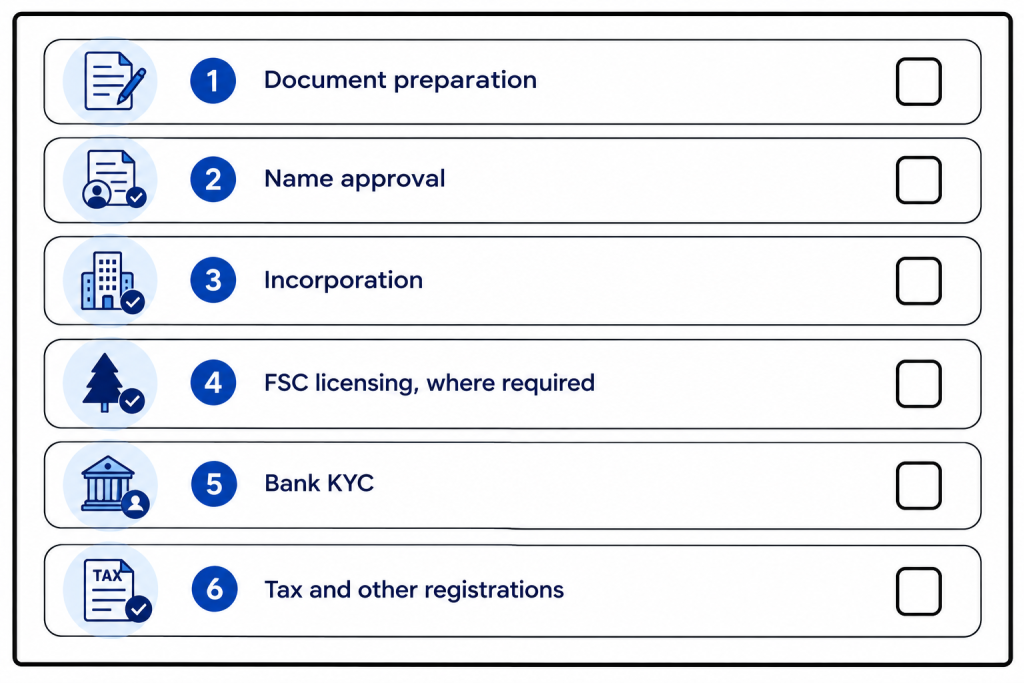
Company incorporation and operational readiness should be treated as separate milestones. A company may be incorporated before its bank account, licences or full operating arrangements are ready.
What Compliance Is Required After Registration?
Depending on the structure, ongoing obligations may include:
- Annual returns
- Accounting records
- Financial statements
- Tax returns
- Beneficial ownership updates
- Registered office maintenance
- Director and shareholder records
- FSC compliance for regulated entities
- Indian ODI reporting and related FEMA compliance
The FSC’s current framework also contains specific obligations for Authorised Companies and GBCs.
For GBCs, Mauritius introduced a new authorised bank signatory regime effective 19 June 2026, requiring at least one officer of the management company to be among the authorised bank signatories, subject to the applicable transitional arrangements.
What Are the Common Mistakes Indian Founders Make?
- Choosing the structure only for tax reasons
- Ignoring FEMA and ODI requirements
- Selecting an unsuitable company type
- Underestimating banking KYC
- Failing to establish required Mauritius substance
- Missing annual filings
- Treating incorporation as the end of the process
- Failing to document beneficial ownership
- Assuming a Mauritius company automatically avoids Indian tax
Mauritius Company Setup From India Checklist
☐ Business purpose defined
☐ Company structure selected
☐ Company name checked
☐ Directors and shareholders identified
☐ KYC documents prepared
☐ Beneficial ownership documented
☐ Registered office arranged
☐ Company incorporated
☐ Required licence obtained
☐ Bank account application prepared
☐ FEMA/ODI compliance reviewed
☐ Tax registrations completed
☐ Annual compliance calendar created
How Can Arnifi Help With Mauritius Company Setup From India?
Arnifi can help Indian founders coordinate the Mauritius company setup process, from choosing an appropriate structure and preparing incorporation documents to coordinating registered office, licensing, banking and ongoing compliance requirements. For founders investing from India, the setup can also be planned alongside the applicable FEMA/ODI requirements so that the Mauritius entity and India-side compliance are considered together.
Conclusion
Setting up a Mauritius company from India involves more than registering an entity with the Mauritius Company Registry. Indian founders need to select the right structure, complete Mauritius incorporation and licensing requirements, arrange appropriate local substance and maintain ongoing compliance. At the same time, the Indian side should be reviewed under the FEMA/ODI framework, including the applicable reporting and authorised dealer bank requirements. A well-planned structure therefore combines Mauritius incorporation + India-side ODI/FEMA compliance + appropriate tax and substance planning, rather than treating company registration as a standalone step.
FAQs
Can I register a Mauritius company from India?
Yes. Mauritius allows online company incorporation for eligible structures, although additional local and regulatory requirements may apply.
Can Indians own a Mauritius company?
Yes, subject to the applicable company, activity, licensing and Indian overseas investment rules.
Do I need to visit Mauritius to register a company?
Not necessarily. Eligible incorporation applications can be submitted online through the Mauritius system.
What documents are required from Indian founders?
Typically, passport, address proof, ownership details and beneficial ownership information are required. Additional documents may apply.
How much does Mauritius company registration cost?
Costs depend on the structure, licensing, registered office, professional services, banking and ongoing compliance.
How long does Mauritius company registration take?
The timeline depends on the structure, document readiness, KYC and any required regulatory approval.
Do I need a registered office in Mauritius?
A Mauritius company requires an appropriate registered office arrangement. Additional substance or premises may apply depending on the structure.
What is the best Mauritius company structure for Indians?
There is no single best structure. Domestic companies, GBCs and Authorised Companies serve different purposes.
Do Indian founders need RBI approval?
Not always. The investment may fall under the applicable automatic route or require approval depending on the circumstances. The transaction should be reviewed with the designated AD bank.
What is the role of FEMA in Mauritius company setup?
FEMA governs the Indian resident’s overseas investment and related transactions. It is separate from Mauritius company incorporation.
Is a Mauritius company taxable in India?
Potentially. Indian tax implications depend on factors such as the company’s residence, management, income, transactions and applicable Indian tax rules.
Can a Mauritius company open a corporate bank account?
Yes, subject to the bank’s KYC, business activity, ownership, source-of-funds and other onboarding requirements.
References
Top UAE Packages
Related Articles
Top UAE Packages
Get in Touch
