
ILOE Insurance in the UAE | Eligibility, Claims & Fine Check

Anushka
Content Writer
Anushka Basu is a business content writer specialised in global business market insights. She aims to simplify complex regulatory, financial, and business concepts into… Read more

Tulika Saxena
AVP, Sales & Marketing | IIM Nagpur
Tulika Saxena specializes in business finance, sales strategy, and market positioning. Leads growth and partnerships, ensuring seamless business setup experiences and client success across… Read more


Key Fact: ILOE is mandatory for eligible private-sector and federal-government employees and can provide up to 60% of average basic salary for up to three months, subject to the scheme’s conditions and limits.
Table of contents
- What is ILOE Insurance in the UAE?
- Who needs to subscribe to ILOE Insurance in the UAE?
- How much does ILOE Insurance in the UAE cost?
- How can you subscribe to ILOE Insurance in the UAE?
- What documents and details are needed for ILOE subscription?
- How does ILOE compensation work?
- When can you claim ILOE Insurance in the UAE?
- How do you file an ILOE claim?
- How can you check your ILOE insurance status online?
- How can you check ILOE fines online?
- What are the ILOE fines for non-compliance?
- What happens if you stop paying ILOE premiums?
- Does ILOE continue when you change jobs?
- What does ILOE not cover?
- What are the common ILOE mistakes employees make?
- How can employers support ILOE compliance?
- How can Arnifi help with UAE employment compliance?
- FAQs
- Conclusion
What is ILOE Insurance in the UAE?
ILOE stands for Involuntary Loss of Employment. ILOE Insurance in the UAE provides temporary financial support to eligible employees who lose their jobs involuntarily, subject to the scheme’s eligibility requirements and policy conditions.
The scheme covers eligible employees in the private sector and federal government sector. Compensation can reach 60% of the average basic salary for the six months before unemployment, subject to category limits and a maximum of three months per claim.
ILOE is administered through the insurance framework established by the UAE Government and operates in coordination with the Ministry of Human Resources and Emiratisation (MOHRE) and the Insurance Pool.
The important distinction is that ILOE is not a general unemployment payment. An insured employee must meet the required subscription, payment and job-loss conditions before compensation can be paid.
Who needs to subscribe to ILOE Insurance in the UAE?
Eligible private-sector and federal-government employees are generally required to subscribe to the scheme. This includes UAE nationals and residents working within the covered sectors. The employee is generally responsible for purchasing the policy and paying the premium.
The principal exempt categories include:
- Investors who own the establishment where they work
- Domestic workers
- Employees working under temporary contracts
- Employees under 18 years of age
- Certain retirees receiving a pension who have joined a new job
Therefore, ILOE should not simply be described as mandatory for every person working in the UAE. Eligibility depends on the employee’s sector and whether an exemption applies.
How much does ILOE Insurance in the UAE cost?
The scheme has two basic premium categories based on the employee’s subscription salary:
| Category | Basic salary | Premium | Maximum monthly compensation |
| Category A | AED 16,000 or below | Up to AED 5/month + VAT | ~AED 10,000 |
| Category B | Above AED 16,000 | Up to AED 10/month + VAT | ~AED 20,000 |
The compensation is separate from the premium. An employee paying AED 5 or AED 10 per month does not automatically receive AED 10,000 or AED 20,000. The actual benefit is calculated at up to 60% of the average basic salary for the preceding six months, subject to the applicable maximum.
Employees whose remuneration is commission-based may have specific category options where the basic salary is not specified in the employment contract.
How can you subscribe to ILOE Insurance in the UAE?
Employees can subscribe and pay through official and authorised channels, including:
- The official ILOE website
- The ILOE mobile application
- The ILOE contact centre
- Business service centres such as Tasheel and Tawjeeh
- Approved exchange centres
- Selected bank applications and ATMs
- Approved kiosks and other authorised channels
The official ILOE website and app provide direct subscription channels. Some third-party channels may apply additional service charges.
For current subscription options, employees should use the official ILOE channels rather than relying on older lists of payment providers.
What documents and details are needed for ILOE subscription?
The subscription process requires employee identification and contact information, with the applicable employment and salary details used to determine the insurance category.
Employees should ensure that:
- Their Emirates ID or relevant identification details are accurate
- Their mobile number is current
- Their employment and basic salary information matches official records
- The selected insurance category corresponds to the applicable subscription salary
Once subscribed, employees can use the official ILOE system to access policy information and manage their insurance details.
How does ILOE compensation work?
ILOE compensation is calculated using the employee’s average basic salary for the six months immediately preceding unemployment. It can reach 60% of that average, subject to the category maximum.
For example, if an employee’s average basic salary over the relevant six-month period is AED 12,000, 60% would be AED 7,200 per month. If the employee meets all eligibility conditions, the monthly compensation could therefore be up to AED 7,200 rather than being automatically set at the AED 10,000 category maximum.
The maximum compensation is:
- Category A: AED 10,000 per month
- Category B: AED 20,000 per month
- Maximum duration: three months per claim
The scheme also contains an aggregate limit on compensation during an employee’s period in the UAE labour market. Where the maximum claim period has been exhausted, the applicable rules require a further 12 consecutive months of subscription before a new claim can generally be made.
When can you claim ILOE Insurance in the UAE?
Being subscribed to ILOE does not automatically mean that an employee qualifies for compensation. The main eligibility conditions include:
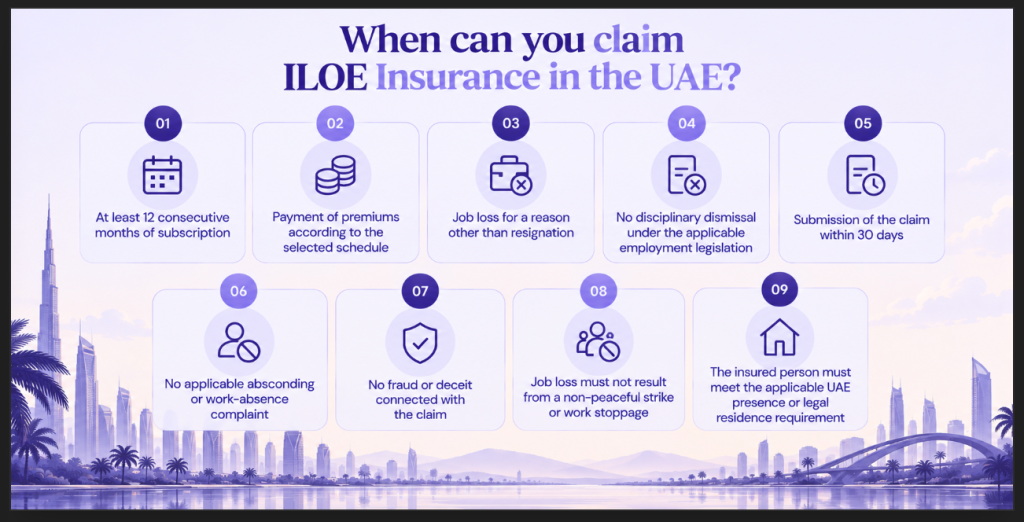
Compensation is also suspended if the insured person obtains a new job during the compensation period.
How do you file an ILOE claim?
The claim process can be approached as a simple checklist:
- Confirm that the employment ended for a qualifying reason
- Check that at least 12 consecutive months of subscription have been completed
- Confirm that all required premiums have been paid
- Gather the relevant employment and identification information
- Submit the claim within 30 days of the end of the employment relationship
- Track the claim and provide any additional documents requested
The official policy terms require supporting information, including documentation relating to the termination of employment. The insurer reviews the claim before determining entitlement. The UAE Government states that compensation is to be paid within two weeks of submission where the claim is approved and the applicable conditions are satisfied.
How can you check your ILOE insurance status online?
An ILOE status check can help employees confirm whether their policy is active, review policy information and identify outstanding payment issues.
The current process generally involves:
- Open the official ILOE portal or mobile application
- Select the relevant employment sector
- Enter the requested Emirates ID and mobile details
- Complete OTP verification
- Review the available policy or statement information
The exact interface can change as the portal or application is updated, so employees should rely on the current official ILOE system for status information.
How can you check ILOE fines online?
An ILOE fine check is useful when an employee has missed subscription or premium payments or wants to confirm whether any amount is outstanding.
Employees should distinguish between:
- An unpaid insurance premium
- A policy cancellation caused by prolonged non-payment
- A statutory fine imposed for non-compliance
The official ILOE system and UAE Government channels should be used to verify the current amount due and the status of the policy. Employees should not assume that an outstanding premium and a statutory fine are the same charge.
What are the ILOE fines for non-compliance?
The penalty framework distinguishes between failure to subscribe and failure to pay premiums. Ministerial Decision No. 604 of 2022 provides for an AED 400 fine for failure to subscribe and an AED 200 fine where premiums remain unpaid for more than three months, after which the insurance certificate is cancelled.
However, the current UAE Government English information page states an AED 400 fine for both non-subscription and non-payment, while the Arabic version continues to state AED 200 for non-payment. Employees should therefore verify the penalty amount currently recorded against their ILOE/MOHRE account before making payment.
What happens if you stop paying ILOE premiums?
Employees can choose an applicable payment frequency when subscribing. If premiums remain unpaid beyond the applicable period, the policy can be cancelled and the employee may need to purchase a new policy.
A prolonged payment lapse can therefore affect more than the immediate amount outstanding. It may interrupt the continuous subscription period required for a future compensation claim.
Before assuming that an old policy remains active, employees should check their status through the official ILOE system.
Does ILOE continue when you change jobs?
Changing employers does not mean employees should automatically assume that their ILOE status has been handled for them.
Because eligibility for compensation depends on maintaining the required subscription period and satisfying the applicable conditions, employees should check their policy after changing jobs and ensure that their subscription remains compliant.
This is particularly relevant when an employee is moving between employers while trying to maintain continuous coverage.
What does ILOE not cover?
ILOE compensation is designed for qualifying involuntary loss of employment. Important exclusions and disqualifying circumstances include:
- Voluntary resignation
- Disciplinary dismissal
- Fraud or deceit connected with a claim
- Certain work-absence or absconding situations
- Job loss resulting from non-peaceful strikes or work stoppages
- Other exclusions specified in the applicable policy terms
The full policy terms should be checked before submitting a claim because eligibility depends on the complete set of conditions rather than the reason for termination alone.
What are the common ILOE mistakes employees make?
Common mistakes include:
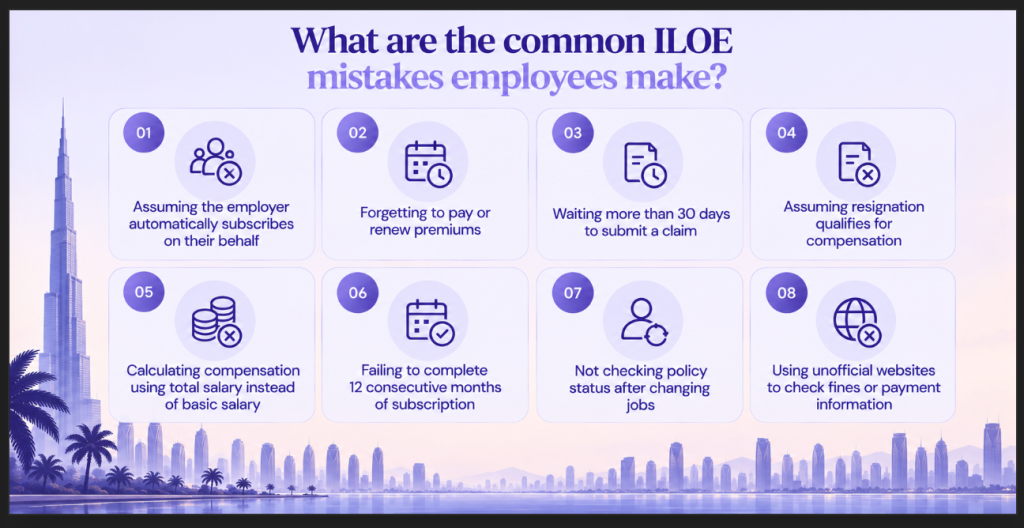
Regularly checking the official policy record can help employees identify problems before they become relevant to a claim.
How can employers support ILOE compliance?
The employee is generally responsible for subscribing to the scheme and paying the applicable premium. Employers therefore should not automatically be treated as the party responsible for purchasing the employee’s policy.
Employers can nevertheless support awareness by:
- Including ILOE information in employee onboarding materials
- Communicating the subscription requirement to eligible employees
- Adding ILOE information to internal compliance checklists
- Reminding employees that maintaining their policy is their responsibility
This provides practical support without transferring the employee’s statutory responsibility to the employer.
How can Arnifi help with UAE employment compliance?
Arnifi can support businesses with broader UAE corporate, employment and administrative compliance requirements during setup and ongoing operations.
Its support can include:
- Helping businesses understand relevant compliance requirements during establishment
- Coordinating corporate and administrative requirements
- Supporting broader UAE employment-related compliance processes
- Helping businesses organise compliance obligations as part of their operational setup
ILOE is one component of wider UAE employment compliance. Arnifi does not act as the ILOE insurer and does not approve or guarantee compensation claims.
FAQs
What is ILOE insurance in the UAE?
ILOE is an insurance scheme providing temporary compensation after qualifying involuntary employment loss.
Is ILOE insurance mandatory in the UAE?
Yes, it is mandatory for eligible private-sector and federal-government employees, subject to statutory exemptions.
Who is exempt from ILOE insurance?
Investors, domestic workers, temporary employees, workers under 18 and certain retirees are exempt.
How much does ILOE insurance cost?
Premiums are up to AED 5 or AED 10 monthly, depending on the applicable salary category.
How much compensation does ILOE provide?
Compensation can reach 60% of average basic salary, subject to category limits and conditions.
How can I check my ILOE insurance status?
Use the official ILOE portal or app to review your current policy information.
How can I check my ILOE fine online?
Check your policy and outstanding amounts through the official ILOE or MOHRE channels.
What happens if I don’t pay my ILOE premium?
Prolonged non-payment can result in policy cancellation, penalties and the need to re-subscribe.
Can I claim ILOE after resigning?
No. Compensation requires the employment loss to qualify as involuntary rather than resignation.
How long do I need to subscribe before claiming ILOE?
You generally need at least 12 consecutive months of subscription before making a qualifying claim.
How long do I have to submit an ILOE claim?
The claim must generally be submitted within 30 days of the end of the employment relationship.
Does ILOE continue when I change jobs?
Employees should verify their policy status after changing jobs and maintain the required subscription continuity.
Conclusion
ILOE Insurance in the UAE provides temporary financial protection to eligible employees who experience qualifying involuntary job loss. Understanding the premium categories, 60% compensation calculation, 12-month subscription requirement, 30-day claim deadline and payment obligations can help employees maintain their coverage. Businesses can also include ILOE awareness within broader UAE employment compliance processes with support from Arnifi.
Official references
Top UAE Packages
Related Articles



Top UAE Packages
Get in Touch
