
Liberalised Remittance Scheme | What Is the LRS Limit for UAE Businesses?

Anushka
Content Writer
Anushka Basu is a business content writer specialised in global business market insights. She aims to simplify complex regulatory, financial, and business concepts into… Read more

Tulika Saxena
AVP, Sales & Marketing | IIM Nagpur
Tulika Saxena specializes in business finance, sales strategy, and market positioning. Leads growth and partnerships, ensuring seamless business setup experiences and client success across… Read more



Key Fact: The Liberalised Remittance Scheme allows eligible resident individuals to make permitted overseas remittances within an annual limit of USD 250,000 per financial year. Investing in a UAE business may also require compliance with India’s FEMA overseas-investment framework.
Table of contents
- Introduction
- What Is the Liberalised Remittance Scheme for UAE Business?
- Can an Indian Resident Use LRS to Invest in a UAE Company?
- Who Can Use LRS for UAE Business Investment?
- What Is the LRS Limit for a UAE Business?
- How Can an Indian Entrepreneur Fund a UAE Business Through LRS?
- LRS vs ODI | What Rules Apply to UAE Business Investment?
- Which UAE Business Structures Can an Indian Resident Invest In?
- What Documents Are Required to Remit Business Capital to the UAE?
- What Role Does the Authorised Dealer Bank Play?
- What RBI Reporting Is Required After Investing in a UAE Company?
- What Tax Considerations Apply to an India-to-UAE Business Investment?
- What Happens After the UAE Business Is Set Up?
- UAE Business Investment Through LRS | Pre-Remittance Checklist
- How Can Arnifi Help?
- FAQs
- Conclusion
- References
Introduction
Indian entrepreneurs looking to establish businesses in the UAE need to consider two separate regulatory environments. India’s FEMA framework governs foreign-exchange transactions and applicable overseas investments by persons resident in India, while UAE laws govern the incorporation, licensing, ownership, banking and operation of the UAE business.
The Liberalised Remittance Scheme (LRS) is relevant to eligible resident individuals making permitted outward remittances. However, LRS itself does not establish a UAE company or provide a UAE trade licence. The investment may also need to be assessed under India’s overseas-investment framework before funds are transferred.
What Is the Liberalised Remittance Scheme for UAE Business?
LRS is an RBI framework under which eligible resident individuals can make permitted current-account or capital-account transactions, subject to the applicable FEMA rules and limits. The current aggregate limit is USD 250,000 per financial year, covering qualifying LRS transactions.
For a UAE business, LRS may become relevant where a resident individual is making a permitted overseas investment or otherwise remitting funds for an eligible purpose.
It is important to distinguish what LRS does from what it does not do:
- It provides a route for permitted outward remittances
- It does not incorporate a UAE company
- It does not issue a UAE trade licence
- It does not replace UAE ownership or licensing requirements
- It does not remove applicable FEMA or overseas-investment reporting requirements
Can an Indian Resident Use LRS to Invest in a UAE Company?
An eligible resident individual may use the permitted overseas-investment framework to invest in a foreign entity, including a UAE entity, where the transaction satisfies the applicable FEMA requirements.
The structure should be determined before the remittance because the Indian compliance requirements depend on the nature of the investment. Setting up the UAE company and funding that company from India are separate steps.
Possible structures can include:
- Establishing a new UAE company
- Acquiring equity in an existing UAE company
- Subscribing to shares or other eligible equity capital
- Making an eligible contribution to an overseas business
The UAE’s rules on ownership do not by themselves determine whether the proposed investment complies with Indian FEMA requirements.
Who Can Use LRS for UAE Business Investment?
LRS applies to eligible resident individuals. FEMA residential status is therefore important and should not be confused with citizenship or tax residency.
| Term | What It Means |
| Indian citizenship | Citizenship under Indian law |
| FEMA residential status | Status relevant to foreign-exchange rules |
| UAE residence | Immigration or residency status in the UAE |
| Tax residency | Status determined under applicable tax rules |
An Indian company or another eligible entity does not use LRS in the same manner as a resident individual. Where an Indian company invests in a UAE business, the applicable overseas-investment rules for that entity need to be considered separately.
What Is the LRS Limit for a UAE Business?
The current LRS limit is USD 250,000 per resident individual per financial year, covering permitted current-account and capital-account transactions or a combination of both. The financial year runs from 1 April to 31 March.
This is not a separate USD 250,000 allowance specifically for UAE business investment. Other qualifying remittances made during the same financial year can reduce the amount available.
These may include:
- Overseas education
- Medical expenses
- Travel
- Gifts
- Permitted foreign investments
- Overseas property transactions where permitted
- Other eligible LRS transactions
Entrepreneurs should therefore calculate their available LRS capacity before planning the amount of capital to send to the UAE.
How Can an Indian Entrepreneur Fund a UAE Business Through LRS?
The process should connect the UAE setup with the India-side foreign-exchange requirements rather than treating them as completely separate exercises.
| Step | UAE Business + India-Side Requirement |
| 1 | Decide the UAE business activity and structure |
| 2 | Determine the investor’s FEMA residential status |
| 3 | Establish the proposed ownership and investment structure |
| 4 | Check the available LRS limit |
| 5 | Determine whether ODI or another overseas-investment framework applies |
| 6 | Complete the relevant UAE incorporation, licensing and ownership requirements |
| 7 | Approach the authorised dealer bank |
| 8 | Submit required KYC, declarations and investment documents |
| 9 | Complete the outward remittance |
| 10 | Maintain RBI, tax and UAE corporate records |
| 11 | Complete applicable post-investment reporting |
| 12 | Maintain ongoing compliance for the UAE business and investment |
LRS vs ODI | What Rules Apply to UAE Business Investment?
LRS and Overseas Direct Investment (ODI) are related but are not the same thing. LRS provides the outward-remittance framework for eligible resident individuals, while ODI is the regulatory framework governing qualifying overseas investment.
Under the overseas-investment framework, ODI includes:
- Acquisition of unlisted equity capital in a foreign entity
- Investment of 10% or more of the paid-up equity capital of a listed foreign entity
- Investment with control where the holding in a listed foreign entity is below 10%
Under India’s overseas-investment framework, whether an investment qualifies as ODI depends on the nature of the investment and the investor’s level of ownership or control in the foreign entity. The framework includes specified investments in unlisted foreign equity and certain investments in listed foreign entities based on the applicable ownership and control criteria.
The classification matters because ODI can create additional reporting and compliance obligations. The RBI requires a person resident in India making ODI to obtain a Unique Identification Number through the designated authorised dealer bank before the relevant outward remittance or acquisition, whichever is earlier.
Which UAE Business Structures Can an Indian Resident Invest In?
Mainland UAE
A mainland company can provide a UAE commercial presence, subject to the relevant activity, legal form and licensing requirements.
UAE Free Zones
Free-zone companies provide another route for establishing a UAE presence, with the applicable activities, ownership structures, facilities and requirements varying between free zones.
Holding or Investment Structures
A UAE company may also form part of a wider holding or investment structure. Where this is proposed, the Indian investor should separately assess whether the investment is permitted under the applicable overseas-investment framework.
Regulated Businesses
Activities such as banking, insurance, lending, payment services, investment management and brokerage can involve additional UAE regulatory requirements. They should not automatically be treated like ordinary commercial activities.
What Documents Are Required to Remit Business Capital to the UAE?
The authorised dealer bank determines the documentation required for the remittance and applicable transaction. Depending on the transaction and the authorised dealer bank’s requirements, the investor may need to provide:
- PAN and KYC documents
- Bank details
- Source-of-funds evidence
- UAE incorporation documents
- Ownership or shareholding structure
- Share subscription or investment documentation
- Valuation documents where applicable
- LRS declaration
- Form A2
- Applicable overseas-investment reporting information
- Beneficiary details
The documentation should clearly establish the purpose and legitimacy of the remittance.
What Role Does the Authorised Dealer Bank Play?
LRS remittances are processed through authorised dealer banks. The bank may examine the investor’s identity, purpose of remittance, available limit, supporting documentation and applicable FEMA requirements.
It may also conduct relevant KYC and AML checks and handle applicable reporting and tax-collection requirements.
Entrepreneurs should therefore approach the authorised dealer bank before transferring business capital, rather than assuming that the UAE company’s bank account can simply receive funds from India.
What RBI Reporting Is Required After Investing in a UAE Company?
FEMA and overseas-investment compliance can continue after the funds have been remitted.
For qualifying ODI, RBI rules provide for reporting through the designated authorised dealer bank. Depending on the transaction, this can include:
- Reporting the financial commitment
- Obtaining and using the relevant UIN
- Reporting disinvestment or restructuring
- Filing an Annual Performance Report where applicable
The RBI framework also provides an exemption from APR in specified circumstances, including where a resident individual holds less than 10% without control and has no other financial commitment apart from equity capital.
What Tax Considerations Apply to an India-to-UAE Business Investment?
Indian Aspect
Indian tax requirements should be assessed separately from FEMA requirements. Depending on the transaction and rules in force, entrepreneurs may need to consider:
- TCS on applicable LRS remittances
- PAN and tax records
- Foreign-asset reporting where applicable
- Tax treatment of future dividends
- Capital gains on future disposal
- Salary or director remuneration received from the UAE structure
From 1 April 2026, no TCS is required where aggregate LRS remittances do not exceed ₹10 lakh during the relevant financial year. For remittances for purposes other than education or medical treatment, TCS is generally collected at 20% on the amount exceeding ₹10 lakh, subject to the applicable tax rules and exceptions.
UAE Aspect
The UAE company should separately assess Corporate Tax and VAT obligations. UAE Corporate Tax applies under the federal Corporate Tax regime. The standard rate is 0% on taxable income up to AED 375,000 and 9% on taxable income above AED 375,000, subject to applicable exemptions, special regimes and rules.
VAT is generally charged at 5% on taxable supplies, subject to the applicable rules. Cross-border matters such as transfer pricing, permanent establishment and place of effective management may also require professional review.
What Happens After the UAE Business Is Set Up?
Once the business is operational, the owner should maintain clear separation between personal and company finances.
Important records can include:
- Share capital
- Shareholder loans
- Salary and director remuneration
- Dividends
- Expense reimbursements
- Interest
- Service fees
- Related-party transactions
- UAE accounting and tax records
- Indian overseas-investment records
The original investment documentation should also be retained because future distributions, restructuring, disinvestment or repatriation may require evidence of the underlying transaction.
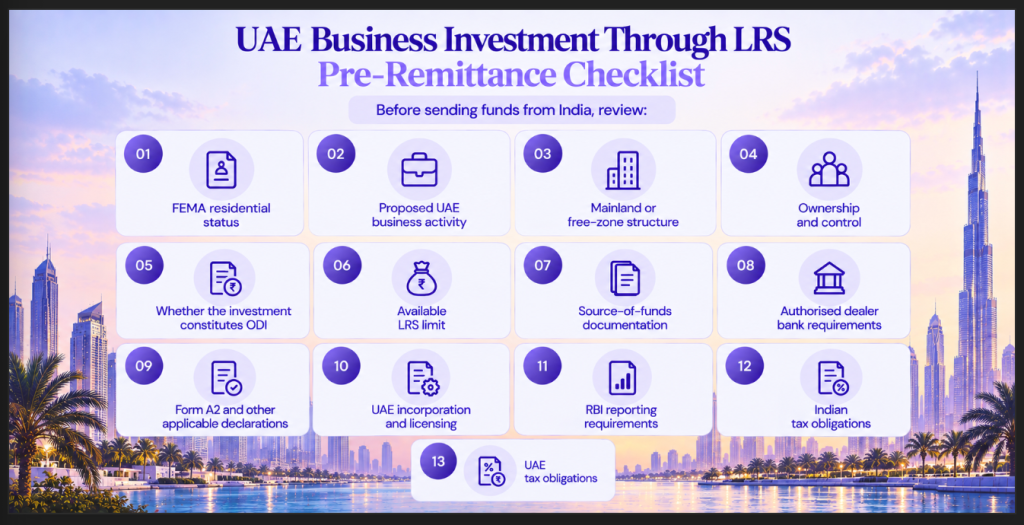
UAE Business Investment Through LRS | Pre-Remittance Checklist
How Can Arnifi Help?
Arnifi can support your UAE business setup process, including mainland and free-zone incorporation, licensing, corporate documentation and UAE business banking requirements. Entrepreneurs should obtain the relevant regulatory or tax advice where the transaction requires interpretation of Indian overseas-investment or tax rules.
FAQs
Can an Indian resident use LRS to start a business in the UAE?
An eligible resident individual may make permitted overseas investments subject to the applicable FEMA and overseas-investment framework. The UAE incorporation and licensing process remains separate.
What is the LRS limit for investing in a UAE business?
The current LRS limit is USD 250,000 per resident individual per financial year. It is an aggregate limit across qualifying LRS transactions, not a separate UAE business allowance.
Is investment in a UAE company through LRS considered ODI?
It can be, depending on the nature of the investment. Unlisted equity and certain investments involving listed foreign entities or control can fall within the ODI definition.
What documents are required to send business funds from India to the UAE?
Requirements vary by transaction and bank, but may include PAN, KYC documents, Form A2, source-of-funds evidence and UAE investment or incorporation documents.
What tax and reporting requirements apply after investing in a UAE company?
The investor may need to consider Indian tax and foreign-asset reporting, applicable TCS and overseas-investment reporting, while the UAE company must separately assess UAE Corporate Tax, VAT and other applicable obligations.
Conclusion
The Liberalised Remittance Scheme can provide eligible Indian resident individuals with a route for permitted overseas investment into a UAE business, subject to the applicable FEMA framework.
The USD 250,000 annual LRS limit applies across qualifying transactions and is not a separate allowance for UAE business setup. Where an investment qualifies as ODI, additional reporting and compliance requirements may apply.
UAE incorporation, licensing and ownership requirements operate separately from India’s foreign-exchange rules. Entrepreneurs should therefore establish the UAE business structure and India-side investment route before transferring capital.
The safest approach is to confirm the proposed investment with the authorised dealer bank and obtain appropriate professional advice where FEMA, ODI or tax treatment requires interpretation.
References
Top UAE Packages
Related Articles


Top UAE Packages
Get in Touch
