
UAE-Singapore Business Council | Business Opportunities, Trade & Expansion Guide

Anushka
Content Writer
Anushka Basu is a business content writer specialised in global business market insights. She aims to simplify complex regulatory, financial, and business concepts into… Read more

Tulika Saxena
AVP, Sales & Marketing | IIM Nagpur
Tulika Saxena specializes in business finance, sales strategy, and market positioning. Leads growth and partnerships, ensuring seamless business setup experiences and client success across… Read more


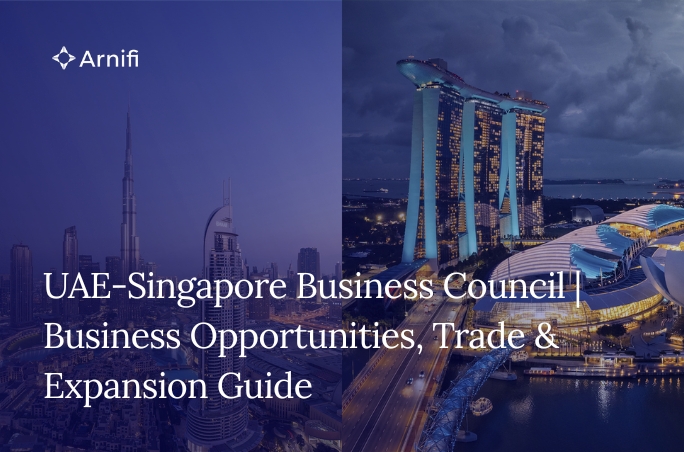
Key Fact: The UAE and Singapore maintain strong economic and commercial ties, supported by bilateral trade, investment cooperation and business-focused institutions that facilitate connections between companies in both markets.
Table of contents
- Introduction
- What Is the UAE-Singapore Business Council?
- Why Are UAE-Singapore Business Relations Important?
- What Are the Main UAE-Singapore Trade and Investment Opportunities?
- How Can Singapore Businesses Expand Into the UAE?
- How Can UAE Businesses Expand Into Singapore?
- What Role Does the UAE-Singapore Business Council Play in Business Expansion?
- What Government and Business Institutions Support UAE-Singapore Trade?
- What Are the Key Benefits for Businesses Exploring Both Markets?
- What Should Businesses Consider Before Expanding Between the UAE and Singapore?
- UAE-Singapore Trade and Investment | What Should Businesses Watch?
- How Can Businesses Use the UAE-Singapore Relationship for Regional Expansion?
- How Can Arnifi Help With UAE Business Expansion?
- FAQs
- Conclusion
Introduction
The UAE-Singapore Business Council (UAESBC) is a trade association focused on strengthening business and commercial relationships between the UAE and Singapore.
The UAE provides access to the GCC, Middle East and Africa, while Singapore provides access to Southeast Asia, ASEAN and the wider Asia-Pacific region. Their commercial relationship creates opportunities for businesses exploring cross-border trade, investment, partnerships and regional expansion.
Businesses exploring both markets may consider:
- Bilateral trade
- Investment opportunities
- Business expansion
- Sector-specific opportunities
- Government and private-sector cooperation
- Business networking and market connections
The UAE-Singapore Business Council is a business network that supports commercial relationships between companies and institutions in the UAE and Singapore. It facilitates networking, business discussions, trade missions and commercial connections. However, it is not a business licensing authority, regulator or market-entry authority.
What Is the UAE-Singapore Business Council?
The UAE-Singapore Business Council supports commercial relationships between businesses in both countries. Business councils generally provide a platform for companies to build relationships, exchange market knowledge and explore commercial opportunities.
Its activities can support:
- Business networking
- Investment discussions
- Trade relationships
- Institutional cooperation
- Market knowledge
- Commercial introductions
- Business delegations and events
The Council itself is not responsible for issuing business licences, approving investments, granting visas or making tax and regulatory decisions. Those functions remain with the relevant government authorities.
Why Are UAE-Singapore Business Relations Important?
The UAE and Singapore have strategic positions as international business and trade hubs.
The UAE can provide businesses with access to:
- GCC markets
- Middle East markets
- African markets
- International logistics networks
Singapore can provide access to:
- Southeast Asia
- ASEAN markets
- Wider Asia-Pacific markets
- International trade and logistics networks
Both countries also have established financial, logistics, technology and professional-services ecosystems. This creates potential opportunities for companies considering cross-border expansion, investment and regional operations.
The relationship should therefore be viewed around market access and commercial connectivity rather than simply bilateral trade.
What Are the Main UAE-Singapore Trade and Investment Opportunities?
Businesses from both markets may explore opportunities across a range of sectors, including:
- Infrastructure
- Logistics
- Green economy
- Advanced manufacturing
- Food and agritech
- Biotech and pharmaceuticals
- Water sustainability
- Space
- Energy and energy resilience
- Technology and innovation
The existence of bilateral commercial ties does not mean that every sector receives special treatment. Businesses must still assess applicable licensing, investment and sector-specific regulations before entering either market.
How Can Singapore Businesses Expand Into the UAE?
Singapore companies considering UAE expansion can approach market entry through several stages.
1. Identify the UAE Activity
Determine what the Singapore company intends to sell, provide or establish in the UAE.
The company should also check whether the proposed activity is regulated or requires additional approvals.
2. Choose the Business Structure
Depending on the activity and intended market, options may include:
- Mainland company
- Free-zone company
- Branch or subsidiary structure where appropriate
The appropriate structure depends on the company’s activity, ownership requirements and intended operations.
3. Determine Licensing Requirements
The company should identify the relevant licensing category, which may include:
- Commercial activities
- Professional activities
- Industrial activities
- Additional approvals for regulated sectors
4. Establish Local Operations
Depending on the business model, this may involve:
- Office requirements
- Corporate bank account
- Tax and accounting compliance
- Employment requirements
- Immigration arrangements
5. Develop Local Partnerships
Singapore companies may also explore relationships with:
- Distributors
- Suppliers
- Strategic partners
- Investors
- Local service providers
How Can UAE Businesses Expand Into Singapore?
UAE companies considering Singapore can follow a similar market-entry process while assessing Singapore-specific requirements.
The company should:
- Determine its intended business activity
- Identify the appropriate Singapore entity or market-entry structure
- Check sector-specific regulatory requirements
- Understand tax and accounting obligations
- Establish local banking and operational arrangements
- Explore distributors and strategic partners
- Connect with local business networks
- Assess Singapore’s potential as a gateway to ASEAN markets
Establishing a UAE company does not automatically create a right to operate in Singapore, and the reverse also applies. Each market has its own incorporation, licensing, tax and regulatory requirements.
What Role Does the UAE-Singapore Business Council Play in Business Expansion?
The UAE-Singapore Business Council can support businesses at the networking and commercial-engagement stage of expansion.
Its role may include:
- Business networking and introductions
- Connecting companies with relevant stakeholders
- Supporting commercial dialogue
- Facilitating knowledge-sharing
- Identifying potential investment and partnership opportunities
- Supporting business delegations and commercial events where applicable
- Helping businesses understand the broader commercial environment
The distinction is important:
Business Council = networking and commercial facilitation
Government authorities = licensing, approvals, immigration, tax and regulatory decisions
What Government and Business Institutions Support UAE-Singapore Trade?
Several government and business institutions can support companies exploring the UAE-Singapore commercial relationship.
UAE side
- UAE government economic authorities
- UAE Ministry of Economy and Tourism
- Dubai Chambers and relevant emirate-level chambers
- Investment and economic-development authorities
Singapore side
- Singapore Ministry of Trade and Industry
- Enterprise Singapore
- Singapore Business Federation
- Other relevant trade and investment bodies
These institutions have different functions. Businesses should use the relevant official authority for licensing, investment approvals, taxation, immigration and other regulatory matters rather than treating the Business Council as a government approval body.
What Are the Key Benefits for Businesses Exploring Both Markets?
Companies exploring the UAE and Singapore may consider the relationship in terms of practical commercial objectives, including:
- Access to new customers
- Regional market expansion
- Investment and partnership opportunities
- Access to international talent and expertise
- Supply-chain diversification
- Access to financial and professional services
- Cross-border technology collaboration
- Regional headquarters opportunities
- Connections with investors and strategic partners
The UAE and Singapore can function as regional business gateways, but the suitability of either market depends on the company’s sector, customers, operating model and expansion strategy.
What Should Businesses Consider Before Expanding Between the UAE and Singapore?
Businesses should assess both commercial and regulatory considerations before establishing operations in either market.

Trade opportunities do not remove normal regulatory obligations. Businesses should understand the requirements that apply to their specific activity before selecting an entity or entering a market.
UAE-Singapore Trade and Investment | What Should Businesses Watch?
Businesses exploring the relationship should monitor developments that may affect trade, investment and market access.
These may include:
- Changes in bilateral trade policy
- New investment agreements or economic partnerships
- Sector-specific regulatory developments
- New business delegations and trade missions
- Emerging technology and sustainability opportunities
- Changes affecting cross-border investment
- Developments affecting market access
Businesses should verify current trade figures, agreements and institutional developments through official UAE and Singapore government sources before relying on them for commercial decisions.
How Can Businesses Use the UAE-Singapore Relationship for Regional Expansion?
The UAE-Singapore relationship can be relevant to companies considering a broader regional expansion strategy.
Potential structures and objectives may include:
- Singapore → UAE → GCC and Middle East
- UAE → Singapore → ASEAN and Asia-Pacific
- Regional headquarters
- Cross-border distribution
- Investment holding structures
- Technology expansion
- Supply-chain development
- Regional customer acquisition
- Strategic partnerships
A Singapore company may assess the UAE as a potential base for Middle East operations, while a UAE company may consider Singapore as a potential base for Asian activities.
Neither country automatically provides access to the other’s wider region. Businesses should assess whether the structure makes commercial, operational and regulatory sense for their particular business model.
How Can Arnifi Help With UAE Business Expansion?
Arnifi can support international businesses considering UAE market entry with company formation, licensing and ongoing corporate requirements.
Support can include:
- UAE company formation support
- Mainland and free-zone setup guidance
- Licensing and activity selection
- Corporate structuring support
- Visa and establishment-related services
- Accounting, tax and compliance support
- Ongoing corporate administration
- Support for international businesses entering the UAE
Singapore-based companies considering UAE expansion can discuss their intended business activity and preferred setup with Arnifi before selecting an appropriate structure.
FAQs
What is the UAE-Singapore Business Council?
The UAE-Singapore Business Council is a business organisation that supports commercial relationships between businesses and institutions in the UAE and Singapore through networking, business discussions, delegations and commercial engagement.
What does the UAE-Singapore Business Council do?
The Council supports business networking, seminars, trade missions, delegations, institutional engagement and commercial connections between stakeholders in both markets.
How can Singapore companies expand into the UAE?
Singapore companies can identify their intended UAE activity, select an appropriate mainland or free-zone structure where applicable, obtain the required licences and establish the necessary banking, tax, employment and operational arrangements.
How can UAE companies enter the Singapore market?
UAE companies should determine their proposed activity, assess Singapore’s entity and licensing requirements, review tax and accounting obligations and establish the necessary operational and commercial arrangements.
What sectors have opportunities between the UAE and Singapore?
Potential areas include logistics, technology, financial services, fintech, infrastructure, energy, clean technology, healthcare, food, manufacturing and professional services.
Does the Business Council help companies set up businesses?
The Business Council’s role is focused on business networking, commercial engagement, events and partnerships. Business incorporation, licensing and regulatory approvals remain matters for the relevant government authorities.
What are the main UAE business setup options for Singapore companies?
Depending on the activity, a Singapore company may consider a mainland company, free-zone company, branch or subsidiary structure. The appropriate option depends on the intended activity and operating model.
Is there a trade agreement between Singapore and the UAE?
Singapore and the UAE are covered by the GCC-Singapore Free Trade Agreement, which entered into force in 2013. The two countries also have a Double Tax Avoidance Agreement.
Can a UAE company use Singapore as a gateway to Asia?
Singapore can serve as a potential regional base for businesses targeting Southeast Asia and wider Asia-Pacific markets, subject to the company’s activities, structure and applicable regulatory requirements.
Can a Singapore company use the UAE as a gateway to the GCC?
The UAE’s location, infrastructure and connectivity can support Singapore businesses seeking access to the Middle East and GCC markets, subject to applicable market-entry and regulatory requirements.
Conclusion
The UAE-Singapore commercial relationship creates opportunities for companies exploring cross-border trade, investment, partnerships and regional expansion. The UAE can provide connectivity with the GCC and wider Middle East, while Singapore provides an established business environment for companies looking towards Southeast Asia and the Asia-Pacific region.
The UAE-Singapore Business Council can support this relationship through networking, business delegations, seminars, institutional partnerships and commercial connections. However, businesses still need to independently assess licensing, tax, regulatory and operational requirements before entering either market.
Businesses should begin by identifying their intended activity, target customers and expansion objectives. They can then assess the appropriate entity, jurisdiction, licensing requirements and regional strategy.
For Singapore-based companies exploring UAE market entry, Arnifi can support company formation, licensing, structuring and ongoing compliance requirements.
Official References
Top UAE Packages
Related Articles

Top UAE Packages
Get in Touch
