
Health Insurance for Employees in UAE | Requirements, Coverage & Employer Rules

Anushka
Content Writer
Anushka Basu is a business content writer specialised in global business market insights. She aims to simplify complex regulatory, financial, and business concepts into… Read more

Tulika Saxena
AVP, Sales & Marketing | IIM Nagpur
Tulika Saxena specializes in business finance, sales strategy, and market positioning. Leads growth and partnerships, ensuring seamless business setup experiences and client success across… Read more


Key Fact: Since 1 January 2025, health insurance has been required for covered private-sector employees and domestic workers when their residency permits are issued or renewed, subject to applicable transition rules. Employers must purchase the required employee health insurance.
Table of contents
- Introduction
- Is Health Insurance Mandatory for Employees in the UAE?
- Why Do Employees in the UAE Need Health Insurance?
- Who Needs Health Insurance in the UAE?
- What Does the UAE Basic Health Insurance Package Cover?
- Employee Health Insurance | What Employees Need to Do
- Employer Health Insurance Requirements in UAE
- How Businesses Should Manage Employee Health Insurance | An Employer’s POV
- Who Pays for Employee Health Insurance in the UAE?
- Health Insurance Rules in Dubai
- Health Insurance Rules in Abu Dhabi
- Health Insurance in Sharjah, Ajman, Fujairah, Ras Al Khaimah & Umm Al Quwain
- Basic vs Enhanced Health Insurance in UAE
- What Happens If an Employee Does Not Have Required Health Insurance?
- Health Insurance and UAE Residence Visa Renewal
- How to Get Health Insurance for Employees in the UAE
- Common Employer Mistakes to Avoid
- How Arnifi Can Help With Employee Health Insurance Compliance
- FAQs
- Conclusion
Introduction
Does my employer have to provide health insurance in the UAE?
For covered private-sector employees, the answer is yes. Health insurance is now part of the residency process across the UAE, although the exact framework differs between emirates.
Dubai and Abu Dhabi already had mandatory health insurance systems. From 1 January 2025, the UAE extended mandatory coverage to private-sector employees and domestic workers in Sharjah, Ajman, Umm Al Quwain, Ras Al Khaimah and Fujairah.
For employees, this means knowing what their policy covers, where they can receive treatment and what they may have to pay. For employers, insurance has become part of the wider HR and residency compliance process.
Is Health Insurance Mandatory for Employees in the UAE?
Health insurance is mandatory for covered private-sector employees and domestic workers under the UAE’s current framework.
From 1 January 2025, employers in Sharjah, Ajman, Umm Al Quwain, Ras Al Khaimah and Fujairah became responsible for arranging the required basic health insurance for covered workers. Dubai and Abu Dhabi already had mandatory insurance arrangements.
Employees whose work permits were issued before 1 January 2025 and remained valid were given transition treatment, with insurance becoming mandatory when their residence permits were renewed.
The requirement should not be confused with an obligation for every resident to personally purchase a policy. For covered employees, the employer carries the financial responsibility for the required employee insurance under the federal basic scheme.
Why Do Employees in the UAE Need Health Insurance?
Health insurance serves two purposes: compliance and access to healthcare.
For employees, an insurance policy can reduce the amount they have to pay directly for eligible medical treatment. It also provides access to the healthcare network included in the policy.
More importantly, the required insurance is connected to the issuance or renewal of residence permits for covered workers. Employers therefore need to treat insurance as part of employee onboarding and renewal rather than as an optional workplace benefit.

Note: The above image is from the Official UAE Government Portal – Health Insurance Page
Who Needs Health Insurance in the UAE?
The current framework covers:
- Private-sector employees
- Domestic workers
- Employees of mainland companies
- Employees of free-zone companies where the relevant emirate’s mandatory framework applies
- Workers covered by the nationwide basic scheme
- Employees already covered under Dubai or Abu Dhabi’s mandatory systems
The exact requirements depend on the employee’s category, emirate and existing insurance arrangements.
What Does the UAE Basic Health Insurance Package Cover?
The federal basic package introduced for covered private-sector employees and domestic workers has the following key features:
| Benefit | Basic Package |
| Annual premium | AED 320 |
| Inpatient co-payment | 20% |
| Inpatient co-payment cap | AED 500 per visit / AED 1,000 annually |
| Outpatient co-payment | 25% |
| Outpatient co-payment cap | AED 100 per visit |
| Follow-up within 7 days | No co-payment |
| Medication co-payment | 30%, capped at AED 1,500 annually |
| Policy duration | 2 years |
| Age coverage | 1–64 years |
The package also covers chronic and pre-existing conditions without a waiting period. Workers above 64 years must complete a medical disclosure form and provide recent medical reports.
This is the basic package. Employers can choose broader insurance where appropriate.
Employee Health Insurance | What Employees Need to Do
The employer is responsible for arranging the required insurance, but employees should still understand their coverage.
After receiving the policy, an employee should:
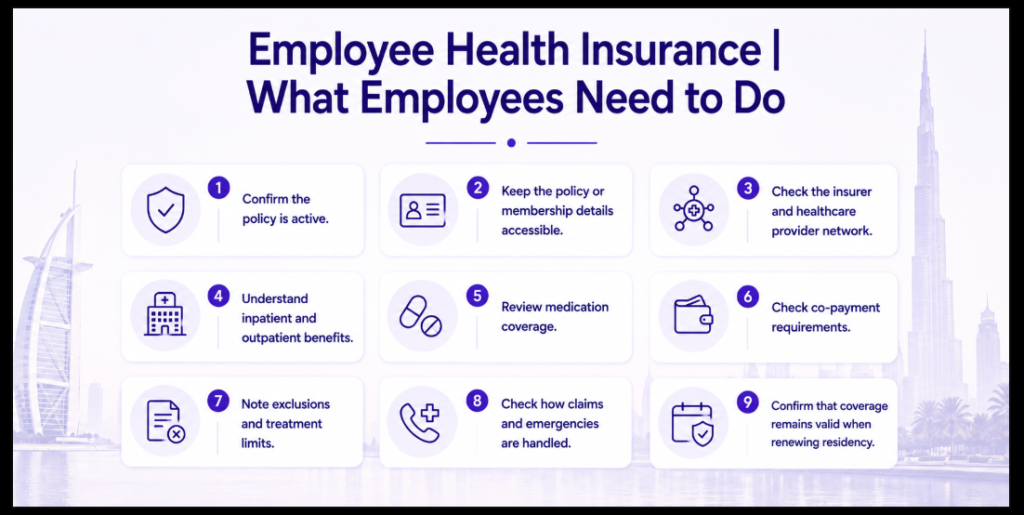
Knowing these details can prevent surprises when medical treatment is required.
Employer Health Insurance Requirements in UAE
Employers must arrange the required health insurance for covered employees and bear the financial obligation for the basic policy under the federal scheme. Insurance is also connected to residence permit issuance and renewal.
For employers, compliance therefore involves more than buying a policy once. Coverage needs to remain valid and should be coordinated with employee onboarding, residency applications and renewals.
Employers should also keep appropriate policy and employee records and provide workers with the information they need to use their coverage.
How Businesses Should Manage Employee Health Insurance | An Employer’s POV
A practical employer workflow can be kept simple:
- Identify employees who require coverage.
- Check whether they already have valid insurance.
- Select an approved insurance product.
- Purchase the required coverage.
- Coordinate the policy with residency issuance or renewal.
- Give employees their policy information.
- Track expiry and renewal dates.
- Update records when an employee’s status changes.
- Keep evidence of valid coverage.
MoHRE states that employers can purchase the basic package through the approved channels, including the DubaiCare Network, accredited insurance companies and designated business service centres.
Who Pays for Employee Health Insurance in the UAE?
For covered private-sector employees under the nationwide basic scheme, the employer is responsible for the financial obligation of the required health insurance.
Employee coverage should be distinguished from dependent coverage. The federal basic package allows eligible dependants to access the same benefits and pricing as specified in the policy, but this should not be read as a universal requirement for every employer to provide family insurance. An employee is expected to be insured but the not their family by default.
Dubai and Abu Dhabi have their own rules concerning dependants and sponsorship.
Health Insurance Rules in Dubai
Dubai has had a mandatory health insurance framework since the implementation of its health insurance law.
The Dubai Health Authority states that Dubai-registered employers, including free-zone companies, must provide employees with at least the required basic level of health insurance. Dubai’s framework includes the Essential Benefits Plan (EBP).
The responsibility can also extend to sponsors for resident dependants and domestic workers under Dubai’s framework. Employers may provide coverage beyond the minimum requirements through enhanced insurance products.
This means a Dubai free-zone employer should not assume that being outside the mainland removes the mandatory insurance requirement.
Health Insurance Rules in Abu Dhabi
Abu Dhabi operates under its own mandatory health insurance framework.
The Department of Health – Abu Dhabi states that covered non-UAE nationals holding work or residence visas issued in Abu Dhabi must have the appropriate health insurance coverage. Employers are responsible for providing coverage for their covered non-national employees and specified dependants.
The framework is based on Health Insurance Law No. 23 of 2005 and its regulations. Employers and sponsors should therefore follow Abu Dhabi-specific requirements rather than applying the federal basic package automatically.
Health Insurance in Sharjah, Ajman, Fujairah, Ras Al Khaimah & Umm Al Quwain
The nationwide health insurance scheme extended mandatory coverage to private-sector employees and domestic workers in these five emirates from 1 January 2025.
For covered workers, employers must purchase the required policy when issuing or renewing the relevant residence permit.
The federal basic package costs AED 320 per year, provides two years of policy validity and includes defined inpatient, outpatient and medication co-payments.
Basic vs Enhanced Health Insurance in UAE
| Feature | Basic Coverage | Enhanced Coverage |
| Purpose | Minimum applicable coverage | Broader protection |
| Cost | Lower | Generally higher |
| Provider network | Defined network | May be broader |
| Benefits | Minimum required benefits | Additional benefits depending on policy |
| Employer choice | Can satisfy applicable minimum requirements | Can provide additional employee benefits |
The mandatory requirement should not be confused with a requirement to provide the most comprehensive insurance available. Employers can choose enhanced coverage where they want to offer broader benefits.
What Happens If an Employee Does Not Have Required Health Insurance?
The consequences depend on the applicable emirate and framework.
Under the federal scheme, health insurance is a prerequisite for issuing or renewing residence permits for covered private-sector employees and domestic workers.
In Abu Dhabi, the health insurance framework also places specific obligations on employers and sponsors. The Department of Health can impose financial penalties where required insurance is not maintained.
Employees should raise coverage issues with their employer, insurer or the relevant government authority rather than assuming that treatment will automatically be covered.
Health Insurance and UAE Residence Visa Renewal
For covered private-sector employees and domestic workers, health insurance is directly connected to residence permit issuance and renewal under the nationwide scheme introduced from 1 January 2025.
Employers should therefore arrange insurance before the relevant residency process rather than waiting until the last stage of renewal.
However, the mandate does not apply to employees with work permits issued before 1 January 2024 that remain valid, but will become mandatory when their residency permits are due for renewal.
How to Get Health Insurance for Employees in the UAE
The process generally starts by identifying the employee’s emirate, employment category and existing coverage.
Employers should then:
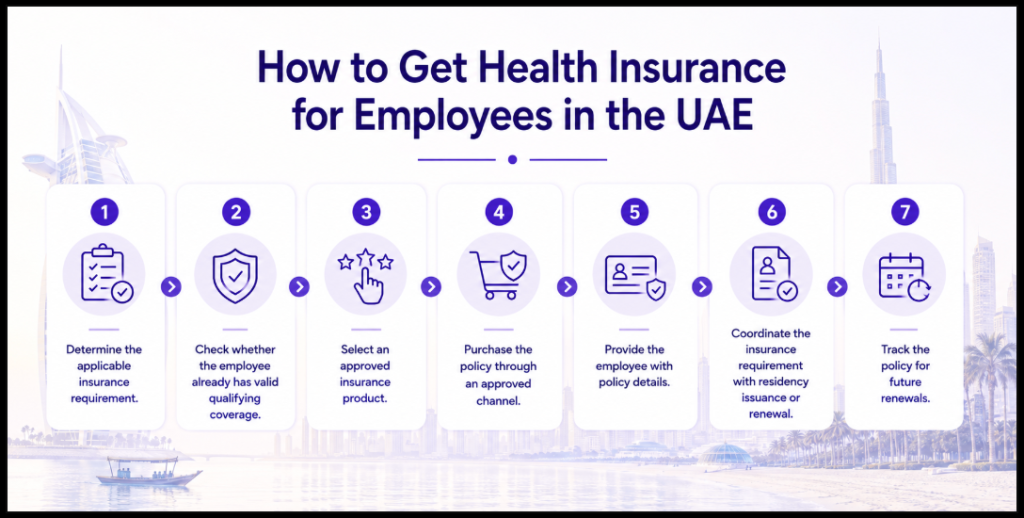
For the federal basic package, MoHRE identifies approved insurance companies, the DubaiCare Network and designated Business Service Centres as purchase channels.
Common Employer Mistakes to Avoid
Employers should avoid:
- Treating employee health insurance as optional.
- Waiting until residence renewal to arrange coverage.
- Choosing a policy without checking the applicable requirements.
- Failing to track policy expiry dates.
- Assuming Dubai, Abu Dhabi and the other emirates follow identical insurance frameworks.
- Assuming employee insurance automatically covers all dependants.
- Failing to give employees their policy information.
- Confusing basic mandatory coverage with enhanced insurance.
How Arnifi Can Help With Employee Health Insurance Compliance
Arnifi can help businesses coordinate the administrative side of employee health insurance, including:
- Employee insurance coordination
- New employee onboarding support
- Residency-related insurance coordination
- Policy documentation
- Renewal tracking
- Employer compliance support
- Assistance with understanding applicable requirements
The role is to simplify the administrative process for businesses while the insurance provider remains responsible for the insurance policy itself.
FAQs
Is health insurance mandatory for employees in the UAE?
Yes. Health insurance is mandatory for covered private-sector employees, with the nationwide scheme extending to five emirates from 1 January 2025.
Who pays for employee health insurance in the UAE?
For the federal basic scheme, employers are responsible for the financial obligation of the required employee health insurance.
What does the basic health insurance package cover?
It includes inpatient, outpatient and medication benefits, with defined co-payments, limits and coverage conditions.
Do employers have to provide health insurance to employees in Dubai?
Yes. Dubai-registered employers, including free-zone entities, must provide the required minimum health insurance cover.
Do employers have to provide health insurance to employees in Abu Dhabi?
Yes. Abu Dhabi’s health insurance framework requires employers to provide coverage for covered non-UAE-national employees.
Is health insurance required for UAE residence visa renewal?
For covered private-sector employees and domestic workers, the required health insurance policy is linked to residence permit issuance and renewal.
Conclusion
Health insurance is now part of the compliance process for covered employees across the UAE.
Since 1 January 2025, the federal basic scheme has extended mandatory coverage to private-sector employees and domestic workers in Sharjah, Ajman, Umm Al Quwain, Ras Al Khaimah and Fujairah, while Dubai and Abu Dhabi continue to operate their established mandatory frameworks.
For employers, the practical approach is to arrange the required coverage, keep policies active and coordinate insurance with employee onboarding and residence renewals. Employees, meanwhile, should understand their policy, healthcare network, benefits and out-of-pocket costs.
Official References
Top UAE Packages
Related Articles

Top UAE Packages
Get in Touch
