
GPSSA UAE 2026 | Pension, Social Security & Employer Guide

Tulika Saxena
AVP, Sales & Marketing | IIM Nagpur
Tulika Saxena specializes in business finance, sales strategy, and market positioning. Leads growth and partnerships, ensuring seamless business setup experiences and client success across… Read more


Key Facts: Get a quick overview of GPSSA UAE, including eligibility, registration, contribution rules, employer responsibilities, Ma’ashi services, and how employees can track their pension and social security records.

Table of contents
- Introduction
- What Is GPSSA and What Does It Do?
- Who Is Covered by GPSSA in the UAE?
- Do UAE Employers Need to Register Their Emirati Employees With GPSSA?
- How Does GPSSA Contribution Work?
- What Benefits Does GPSSA Provide?
- How Can Employers Complete GPSSA Registration?
- What Are the Main GPSSA Services?
- What Are the GPSSA Responsibilities of Employers?
- What Happens If GPSSA Contributions or Records Are Incorrect?
- Can Employees Check Their GPSSA Contributions and Service History?
- Can GPSSA Service Periods Be Combined?
- What Is the Difference Between GPSSA and Other UAE Pension Authorities?
- GPSSA Compliance Checklist for UAE Employers
- How Can Arnifi Help With GPSSA Compliance?
- FAQs
- Conclusion
Introduction
For businesses employing UAE nationals, GPSSA is an important part of payroll and employment compliance. Employers need to register eligible employees, report the correct contribution salary and make contributions within the required deadlines. For Emirati employees, GPSSA provides a framework for pension and social security benefits. It also gives employees access to their contribution records, service history and pension-related services. The rules are not identical for every Emirati employee. Federal Law No. 57 of 2023 applies to Emiratis first employed from 31 October 2023 in the sectors and emirates covered by the law, while certain employees remain under the earlier Federal Law No. 7 of 1999.
What Is GPSSA and What Does It Do?
The General Pension and Social Security Authority (GPSSA) is the UAE authority responsible for administering pension and social security matters for employees covered by its legislation. Its role includes maintaining insured employees’ records, collecting contributions, administering pension and end-of-service benefits, and providing services to employers, insured individuals, pensioners and beneficiaries. For employers, GPSSA is mainly a compliance responsibility. For employees, it provides a way to build and track eligible service and pension rights.
Who Is Covered by GPSSA in the UAE?
GPSSA generally covers eligible UAE nationals working for employers subject to its pension legislation. The standard registration conditions include being a UAE national, being between 18 and 60 years old and being medically fit for work at the time of appointment. Expatriate employees do not normally register with GPSSA simply because they work in the UAE. Their employment and social security arrangements are different.
There are also separate pension authorities in the UAE. For example, Emiratis working in Abu Dhabi’s government and private sectors are covered by the Abu Dhabi Pension Fund, while government employees in Sharjah are covered by the Sharjah Social Security Fund. This means an employer should confirm which pension authority applies before completing registration.
Do UAE Employers Need to Register Their Emirati Employees With GPSSA?
Yes, where the employee and employer fall within GPSSA’s coverage. An employer subject to GPSSA must register an eligible Emirati employee within the required period after joining. GPSSA’s current registration service states that the request should be submitted within one month of the employee joining the establishment.
Employers should also make sure employee information is accurate, including employment details and the salary used for contribution calculations. Failure to register an eligible employee can result in penalties and additional amounts payable by the employer. GPSSA currently states that an employer that fails to register an insured individual may face a fine of AED 5,000 for each insured individual.
How Does GPSSA Contribution Work?
The contribution is based on the employee’s Contribution Account Salary, rather than simply taking a percentage of every component shown on a payslip. For employees covered by Federal Law No. 57 of 2023, the total contribution rate is 26%. The insured employee bears 11%, while the employer bears 15%. For eligible private-sector employees whose contribution account salary is below AED 20,000, the UAE Government bears 2.5% of the employer’s share.
The newer law also increased the maximum contribution account salary to AED 70,000 for private-sector employees and AED 100,000 for government-sector employees. However, employees covered by the earlier pension law can have different contribution rules. Therefore, employers should not apply the newer rate to every GPSSA-registered employee without checking the employee’s applicable legislation.
| Employee | Employer | Insurance Salary | Payment Frequency |
| Employee share depends on applicable law | Employer share depends on applicable law | Contribution Account Salary | Monthly |
In the private sector, contribution calculations also follow specific rules around the salary used during the year. GPSSA states that contributions are generally calculated using the salary applicable in January, with specific rules for employees who join after January.
What Benefits Does GPSSA Provide?
GPSSA benefits depend on the applicable pension law and the individual’s circumstances. They can include:
- Retirement pension: Eligible insured individuals can receive pension benefits when the relevant retirement conditions are met.
- End-of-service benefits: Depending on the applicable law and circumstances, an insured individual may qualify for an end-of-service gratuity rather than, or in addition to, other benefits.
- Disability and death benefits: The pension system provides benefits in qualifying cases involving disability, death or other circumstances established under the law.
- Benefits for beneficiaries: Eligible family members may receive benefits following the death of an insured individual.
The newer Federal Law No. 57 of 2023 also introduced specific provisions relating to employed mothers and beneficiaries. The exact entitlement depends on the individual’s service record and applicable legal provisions.
How Can Employers Complete GPSSA Registration?
Employers can manage GPSSA registration through the Ma’ashi digital platform.
The basic process is:
- Set up employer access
Register and log in to Ma’ashi using UAE Pass. - Register the employer
Complete the employer registration process and provide the required information. - Register eligible employees
Select the insured registration service and enter the employee’s details. - Submit the required information
Attach the required documents and submit the request for review. - Declare the contribution salary
Ensure the correct Contribution Account Salary and employment information are recorded. - Manage monthly contributions
Pay the required contributions and keep the employee’s records updated.
GPSSA’s current employer registration service confirms that employers can access its services through Ma’ashi, while the insured registration service is specifically designed for registering Emirati employees.
What Are the Main GPSSA Services?
Ma’ashi has moved many GPSSA processes into a single digital platform for employers and insured individuals.
| Service | Who Uses It | Purpose |
| Registration | Employers/Employees | Register with GPSSA |
| Contribution Management | Employers | Manage monthly contributions |
| Service Period | Employees | Check recorded service |
| Pension Estimate | Employees | Review projected pension |
| Employee Updates | Employers | Update employment and salary information |
Other services include pension advisory support, end-of-service requests, service-period merging and purchasing eligible service years.
What Are the GPSSA Responsibilities of Employers?
Once an employer falls within GPSSA’s scope, compliance does not end after registration.
Employers should:
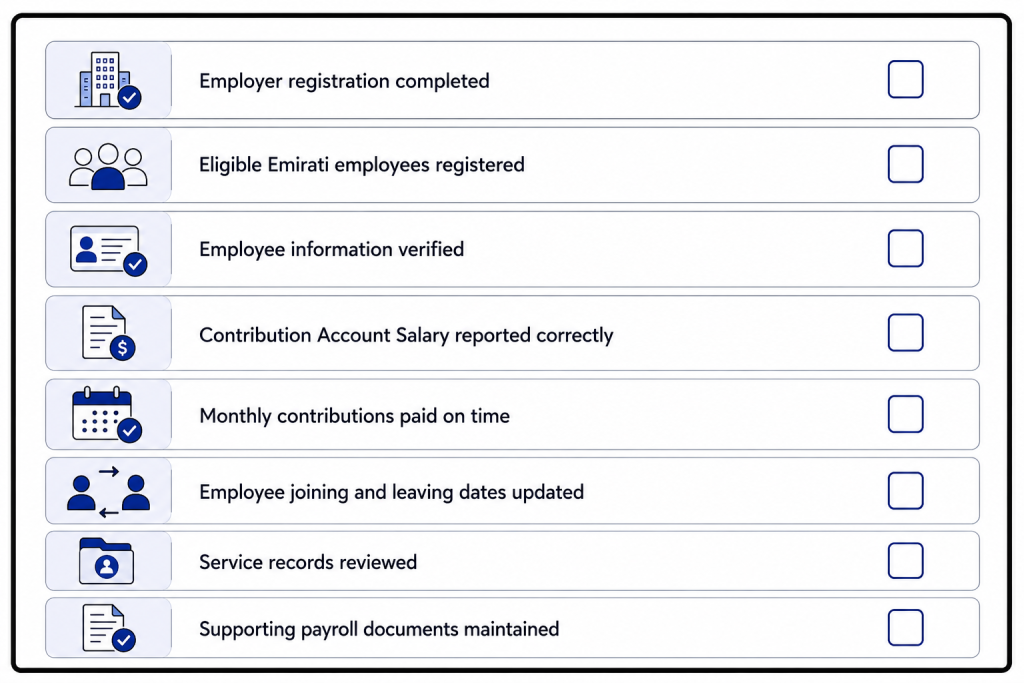
- Register eligible Emirati employees within the required period.
- Report accurate employment and salary information.
- Deduct the employee’s applicable contribution from salary.
- Pay contributions within the prescribed deadline.
- Report employees whose service has ended.
- Keep supporting employment and payroll records.
- Correct inaccurate information as soon as it is identified.
GPSSA states that contributions are generally due from the first day of the following month and may be paid up to the 15th day of that month.
What Happens If GPSSA Contributions or Records Are Incorrect?
Incorrect GPSSA information can affect an employee’s recorded service, contributions and eventual benefits. Common problems include incorrect salary information, missing payments, delayed employee registration and incomplete service records. Employers should review their GPSSA records regularly and correct discrepancies rather than waiting until an employee leaves the business.
If an employer fails to pay contributions, GPSSA can impose additional amounts. The Authority’s current FAQ states that delayed or unpaid contributions can attract an additional amount equal to 10% of the contributions due. Employees who notice an issue can review their records through Ma’ashi and raise a support request where necessary.
Can Employees Check Their GPSSA Contributions and Service History?
Yes. Ma’ashi allows insured individuals to review important information connected with their GPSSA records.
Employees can use the platform to check:
- Contribution payments
- Contribution Account Salary
- Recorded employment periods
- Insurance information
- Expected pension information
- Available pension and social security services
GPSSA says the platform also supports pension planning by allowing insured members to review service information and calculate expected pension amounts.
Can GPSSA Service Periods Be Combined?
In eligible cases, an insured individual can request to merge previous service periods with their current service. GPSSA’s current Merge Service Period service allows an active insured person to merge eligible previous service with their current service under an employer registered with GPSSA. The service is intended to enhance end-of-service benefits.
Eligible periods can include previous employment covered by applicable pension legislation, certain government or military service and some service completed before obtaining UAE nationality, subject to the legal conditions. Because merging can involve additional contribution amounts, employees should check the applicable conditions before submitting a request.
What Is the Difference Between GPSSA and Other UAE Pension Authorities?
The UAE does not operate one identical pension arrangement for every Emirati employee.
- GPSSA: Covers employees and employers falling under the federal GPSSA framework.
- Abu Dhabi Pension Fund: Covers eligible Emiratis working in Abu Dhabi’s government and private sectors.
- Sharjah Social Security Fund: Covers eligible government employees in Sharjah.
There can also be specific arrangements for GCC nationals working in the UAE under the insurance protection extension system. For employers with operations across different emirates, checking the applicable pension authority for each employee is therefore important.
GPSSA Compliance Checklist for UAE Employers
How Can Arnifi Help With GPSSA Compliance?
Managing GPSSA alongside payroll, employee records and other UAE employment requirements can become difficult as a business grows. Arnifi can support businesses with employee registration coordination, payroll and contribution tracking, employee record management and compliance reminders. This helps employers keep GPSSA obligations aligned with their wider HR and payroll processes.
FAQs
What is GPSSA in the UAE?
GPSSA manages pension and social security for employees covered under its laws.
Who is eligible for GPSSA?
Eligible UAE nationals working for covered employers can register, subject to applicable conditions.
Do expatriates need GPSSA registration?
Generally, no. GPSSA mainly covers eligible UAE nationals.
Do private companies have to register Emirati employees?
Yes, if the employer and employee fall under GPSSA coverage.
How is GPSSA contribution calculated?
Contributions are calculated using the applicable Contribution Account Salary and rates.
What is the GPSSA insurance salary?
It is the salary amount used to calculate pension contributions under the applicable law.
Who pays GPSSA contributions?
Both employers and employees contribute according to the applicable rules.
When should an employee be registered with GPSSA?
Generally, within one month of joining the employer.
Can I check my GPSSA contribution history online?
Yes. Employees can check their records through the Ma’ashi platform.
Can GPSSA service years be combined?
Yes, eligible previous service periods can be merged subject to applicable conditions.
What happens if an employer does not pay GPSSA contributions?
Late or unpaid contributions may result in additional amounts and compliance consequences.
Does GPSSA cover retirement benefits?
Yes. GPSSA administers pension and eligible end-of-service benefits under applicable laws.
Conclusion
GPSSA compliance is an important part of employing Emirati nationals in the UAE. Employers need to identify eligible employees, complete registration on time, report the correct contribution salary and keep monthly payments and employee records up to date. For employees, checking GPSSA records regularly can help identify missing contributions or service information early. With services now managed digitally through Ma’ashi, both employers and insured individuals have greater visibility over their pension and social security records.
References:
Top UAE Packages
Related Articles

Top UAE Packages
Get in Touch
