
Free Trade Zone Entity in UAE: The Definitive Setup & Corporate Tax Guide

Zahira Shaik
SEO Content Writer
Zahira Shaik is an SEO Content Writer and Published Author specializing in research-based content. She excels at analyzing market trends, regulations, and industry developments… Read more

Tulika Saxena
AVP, Sales & Marketing | IIM Nagpur
Tulika Saxena specializes in business finance, sales strategy, and market positioning. Leads growth and partnerships, ensuring seamless business setup experiences and client success across… Read more


Key Fact: UAE offers over 40 Free Trade Zones which provide 100% foreign equity, 0% personal income tax, and 100% capital repatriation. The registration is easy and takes about 1 month, starting from ~AED 12,000.
Table of contents
- Introduction
- Overview and Key Benefits of UAE Free Zones
- Foreign Setup and Operational Scope
- Setup Costs and Recurring Expenses
- Post-MD 229/2025 Qualifying Activity and Commodity Mapping
- Free Zone vs. Corporate Tax Designated Zone Breakdown
- Setup Timeline & Physical Presence Requirements
- Tax Structure, Remittances and DTRC Compliance
- Bank Account Opening Process
- Frequently Asked Questions
- Conclusion
- References
Introduction
The process of creating a Free Trade Zone Entity in the UAE is still one of the most powerful ways to expand your business overseas in the Middle East, Africa, and South Asia regions. Free zones are special territories where the investor enjoys certain advantages in the regulatory regime and taxes.
Although the process of registration may be quite simple, the modern regulatory system demands more from the entrepreneur than choosing only a budget license. The difference between Free Trade Zone Entity in UAE registration for obtaining an opportunity to do business in the UAE or for cross-border activities consists in important legal nuances. It is important to understand whether you need Free Trade Zone Entity in UAE registration or a Department of Economy and Tourism/Dubai Economy & Tourism (DED) license.
This comprehensive guide breaks down setup parameters, including 100% foreign ownership, entry-level costs starting from ~AED 12,000, 1-month setup timelines, and the overall tax framework. More importantly, it provides essential context omitted from standard guides: integrating the post-MD 229/2025 qualifying activity mappings across budget zones and navigating the FTA TAXP010 Designated Zone distinctions for strategic corporate tax planning.
Overview and Key Benefits of UAE Free Zones
100% Foreign Ownership
The United Arab Emirates hosts more than 40 multi-disciplinary free zones, each tailored to specific commercial sectors. Establishing a Free Trade Zone Entity in UAE allows foreign investors 100% equity ownership without requiring a UAE National Service Agent (LSA) or local shareholder.
Core Advantages
- 100% Capital and Profit Repatriation: Investors have unrestricted freedoms to transfer all funds, capital, and operational profits back to their home jurisdictions.
- Favorable Tax Framework: Enjoys a 0% personal income tax regime alongside a standard 5% Value Added Tax (VAT) framework.
- Turnkey Infrastructure: Offers modular office spaces, modern flexi-desks, high-tech industrial warehouses, and direct proximity to major seaports and international airports.
Foreign Setup and Operational Scope
Global Operations
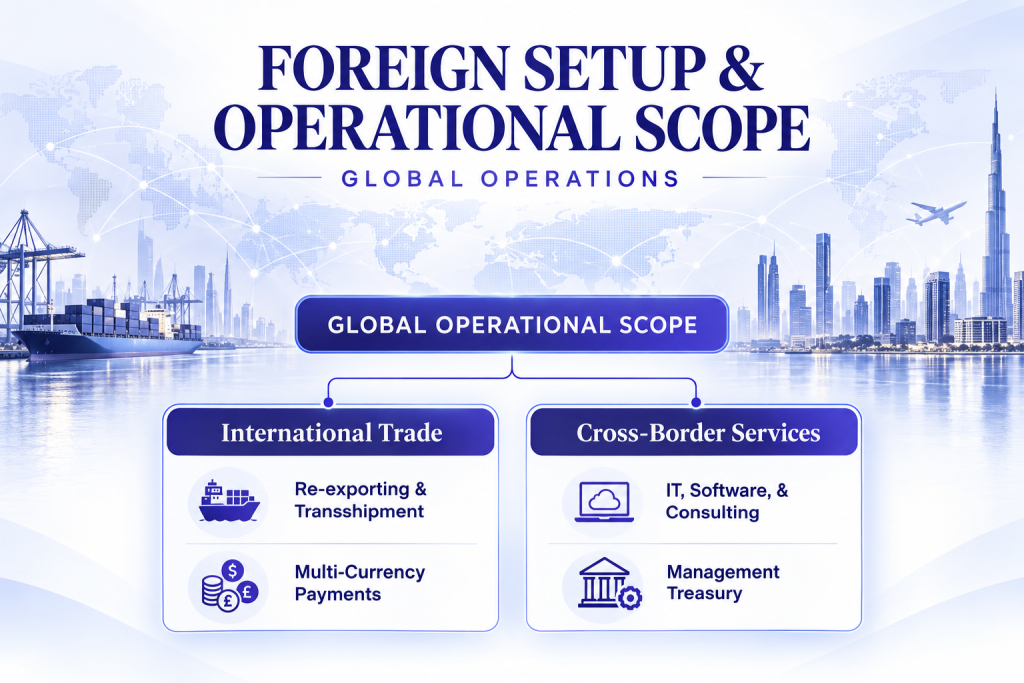
A Free Trade Zone Entity in UAE provides absolute operational flexibility for foreign entrepreneurs. It serves as a seamless corporate vehicle for managing international trade, conducting cross-border consulting services, holding foreign assets, and executing global payment transactions.
Prohibited & Restricted Activities
Under the GCC Unified Customs Law, every Free Trade Zone Entity in UAE must comply strictly with import/export safety protocols. Free zone licenses prohibit handling, storing, or transporting restricted items without specialized statutory approvals:
- Flammable or radioactive materials
- Military weapons, ammunition, and military-grade explosives
- Controlled substances and illegal narcotics
Setup Costs and Recurring Expenses
Variable Pricing Models
Setup expenses for a Free Trade Zone Entity in UAE fluctuate depending on the activity classification selected: Service/Consulting, Commercial/Trading, or General Industrial.
Cost-Effective Zones Breakdown
Budget-friendly free zones provide competitive gateway packages:
- RAKEZ (Ras Al Khaimah Economic Zone): Entry-level packages start from AED 12,000. This initial setup package typically includes a 1-year business license, pre-allocated lease agreement, Memorandum of Association (MOA), Certificate of Incorporation, immigration file opening, e-channel registration, one medical fitness test, and one Emirates ID application.
- Alternative Competitive Options: SHAMS (Sharjah Media City), SPCFZ (Sharjah Publishing City), Ajman Free Zone, IFZA (International Free Zone Authority), and Meydan Free Zone in Dubai.
Recurring Operational Costs
Operating a Free Trade Zone Entity in UAE requires managing recurring annual costs:
- Annual License Renewals: Commercial license, lease/virtual desk agreement, and mandatory portal maintenance fees.
- Employee & Sponsor Visa Maintenance: Medical fitness examinations, biometrics processing, residency visa stamping, Emirates ID renewal fees, and mandatory e-channel quota updates.
Post-MD 229/2025 Qualifying Activity and Commodity Mapping
Under Ministerial Decision No. 229 of 2025 (which abrogated MD 265/2023), the UAE Ministry of Finance updated the framework defining Qualifying and Excluded Activities for free zone corporate tax exemptions.
Expanded Definitions for Budget Zones
When launching a Free Trade Zone Entity in UAE in popular budget hubs like RAKEZ, IFZA, Meydan, or SHAMS, business activity codes must align strictly with MD 229/2025 guidelines to qualify for Qualifying Free Zone Person (QFZP) status:
- Trading of Qualifying Commodities: Refers to raw physical commodities traded on recognized commodity exchanges.
- Manufacturing and Processing: Physical transformation of raw materials into finished or semi-finished goods.
- Headquarter and Treasury Services: Intra-group financing, management, and treasury support services provided to corporate related parties.
- De Minimis Threshold Compliance: Non-qualifying revenue generated by the entity must not exceed 5% of total revenue or AED 5,000,000 (whichever is lower). Exceeding this limit causes the business to lose QFZP status for that tax period and the subsequent four years.
Free Zone vs. Corporate Tax Designated Zone Breakdown
A primary area of confusion for new businesses is assuming all free zones enjoy equal corporate tax treatment. The Federal Tax Authority (FTA) issued Public Tax Clarification TAXP010 (October 2026), reinforcing that VAT Designated Zone status does not automatically qualify an area as a Corporate Tax Designated Zone.
For physical wholesale, logistics, and trading operations, qualifying for 0% Corporate Tax on goods distribution requires operating specifically inside a Corporate Tax Designated Zone equipped with physical customs fencing and security controls.
Designated Zone Status Matrix
| Free Zone Name | Corporate Tax Designated Zone Status | Qualifying for 0% CT on Goods Distribution? | Physical Customs Fencing Present? |
| RAKEZ | Specific Designated Port/Park Areas Only | Yes (within Designated Zone boundary) | Yes |
| IFZA | Standard Free Zone | No (Subject to 9% CT on distribution) | No |
| Meydan Free Zone | Standard Free Zone | No (Non-Designated Zone for physical distribution) | No |
| SHAMS | Standard Free Zone | No (Non-Designated Zone for physical goods) | No |
| JAFZA / DAFZA / KIZAD | Full Designated Zone Status | Yes (Qualifies under wholesale distribution rules) | Yes |
Setup Timeline & Physical Presence Requirements
Setting up a Free Trade Zone Entity in UAE typically takes about 1 month end-to-end.
Timeline Breakdown
- Business License Issuance: 5–6 working days (trade name approval and corporate charter generation).
- Immigration Card Processing: 2–3 days (establishes the corporate file with UAE ICP authority).
- Entry Permit, Biometrics & Emirates ID: 15–20 days (in-country processing).
Mandatory Travel Requirement
While preliminary corporate registration occurs remotely, investors establishing a Free Trade Zone Entity in UAE must visit the UAE at least once. This in-person visit is mandatory to complete preventive medical fitness examinations (blood test and chest X-ray), biometric capture, and Emirates ID verification.
Tax Structure, Remittances and DTRC Compliance
UAE Tax Framework Summary
- Personal Income Tax: 0% across all income levels.
- Value Added Tax (VAT): Standard 5% rate on taxable goods and services supplied domestically.
- Corporate Tax (CT): 0% on taxable profits up to AED 375,000, and 9% on taxable profits exceeding AED 375,000. Qualifying Free Zone Persons (QFZPs) meeting substance and qualifying activity rules maintain 0% corporate tax on Qualifying Income.
Foreign Inbound Remittances
Capital infusions and foreign money transfers remitted directly into a UAE corporate bank account belonging to a Free Trade Zone Entity in UAE face 0% withholding tax at the point of receipt.
Tax Residency Certificate (DTRC)
To leverage Double Taxation Avoidance Agreements (DTAA) and mitigate foreign tax exposure, a Free Trade Zone Entity in UAE (or individual residency visa holder) can apply for a Domestic Tax Residency Certificate (DTRC) through the FTA portal.
- Individual Criteria: Physical presence in the UAE for 183 days or more during a 12-month period (or 90 days for UAE citizens/GCC nationals with primary place of residency).
- Corporate Criteria: Entity incorporated in the UAE with local management and physical operational substance.
Bank Account Opening Process
Physical Corporate Banking
Opening a traditional tier-1 commercial bank account (e.g., Emirates NBD, First Abu Dhabi Bank, Mashreq) requires the physical presence of authorized company signatories in the UAE. This is typically completed during the investor’s Emirates ID trip.
Digital Banking Alternatives
For startups seeking rapid deployment, digital business banking platforms (such as Wio Business or Mashreq NeoBiz) allow remote digital onboarding, significantly reducing physical presence requirements during initial financial setup.
Document Requirements Matrix
| Required Document | Mandatory for Initial Free Zone Setup? | Mandatory for Corporate Bank Account Opening? |
| Passport Copies (Shareholders/Directors) | Yes | Yes |
| Proof of Residence / Utility Bill | Yes | Yes |
| Detailed Business Plan | Optional (Zone dependent) | Yes |
| Trade Name Reservation Certificate | Yes | Yes |
| Memorandum & Articles of Association (MOA) | Yes | Yes |
| Emirates ID & Resident Visa Copy | Post-Arrival Phase | Yes |
| 6-Month Personal Bank Statements | No | Yes |
Frequently Asked Questions
What is the primary distinction between a standard Free Zone and a Corporate Tax Designated Zone?
A regular Free Zone is characterized by 100% foreign ownership and is exempt from customs. But according to FTA TAXP010, only those free zones that have customs fences and status are considered Corporate Tax Designated Zones, which is necessary to be eligible for 0% Corporate Tax on goods distribution.
Can a Free Trade Zone Entity in UAE sell goods directly to the local UAE Mainland market?
Yes, but not directly. Free Trade Zone Entity in the UAE should either have a mainland distributor licensed, a mainland office branch, or pay customs duties at 5% upon importation of goods to the mainland territory.
Must shareholders reside in the UAE full-time to maintain a free zone corporate license?
No. It is not necessary to have a Free Trade Zone Entity in the UAE with residents on a full-time basis. But the holder of an investor visa is required to visit the UAE at least once in 180 days.
How does Ministerial Decision No. 229 of 2025 impact commercial activities in budget zones like IFZA or RAKEZ?
MD 229/2025 unifies qualifying activity descriptions for all free zones. Businesses in budget zones need to make sure that their income fully qualifies according to the definition and remains below 5% or AED 5,000,000 threshold on non-qualifying income for the 0% Corporate Tax rate.
Is it possible to open a corporate bank account before receiving an Emirates ID?
Most standard banks will request a valid Emirates ID and a residency visa. The preliminary compliance process, however, can be performed with an entry permit, and there are business platforms providing convenient ways to get a corporate bank account opened faster after completing biometric verification.
What are the core criteria to secure a UAE Tax Residency Certificate (DTRC)?
Corporations require proof of incorporation, substance, and operational activities in the UAE. Individuals should be physically present in the UAE for 183 days or more in the past 12 months consecutively.
Conclusion
Creating a Free Trade Zone entity in the UAE gives international investors 100% foreign ownership, 0% personal income tax, and capital repatriation. But dealing with the modern business environment calls for consideration of startup expenses against compliance obligations.
In comparing budget options (such as RAKEZ and IFZA) and focused zones (such as JAFZA and DAFZA), you have to go beyond mere registration costs. Compliance with the Trade Activities Code per MD 229/2025 and Corporate Tax Designated Zone per FTA TAXP010 is an important part of safeguarding your tax status.
References
- Ministry of Finance (MoF) UAE Corporate Tax Portal: Official updates on Federal Decree-Law No. 47 of 2022 on the Taxation of Corporations and Businesses.
- Federal Tax Authority (FTA) Official Portal: Official directives including Cabinet Decision No. 100 of 2023, Ministerial Decision No. 229 of 2025, and Public Tax Clarification TAXP010 (October 2026).
- Federal Authority for Identity, Citizenship, Customs & Port Security (ICP): Regulatory guidelines and statutory administration under the GCC Unified Customs Law.
Top UAE Packages
Related Articles

Top UAE Packages
Get in Touch
