
Dubai Business Licence for Singapore Entrepreneurs: Types, Costs & Requirements

Zahira Shaik
SEO Content Writer
Zahira Shaik is an SEO Content Writer and Published Author specializing in research-based content. She excels at analyzing market trends, regulations, and industry developments… Read more

Tulika Saxena
AVP, Sales & Marketing | IIM Nagpur
Tulika Saxena specializes in business finance, sales strategy, and market positioning. Leads growth and partnerships, ensuring seamless business setup experiences and client success across… Read more


Key Fact: Dubai and Singapore are a formidable trade corridor of the globe. In terms of the GCC-Singapore Free Trade Agreement, double taxation treaty, and zero percent tax on profit up to AED 375,000, Dubai provides the perfect gateway to MEASA markets for Singaporean businesses.
Table of contents
- Why Singapore and Dubai Are Complementary Global Business Hubs
- Mainland vs. Free Zone vs. Offshore: Which Dubai Structure Fits Your Business?
- Dubai Business Licence Types: Commercial, Professional & Industrial
- How Much Does a Dubai Business Licence Cost for Singapore Entrepreneurs?
- Singapore Document Legalisation for Dubai Company Setup
- Step-by-Step Process to Get a Dubai Business Licence
- UAE Corporate Tax and Compliance Requirements for Singapore Businesses
- Opening a UAE Corporate Bank Account: What Singapore Entrepreneurs Should Expect
- Singapore VCC vs. DIFC VCC: Which Structure Serves Different Capital Needs?
- Can Singapore Startups Test the UAE Market Before Incorporating?
- How Arnifi Helps Singapore Entrepreneurs Set Up and Manage a Dubai Business
- Conclusion: Planning a Dubai Business Licence From Singapore
- FAQs
- References
Why Singapore and Dubai Are Complementary Global Business Hubs
Both Singapore and Dubai are among the world’s most active commercial and financial centers. While Singapore is considered to be the ultimate finance center and treasury of the APAC region, Dubai is regarded as the gateway to MEASA markets.
This way, business can operate on a 24-hour schedule, linking the Asian markets with the Middle East, Europe, and Africa.
Key factors driving the Singapore–Dubai business corridor include:
- Bilateral Trade & Investment Flows: Economic relations are strong due to huge volumes of bilateral trade, logistical connections, and investments in technology, real estate, and finance sectors.
- GCC-Singapore Free Trade Agreement (GSFTA): The agreement abolishes or drastically reduces import duties on goods traded between Singapore and GCC countries.
- Double Taxation Avoidance Agreement (DTAA): An agreement that prevents double taxation of the cross-border income of the companies in both jurisdictions.
Mainland vs. Free Zone vs. Offshore: Which Dubai Structure Fits Your Business?
Choosing the right jurisdiction is one of the most critical decisions when establishing an entity in Dubai.
| Feature | Mainland (DET) | Free Zone | Offshore |
| Primary Regulator | Dubai Department of Economy and Tourism (DET) | Individual Free Zone Authorities (e.g., IFZA, DMCC, DIFC) | Offshore Registry (e.g., JAFZA Offshore, RAK ICC) |
| Foreign Ownership | 100% for most commercial/industrial activities | 100% foreign ownership | 100% foreign ownership |
| Market Access | Direct access to UAE local market & government tenders | Designated free zone & international markets | International trade & holding purposes only |
| Physical Office | Mandatory (Ejari required) | Flexi-desk or physical office options | Not required (Registered agent address used) |
| Corporate Tax | Standard UAE Corporate Tax rates | 0% on Qualifying Income for Qualifying Free Zone Persons | Not subject to corporate tax (holding entities) |
Direct Mainland Market Access for Free Zone Entities: Although free zone entities benefit from foreign ownership and tax-free income, in order to conduct their business within the UAE mainland market directly, they usually have to appoint a local distributor, operate through a mainland branch, or acquire dual-licensing rights.
Dubai Business Licence Types: Commercial, Professional & Industrial
Dubai has different types of business licences that define the type of business activities. Choosing the right economic activity code is extremely important.
1. Commercial Licence
- Scope: Trading, importing, exporting, distribution, trading in general, and retail of tangible goods.
- Key Characteristics: A commercial licence enables buying and selling tangible goods directly in the UAE or abroad.
2. Professional Licence
- Scope: Designed for service-oriented, knowledge-based, software/SaaS, and consulting businesses (e.g., management consulting, IT services, design, education).
- Key Restrictions: A professional licence permits service delivery but does not allow physical trading or stockholding of products. Certain regulated professions (e.g., legal, healthcare, financial advisory) may require local approvals or specific qualifications.
3. Industrial Licence
- Scope: Service-based, software, knowledge-based companies, SaaS businesses, and consulting (management, IT services, design, education).
- Key Requirements: With the professional licence, one can deliver services but cannot trade or hold stock of any product.
How Much Does a Dubai Business Licence Cost for Singapore Entrepreneurs?
Setting up a business in Dubai involves setup budgets, physical space requirements, and cross-border documentation fees.
Setup Budget Breakdowns
- Lean / Solo Setup (AED 20,000–35,000): Suitable for solopreneurs, digital consultants, and tech founders using Free Zone flexi-desk options with 1–2 visas.
- Standard SME / Trading Setup (AED 35,000–60,000): Suitable for commercial trading or service firms requiring mainland registration, physical office space, and multiple visa allocations.
Additional Setup Expenses
- Office & Ejari Registration: For physical offices, there is a requirement for Ejari (official lease registration in the UAE), which is dependent on where and how big your office is.
- Visa & Health Insurance Costs: Entry permits, medical fitness tests, Emirates ID, and mandatory health insurance (cost approx. AED 4,000-7,000 per person).
- Singapore Document Legalisation Costs: Legalisation of Singapore corporate documents abroad (ACRA, Board Resolution, etc.) usually costs SGD 1,500 to SGD 3,500+ depending on the number of pages and urgency.
- Hidden Cross-Border Setup Expenses: Processing fees at the bank, translation (English to Arabic), currency exchange (SGD to AED/USD), legal fees locally.
Singapore Document Legalisation for Dubai Company Setup
In order to register a corporate parent entity branch, subsidiary, or corporate shareholder in the UAE, corporate documents from Singapore will need to be legalized in a multi-step process.
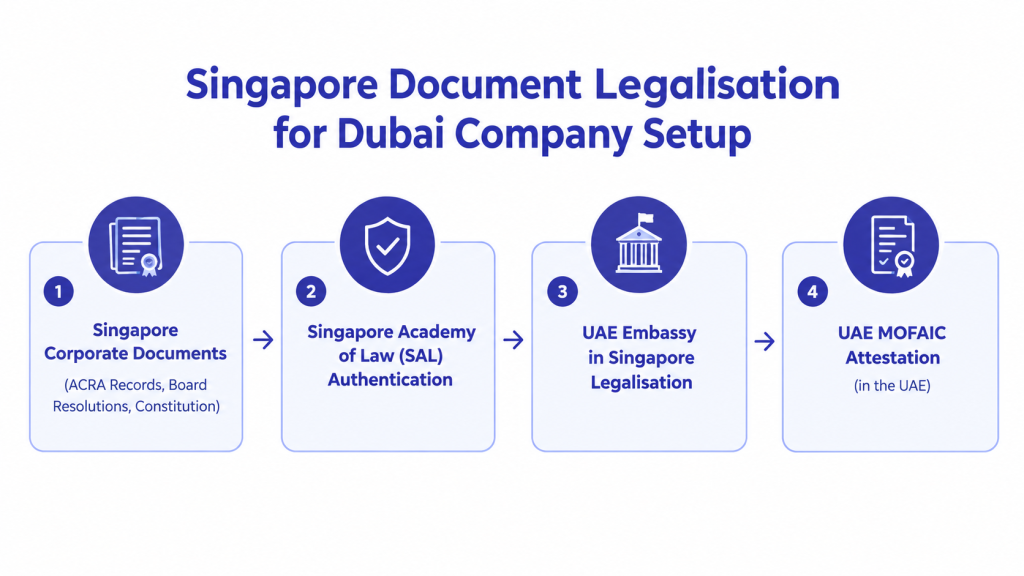
Step-by-Step Legalisation Process
- Document Issuance: Obtain documents from ACRA BizFile, Board Resolutions concerning the formation of the company in the UAE, and the Constitution of the company.
- Notarisation & SAL Authentication: Have the documents notarized through the Notary Public in Singapore and then obtain an apostille from the Singapore Academy of Law (SAL).
- UAE Embassy Legalisation: Submit the notarized documents to the UAE Embassy in Singapore for legalization.
- UAE MOFAIC Attestation: Attestation of the documents by UAE MOFAIC upon receipt of the documents in Dubai.
Important: It is recommended to legalize the documents 2-4 weeks before the incorporation of the company to avoid delays in obtaining the license and opening a bank account.
Step-by-Step Process to Get a Dubai Business Licence
- Select Business Activity & Licence Type: Select the exact activity codes that correspond to your business model.
- Choose the Appropriate Jurisdiction: Decide if you need a Mainland (DET) or specific Free Zone setup.
- Reserve Trade Name: Send name suggestions to the regulatory body and get them approved.
- Prepare & Notarise MOA/AOA: Create MOA & AOA. If corporate shareholders are involved, notarize the documents proving the authorization from the parent company.
- Secure Office Facility & Register Ejari: Lease an office space and/or a warehouse, and finalize Ejari.
- Submit Final Documents & Obtain Business Licence: Pay fees to the government and receive the Trade Licence, Commercial Register, and Share Certificates.
UAE Corporate Tax and Compliance Requirements for Singapore Businesses
The UAE’s federal Corporate Tax regime requires all businesses operating in Dubai to maintain strict compliance.
Key Corporate Tax Rules
- Tax Rates:
- 0% tax on taxable net income not more than AED 375,000 (~SGD 138,000).
- 9% tax on taxable net income above AED 375,000.
- Small Business Relief (SBR): Resident entities with income below designated levels have an option to apply for SBR to consider their taxable income as 0% for designated taxation periods.
- Qualifying Free Zone Persons (QFZP): Free zone entities may benefit from a 0% Corporate Tax on Qualifying Income only if they satisfy requirements of having substance, qualifying income, not electing standard tax, and compliance with transfer pricing requirements.
- Mandatory Audited Financial Statements: QFZPs and mainland entities satisfying statutory criteria must maintain audited financial statements that were prepared in accordance with IFRS standards.
- Corporate Tax Registration & Penalties: All licence holders must be registered for Corporate Tax through the EmaraTax platform. Non-compliance with registration mandates in the required timeframe results in a late registration fee of AED 10,000.
- Ultimate Beneficial Ownership (UBO) Filing: Entities must prepare and file UBO registers as per the regulatory requirements.
- Upcoming E-Invoicing System: A nationwide digital e-invoicing solution is to be introduced in the UAE with the requirement of structured e-invoices for B2B and B2G transactions.
Opening a UAE Corporate Bank Account: What Singapore Entrepreneurs Should Expect
Opening a corporate bank account in the UAE requires preparation due to strict Anti-Money Laundering (AML) and Know Your Customer (KYC) regulations.
What to Expect During Account Opening
- Onboarding Timelines: Anticipate a 2-8 week process, based on the complexity of the firm, entity type, and background checks.
- AML & KYC Requirements: Banks perform background checks on the ultimate beneficial owners and need documents proving address, source of wealth, curriculum vitae, and track record in the business.
- Corporate Documentation: Provide attested documents of the parent firm, business plan, potential client/supplier agreements, and six-month past personal/corporate bank statements.
- Strategic Dual-Banking Model: Singapore-based firms usually keep their main Singapore bank account, such as DBS, OCBC, or UOB, for managing the region’s treasury and fund management, and use UAE corporate banking accounts such as Emirates NBD, First Abu Dhabi Bank, and Mashreq for local AED collections and GCC vendor payments.
Singapore VCC vs. DIFC VCC: Which Structure Serves Different Capital Needs?
Both Singapore and Dubai offer advanced Variable Capital Company (VCC) frameworks tailored for fund managers, family offices, and cross-border asset structuring.
| Feature | Singapore VCC | DIFC VCC (Dubai International Financial Centre) |
| Primary Regulator | Monetary Authority of Singapore (MAS) | DIFC Authority / Dubai Financial Services Authority (DFSA) |
| Primary Focus | Investment fund management, institutional capital, APAC investments | Middle East family office wealth, asset holding, regional investment |
| Sub-Fund Flexibility | Segregated cell structures for multiple funds | Segregated portfolio structures for asset isolation |
| Fund Manager Requirement | Requires a licensed or registered Fund Management Company (FMC) in Singapore | Flexible manager requirements; can support proprietary wealth holding |
| Use Cases | Venture capital, private equity, hedge funds catering to Asian capital | Family office consolidation, real estate holding, cross-border asset pooling |
- Singapore VCC: Most appropriate for investment managers who raise institutions’ capital from the APAC region and allocate this capital globally under the regulation of MAS.
- DIFC VCC: Appropriate for family offices, private wealth aggregation, regional asset management, and multi-asset protection within the MEASA region.
Can Singapore Startups Test the UAE Market Before Incorporating?
A complete legal entity is not always required for pilot testing of the market. The Employer of Record can be used for Singapore startups to employ their personnel in the UAE without setting up a local company.
How EOR Works for UAE Expansion
- Hiring Without a UAE Entity: An EOR is the official employer in the UAE, who provides work visas, takes care of the payroll, and complies with the UAE Labor Law.
- Rapid Deployment: Deploy your sales, BD, or technical personnel to UAE markets in days, rather than in weeks waiting for an entity to be set up.
- Risk Mitigation: Assess customer demand, develop business contacts, and determine market suitability before going into incorporation and office rent and capital investments.
- Transition to Incorporation: After proving some sales traction, your employees and payroll can be transitioned seamlessly from EOR to your UAE incorporated entity.
How Arnifi Helps Singapore Entrepreneurs Set Up and Manage a Dubai Business
The process of cross-border incorporation, document legalisation, taxation registration, and banking requires certain knowledge. Arnifi presents you with a solution that allows you to simplify the process of your expansion into the UAE market.
- End-to-End Incorporation: Professional help with trade license applications, name reservation, MOA preparation, and jurisdiction selection in the Mainland and Free Zones.
- Fixed Pricing & Transparent Guidance: Detailed information about the prices without any extra costs or unexpected payments.
- Cross-Border Document Attestation: Legalisation of your documents in the UAE SAL, UAE Embassy in Singapore, and UAE MOFAIC.
- Banking & Compliance Support: Professional assistance with opening a corporate bank account, AML/KYC preparation, corporate tax registration in EmaraTax, and UBO compliance.
- Arnifi HR / EOR Solutions: Flexible services of the Employer of Record that allow you to hire UAE employees right away without opening a company there.
- Proprietary Technology Tools:
- Arni Cost Calculator: Estimate exact setup costs depending on the jurisdiction, visas, and office rent.
- Arni Organogram: Prepare a visual representation of corporate structure and hierarchy of UBOs for the bank and regulatory compliance.
- Arni AML Checker: Perform pre-screening and compliance checks before corporate onboarding.
- Arni Docs & Assistant: Document management tool for legalisation and compliance deadlines monitoring.
Conclusion: Planning a Dubai Business Licence From Singapore
Entering Dubai gives Singaporean businesses a great opportunity to enter the fast-growing MEASA region, but success depends on effective early planning. Businesses need to decide what kind of expansion is needed: whether to expand into the jurisdiction that will give direct access to the market or use the other one to gain more flexibility in ownership and select appropriate trade licence activity codes.
Early preparation is also needed for the cross-border management process, especially when dealing with the legalisation of Singapore documents by the SAL and the UAE Embassy.
In order to make the further process of operation successful after incorporation, the founders need to prepare the bank dossiers in time and register the UAE Corporate Tax on EmaraTax. The founders of startups can reduce financial risks with the help of market testing tools like Arnifi HR.
FAQs
1. Do I need to live in Dubai to get a business licence or own a company?
No. You can own 100% of a Dubai entity while living in Singapore, though obtaining residency helps with local banking and operations.
2. Can I use my Singapore ACRA company records directly in the UAE?
No. Your ACRA records must be legalised through Singapore Academy of Law, the UAE Embassy in Singapore, and UAE MOFAIC before acceptance.
3. How long does the setup process take for Singapore entrepreneurs?
Licence issuance takes 3 to 10 days, document legalisation takes 2 to 3 weeks, and bank account opening takes 2 to 8 weeks.
4. What is the difference between a Free Zone and a Mainland licence?
Mainland licences grant direct UAE market access and government tenders, while Free Zone licences offer tax benefits and regional trading flexibility.
5. What are the UAE Corporate Tax rules for Singapore-owned businesses?
Taxable net income up to AED 375,000 is taxed at 0%, while income above AED 375,000 incurs a standard 9% corporate tax rate.
6. Do I need a physical office, or can I use a virtual desk?
Free Zones allow flexible co-working spaces or virtual desks, whereas Mainland entities require a registered physical office with an Ejari lease contract.
7. How does market testing with an EOR work before incorporation?
An EOR legally employs staff, manages payroll, and issues UAE visas on your behalf, letting you test the market before establishing an entity.
References
- Dubai Department of Economy and Tourism (DET) – Official authority for Dubai Mainland licensing and business regulation.
- UAE Federal Tax Authority (FTA) – Governing body for UAE Corporate Tax and VAT compliance on EmaraTax.
- Singapore Academy of Law (SAL) – Authorized agency for Singapore document authentication and legalisation.
- Enterprise Singapore (ESG) – Government agency supporting Singapore companies in international expansion and trade agreements (GSFTA).
Top Singapore Packages
Related Articles

Top Singapore Packages
Get in Touch
