
The Complete Guide to Dubai Business Setup Costs for Singapore Entrepreneurs (2026)

Zahira Shaik
SEO Content Writer
Zahira Shaik is an SEO Content Writer and Published Author specializing in research-based content. She excels at analyzing market trends, regulations, and industry developments… Read more

Tulika Saxena
AVP, Sales & Marketing | IIM Nagpur
Tulika Saxena specializes in business finance, sales strategy, and market positioning. Leads growth and partnerships, ensuring seamless business setup experiences and client success across… Read more


Key Fact: Dubai provides a variety of business structures ranging from Free Zone entities and Mainland firms to financial zones that will allow Singapore entrepreneurs to establish an appropriate structure based on the nature of their business, their visa requirements, and regional expansion goals in 2026.
Table of contents
- Introduction: Why Singapore Businesses Are Heading to Dubai
- First-Year Setup Cost Comparison by Jurisdiction
- Itemized Breakdown of Initial Setup Line Items
- Post-Setup and Ongoing Operational Costs
- How Arnifi Streamlines Dubai Expansion for Singapore Founders
- Arnifi Business Setup Packages and Jurisdiction Cost Comparison
- Step-by-Step Timeline: From Incorporation to Bank Account Opening
- Frequently Asked Questions
- References
Introduction: Why Singapore Businesses Are Heading to Dubai
The Growing Singapore: UAE Business Corridor
The business link between Singapore and the United Arab Emirates is thriving, supported by good diplomatic relations and bilateral trade worth about SGD 27.94 billion. It makes sense for Singaporean entrepreneurs to venture into Dubai because it will provide a strategic entry point into the GCC, Middle East, North Africa, and South Asian regions. Similarities like having strong legal structures, advanced infrastructure, and favorable policies towards businesses make Dubai a natural next step for businesses from Singapore that intend to internationalize.
The Real Cost Dilemma: Headline Fees vs. Total First-Year Outlay
An often-made mistake by business expansionists is getting lured into seemingly cheap license fees advertised online. While an advertised initial license fee can be as low as AED 5,500, the real cost of establishing a business in Dubai includes more than just the above:
- Business Licensing & Trade Name Reservation: Business licensing fees, trade name registration, and industry-specific license requirements.
- Workspace Requirements: Flexi-desk arrangements, lease of office space, or Ejari.
- Establishment Cards & Residency Visas: Entry permit, health examination, Emirates ID, and visa stamp.
- Document Attestation: Attestation of company documents (ACRA company profile) from the Singapore Academy of Law and the UAE Embassy.
- Corporate Banking Setup & Ongoing Compliance: Deposit requirement, accountancy, economic substance compliance, and tax filings.
Key Tax Differences: Singapore’s 17% Corporate Tax vs. UAE’s 0–9% Structure
Singapore’s standard rate of corporate tax is 17%, though some exemptions apply for startups. On the other hand, the UAE has put in place the federal corporate tax that will be charged at 9% on income exceeding AED 375,000 while keeping income below AED 375,000 tax-free. Moreover, free zones that generate “qualifying income” remain eligible for a 0% corporate tax rate.
First-Year Setup Cost Comparison by Jurisdiction
Choosing the right jurisdiction is the single largest factor influencing your total first-year outlay. Below is an indicative comparison across major setup routes using an exchange rate of 1 AED ≈ S$0.3475.
| Jurisdiction / Setup Structure | Indicative First-Year Range (AED) | Indicative First-Year Range (SGD) | Primary Use Case & Key Characteristics |
| Entry-Level Free Zones | AED 12,000 – AED 25,000 | S$4,170 – S$8,690 | Remote founders, tech consultancies, digital nomads, 100% foreign ownership. |
| Mid-Range & Premium Free Zones | AED 25,000 – AED 45,000+ | S$8,690 – S$15,620+ | Trading firms, general commerce, brands requiring prestige addresses (DMCC, JAFZA). |
| Dubai Mainland LLC | AED 40,000 – AED 60,000+ | S$13,900 – S$20,850+ | Onshore commercial retail, local UAE contracts, government tenders, physical offices. |
| Financial Free Zones (DIFC / ADGM) | AED 155,000 – AED 280,000+ | S$53,860 – S$97,300+ | Asset management, fintech, regulated financial services, common-law courts. |
Entry-Level Free Zones: AED 12,000–25,000 (Approx. S$4,170–S$8,690)
For instance, jurisdictions like IFZA, SHAMS, and RAKEZ provide quick and affordable access to setting up an offshore company. These free zones feature 100% foreign ownership, no import-export duties on re-exports, and desk services that suit service-based business needs.
Mid-Range & Premium Free Zones: AED 25,000-45,000+ (Approx. S$8,690–S$15,620+)
Free zones like DMCC (Dubai Multi Commodities Centre) and JAFZA (Jebel Ali Free Zone) accommodate businesses that need a global logistics network, warehousing facilities, or a prestigious trade license. Fees will increase depending on the size of your office, additional activity codes, and visas allotted.
Dubai Mainland LLC: AED 40,000–60,000+ (Approx. S$13,900–S$20,850+)
A Mainland company registered by the Dubai Department of Economy and Tourism (DET) provides unlimited opportunities to deal in the UAE internal market. Almost all commercial and professional activities are open to foreign nationals without a local sponsor. Mandatory provision is an office and Ejari registration.
Financial Free Zones: DIFC: AED 155,000–280,000+ (Approx. S$53,860–S$97,300+)
Dubai International Financial Centre (DIFC) and Abu Dhabi Global Market (ADGM) are separate financial zones running under English Common Law. The DIFC is characterized by increased regulation, special licensing fees, and a lot of compliance systems specifically designed for investment funds, holding companies, and financial organizations.
Calculate Your Dubai Business Setup Cost with Arni Cost Calculator
Going beyond general cost ranges? Get an accurate cost assessment with Arni Cost Calculator.
Itemized Breakdown of Initial Setup Line Items
Business Licensing & Trade Name Registration Fees
- Trade Name Approval: ~AED 620 to AED 2,000 (depending on non-Arabic/foreign name surcharges).
- Base Trade License: AED 10,000 to AED 22,000.
- Activity Grouping: Combining activities across different categories (Commercial, Professional, Industrial) can add AED 1,000 to AED 3,000 per additional group.
Physical Address & Office Requirements: Flexi-Desk vs. Ejari Contracts
- Free Zone Flexi-Desk / Co-Working: AED 5,000 to AED 19,000/year. Sufficient for obtaining standard visa allocations.
- Mainland Ejari Physical Office Lease: AED 25,000 to AED 80,000+/year depending on location (e.g., Business Bay, Downtown Dubai). Ejari attestation adds roughly AED 220–AED 1,000 in government processing fees.
Residency Visas, Medical Screening & Emirates ID Costs
Allocating visa budgets is essential if you plan to relocate or hire locally. Expect AED 3,000 to AED 9,000 per person, covering:
- Establishment Card (Immigration Card): ~AED 2,000–AED 5,000 (renewed annually or biennially).
- Entry Permit & Status Change: ~AED 1,000–AED 1,500.
- VIP Medical Fitness Testing & Emirates ID Application: ~AED 1,200–AED 2,500.
- Visa Stamping & Security Clearance: ~AED 500–AED 1,000.
Singapore Document Legalisation: SAL Certification & UAE Embassy Attestation
The establishment of a subsidiary or branch of any organization from Singapore will require corporate documents to be legalized. Since the UAE does not belong to the Hague Apostille Convention, there will be several steps in the process:
- Notarisation & Authentication: Singapore Public Notary + Singapore Academy of Law (SAL).
- Ministry Attestation: Singapore Public Notary + Singapore Academy of Law (SAL).
- Consular Attestation: Singapore Ministry of Foreign Affairs (MFA).
- Local MOFAIC Attestation: UAE Ministry of Foreign Affairs in Dubai (~AED 150–AED 2,000 per corporate document).
Build Your Complete Setup Budget with Arni Cost Calculator
Calculate the cost of document legalization, visa numbers, and municipal charges in one unified plan before making financial investments.
Post-Setup and Ongoing Operational Costs
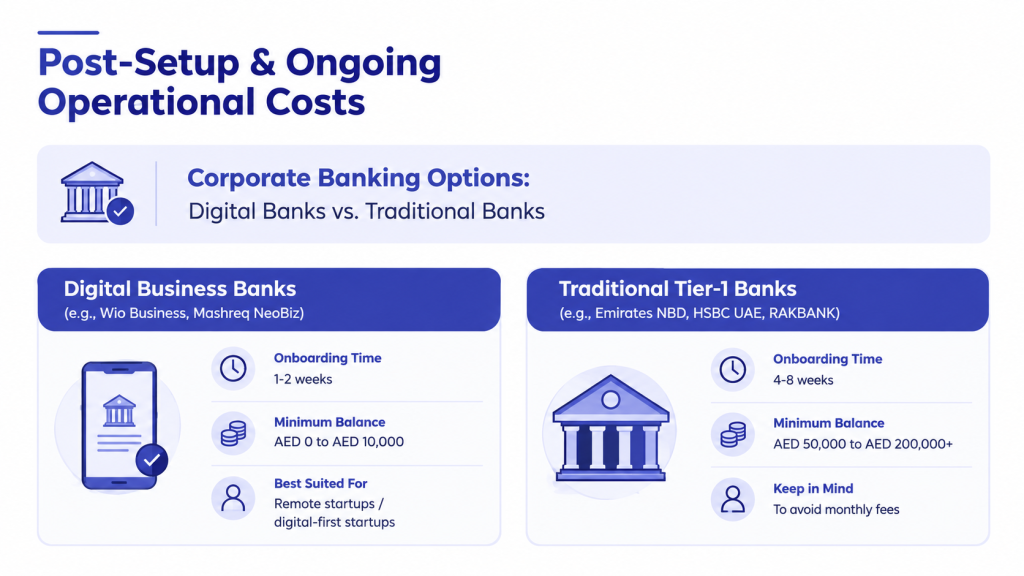
Corporate Banking Options: Digital Banks vs. Traditional Banks
For opening an account in any commercial bank in the UAE, there will be a requirement for Know Your Customer (KYC) procedures, documentation of business activity, and in-person signing.
UAE Corporate Tax Compliance: 9% Rate & Qualifying Free Zone Person Rules
Although businesses with a net profit less than AED 375,000 pay 0%, those earning above that amount are charged at 9%. In order to continue paying 0% tax for a Qualifying Free Zone Person (QFZP) operating in a Free Zone and earning from Qualifying Income (dealing with foreign entities/other Free Zone firms), they need to maintain proper substance.
Cross-Border Profit Repatriation & the Singapore-UAE Tax Treaty
The Double Taxation Avoidance Agreement (DTAA) between the two countries helps reduce the incidence of double taxation on cross-border earnings.
- Dividend Repatriation: The UAE levies no tax (0%) on outgoing dividends paid to companies based in Singapore.
- Singapore Tax Exemption: According to the provisions of Section 13(8) of the Singapore Income Tax Act, dividends earned abroad by a company registered in Singapore can be exempt from Singapore taxes if the maximum marginal tax rate in the source country is 15% or more when such income is earned or if certain tax exemptions apply.
Annual Trade License & Facility Renewal Budgets
Business setup is not a one-time expense. Budgeting for annual recurring costs ensures uninterrupted trading privileges:
Total Annual Recurring Budget = Trade License Renewal (70-85% of initial license fee) + Office / Ejari Lease Renewal + Establishment Card Renewal + Corporate Tax Filing & Audit Compliance Fees
How Arnifi Streamlines Dubai Expansion for Singapore Founders
Transparent Fixed Pricing: Packages from AED 5,500
By providing clear, itemized execution packages that start from AED 5,500, Arnifi eliminates the guesswork in your administrative tasks. You have access to flexible payment options such as ‘Pay in 4’ installment plans.
Smart Planning Tools: Arni Cost Calculator & Arni Organogram
- Arni Cost Calculator: Projects the total expenses for the first year on licenses, visas, and office set-up.
- Arni Organogram: Illustrates the organizational hierarchy, foreign ownership and shareholding structure, and cross-jurisdictional management system before legal submission.
End-to-End Execution: Remote Registration, Document Attestation & Visas
Whether it involves SAL legalisation in Singapore or local UAE Ministry approvals, Arnifi provides end-to-end remote incorporation services, allowing founders to start their business without disrupting their current domestic operations.
Arnifi HR: Hiring in the UAE Through an Employer of Record
Singapore companies seeking to measure market demand before incorporating a fully-fledged corporation can take advantage of Arnifi HR’s Employer of Record (EOR). This will allow you to bring in your UAE-based sales representatives or tech people without forming a local company right away.
Arnifi Business Setup Packages and Jurisdiction Cost Comparison
| Package Level / Structure | Starting Package Price | Ideal Target Audience & Key Inclusions |
| Ajman Free Zone Virtual Office | From AED 5,555 | Solo entrepreneurs, consultants, digital service providers. |
| SHAMS Standard Package | From AED 6,885 | Media, marketing agencies, low-cost baseline licensing. |
| RAKEZ Lite Promo | From AED 12,000 | E-commerce, trading startups needing flexible visa options. |
| Meydan Free Zone | From AED 12,520 | Premium location near Downtown Dubai, flexi-desk included. |
| IFZA License & Visa Package | From AED 12,900 | Growing SMBs seeking fast processing and visa allocations. |
| Dubai Mainland Standard Professional | From AED 23,005 | Onshore service companies targeting local UAE clients directly. |
| DIFC Prescribed SPV | From USD 5,000 | Holding structures, asset protection, intellectual property holding. |
| ADGM Tech Startup Package | From USD 11,230 | Venture-backed tech startups needing English Common Law frameworks. |
Step-by-Step Timeline: From Incorporation to Bank Account Opening
1. Choosing Activity & Structuring:Duration: 1–2 Days.
Choose the main activity and decide on whether you should operate in the Mainland or in a Free Zone. Also, arrange shareholder distribution.
2. Trade Name Approval & Initial Clearance:Duration: 2–3 Days.
Submit trade name proposals for checking and initial approval at DET or selected Free Zone.
3. Document Legalisation & Attestation:Duration: 5–10 Days.
Legalise Singapore corporate registry documents (ACRA) at a public notary, SAL, MFA, and the UAE Embassy of Singapore.
4. License Issuance & Visa Processing:Duration: 5–7 Days.
Submit formal government fees to get the trade license. Get the Establishment Card, entry permits, pass medical screening, and get the Emirates ID.
5. Opening a UAE Business Bank Account:Duration: 2–4 Weeks.
Present business plans, client agreements, personal bank statements, and attested corporate documents to the bank onboarding team.
Frequently Asked Questions
What is the cost of setting up a business in Dubai for a Singapore entrepreneur?
Minimum one-year cost may amount between AED 12,000-AED 25,000 (approximately S$4,170-S$8,690) for basic Free Zones, AED 40,000-AED 60,000 and more (approximately S$13,900-S$20,850 and more) for an LLC on Mainland, AED 155,000 and more (approximately S$53,860 and more) for dedicated financial zones such as DIFC.
Can a Singapore entrepreneur register a Dubai company remotely?
Yes. Initial business registration, trade name reservation, and issuance of a trade license can be conducted entirely online, not requiring presence in the UAE. Presence of an applicant will be required later for a medical examination for a residency visa and bank account signature verification.
Do Singaporeans need a UAE local sponsor for a Mainland LLC?
No. New amendments to UAE commercial law make it possible for 1,000+ commercial and industrial activities to be conducted without having a local Emirati partner who should possess 51% of the shares.
Is Dubai Mainland or a Free Zone cheaper for a Singapore business?
Free Zone companies are usually cheaper due to their lower virtual desk price and combined visa package. On the other hand, a mainland company incurs high rental expenses and can trade freely within the UAE local market.
How much does a Dubai business license cost?
A stand-alone business license within the Free Zone is going to cost approximately AED 5,500 to AED 12,500, while the cost of a Mainland commercial or professional license issued by DET will cost around AED 15,000 to AED 25,000.
How much do UAE residence visas cost for Singapore entrepreneurs?
Residency visas normally cost between AED 3,000 and AED 9,000 per individual, with fees for establishment card application, entry permit issuance, VIP health check-ups, Emirates ID issuance, and visa status changes included.
Do Singapore documents need to be attested for Dubai company formation?
Yes, the documents will be required to be attested if the parent company is based in Singapore and wants to form its subsidiary/branch company in the UAE.
Do Singapore documents require an apostille or UAE Embassy attestation?
Because the UAE is not part of the Hague Apostille Convention, documents require full consular attestation: Notary Public → SAL → Singapore MFA → UAE Embassy in Singapore → UAE MOFAIC
What corporate tax rate applies to a Dubai company?
UAE corporate tax rate for any corporation is 9% of the net profit after the taxable amount exceeds AED 375,000. Up to AED 375,000 of the net profit is taxable at 0%.
Can a Free Zone company get 0% UAE corporate tax?
Yes, Free Zone entities that fit in the category of ‘Qualifying Free Zone Person’ (QFZP) and earn money from the qualifying activities and cross-border trading can retain the 0% tax.
What documents are required to open a UAE corporate bank account?
Documents include the UAE Trade License, Share Certificates, MOA (Memorandum of Association), Ejari/Office Lease, copies of Passports & Emirates IDs of shareholders, six months of personal/corporate bank statements, and active customer contracts/invoices.
Can a Singapore company hire employees in Dubai without incorporating a UAE company?
Yes, the Singapore company can use the services of the Employer of Record (EOR), such as Arnifi HR, for hiring & paying, and managing UAE employees.
How does Arnifi HR help Singapore companies test the UAE market?
Arnifi HR becomes the official employer for purposes of issuing UAE work visas and payroll compliance, enabling founders to test market interest before investing in company formation.
How can Arnifi help reduce the complexity of setting up a Dubai company?
The help of Arnifi comes in the form of clear and affordable pricing, structured planning tools (Arni Cost Calculator and Organogram), full-fledged legalisation process management, and account management.
Final Takeaway
In order to get an accurate estimate of costs related to company formation in Dubai, one needs to consider additional aspects. Think about the cost of space you require for your office and number of residency visas, cost of Singapore document legalisation and banking, licensing and other recurring compliance fees. Using structured planning tools, EOR solutions across the border, and fixed-fee packages from Arnifi can greatly simplify your task.
References
- Dubai Department of Economy and Tourism (DET): https://www.ded.ae
- UAE Federal Tax Authority (FTA): https://tax.gov.ae
- Singapore Academy of Law (SAL) Legalisation: https://www.sal.sg
- UAE Ministry of Foreign Affairs (MOFAIC): https://www.mofa.gov.ae
- Inland Revenue Authority of Singapore (IRAS) – DTAA Guidelines: https://www.iras.gov.sg
Top UAE Packages


Related Articles


Top UAE Packages
Get in Touch