
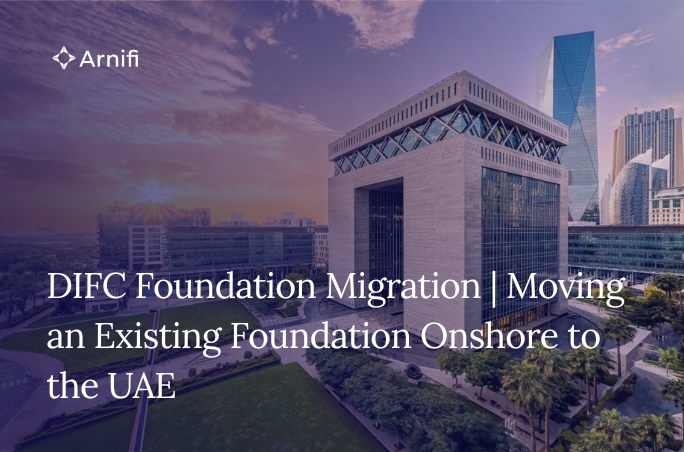
DIFC Foundation Migration | Moving an Existing Foundation Onshore to the UAE

Anushka
Content Writer
Anushka Basu is a business content writer specialised in global business market insights. She aims to simplify complex regulatory, financial, and business concepts into… Read more


A DIFC Foundation migration can help families move an existing foundation into a UAE-based common law environment without rebuilding the entire wealth structure again. For founders and family offices, this is often useful when assets, family members, advisers, banks or operating companies are now closer to the UAE than the original foundation jurisdiction.
The aim is not only relocation; it is continuity. A well-planned migration should preserve governance logic, asset ownership, succession intent and compliance records while giving the structure a stronger UAE anchor.
Table of contents
What DIFC Foundation Migration Means
DIFC allows a party to transfer an existing foundation into the centre as a Continued Foundation. The DIFC Registrar also lists three foundation routes under the Foundations Law: a new Foundation, a Recognised Foundation as a branch of a pre-existing foundation and a Continued Foundation where an existing foundation is transferred into DIFC.
This distinction matters. A Recognised Foundation is closer to a registered branch. A Continued Foundation is closer to a foundation transfer in, where the structure moves its legal seat into DIFC and continues under DIFC law.
The DIFC Registrar explains that once a foundation transfer is completed, it has the effect of establishing the transferred foundation in DIFC as if it had been incorporated under the relevant DIFC law.
Why Families Consider Moving Onshore To The UAE
Many family structures were first set up offshore because the family needed privacy, succession continuity and asset protection. Over time, the family’s real centre of life may shift. Children may move to Dubai. Operating businesses may expand in the UAE. Banks, advisers and investment activity may also become UAE-focused.
At that point, an older offshore foundation can start feeling distant. The family may still like the foundation model, but it may want the structure to sit closer to its main wealth decisions.
This is where DIFC redomicile planning becomes practical. The family is not simply creating a new UAE entity. It is reviewing if the existing foundation can move into a DIFC framework while keeping governance continuity.
Quick Migration View
| Area | What families should check |
| Current foundation law | Does the existing jurisdiction allow outward continuation or migration? |
| DIFC route | Should it be a Continued Foundation or a Recognised Foundation? |
| Governance | Do charter, by-laws, council roles and guardian roles need revision? |
| Assets | Can ownership transfer or legal continuity happen without tax or banking issues? |
| Compliance | Are AML, UBO, accounting and records ready for DIFC review? |
| Banking | Will banks accept continuity or ask for new onboarding documents? |
| Timeline | Depends on home jurisdiction approval, DIFC filing and adviser coordination |
When a Migration May Make Sense
A foundation migration is usually worth reviewing when the existing structure no longer matches the family’s operating reality. For example, a Panama, Liechtenstein or other foreign foundation may still work legally, but the family may now want a UAE-facing structure for better alignment with residency, banking or regional assets.
A migration may be useful when:
- The family wealth base has shifted toward the UAE or wider GCC.
- The foundation owns shares in UAE businesses or regional holding companies.
- Family members want meetings, governance and advisers closer to Dubai.
- Banks prefer a UAE-recognised structure with clearer local administration.
- The family wants continuity instead of terminating the old foundation and starting again.
What The Legal Review Should Cover
The first question is not, “Can DIFC accept the foundation?” The first question is, “Can the original jurisdiction release it cleanly?” Some jurisdictions allow outward continuation. Others may require liquidation, transfer of assets or court steps.
The legal review should cover the following:
- Current charter terms
- Founder powers
- Council approvals
- Guardian consent
- Asset ownership
- Creditor issues
- Beneficiary rights
- Tax impact
If the current documents do not allow continuation, amendments may be needed before any DIFC filing starts.
DIFC’s 2024 amendments also reinforce the importance of proper AML, UBO and accounting checks in foundation administration. The amendment law allows arrangements where a Registered Agent may help lodge documents and certify adherence to AML Requirements, UBO Regulations and accounting record requirements.
That means migration planning should not be treated as a simple formality. The compliance file must be strong before the application moves forward.
Governance Continuity After Migration
The best foundation continuation is one where the family does not lose the original purpose of the structure. The charter and by-laws should be reviewed so they still reflect founder intent, qualified recipients, council powers, guardian roles and asset use.
Updated provisions cover the continuation of a company as a DIFC Foundation and the preservation of rights and liabilities in such continuations. When a company is continued as a Foundation in DIFC, its property becomes property of the Foundation, obligations continue and existing proceedings or liabilities are unaffected.
While this specific provision deals with company-to-foundation continuation, it shows the broader policy value of continuity. For family migration planning, that principle is important because wealth structures should not create gaps in ownership, liabilities or governance.
Compliance and Records To Prepare
Before filing, families should collect a clean document pack. This reduces delay and helps banks, registered agents and advisers understand the structure.
Prepare these records early:
- Current foundation charter, by-laws and registration certificate.
- Council, guardian and founder resolutions approving continuation.
- Asset register, ownership chart and valuation support.
- UBO, source-of-wealth and source-of-funds documents.
- Tax advice covering the old jurisdiction, DIFC and connected family countries.
- Banking letters, account status and service provider confirmations.
Foundation-related failures can attract fines, including failure to notify the Registrar of changes to the charter and failure to notify changes to a guardian. This makes post-migration record discipline important, not optional.
Conclusion
Moving an existing foundation onshore to the UAE can be a strong step when the family’s wealth, governance and advisory base now sit closer to Dubai.
At Arnifi, we help founders, families and advisers compare UAE foundation routes with practical setup clarity. We support entity formation, documentation coordination, compliance planning and banking preparation.
For DIFC Foundation migration, we help organise the early facts so legal, tax and registry advisers can review the route with fewer gaps and better context.
FAQs:
1. What is a Continued Foundation in DIFC?
A Continued Foundation is an existing foundation transferred into DIFC under the Foundations Law. Once completed, it continues as a DIFC foundation under the relevant DIFC framework.
2. Is a Recognised Foundation the same as migration?
No. A Recognised Foundation is closer to a branch or registered presence of a foreign foundation. A Continued Foundation involves transferring the existing foundation into DIFC.
3. Why migrate foundation to UAE?
Families may migrate a foundation to UAE when residency, banking, operating businesses, advisers or governance meetings are now UAE-centred. DIFC can give the structure a clearer local anchor.
4. Does migration avoid tax review?
No. Migration does not remove tax duties. Families should review tax impact in the original jurisdiction, UAE and every country linked to founders, qualified recipients, assets or income.
Top UAE Packages
Related Articles
Top UAE Packages
Get in Touch
