
Navigating the BVI Approved Manager AUM Cap: Growth, Compliance, and Transition Planning

Zahira Shaik
SEO Content Writer
Zahira Shaik is an SEO Content Writer and Published Author specializing in research-based content. She excels at analyzing market trends, regulations, and industry developments… Read more

Tulika Saxena
AVP, Sales & Marketing | IIM Nagpur
Tulika Saxena specializes in business finance, sales strategy, and market positioning. Leads growth and partnerships, ensuring seamless business setup experiences and client success across… Read more


Key Fact
The BVI Approved Manager regime limits open-ended funds to US$400 million and closed-ended funds to US$1 billion. Failure to adhere to these limits subjects the manager to a rigorous 3-month grace period during which the manager must either decrease the AUM or apply for a full SIBA licence.
Table of contents
- Introduction
- What Is the BVI Approved Manager Regime?
- What Are the BVI Approved Manager AUM Limits?
- Why Do Managers Accidentally Exceed the Limits?
- How Should Managers Monitor AUM Before Reaching the Cap?
- What Happens If the AUM Cap Is Exceeded?
- Why Is Transition Planning So Important?
- How Do Beneficial Ownership Requirements Interact With Rapid Fund Growth?
- What Are the Most Common Approved Manager Pitfalls?
- Why Are Regulators Focusing More on Approved Managers?
- How Can Managers Reduce Compliance Risks?
- How Can Arnifi Help With Investment Management Compliance?
- Frequently Asked Questions (FAQs)
- Conclusion
- References
Introduction
The BVI Approved Manager regime provides a simple and quick regulatory framework for asset management firms that are just starting out. The problem is that rapid raising of capital, market performance gains, and having multiple funds will cause you to reach the statutory cap very quickly, which is $400 million for open-ended funds and $1 billion for closed-ended funds.
In this guide, we look at things beyond the basics of fund formation and get into what happens when you grow and how to deal with aggregation, beneficial ownership, and the transition period.
What Is the BVI Approved Manager Regime?
Meaning and Regulatory Framework
BVI Approved Manager regime was introduced as part of the BVI Securities and Investment Business Act (SIBA) as an amendment. The regime offers a cost-efficient way of obtaining regulation for investment managers who don’t have to go through the lengthy licensing procedure before the launch of their business and may start operating right after applying to the FSC of the BVI.
Who Can Use the Regime?
The regime accommodates managers who manage funds with various structural and investment strategies, such as:
- Open-ended funds (like hedge funds and liquid trading strategies)
- Closed-ended funds (like private equity, venture capital, and real estate funds)
- Feeder funds, parallel funds, and co-investment structures
- Family office investment vehicles and private funds
Why Managers Choose the Regime
- Speed to Market: Shorter approval periods allow managers to trade and earn income sooner.
- Proportional Regulatory Burden: Lower administration, reporting, and capital adequacy obligations than a SIBA license.
- Scalability: Enables new managers to prove themselves before being fully supervised by institutions.
What Are the BVI Approved Manager AUM Limits?
The regime establishes strict statutory caps on the aggregate value of assets under management:
| Fund Structure Type | Maximum Aggregate AUM Cap |
| Open-Ended Funds | US$400 Million |
| Closed-Ended Funds | US$1 Billion |
Monitoring Aggregate AUM vs. Individual Funds
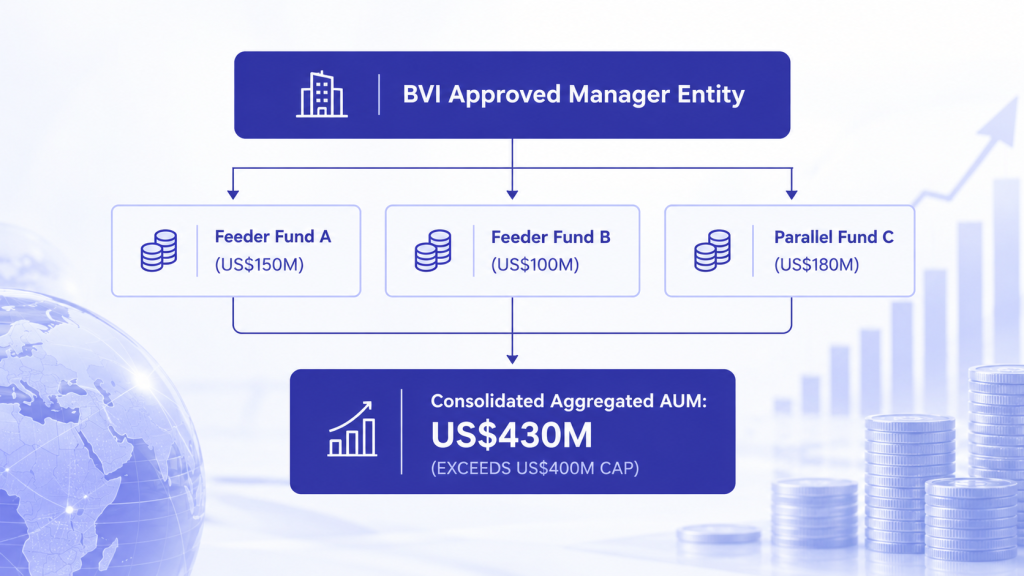
An important stipulation under the BVI rules is that such caps should be applied to the overall AUM of all relevant managed vehicles and not on a per-fund basis.
It gets complicated for the manager to calculate aggregate AUM in cases where there is more than one parallel managed vehicle or master and feeder arrangements, as well as co-investment vehicles.
Why Do Managers Accidentally Exceed the Limits?
Exceeding AUMs is not often a conscious decision but an outcome of fast-paced growth outpacing compliance. The common reasons for this are:
1. Rapid Fundraising
The arrival of big institutional investors or the development of additional funds can increase total commitments practically instantly.
2. Passive Market Appreciation
In a market upturn, asset value can grow significantly. Even if the manager does not raise additional funds, he may violate regulations because of the portfolio’s strong performance.
3. Complex Multi-Fund Structures
The lack of proper consolidation of parallel funds, master-feeder funds, or co-investments can result in an understatement of the total AUM.
4. Periodic vs. Continuous Monitoring
The use of periodic financial statements and not daily reports makes the manager miss the AUM increase and violate the regulations after the fact.
5. The Shared Operational Infrastructure Trap
Although US$400M funds and US$1B funds have different statutory caps, the management team often operates these two fund structures using the same operational, compliance, and technological resources. Viewing the two structures in isolation may prevent the management from understanding the operational and compliance pressures the firm faces.
How Should Managers Monitor AUM Before Reaching the Cap?
AUM monitoring ensures that no compliance emergencies arise and provides management with sufficient time to prepare for changes in licensing.
- Maintain Regular Consolidated Reviews: Calculate consolidated AUM on a monthly or quarterly basis, taking into account changes in valuations and net subscriptions.
- Audit Complex Fund Structures: Occasionally map all the feeder funds, parallel funds, and co-investment vehicles to ensure consolidated monitoring.
- Factor In Forward-Looking Growth: Take into consideration soft commitments, future fundraising closings, future pipeline transactions, and market growth expectations in evaluating proximity to caps.
- Establish Internal Warning Thresholds: Create internal alerts (at 75% and 90% of statutory caps) to raise the issue of licensing with the board and compliance advisers well in advance of statutory thresholds.
What Happens If the AUM Cap Is Exceeded?
Exceeding an AUM cap activates specific regulatory obligations under BVI law.
The Strict 3-Month Grace Period
After any breach of the AUM cap, the manager is required to inform the BVI FSC right away. The scheme gives a strict 3-month grace period from the date of breach to sort out the problem with one of the following two options:
- Option 1: Reduce Aggregate AUM: Work on reducing the total AUM by taking appropriate steps to ensure that it falls under the allowed cap.
- Option 2: Apply for a Full SIBA Licence: Make an official application to have the full SIBA Investment Business Licence.
Risks of Inaction
Failure to take action within 3 months from the breach will lead to automatic non-compliance with the regulatory requirement, which could invite action by the FSC, including administrative penalties or even an order not to manage BVI fund vehicles anymore.
Operational Note: The 3-month grace period is the deadline to take remedial action or file an application, not the period to think about your licence strategy.
Why Is Transition Planning So Important?
The move from being an Approved Manager to becoming a fully licensed SIBA Investment Business Licence is indeed a huge step forward in terms of supervision and operational complexities.
Enhanced Regulatory Requirements
To become a fully licensed investment business firm, the following must be set up, among others:
- Expanded Governance: More independent directors, governance processes, and risk management committees.
- Enhanced Compliance Infrastructure: Internal compliance officers, anti-money laundering and counter-financing of terrorism measures, and a transaction monitoring system.
- Capital and Financial Adequacy: Maintaining capital adequacy, financial statements annually audited, and other regulatory reporting.
- Operational Controls: Preparedness plans in case of disaster, cybersecurity framework, and internal supervision policies.
Preserving Institutional Investor Confidence
The institutional investor will conduct extensive operational due diligence (ODD) on the business. Therefore, if this change happens at the very end of the grace period allowed by statute, it may cast doubt over the operation of the company.
How Do Beneficial Ownership Requirements Interact With Rapid Fund Growth?
As fund management businesses scale and raise capital, ownership and control structures frequently evolve. In the BVI, beneficial ownership compliance is closely linked to broader corporate governance.
- Beneficial Ownership Filings: The BVI laws require companies (for example, the Beneficial Ownership Secure Search System Act) to have accurate beneficial ownership filings for ultimate beneficial owners who own or control a significant interest.
- Growth-Driven Structural Changes: Fundraising, GP holding changes, or introduction of a cornerstone investor might trigger such changes to ownership and control that need to be reported.
- 2025–2026 Compliance Focus: Beneficial ownership and international AML/CFT requirements are high on the BVI regulator’s agenda.
Practical Takeaway: As you near the AUM threshold, it is important to check your beneficial ownership registers and licensing.
What Are the Most Common Approved Manager Pitfalls?
- Monitoring AUM Only Periodically: Relying on annual audits instead of monthly valuation updates.
- Ignoring Market Appreciation: Assuming caps can only be breached through active, new capital raises.
- Miscalculating Aggregated AUM: Omitting parallel funds, co-investment vehicles, or feeder structures from total calculations.
- Treating Fund Structures in Isolation: Failing to realize that open-ended and closed-ended funds share operational and compliance risks.
- Waiting Until the Breach Occurs: Deferring licensing preparation until the strict three-month grace period has already started.
- Neglecting Beneficial Ownership Updates: Forgetting to update UBO filings during major capital expansion or corporate reorganizations.
Why Are Regulators Focusing More on Approved Managers?
Increasing Regulatory Scrutiny
The BVI FSC is very active in monitoring the investment management industry to ensure that the standards in place in the BVI comply with international requirements from FATF, OECD, and EU regulations. The regulators are concerned about those managers who exceed the light-touch regulation and transition into a full-scope regulatory regime.
Scale of the Approved Manager Market
With more than 1,300 Approved Managers in the BVI, there is an international obligation for the regulator to enforce strict compliance with statutory limits and governance requirements.
What Regulators Expect
- Continual and accurate monitoring of AUM and reporting of any breaches.
- Evidence of effective governance, oversight, and substance.
- Upgrading to an SIBA licence when the business grows.
How Can Managers Reduce Compliance Risks?
To manage regulatory risks while scaling, investment managers should follow a proactive compliance roadmap:
- Track Consolidated AUM Proactively: Conduct monthly valuation meetings covering all the managed entities while considering subscriptions, redemptions, and performances of the markets.
- Set Internal Warning Triggers: Set up internal alert levels at 75% and 90% of statutory caps to give management ample time to consider licensing arrangements.
- Review Fund Structures & Beneficial Ownership: Periodic mapping of all associated entities, feeder funds, and equity structures to ensure proper filing of AUMs and UBOs.
- Prepare for Full Licensing Early: Prepare the compliance manuals, obtain independent directors, and gather SIBA license application documents six months before the expected violation.
- Engage Offshore Compliance Advisors: Seek advice from BVI lawyers and regulators regarding compliance requirements and application deadlines.
How Can Arnifi Help With Investment Management Compliance?
Arnifi offers complete offshore regulatory advice, structuring, and compliance management services in major international locations, such as the British Virgin Islands.
- Regulatory Structuring Support: Providing assistance in selecting, establishing, and administering compliant offshore structures for asset managers that are growing and expanding.
- Governance & Operational Reviews: Carrying out diagnostics of internal controls, AML/CFT frameworks, and operational governance to identify compliance deficiencies.
- Full SIBA Licensing Coordination: Providing services for the transition from the status of an Approved Manager to a SIBA Investment Business License.
- Ongoing BVI Compliance Support: Offering continuous compliance services for beneficial ownership, AUM, appointment of directors, and statutory compliance.
Frequently Asked Questions (FAQs)
What is the BVI Approved Manager regime?
The BVI Approved Manager is a regime introduced under the Securities and Investment Business Act (SIBA) whereby eligible investment managers can manage investment funds without the need for an investment business license.
What is the AUM limit for a BVI Approved Manager?
The statutory AUM caps are US$400 million for open-ended funds and US$1billion for closed-ended funds, measured on a combined aggregate basis in all managed funds.
What happens if a BVI Approved Manager exceeds the AUM threshold?
The manager is required to inform the BVI FSC. Exceeding the AUM cap activates a three-month strict grace period during which time the manager must bring down total AUM to the level below the cap limit or obtain a SIBA license.
How long is the BVI Approved Manager grace period?
There is a strict three-month grace period from the day on which the AUM cap is exceeded.
Can a BVI Approved Manager manage both open-ended and closed-ended funds?
Yes. The Approved Manager can manage open-ended and closed-ended funds together provided that both categories do not exceed their respective AUM statutory caps.
How is AUM calculated for a BVI Approved Manager?
AUM shall be determined on a consolidated basis taking into consideration all the funds, feeders and parallel structures controlled by the entity on a current market valuation basis.
Do feeder funds count toward the BVI Approved Manager AUM limit?
Yes, feeder funds and any parallel structures should be considered for AUM requirements to prevent any duplication and understatement of total managed assets.
Can market appreciation cause an Approved Manager to exceed its AUM cap?
Yes, it may result in exceeding of AUM limits without raising any additional capital from the investors.
What happens during the three-month BVI Approved Manager transition period?
During this period, the entity will have to restructure itself or prepare an application for a full SIBA Investment Business Licence to the BVI FSC.
When should a BVI Approved Manager start preparing for a full SIBA licence?
They should start planning 6 to 12 months before hitting the statutory thresholds or as soon as they receive an internal warning signal that their assets exceed the thresholds (75% or 90%, etc.).
What are the beneficial ownership requirements for BVI Approved Managers?
They are obliged to disclose and maintain updated information about the ultimate beneficial owners (UBOs) who have substantial interest or control according to the BVI beneficial ownership rules.
How does rapid fundraising affect BVI beneficial ownership compliance?
Fast fundraising may change percentage interests, bring new cornerstone investors, or change control of the board, which requires updating of beneficial ownership filing accordingly.
What are the common compliance mistakes made by BVI Approved Managers?
Typical mistakes include monitoring AUM solely during annual reporting, ignoring the effect of market gains on the calculation, missing consolidation of feeder funds, and waiting until the breach happens to start getting a license.
Why is ongoing AUM monitoring important for BVI Approved Managers?
Continuous monitoring will help detect any possibility of a limits breach in advance, provide the company with enough time to prepare for licensing, and avoid any regulatory enforcement due to non-compliance.
How can Arnifi help with BVI investment management compliance?
Arnifi can offer the following services: AUM monitoring strategies, governance review, beneficial ownership maintenance, and the SIBA licensing process.
Conclusion
The BVI Approved Manager Regime provides a great balance in terms of speed, cost-effectiveness, and minimum regulatory burden. Nevertheless, the statutory limits on AUM are US$400 million for open-ended funds and US$1 billion for closed-ended funds. Rapidly growing assets can be caused by successful performance and fundraising or a complicated structure of multi-funds.
Managers have to think of the transition process from the very first day, not from the beginning of the grace period. Through AUM tracking, setting the early warning levels, beneficial ownership maintenance, and engaging compliance consultants, growing managers can guarantee their institutional investors’ trust and a smooth transition to SIBA licensing.
References
- BVI Financial Services Commission (FSC) – Official regulatory authority governing SIBA and BVI financial services.
- BVI Investment Funds Association (BVI IFA) – Industry association for offshore funds and asset managers in the BVI.
- BVI Official Gazette – Official legal updates and legislative amendments for BVI corporate law.
Top UAE Packages
Related Articles



Top UAE Packages
Get in Touch
