
BVI AML/CFT Compliance Guide for Funds & Approved Managers 2026

Zahira Shaik
SEO Content Writer
Zahira Shaik is an SEO Content Writer and Published Author specializing in research-based content. She excels at analyzing market trends, regulations, and industry developments… Read more

Tulika Saxena
AVP, Sales & Marketing | IIM Nagpur
Tulika Saxena specializes in business finance, sales strategy, and market positioning. Leads growth and partnerships, ensuring seamless business setup experiences and client success across… Read more


Key Fact
Regulated BVI entities are required to file the Annual AML Return before March 31 annually in order to prove compliance with FATF standards, MLRO supervision, and risk-based controls that are managed by the Financial Services Commission.
Table of contents
- Introduction
- What Is the BVI AML/CFT Framework?
- Why Is AML/CFT Compliance Important for BVI Funds and Approved Managers?
- What Are the BVI MLRO Appointment Requirements?
- Why Is Customer Due Diligence (CDD) Important?
- What Is the Annual AML Return Requirement in the BVI?
- How Should BVI Funds Prepare for the FATF Effectiveness Review?
- How Can BVI Funds Prepare for VASP Travel Rule and Sanctions Screening Requirements?
- How Can Technology Support BVI AML/CFT Compliance?
- How Can Arnifi Help With BVI AML/CFT Compliance?
- Conclusion
- Frequently Asked Questions
- References
Introduction
AML and CFT compliance in the British Virgin Islands (BVI) is no longer about ticking boxes on certain requirements. The ability to have robust compliance frameworks is critical for investment funds and approved managers since it will help them secure operational integrity, access to global markets, and regulatory compliance.
The FSC is always up-to-date in relation to the FATF Recommendations and its supervisory standards. In order to be proactive in view of expanded reporting requirements and continuous compliance reviews, the regulated entities need a practical roadmap.
What Is the BVI AML/CFT Framework?
The BVI AML/CFT system offers a robust set of regulations that serve the purpose of detecting, preventing, and reporting financial crime in regulated offshore firms.
Key Legal Drivers
- Anti-Money Laundering Regulations, BVI: This regulation outlines all the statutory provisions regarding customer risk assessment and compliance record-keeping.
- Anti-Money Laundering and Terrorist Financing Code of Practice: It describes all the practical procedures for due diligence, internal controls, and suspicious transaction reporting.
- FSC Guidance Notices: Provide continuous supervision over emerging risks, sanctions compliance, and statutory submissions.
Risk-Based Approach
Each regulated firm is to introduce compliance routines based on its individual risk profile:
- Identify Financial Crime Risks: This involves an evaluation of investment profile, transaction types, geographic risks, and delivery mechanisms.
- Establish Appropriate Internal Controls: Development of an appropriate set of compliance policies and procedures.
- Monitor and Update Systems: Ongoing monitoring of internal controls for evolving risks and regulatory changes.
Who Does It Apply To?
- Investment Funds (Public, Private, Professional, Incubator, Approved)
- Approved Managers
- Investment Businesses
- Trust Companies & Corporate Service Providers
Ongoing Regulatory Adaptation
As international standards push for financial transparency, BVI financial institutions need to update their internal policies. They must also train compliance staff. Adapt to new guidance from the BVI FSC.
Why Is AML/CFT Compliance Important for BVI Funds and Approved Managers?
Cross-Border Risk Exposure
Offshore fund structures often involve cross-border movements. These include:
- Foreign Investor Pools: Capital contributions originating across diverse international jurisdictions.
- Cross-Border Transactions: Investments made in currencies and across various global markets.
- Multi-Layered Structures: Layers of entities, ultimate beneficial owners, and institutional partners that make operations harder to track.
Governance Requirements
AML/CFT compliance is now a part of good corporate governance. Senior leaders and fund directors must stay actively involved. They must oversee controls, compliance checks, and operational protections.
Consequences of Compliance Deficiencies
Failing to maintain effective controls exposes entities to severe consequences:
- Regulatory Enforcement: The BVI FSC may issue public warnings, limit licenses, or cancel them altogether.
- Financial Penalties: Fines levied by the BVI FSC for non-compliance.
- Operational Disruption: Banks may freeze accounts, delay payments, or stop working with the entity.
- Reputational Damage: Trust from investors can be lost. The reputation of the institution may never recover.
What Are the BVI MLRO Appointment Requirements?
Required Compliance Roles
BVI regulations require companies to assign compliance officers:
- Money Laundering Reporting Officer (MLRO): This officer is the main person responsible for receiving, looking into, and sending internal suspicious activity reports (SARs) to the BVI Financial Investigation Agency (FIA).
- Deputy MLRO: This person acts as the backup when the MLRO is not available to make sure that the process of sending reports continues without any breaks.
- Compliance Officer: This person makes sure that the company follows all the rules and laws related to money laundering and counter terrorism financing every day. This person reports directly to the Board of Directors.
Qualifications & Responsibilities
Appointed compliance officers must possess:
- Relevant industry experience and proven compliance competencies.
- Sufficient authority and operational independence within the organization.
- Direct access to all customer records, transaction logs, and key personnel.
- Expertise in filing timely suspicious activity reports and managing regulatory inquiries.
Can AML/CFT Functions Be Outsourced?
Yes. BVI entities can outsource tasks such as investor background screening, document collection, and software monitoring to specialized third‑party providers. However, the regulated entity and its board of directors remain fully responsible for accountability.
Why Is Customer Due Diligence (CDD) Important?
Investor and Counterparty Identification
CDD ensures that entities verify every legal entity involved in business relationships before completing capital subscriptions or executing transactions.
- Identify Investors: Collect basic corporate and identity documents.
- Verify Identities: Cross-check government-issued identification and official registry filings.
- Identify Beneficial Owners: Map ownership structures down to individual ultimate beneficial owners who hold required threshold percentages.
- Verify Counterparties: Ensure third-party brokers, custodians, and financial intermediaries meet equivalent regulatory standards.
Ongoing Monitoring
Compliance extends beyond onboarding. Regulated entities must:
- Monitor subscription and redemption activity for patterns.
- Keep investor risk profiles and identity documents current through reviews.
- Escalate and record unexpected transaction deviations.
When Is Enhanced Due Diligence (EDD) Required?
Enhanced Due Diligence (EDD) is required when there are higher-risk situations. These include:
- Politically Exposed Persons (PEPs): This includes individuals in high public offices, their family members, and people closely associated with them.
- High-Risk Jurisdictions: When dealing with counterparties located in countries that are non-cooperative or listed on grey lists by international authorities.
- Complex Ownership Structures: When there are multi-layered offshore entities where the true economic purpose is unclear or hard to verify.
Record-Keeping Requirements
Companies are required to keep comprehensive compliance records, CDD/EDD files, transaction logs, and internal review notes for at least 5 years, and these records must be easily accessible during BVI FSC regulatory inspections.
What Is the Annual AML Return Requirement in the BVI?
What Is the Annual AML Return?
The Annual AML Return is a compulsory compliance form which BVI-regulated companies are required to submit, outlining the operational controls, risk assessments, governance arrangements, staff training schemes, and SAR figures for the previous year.
Annual Filing Deadline
The Annual AML Return is generally due on or before March 31 each year.
| Filing Component | Key Focus Area |
| AML Systems | Overview of risk assessments and software tools used. |
| Internal Controls | Policies for CDD, EDD, and sanctions screening. |
| Suspicious Activity Reports | Metrics on internal SARs logged and external SARs escalated to the FIA. |
| Staff Training | Verification of annual training provided to key operational personnel. |
| Governance | Board-approved compliance reports and MLRO oversight logs. |
How Does the FSC Use Annual AML Returns?
- Assesses compliance trends in the financial services sector.
- It identifies systemic risks and operational deficiencies.
- Sets the priority targets for regulatory audits and inspections.
What Happens With Late or Inaccurate Returns?
If returns are submitted late or with inaccuracies, the BVI FSC will impose formal administrative fines, serve enforcement notices, and increase the level of regulatory scrutiny.
How Should BVI Funds Prepare for the FATF Effectiveness Review?
Forward-Looking Compliance Preparation
To maintain compliance during ongoing FATF effectiveness reviews, funds and approved managers should:
- Carry out their own testing of the current internal controls.
- Set international transparency standards in line with risk management frameworks.
- Ensure that comprehensive audit trails are maintained for all decisions relating to compliance and all reviews by the board.
Preparing for Post-Grey-List Operational Friction
To minimize operational disruptions from international counterparties:
- Notify the investors regarding the updates to the onboarding checklists and internal screening procedures.
- Make sure that the disclosures regarding the Ultimate Beneficial Owners are completely documented and are current.
- Store the compliance files in a central location so that they can be accessed quickly when counterparty audits are taking place.
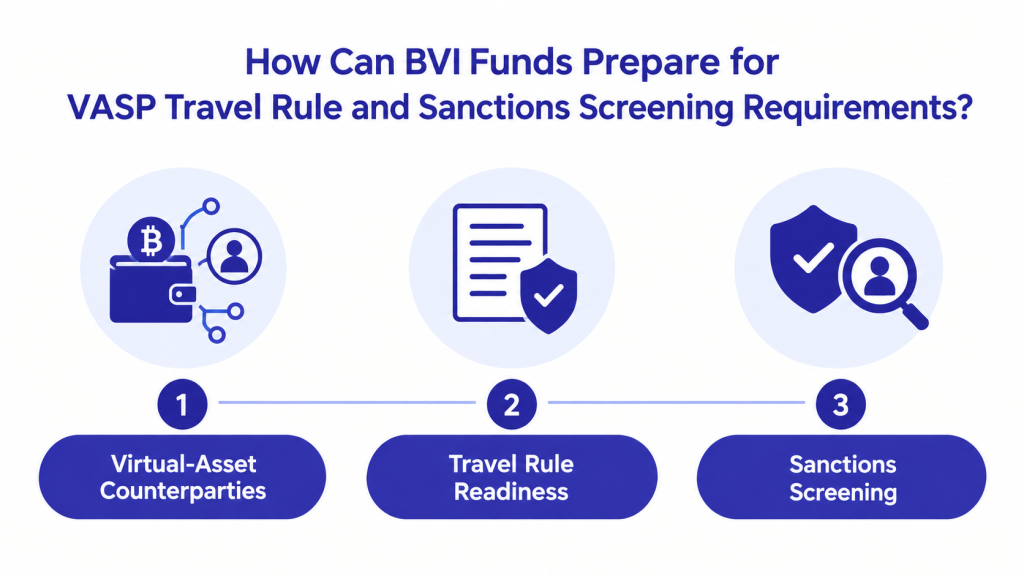
How Can BVI Funds Prepare for VASP Travel Rule and Sanctions Screening Requirements?
Virtual-Asset Counterparties
As traditional investment funds interact with digital asset structures or virtual-asset service providers (VASPs), managers must evaluate potential crypto risks:
- Set up specific AML/CFT policies relating to interactions involving digital assets.
- Look at the counterparty wallet addresses and the source-of-funds documentation.
Travel Rule Readiness
Under global FATF guidelines, financial transfers involving virtual assets require identifying information sharing across counterparties:
- Set up protocols for sending and receiving the details of the originator and the beneficiary.
- Keep full records of the transfers of virtual assets.
Sanctions Screening
Entities that are subject to regulation must check investors, managers, and counterparties against global sanctions lists (such as those of the UN, the UK, the US, and the EU). Sanctions checks should be carried out at the time of onboarding and must be automatically initiated when the lists are updated.
How Can Technology Support BVI AML/CFT Compliance?
Arni AML Checker
An automated compliance solution to ease background verification, identify high-risk counterparties, and ensure ongoing monitoring checks.
Organogram
Visual mapping module to make governance structures clearer, record MLRO and Compliance Officer reporting lines, and show compliance oversight for regulators.
Compliance Dashboard
A centralized management console for monitoring recurring regulatory obligations, managing document collections, tracking ongoing CDD schedules, and assembling data for the Annual AML Return.
How Can Arnifi Help With BVI AML/CFT Compliance?
Arnifi provides specialized compliance solutions for BVI investment funds and approved managers:
- AML/CFT Reviews: Comprehensive reviews of existing compliance manuals, risk models, and operational controls.
- Governance Framework Setup: Advice on how to organize compliant board reporting routines and appointment of qualified MLRO personnel.
- Annual Filing Coordination: Structured support to gather data, perform validation procedures, and file the Annual AML Return on time.
- Practical Offshore Support: Hands-on assistance to streamline onboarding, cut down on administration, and stay compliant with regulations.
Conclusion
BVI investment funds and approved managers must adopt and implement a proactive, structured compliance approach to remain in good standing. Regulated entities must maintain strong risk-based frameworks, appoint qualified MLRO personnel, conduct ongoing CDD and EDD, and file mandatory Annual AML Returns by the March 31 deadline. Fund managers can meet evolving FATF expectations and mitigate operational risk by leveraging modern software tools and working with experienced offshore compliance partners.
Frequently Asked Questions
What is AML/CFT compliance in the BVI?
AML/CFT compliance in the BVI refers to the legal policies, internal controls, and reporting systems that regulated financial entities are required to have in place to combat money laundering, financial crime, and terrorist financing under BVI law.
What laws govern AML/CFT compliance in the BVI?
The framework is largely governed by the BVI Anti-Money Laundering Regulations, the Anti-Money Laundering and Terrorist Financing Code of Practice, and official guidance issued by the BVI Financial Services Commission (FSC).
Who needs to appoint an MLRO in the BVI?
All regulated financial entities, including investment funds, approved managers, investment businesses, and trust entities, must appoint a Money Laundering Reporting Officer (MLRO) to comply with the AML regime.
What does a BVI MLRO do?
A BVI MLRO oversees compliance policies, receives and investigates internal suspicious transaction reports, maintains compliance audit logs, and files official Suspicious Activity Reports (SARs) with the BVI Financial Investigation Agency (FIA).
Is CDD mandatory for BVI investment funds?
Yes. Customer Due Diligence (CDD) is a requirement under BVI AML regulations. Funds must verify the identity of investors, counterparties, and ultimate beneficial owners prior to completing onboarding.
When is Enhanced Due Diligence required in the BVI?
Enhanced Due Diligence (EDD) is required whenever dealing with higher-risk profiles, Politically Exposed Persons (PEPs), non-cooperative jurisdictions, or complex corporate ownership structures.
When is the BVI Annual AML Return due?
The BVI Annual AML Return is usually due on or before March 31 each year.
What happens if a BVI Annual AML Return is filed late?
If a BVI Annual AML Return is filed late, the BVI Annual AML Return will face penalties, supervisory enforcement notices, and increased regulatory monitoring from the BVI FSC.
Do BVI funds need sanctions screening?
Yes. BVI funds must screen investors, key officers, and counterparties against sanctions lists, such as those from the UN, UK, US, and EU, to comply with targeted financial sanctions frameworks.
What is the Travel Rule for virtual-asset transactions?
The Travel Rule, for virtual-asset transactions, requires virtual-asset service providers and regulated entities to gather, hold, and share originator and beneficiary identity details during transaction processing.
Can BVI AML/CFT compliance functions be outsourced?
Yes, some of the compliance tasks can be given to companies that are experts in this area.. The legal responsibility is still with the company that is required to follow the rules and its leaders.
How can technology support BVI AML/CFT compliance?
Technology makes compliance easier by checking investors, keeping track of changes to the list of people or groups that are not allowed to do business, making the process of collecting customer information the same every time, keeping records of reports made by the money laundering reporting officer, and bringing all the data together for the yearly AML return.
References
- BVI Financial Services Commission (FSC)
- BVI Financial Investigation Agency (FIA)
- Financial Action Task Force (FATF)
Top UAE Packages
Related Articles


BVI vs Cayman Company Formation (2026) | Entity Ty...
Key Fact Both jurisdictions provide English common law frameworks for international business. BVI offers cost-efficient corporate management for private asset...
Top UAE Packages
Get in Touch
