
BVI Economic Substance Compliance Guide: Requirements, Out-of-Scope Rules & Annual Reporting

Zahira Shaik
SEO Content Writer
Zahira Shaik is an SEO Content Writer and Published Author specializing in research-based content. She excels at analyzing market trends, regulations, and industry developments… Read more

Tulika Saxena
AVP, Sales & Marketing | IIM Nagpur
Tulika Saxena specializes in business finance, sales strategy, and market positioning. Leads growth and partnerships, ensuring seamless business setup experiences and client success across… Read more


Key Fact: Under the BVI Economic Substance Act, entities carrying on relevant activities must demonstrate local management, staff, and premises. Out-of-scope and dormant entities are still legally required to submit an annual declaration to remain compliant.
The BVI Economic Substance Act requires that companies engaging in any of the relevant activities have local management, employees, and premises. Even out-of-scope or inactive companies are required to submit an annual declaration to their Registered Agent in order to stay compliant and avoid penalties.
The BVI Economic Substance regime requires that offshore entities prove their actual presence in the jurisdiction as opposed to being transactional vehicles only. Although there is plenty of material available on how to determine which of the nine activities under the BVI Economic Substance (Companies and Limited Partnerships) Act apply to one’s business, there is very little information on how to ensure that one’s business is still out-of-scope, which pieces of information need to be gathered for the Registered Agent, and when it is necessary to reconsider the current situation.
This guide provides you with all the necessary information on substance requirements, out-of-scope self-checks, and the report submission process.
What is Economic Substance in the BVI?
The term ‘economic substance’ means the obligation on the part of all entities registered in the BVI to provide evidence of appropriate levels of economic substance, management and control, and physical presence related to the business conducted within the territory.
This regime is introduced to meet the requirements of the international standards developed by the OECD Forum on Harmful Tax Practices (FHTP) and the EU Code of Conduct Group. It aims at achieving tax transparency in the international context.
Who Needs to Assess Substance?
All entities operating in the BVI must review their legal status every year. The regime affects directly:
- Business companies registered in accordance with the BVI Business Companies Act.
- Limited partnerships both with and without legal personality.
- Foreign entities registered to conduct business in the BVI.
It is worth mentioning that all entities are required to complete an annual substance declaration irrespective of the revenue generated or regulated activities conducted.
The Core Economic Substance Requirements
A company that is required to have full economic substance will need to adhere to three main pillars of compliance in the BVI:
- Core Income-Generating Activities (CIGA): Carrying out its main income-generating activities in the BVI.
- Local Decision-Making & Management: Conducting a sufficient number of board meetings in the BVI with a quorum of directors physically present.
- Adequate Local Footprint: Sufficient physical presence, including premises, personnel, and expenses in the BVI.
When Does Substance Become Relevant?
The obligation of economic substance arises when the entity undertakes a relevant activity and at the same time generates gross income as a result of the undertaking in the financial period. The relevant activity will not generate any income, and there will be lighter requirements for filing documentation.
Categories of Relevant Activities
The framework sets out economic substance tests in the following nine business sectors:
| Category | Key CIGA / Core Functions | Substance Benchmark |
| 1. Banking Business | Raising funds, managing risk/credit/liquidity, issuing loans/credit | High in Local presence, BVI-based credit committees |
| 2. Insurance Business | Predicting risk, underwriting, reinsurance, claims handling | High in Local management, local underwriting authority |
| 3. Fund Management | Taking decisions on holding/disposing of investments, risk management | High in Local asset management, operational oversight |
| 4. Finance & Leasing | Terms setup, managing agreements, monitoring real/financial risk | Moderate-High in BVI oversight of financing agreements |
| 5. Headquarters Business | Senior management decisions, operational coordination, risk control | High in Strategic direction executed locally |
| 6. Shipping Business | Managing crew, chartering, overseeing maintenance, route planning | Moderate in Local operational management |
| 7. Holding Business | Holding equity participations and earning dividends/capital gains | Reduced Substance: Complies with BVI statutory filings & RA facilities |
| 8. Intellectual Property | R&D (for patents) or marketing/branding (for trade marks/IP) | High Scrutiny: Rebuttable presumption of non-compliance for high-risk IP |
| 9. Distribution & Service | Transporting/storing goods, taking orders, providing group services | Moderate in Local service execution and distribution management |
Activities Generally Outside Scope
There are numerous organizations within the BVI that undertake none of the nine listed functions and are therefore out of scope.
Common Out-of-Scope Scenarios
- Passive Investments: Investments in debt securities, government bonds, and marketable securities.
- Real Estate Holding: Physical properties held outside the BVI.
- Unrelated Direct Transactions: Rendering commercial services and sale of products to unrelated parties.
- Pure Consultancy Services: Rendering purely consultancy services without the exercise of control at the headquarters level.
- Dormant Entities: Inactive organizations without any income for the financial period.
Practical Self-Check for Founders
To check if an entity is definitely outside the scope, consider the following aspects:
- Mixed Portfolios: Check if non-holding operations (such as lending money to the group companies) may somehow cause an inclusion under the Finance & Leasing category.
- No-Income Periods: It is important to check whether an activity has been conducted even if there is no income, because no income affects substance criteria, not classification.
- Group vs. Third-Party: Check if the distribution or services have been conducted only to third parties, as distribution and servicing of group companies will result in the inclusion in Distribution & Service Centre Business.
- Holding Distinction: Confirm the entity holds only equity participations. If it holds real estate, IP, or debt alongside equity, it loses “pure equity holding company” status.
Important: No matter what, being outside the scope does not exempt the entity from yearly reporting, and each entity has to report on its status every year using its Registered Agent.
Annual Declarations & The BOSS → VIRRGIN System
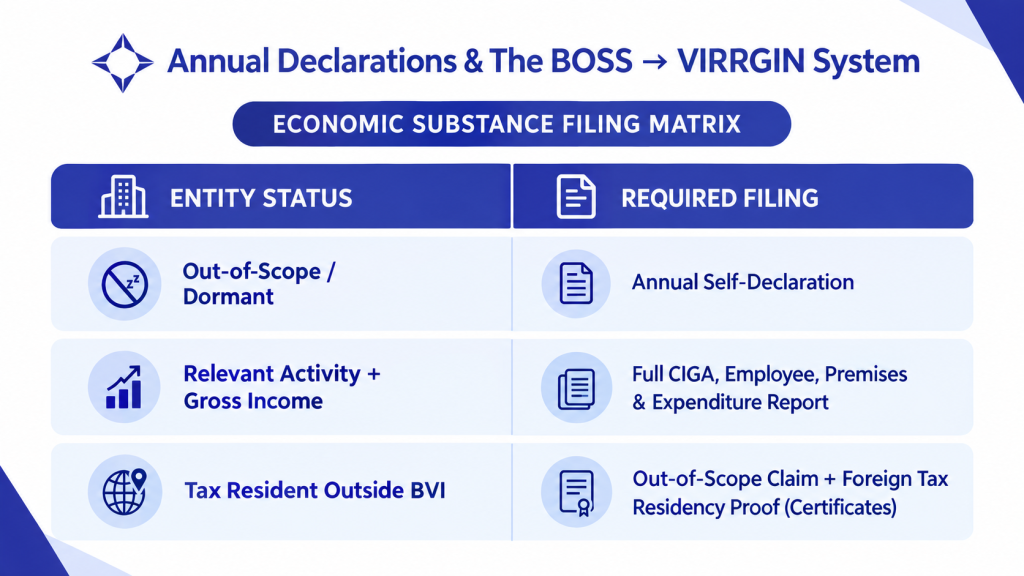
BVI entities should provide economic substance details on an annual basis in respect of each financial period (normally 12 months). Historically submitted through the Beneficial Ownership Secure Search (BOSS) portal, the process shifts to the VIRRGIN system for consolidated company submissions.
Tax Residency Claims Outside the BVI
A person carrying out a relevant activity may be exempted from the requirements of the BVI substance test if he is tax resident in another jurisdiction (which does not figure on the list of EU non-cooperative countries and territories). This can be proven through submission of:
- A tax residency certificate from the foreign tax authority.
- Evidence of assessment and tax payment.
Founder Action Checklist: Data Preparation
1. Ownership & Entity Data
- Certificate of Good Standing / Incumbency: Current official certificate confirming entity registration and status.
- UBO Details & Ownership Chart: Complete Ultimate Beneficial Owner details along with an up-to-date group ownership structure chart.
2. Financial & Revenue Records
- Financial Statements: Balance sheets or official financial accounts covering the reporting period.
- Revenue Breakdown: Detailed categorization of income by source (e.g., dividends, interest, IP royalties, service fees).
3. Activity Classification Records
- Written Classification Assessment: Formal economic substance classification document signed by the entity’s directors.
- Service Agreements: Copies of all active intragroup or third-party service agreements.
4. Local Substance Proof (If In-Scope)
- Board Meeting Minutes: Documented minutes showing board meetings held in the BVI with a local quorum.
- Premises Records: Physical lease agreements and utility bills for premises located in the BVI.
- Personnel Records: Payroll records, employee contracts, and related documentation demonstrating local employment.
When to Force an Immediate Reassessment
However, do not wait for the next year-end filing deadline if your business structure changes. You should reevaluate your substance status right away if you:
- Expand into a new line of business or acquire new kinds of assets.
- Earn income from new sources (such as licensing intellectual property or earning interest from intra-group loans).
- Revamp corporate relations through offering shared services to subsidiary companies.
- Relocate executive management, impacting where strategic decisions are formally made.
Non-Compliance Consequences
Failing to comply with BVI economic substance requirements or missing declaration deadlines exposes entities and officers to strict regulatory enforcement:
- Financial Penalties: The initial notice of failure has financial penalties of between $5,000 and $20,000, and further failures may result in financial penalties of up to $400,000 for high-risk IP entities.
- Spontaneous Information Exchange: The BVI ITA will automatically exchange information regarding non-compliance with the tax authority of the jurisdiction of residence of the ultimate beneficial owners of the entity.
- Strike-Off: The entity will be struck off the Register of Companies if the non-compliance persists.
Frequently Asked Questions
What is economic substance in the BVI?
It means a legal obligation under BVI law for organizations engaging in certain relevant activities to prove that they have true business dealings, local management, employees, and spending in the BVI.
What are the nine relevant activities under the BVI Economic Substance Act?
The nine relevant activities are: Banking, Insurance, Fund Management, Finance and Leasing, Headquarters, Shipping, Holding, Intellectual Property, and Distribution and Service Center businesses.
Is a BVI holding company subject to economic substance requirements?
Yes. Pure equity holding companies qualify as relevant activity companies but are subject to less stringent economic substance rules. They comply with economic substance requirements through BVI corporate filings and registered agent/office services.
What activities are generally outside the scope?
Examples of activities not usually considered relevant include holding foreign property, passive debt investments, third-party trading, direct consulting, and non-revenue-earning activities.
Does a dormant BVI company need to file an annual declaration?
Yes. For a company that does not engage in any relevant activities and has gross income, it has to file an annual declaration.
What triggers detailed economic substance reporting?
Detailed economic substance reporting arises in cases where a person carries out relevant activities and earns gross income from such activities in the reporting financial period.
Can a BVI entity claim tax residency outside the BVI?
Yes. If an entity is tax resident outside of the BVI (off a non-cooperative tax list jurisdiction), then the entity qualifies for an exemption from BVI substance requirements on submission of proof of foreign tax residence to its Registered Agent.
What information should founders prepare for their Registered Agent?
The founders must provide ownership structure, audited/management accounting, revenue sources, board minutes, business description, and documentation for foreign tax residence.
When should a BVI company reassess its economic substance position?
Every time there are changes in the sources of income, new inter-group arrangements, restructuring of a company, relocation of decision-making to directors, and addition of new business activities.
What happens if a BVI company fails to meet economic substance requirements?
In case of non-compliance, there will be imposed progressive sanctions, automatic exchange of information, and finally strike-off or liquidation of the company.
References
To verify specific legal definitions and review official regulatory guidance, consult these statutory authorities:
- BVI International Tax Authority (ITA): The primary regulatory body enforcing economic substance and international tax compliance in the British Virgin Islands.
- BVI Financial Services Commission (FSC): The autonomous regulatory authority responsible for the regulation, supervision, and inspection of all financial services in the BVI.
- OECD Tax Transparency Standards: International guidelines governing fair tax competition, harmful tax practices, and global substance rules.
- EU List of Non-Cooperative Jurisdictions: Official European Council monitoring for tax governance standards world
Top UAE Packages
Related Articles


Top UAE Packages
Get in Touch
