
Exploring the Best Bank in Dubai for Non-Residents in 2026 | A Comprehensive Guide

Ishika Bhandari
Content Writer
Ishika Bhandari is a content writer with experience in creating SEO-focused content across diverse industries, including business, lifestyle, and jewellery. She specializes in turning… Read more


Dubai has emerged as a leading international financial centre. Putting money into the banking system of the UAE is a good idea for international investors, remote entrepreneurs, and those who want to diversify their assets. You will be holding funds in UAE Dirhams (AED), which is directly linked to the US Dollar, and you will have a favourable environment that is highly stable and tax-friendly.
But if you do not live in the UAE full-time, finding the right place to park your capital can be tricky. Non-resident accounts come with different rules, higher minimum balance limits, and stricter compliance checks than standard resident accounts.
If you are looking for the best bank in Dubai for non residents, this straightforward guide breaks down your top options, the paperwork you will actually need, and how the setup process works.
Table of contents
- Why Should You Open a Non-Resident Account in Dubai?
- Which Local Banks Offer the Best Features for Non-Residents?
- Why Choose Emirates NBD?
- What Makes Mashreq Bank Stand Out?
- Is RAKBANK a Good Option for Smaller Deposits?
- How Do Local Options Compare to International Banks?
- What is the Step-by-Step Process to Open Your Account?
- Which Documents Do You Need to Prepare?
- Conclusion
- FAQs
Why Should You Open a Non-Resident Account in Dubai?
Opening a bank account in the UAE requires that you have a residency visa or an Emirates ID. Not true for a typical checking account that has a checkbook, but for large local and international banks, there are special savings and wealth management accounts available for foreign nationals.
Keeping your capital in Dubai as a non-resident gives you several practical advantages:
- Asset Diversification: It allows you to move your money into a politically stable, highly capitalized financial jurisdiction.
- Currency Stability: Since the AED is pegged to the USD, your funds remain secure from the rapid currency fluctuations affecting other markets.
- Global Access: You get full international debit cards and advanced mobile apps to move your money across borders whenever you need to.
Keep in mind that non-resident accounts are usually restricted to savings or investment structures. You will not get a checkbook, and you cannot apply for personal loans or credit cards unless you back them up with a cash deposit held by the bank.
Which Local Banks Offer the Best Features for Non-Residents?
Choosing the right partner depends on what you value most, whether that is cutting-edge mobile apps, lower balance requirements, or specialized wealth management services.
Why Choose Emirates NBD?
Emirates NBD is the biggest banking group in Dubai and is regarded as one of the prime options for international clients. They are very physically large and have one of the most sophisticated mobile platforms in the Middle East. When it comes to brand recognition and strong multi-currency capabilities, they are hard to beat. The compliance team is well laid out and will take some time to get the setup going, but it is highly usable.
What Makes Mashreq Bank Stand Out?
Mashreq Bank focuses heavily on digital-first solutions. They are popular with remote business owners and tech-savvy investors because their online onboarding paths are highly efficient. Mashreq’s non-resident options provide strong foreign exchange tools and multi-currency accounts, making it easier to manage international transfers in real-time without excessive fees.
Is RAKBANK a Good Option for Smaller Deposits?
If you want a straightforward banking setup without overly complicated wealth management demands, RAKBANK is a great alternative. While major tier-one banks might demand massive initial deposits from foreigners, RAKBANK is known for offering slightly more accessible account structures and realistic maintenance terms for everyday savers.
How Do Local Options Compare to International Banks?
If you already hold an account with a global financial institution in your home country, using their Dubai branch can make the entire onboarding process significantly easier.
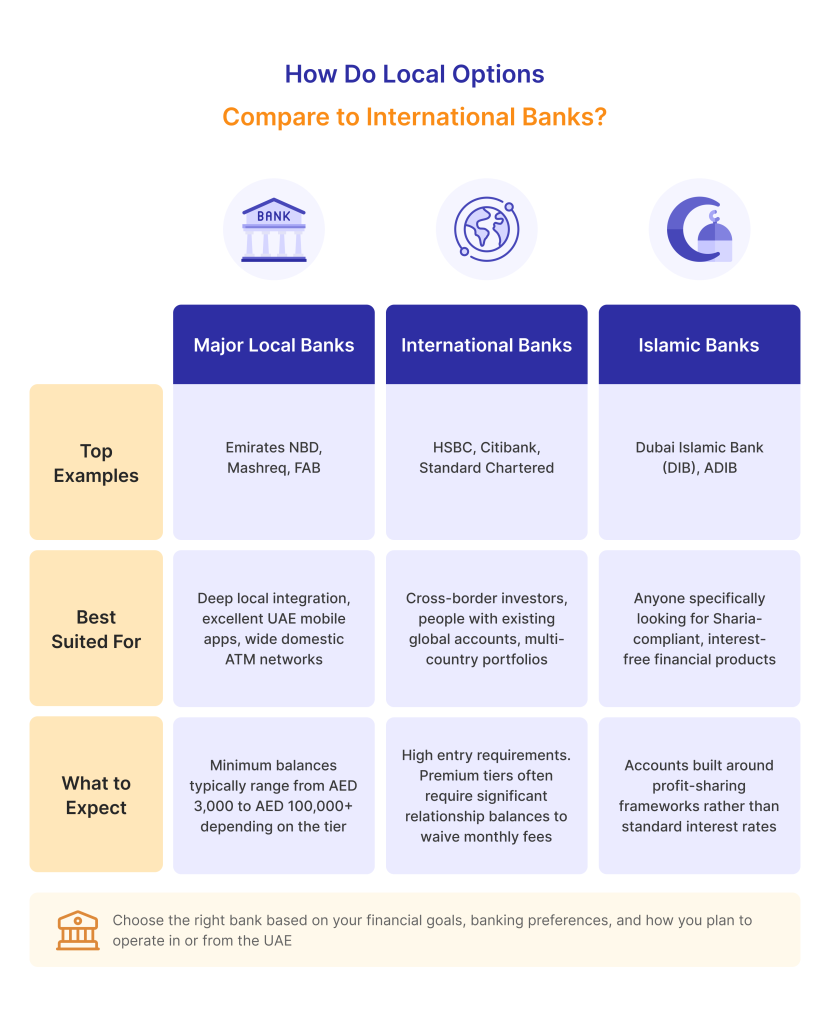
| Bank Type | Top Examples | Best Suited For | What to Expect |
| Major Local Banks | Emirates NBD, Mashreq, FAB | Deep local integration, excellent UAE mobile apps, wide domestic ATM networks | Minimum balances typically range from AED 3,000 to AED 100,000+ depending on the tier. |
| International Banks | HSBC, Citibank, Standard Chartered | Cross-border investors, people with existing global accounts, multi-country portfolios | High entry requirements. Premium tiers often require significant relationship balances to waive monthly fees. |
| Islamic Banks | Dubai Islamic Bank (DIB), ADIB | Anyone specifically looking for Sharia-compliant, interest-free financial products | Accounts built around profit-sharing frameworks rather than standard interest rates. |
What is the Step-by-Step Process to Open Your Account?
You cannot complete the entire process online from your couch. UAE central bank regulations require a physical signature verification for non-residents. This means you will need to plan at least a brief trip to Dubai to finalize your paperwork face-to-face with a banker or a certified agent.
Select Your Bank and Check Eligibility: Compare minimum balance rules and monthly fees. Make sure the institution matches your specific financial goals and currency needs before reaching out.
Gather and Verify Your Documentation: Collect your past six months of original bank statements, your resume, a recent utility bill from your home country, and a bank reference letter.
Travel to Dubai for Identity Verification: Schedule an appointment and fly to the UAE. You must present your physical passport containing your official entry stamp to the account manager.
Fund the Account and Activate Online Banking: Once compliance clears your file (which takes two to four weeks), transfer the required initial deposit to keep your account active and avoid penalties.
Which Documents Do You Need to Prepare?
UAE banks follow strict Know Your Customer (KYC) and Anti-Money Laundering (AML) laws. To avoid immediate delays, make sure you bring original copies of these exact items:
- Your Valid Passport: Complete with the physical entry stamp from your arrival at the UAE airport.
- Proof of Income: Typically your last six months of personal bank statements from your home country, or official invoices/tax documents showing a clear source of funds.
- An Updated CV: Banks want to understand your professional background and the nature of your wealth.
- Proof of Home Address: A recent utility bill or tenancy agreement from your country of residence that clearly displays your name and address.
- Bank Reference Letter: An official letter from your current bank back home confirming you are an account holder in good standing.
Conclusion
Trying to handle bank compliance, document coordination, and physical appointments while managing a trip from overseas can get overwhelming. Working with Arnifi takes the stress out of the process. They can pre-vet your financial documents, introduce you directly to the right managers at the best bank in Dubai for non residents, and coordinate the entire schedule. Whether you are setting up a personal savings pool or looking to transition into a full corporate business bank account later on, expert guidance helps you bypass the usual regulatory bottlenecks.
FAQs
1. Can non-residents open bank accounts in Dubai in 2026?
Yes, many banks offer savings accounts for non-residents.
2. Is a high minimum balance required?
Often yes, but it varies by bank.
3. Can accounts be managed remotely?
Yes, most banks provide full digital banking access.
4. Are multi-currency accounts available?
Yes, several banks offer them.
5. How long does account approval take?
Usually, it takes a few days to several weeks, depending on the documentation.
Reference Links: RAK BANK
Top UAE Packages


Related Articles


Top UAE Packages
Get in Touch