
Qatar Business Setup Costs and Procedures | 2026 Guide

Anushka
Content Writer
Anushka Basu is a business content writer specialised in global business market insights. She aims to simplify complex regulatory, financial, and business concepts into… Read more

Tulika Saxena
AVP, Sales & Marketing | IIM Nagpur
Tulika Saxena specializes in business finance, sales strategy, and market positioning. Leads growth and partnerships, ensuring seamless business setup experiences and client success across… Read more


Key Fact: The cost of setting up a business in Qatar depends on the activity, legal structure, licensing authority, premises, number of employees and immigration requirements. Government fees are only one part of the overall setup budget.
Table of contents
- Introduction
- What Determines the Cost of Business Setup in Qatar?
- What Are the Main Costs of Setting Up a Business in Qatar?
- How Much Does a Commercial Registration and Licence Cost in Qatar?
- What Is the Trade Name Cost in Qatar?
- What Are the Office Costs for a Business in Qatar?
- How Much Do Qatar Business Visas and Employee Visas Cost?
- What Additional Costs Should You Budget for?
- What Is the Difference Between Government Fees and Professional Fees?
- How Much Does It Cost to Renew a Business in Qatar?
- Mainland vs Free Zone | How Can the Setup Route Affect Cost?
- What Is the Estimated Total Budget for Business Setup in Qatar?
- How Can Businesses Reduce Their Qatar Setup Costs?
- What Documents Are Needed for Business Setup in Qatar?
- How Can Arnifi Help With Business Setup in Qatar?
- FAQs
- Conclusion
Introduction
There is no single price tag for starting a company in Qatar. A small service business with limited staffing can have a very different cost structure from an industrial company, a regulated business or an organisation requiring several employees and larger premises.
The business setup cost in Qatar can include government charges, licensing, company documents, office arrangements, immigration, visas and professional support.
The first step is therefore to understand what will actually drive the cost. This helps separate mandatory government charges from expenses that depend on the way a business chooses to operate.
What Determines the Cost of Business Setup in Qatar?
Several factors can change the final amount:
- Business activity and required approvals
- Legal structure
- Mainland or specialised economic-zone setup
- Number of owners or partners
- Office and premises requirements
- Number of investor and employee visas
- Activity-specific approvals
- Legal, accounting, PRO or business-setup support
The activity should be established before calculating the budget. A business may otherwise underestimate costs by looking only at the basic registration charge.
For example, MOCI’s current Single Window information shows that the fees for company establishment can include the commercial registration, additional activities, Qatar Chamber charges and other applicable costs.
What Are the Main Costs of Setting Up a Business in Qatar?
| Cost category | What it covers |
| Trade name | Reserving the proposed company name |
| Commercial registration | Registering the company with the relevant authority |
| Commercial licence | Permission to conduct the approved business activity |
| Incorporation documents | Preparation, drafting and/or attestation of company documents |
| Office/premises | Lease, office arrangement and related requirements |
| Establishment/immigration registration | Requirements for employing staff and handling immigration matters |
| Visas | Investor, partner and employee immigration costs where applicable |
| Additional approvals | Activity-specific licences, permits or certificates |
| Professional fees | Legal, accounting, PRO or business-setup assistance |
| Ongoing compliance | Renewals, accounting, tax, premises and other recurring expenses |
The exact combination depends on the business. Some costs are paid directly to authorities, while others arise from the company’s chosen office, staffing model or professional support.
How Much Does a Commercial Registration and Licence Cost in Qatar?
Commercial registration (CR) and the commercial licence are related but separate parts of the setup process.
MOCI’s current fee information lists ~QAR 500 for a commercial registration or licence, while additional activities, company structures and other applicable services may attract separate charges. The final amount is therefore calculated according to the company’s specific application.
For example, the current Single Window information identifies:
- ~QAR 500 for the applicable commercial registration/licence service
- Additional charges for activities or services where applicable
- Separate fees for certain company structures
- Additional government or documentation charges depending on the application
These are authority charges and should not be treated as the complete cost of establishing the business. Qatar Chamber fees, document accreditation and other applicable charges may also arise depending on the company structure.
MOCI also states that a commercial permit is required before commencing operations. The requirements can include premises documentation, a lease agreement and site-related approvals.
What Is the Trade Name Cost in Qatar?
The trade name is another cost to account for when planning a Qatar company setup.
MOCI states that a trade name can be reserved for 180 days. The Single Window also indicates that a trade-name reservation is free when requested as part of a comprehensive establishment, while a standalone reservation costs ~QAR 1,000.
Because the applicable charge can depend on how the application is submitted, businesses should check the current Single Window calculation rather than automatically adding the standalone reservation fee to every setup budget.
What Are the Office Costs for a Business in Qatar?
Office expenses can have a much bigger effect on the total budget than basic registration charges.
The amount depends on:
- Location
- Business activity
- Licence requirements
- Office size
- Number of employees
- Whether shared or flexible premises are permitted
- Fit-out and furnishing requirements
A company should also consider the initial lease payment, security deposit where applicable, utilities and office equipment.
There is no sensible universal office figure because the requirements for a small professional business and a company requiring operational or industrial space can be very different.
How Much Do Qatar Business Visas and Employee Visas Cost?
Visa-related expenses are separate from the basic incorporation process.
A business may need to budget for:
- Investor or partner immigration procedures
- Employee work and residence arrangements
- Medical examination where applicable
- Identification-related procedures
- Establishment and immigration processing
- Renewals
The number of employees can therefore have a direct impact on the overall setup and operating budget.
A company hiring two employees will naturally have a different immigration cost from one hiring twenty. Visa requirements should be estimated alongside the planned headcount rather than added at the end of the setup process.
What Additional Costs Should You Budget for?
Some expenses do not appear in the headline incorporation fee but can still affect the amount a business needs to spend.
Common additional expenses
- Government approvals for specialised activities
- Translation and document attestation
- Legal drafting
- PRO and administrative services
- Accounting and bookkeeping
- Tax compliance
- Bank-related requirements
- Business insurance where required
- Website and branding
- Recruitment and employee onboarding
Not every company will incur all of these costs. The useful approach is to identify which ones apply to the specific business before incorporation.
What Is the Difference Between Government Fees and Professional Fees?
Keeping these two categories separate makes a setup quotation much easier to understand.
| Government/authority costs | Professional/operational costs |
| Registration | Business setup consultant |
| Commercial licence | Legal services |
| Trade-name reservation | Document preparation |
| Government approvals | PRO services |
| Immigration/visa processing | Accounting/bookkeeping |
| Official renewals | Office setup and administration |
A consultant’s package price, for example, should not automatically be assumed to represent the government’s complete incorporation cost.
Similarly, a low government fee does not mean the company can operate for that amount. Office, staffing, accounting and compliance expenses may continue after incorporation.
How Much Does It Cost to Renew a Business in Qatar?
Initial incorporation is only the beginning of the financial commitment.
Recurring expenses can include:
- Commercial registration renewal
- Commercial licence renewal
- Office or lease costs
- Employee and immigration renewals
- Accounting and bookkeeping
- Tax compliance
- Professional support
- Activity-specific renewals
The current MOCI fee schedule, for example, lists ~QAR 500 annually for licensing certain commercial, industrial or public premises and ~QAR 300 annually for home-based business activities. The applicable renewal fee depends on the specific licence or activity.
This is why businesses should compare both the initial setup budget and the expected annual cost before selecting a structure.
Mainland vs Free Zone | How Can the Setup Route Affect Cost?
Qatar has several routes for establishing a business, and their costs are not structured in exactly the same way.
| Factor | Mainland / MOCI | Specialised economic zones |
| Registration | MOCI/Single Window framework | Relevant zone authority |
| Licensing | Depends on activity | Zone-specific |
| Premises | Requirements depend on activity | Depends on the zone and business |
| Infrastructure | Selected by the business | May be linked to zone facilities |
| Customs/tax considerations | Depends on business | May differ according to the zone |
| Eligibility | Based on activity and legal structure | Based on permitted activities and zone criteria |
QFC, for instance, operates under its own framework. Its current information lists a USD 500 application fee for many non-regulated activities and annual fees that depend on the entity and activity. QFC also requires licensed firms to maintain a registered office at designated premises.
QFZ has a separate investor onboarding and licensing structure. As a result, comparing only the headline registration fee can give an incomplete picture.
What Is the Estimated Total Budget for Business Setup in Qatar?
Rather than assigning one universal figure, businesses can think about the budget according to their operating profile.
| Business profile | Main cost drivers |
| Small/service business | Registration, licence, basic premises and limited visas |
| SME with employees | Registration, licence, office, several visas, accounting and operating expenses |
| Larger/specialised business | Larger premises, additional approvals, employees, professional services and sector-specific requirements |
These are planning categories, not fixed quotations.
The actual figure should be calculated after the activity, legal structure, authority, premises and staffing requirements have been identified. Official fees can then be separated from market-based expenses such as office rent or professional services.
How Can Businesses Reduce Their Qatar Setup Costs?
Cost control does not necessarily mean choosing the lowest advertised incorporation package.
Businesses can:
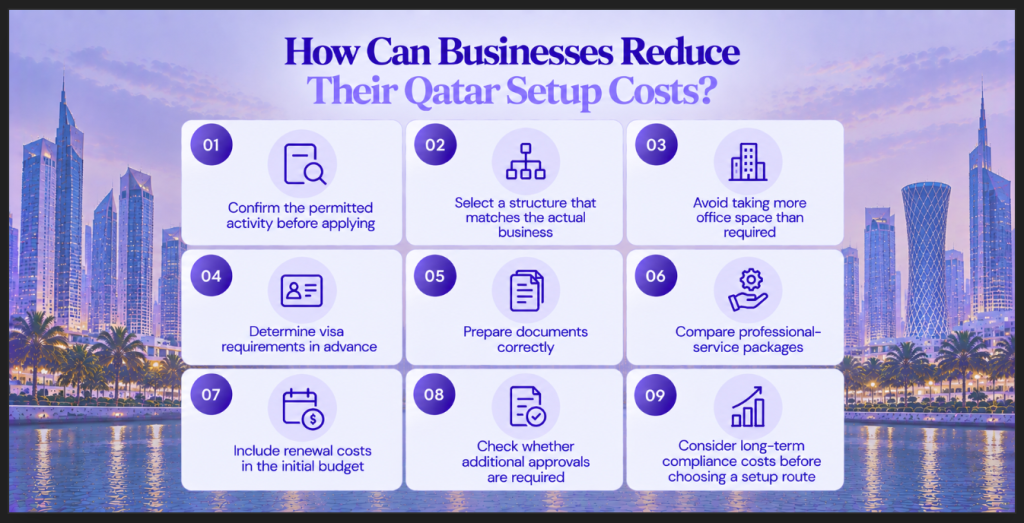
A cheaper initial setup can become more expensive if the structure creates unnecessary premises, licensing or compliance costs later.
What Documents Are Needed for Business Setup in Qatar?
The documentation depends on the company and proposed activity.
Common requirements can include:
- Passport or identification documents of owners and shareholders
- Proposed company or trade name
- Incorporation documents
- Business activity information
- Ownership details
- Office or lease documentation where required
- Activity-specific approvals
MOCI’s current Single Window guidance also identifies partner information, manager and authorised-signatory details and beneficial-owner declarations among the information required for relevant applications.
How Can Arnifi Help With Business Setup in Qatar?
Arnifi can help businesses plan and coordinate their Qatar setup based on the proposed activity and operating requirements.
Support can include:
- Business structure and setup-route guidance
- Company formation and registration
- Licensing and documentation support
- Government-procedure coordination
- Visa and immigration assistance
- Accounting and ongoing compliance support
- Cost planning before incorporation
The objective is to give businesses a clearer picture of both the initial setup requirements and the costs that may continue after incorporation.
FAQs
How much does it cost to set up a business in Qatar?
There is no single fixed cost. The total depends on the business activity, legal structure, registration and licensing fees, premises, visas, additional approvals and professional services. MOCI currently lists QAR 500 for the applicable commercial registration or licence service, but additional charges can apply depending on the company and application.
What are the main costs involved in starting a company in Qatar?
The main cost categories include trade-name reservation, commercial registration, commercial licensing, incorporation documents, premises, immigration and visas, activity-specific approvals, professional services and ongoing compliance.
Is office space mandatory for setting up a business in Qatar?
It depends on the business activity, licensing route and applicable premises requirements. MOCI’s commercial-permit process can require a lease and site-related documentation, while specialised jurisdictions can have their own premises rules. QFC, for example, requires licensed firms to maintain a registered office at designated premises.
How much do business visas add to the setup cost in Qatar?
There is no single amount because visa expenses depend on the type and number of visas required. Investor, partner and employee immigration arrangements can involve different procedures and costs. Businesses should calculate these separately from incorporation and licensing fees.
What are the ongoing costs after setting up a business in Qatar?
Recurring costs can include CR and licence renewals, office expenses, employee and immigration renewals, accounting, tax compliance, professional support and activity-specific requirements.
Conclusion
There is no universal business setup cost in Qatar. The final budget depends on what the company does, where it is established, which legal structure it uses and how it plans to operate.
Government charges are only one part of that calculation. Office arrangements, visas, professional services, additional approvals and recurring compliance can all affect the amount a business ultimately spends.
The safest approach is to establish the activity and structure first, identify the applicable authority fees, and then build the remaining operational costs around the company’s actual requirements.
For businesses planning a Qatar launch, Arnifi can help with company formation, licensing, documentation, visa coordination and ongoing compliance support.
References
Top UAE Packages
Related Articles

Top UAE Packages
Planning Your Next Business Move?
