
Accounting Services in Qatar | Complete Guide for Businesses

Anushka
Content Writer
Anushka Basu is a business content writer specialised in global business market insights. She aims to simplify complex regulatory, financial, and business concepts into… Read more

Tulika Saxena
AVP, Sales & Marketing | IIM Nagpur
Tulika Saxena specializes in business finance, sales strategy, and market positioning. Leads growth and partnerships, ensuring seamless business setup experiences and client success across… Read more


Key Fact: Qatar requires businesses subject to tax to maintain accurate accounting books, records and supporting documents in line with applicable legal and accounting requirements. These records support tax compliance, financial reporting and audit readiness.
Table of contents
- Introduction
- What Are Accounting Services in Qatar?
- What Accounting Services Are Available in Qatar?
- Why Do Businesses Need Accounting Services in Qatar?
- What Accounting Records Must Businesses Maintain in Qatar?
- How Do Accounting Services Support Qatar Tax Compliance?
- Accounting Services vs Bookkeeping vs Auditing | What’s the Difference?
- Should You Outsource Accounting Services in Qatar?
- How Do You Choose an Accounting Services Provider in Qatar?
- What Should a Business Expect From an Accounting Services Provider?
- Accounting Services for Startups and SMEs in Qatar
- Common Accounting Mistakes Businesses Make in Qatar
- How Can Arnifi Help With Accounting Services in Qatar?
- FAQs
- Conclusion
Introduction
Accounting is an essential part of running a business in Qatar. Beyond recording income and expenses, proper accounting helps businesses maintain reliable financial records, prepare reports, meet tax obligations and understand their financial position.
For many businesses, managing these responsibilities internally can become difficult as transactions, employees and regulatory requirements increase. Outsourcing accounting services in Qatar can provide access to professional support without requiring a large in-house finance team.
It is also useful to distinguish between bookkeeping, accounting and auditing. Bookkeeping focuses mainly on recording transactions, accounting involves organising and interpreting financial information, while auditing involves examining financial records and statements through audit procedures.
Businesses in Qatar can therefore use accounting services for everything from day-to-day bookkeeping and payroll to tax support, financial reporting and audit preparation.
What Are Accounting Services in Qatar?
Accounting services cover the processes businesses use to record, organise, analyse and report their financial information.
These services can include maintaining accounting books and records, recording financial transactions, reconciling accounts, preparing financial statements, monitoring income and expenses and producing management reports.
Accounting support can also extend to tax compliance, payroll administration, audit preparation and financial analysis. The exact services required depend on the company’s size, industry, ownership structure and reporting obligations.
What Accounting Services Are Available in Qatar?
| Service | What it covers |
| Bookkeeping | Daily transactions, ledgers, reconciliations and financial records |
| Tax accounting | Tax calculations, documentation and filing support |
| Financial reporting | Balance sheets, income statements, cash-flow reports and management reports |
| Audit support | Preparing records and supporting documentation for audits |
| Payroll accounting | Salaries, bonuses, deductions and payroll records |
| Management accounting | Financial analysis, budgeting and business-performance information |
| Forensic accounting | Investigating financial discrepancies and potential irregularities |
| Business setup advisory | Establishing accounting and financial processes for new businesses |
A business may use several of these services at the same time. For example, a growing company may require bookkeeping throughout the year, tax support before filing deadlines and audit preparation where audited financial statements are required.
Why Do Businesses Need Accounting Services in Qatar?
Accurate accounting gives businesses a structured view of their financial position and helps them meet administrative and regulatory obligations.
Key reasons businesses use accounting services include:
- Maintaining accurate financial records
- Supporting Qatar tax compliance
- Understanding profitability and cash flow
- Monitoring receivables and expenses
- Preparing financial reports
- Supporting audit procedures
- Making informed business decisions
- Reducing the administrative workload for business owners
- Supporting business expansion and growth
There is also a specific compliance reason for maintaining proper records. Qatar’s General Tax Authority states that failure to maintain required accounting records can result in a QAR 30,000 penalty.
Professional accounting support can therefore help businesses keep their financial information organised rather than waiting until a tax filing, audit or regulatory review to identify missing records.
What Accounting Records Must Businesses Maintain in Qatar?
Under Qatar’s Income Tax Law and Executive Regulations, taxpayers operating in the country must maintain accounting books, records and supporting documents necessary for their activities.
The specified records include:
- General journal
- General ledger
- Inventory book
- Supporting accounting documents and other records necessary for the business
Generally, these books, records and documents must be retained for 10 years following the year to which they relate. If the records are connected with an unresolved dispute, the retention period can extend for as long as the dispute remains ongoing.
This makes it important for businesses using outsourced accounting services in Qatar to establish clear processes for recordkeeping, access, documentation and data retention.
How Do Accounting Services Support Qatar Tax Compliance?
Accounting services can help businesses organise the financial information required for Qatar tax compliance.
Typical support may include:
- Organising financial records for tax purposes
- Calculating taxable amounts
- Preparing supporting documentation
- Preparing tax returns
- Supporting tax-return filing
- Accounting for withholding tax where applicable
- Supporting capital-gains reporting where applicable
- Maintaining documentation for tax reviews
Qatar’s General Tax Authority states that tax returns are submitted through the electronic Dhareeba system, generally within four months following the end of the tax year. For the 2025 financial year, for example, the GTA initially announced a filing period from 1 January to 30 April 2026 and subsequently announced an extension to 30 June 2026.
The standard income-tax rate under Qatar’s Income Tax Law is 10% of taxable income, subject to applicable exemptions and special rules.
Qatar has not currently implemented VAT, so businesses should not treat VAT registration or VAT filing as a current general accounting requirement. They should, however, monitor official developments for any future changes.
Accounting Services vs Bookkeeping vs Auditing | What’s the Difference?
| Service | Main purpose |
| Bookkeeping | Recording and organising day-to-day financial transactions |
| Accounting | Interpreting financial information and preparing accounts and reports |
| Tax accounting | Supporting tax calculations, records and filings |
| Auditing | Examining financial statements and records through audit procedures |
| Management accounting | Providing financial information for internal planning and decisions |
These services can overlap, but they are not interchangeable. A company may use bookkeeping and accounting services throughout the year while engaging an appropriately licensed auditor when an audit is required.
The General Tax Authority states that certain companies with Qatari/GCC ownership and specified capital or income thresholds must submit full tax returns supported by audited financial statements. Companies with Qatari and foreign partners, fully foreign-owned companies and certain entities located outside Qatar may also have returns supported by audited financial statements from a licensed auditor registered with the GTA.
Should You Outsource Accounting Services in Qatar?
Outsourcing can be suitable for businesses that do not want to maintain a large internal finance function or need access to specialist accounting and tax expertise.
It can be particularly relevant for:
- Startups without dedicated accounting staff
- Small and medium-sized businesses
- Companies with increasing transaction volumes
- Businesses requiring specialist tax knowledge
- Companies expanding their operations
- Businesses seeking to reduce internal administrative workloads
Outsourcing can also allow business owners to focus more closely on operations while an external accounting team handles agreed financial and administrative responsibilities.
However, outsourcing does not remove the company’s legal responsibilities. Businesses should understand what the provider is responsible for and what remains the responsibility of the company and its management.
How Do You Choose an Accounting Services Provider in Qatar?
Businesses should assess an accounting provider based on both technical capability and familiarity with Qatar’s regulatory environment.
Consider the provider’s:
- Experience with businesses operating in Qatar
- Understanding of Qatar tax requirements
- Accounting and bookkeeping expertise
- Industry experience
- Financial reporting capabilities
- Accounting-software compatibility
- Data-security procedures
- Audit-support capabilities
- Scope of services
- Pricing structure
- Availability of ongoing support
It is also important to distinguish accounting support from regulated audit work. If audited financial statements are required, the audit should be handled by an appropriately licensed or registered auditor.
For companies subject to specific GTA audit requirements, the authority states that financial statements must be supported by an auditor registered with the General Tax Authority.
What Should a Business Expect From an Accounting Services Provider?
A typical accounting workflow can be structured as:
Bookkeeping → Reconciliation → Financial reporting → Tax support → Audit preparation → Management reporting
The provider may begin by recording transactions and reconciling bank and other accounts. Once the underlying records are organised, financial statements and management reports can be prepared.
Where included in the engagement, the provider may then support tax documentation and filings, prepare records requested by auditors and produce financial information for management decision-making.
Payroll accounting can also be integrated into this process, where the provider’s scope includes employee salary records, deductions and related documentation. The exact workflow depends on the company’s requirements and the services included in the engagement.
Accounting Services for Startups and SMEs in Qatar
Startups and SMEs can benefit from establishing accounting processes early rather than waiting until transaction volumes become difficult to manage.
An accounting setup can include:
- Establishing a chart of accounts
- Organising invoices and supporting documents
- Creating regular bookkeeping procedures
- Setting up bank and account reconciliations
- Establishing financial reporting cycles
- Preparing for tax obligations
- Maintaining records for potential audits
- Building processes that can scale with the business
Starting with an organised accounting system can also make it easier to understand cash flow, monitor expenses, and prepare financial information as the company grows.
Common Accounting Mistakes Businesses Make in Qatar
Businesses can encounter avoidable problems when accounting processes are not maintained consistently. Common mistakes include:
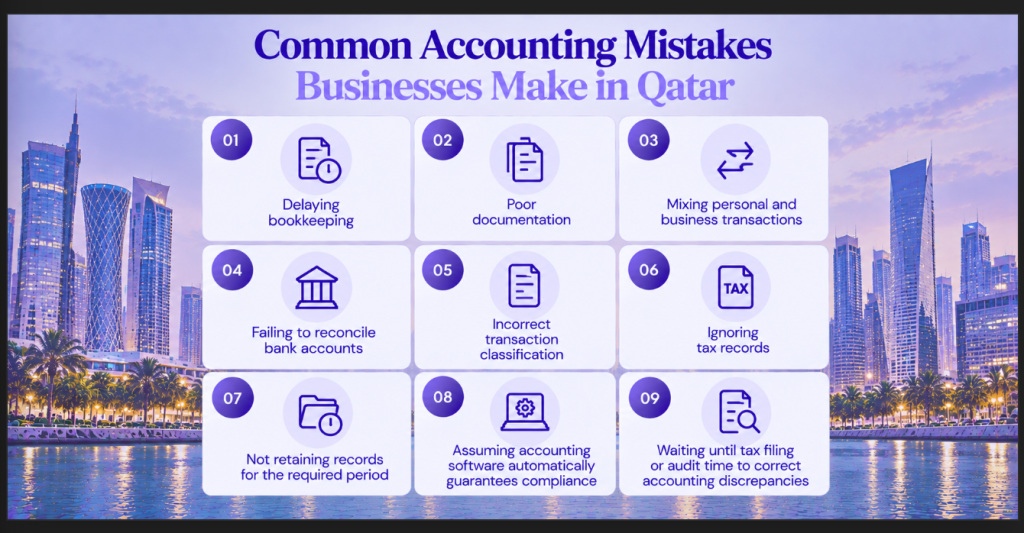
Regular bookkeeping and reconciliation can help identify errors before they affect tax filings or financial reports.
How Can Arnifi Help With Accounting Services in Qatar?
Arnifi can support businesses with establishing and maintaining accounting and bookkeeping processes in Qatar.
Support can include:
- Regular bookkeeping and financial record maintenance
- Qatar tax accounting and compliance support
- Preparation of financial reports and accounting documentation
- Organisation of records required for tax filing and potential audits
- Accounting support for startups, SMEs and established businesses
- Assistance as accounting requirements change with business growth
- Ongoing accounting support for businesses managing their operations in Qatar
This allows business owners to maintain more structured financial processes while focusing on their core operations.
FAQs
Are accounting records mandatory for businesses in Qatar?
Yes. Qatar’s Income Tax Law and Executive Regulations require taxpayers operating in the country to maintain specified accounting books, records and supporting documents. The GTA states that failure to maintain required accounting records can result in a QAR 30,000 penalty.
What accounting services are available in Qatar?
Accounting providers can offer bookkeeping, tax accounting, financial reporting, payroll accounting, management accounting, audit support, forensic accounting and business setup-related accounting support. The exact services depend on the provider and the company’s requirements.
Can businesses outsource accounting services in Qatar?
Yes. Qatar’s regulations allow taxpayers to contract out the maintenance and storage of accounting books and records, provided the applicable requirements are followed. The taxpayer remains responsible for the records and their contents before the General Tax Authority.
What accounting records must businesses maintain in Qatar?
Specified records include the general journal, general ledger, inventory book and supporting accounting documents. Generally, records must be retained for 10 years following the year to which they relate, with longer retention possible where an unresolved dispute exists.
How do I choose an accounting services provider in Qatar?
Consider the provider’s Qatar-specific experience, tax knowledge, bookkeeping and reporting capabilities, audit-support experience, data-security practices, scope of work, pricing and ongoing support. If audited financial statements are required, confirm that the relevant audit work is handled by an appropriately licensed and registered auditor.
Conclusion
Accounting services in Qatar extend beyond basic bookkeeping. They can support financial recordkeeping, reporting, tax compliance, payroll, audit preparation and financial decision-making.
Qatar has specific requirements for maintaining accounting records, including defined records and a generally applicable 10-year retention period. Businesses must also understand that outsourcing accounting work does not remove their responsibility for maintaining compliant records.
For startups, SMEs and established companies, the appropriate accounting setup depends on the business structure, transaction volume, industry and regulatory requirements. Choosing a provider with relevant Qatar accounting and tax experience can help establish consistent financial processes and support ongoing compliance.
For businesses establishing or operating in Qatar, Arnifi can provide accounting support designed around ongoing financial and compliance requirements.
Official references
Top UAE Packages
Related Articles



Top UAE Packages
Get in Touch
