
Singapore Hedge Fund Setup | Requirements & Process

Anushka
Content Writer
Anushka Basu is a business content writer specialised in global business market insights. She aims to simplify complex regulatory, financial, and business concepts into… Read more

Tulika Saxena
AVP, Sales & Marketing | IIM Nagpur
Tulika Saxena specializes in business finance, sales strategy, and market positioning. Leads growth and partnerships, ensuring seamless business setup experiences and client success across… Read more


Key Fact: Singapore hedge fund setup commonly involves establishing an investment fund vehicle, such as a Variable Capital Company (VCC), and appointing a permissible fund manager. Managers conducting regulated fund management generally require a MAS Capital Markets Services (CMS) licence unless an applicable exemption applies. A launch can involve an existing licensed manager rather than a newly established management company.
Table of contents
- Introduction
- Why Do Fund Managers Choose Singapore for Hedge Fund Setup?
- What Structure Should You Choose for a Singapore Hedge Fund?
- Does a Singapore Hedge Fund Need a MAS Licence?
- What Are the Requirements for a Singapore Fund Management Company?
- How Do You Set Up a Hedge Fund in Singapore?
- What Tax Incentives Are Available for Singapore Hedge Funds?
- What Are the Ongoing Compliance Requirements?
- What Does Singapore Hedge Fund Setup Cost?
- How Can Arnifi Help With Singapore Hedge Fund Setup?
- FAQs
- Conclusion
Introduction
Sometimes, structuring an international fund can get complicated. Let’s suppose you manage capital in London and want to target Asian institutional investors. You can’t just incorporate any holding company structure and start pooling capital.
Setting up a hedge fund in Singapore means navigating investment strategy, MAS licensing, investor eligibility, and tax treatment. You need an established financial infrastructure. This guide explains exactly how Singapore hedge fund setup works in practice.
Why Do Fund Managers Choose Singapore for Hedge Fund Setup?
Singapore is a premier hub for international fund management. Managers want access to global capital.
- Established financial services ecosystem
- Access to international investment markets
- Availability of specialised fund administration and professional services
- The VCC framework, tailored specifically for investment funds
- Tax incentive schemes for qualifying funds
- A clear regulatory framework overseen by the Monetary Authority of Singapore (MAS)
Singapore is not automatically tax-free, so it naturally isn’t universally suitable for every single fund strategy.
What Structure Should You Choose for a Singapore Hedge Fund?
Most managers use the Variable Capital Company (VCC) framework:
Standalone VCC: You can establish a standalone VCC for a single investment fund.
Umbrella VCC: Imagine setting up a standalone fund, only to realise a year later you need to launch a distinct secondary strategy. An umbrella VCC fixes this. It accommodates multiple sub-funds. Each sub-fund holds segregated assets and liabilities.
Why Is a VCC Suitable for Hedge Funds?
- Flexible capital issuance and redemption. Ideal for open-ended structures.
- Sub-fund ring-fencing.
- Confidential shareholder registers. Regulators have access. The public doesn’t.
- Clear governance and compliance guidelines.
Note: A VCC is just a vehicle. It does not authorise you to manage investments.
Does a Singapore Hedge Fund Need a MAS Licence?
Fund management is a highly regulated activity. To operate legally, the manager needs a Capital Markets Services (CMS) licence from MAS. This puts them under the Licensed Fund Management Company (LFMC) framework. Because most hedge funds cater to Accredited and Institutional (A/I) investors, this shapes their exact licensing path. Retail management requires far higher base capital.
MAS distinguishes between different categories of fund management companies:
- Accredited/Institutional (A/I) Licensed Fund Management Companies (LFMCs): Manage funds for qualified investors, subject to applicable restrictions.
- Retail LFMCs: Can manage funds for all investor categories, including retail investors, subject to more stringent requirements.
- Venture Capital Fund Managers (VCFMs): Operate under a simplified regime but are restricted to qualifying venture capital funds and investment conditions.
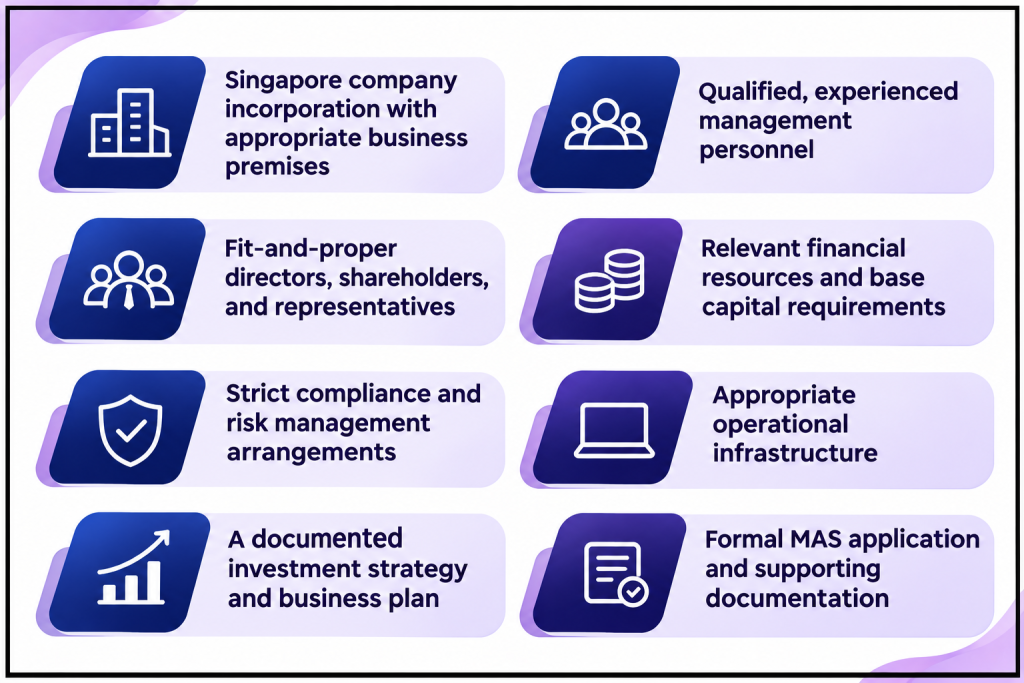
What Are the Requirements for a Singapore Fund Management Company?
Common requirements include:
How Do You Set Up a Hedge Fund in Singapore?
Define the Investment Strategy: Establish your mandate, risk limits, liquidity terms, and target investors.
Select the Fund Manager: Determine whether you will establish your own Singapore fund management company or appoint an existing eligible manager.
Establish the Fund Vehicle: Choose a standalone or umbrella VCC. Complete the necessary ACRA registrations.
Prepare Fund Documentation: You need a VCC constitution. A Private Placement Memorandum (PPM). Subscription agreements. An investment management agreement. Valuation policies. And robust risk disclosures.
Appoint Operational Providers: Imagine dealing with fifty LPs demanding monthly performance updates. Your service providers handle this. Identify an administrator, auditor, custodian or prime broker, and legal counsel.
Complete Investor Onboarding: Establish investor eligibility. Run your KYC and AML/CFT checks. Lock down subscription procedures.
What Tax Incentives Are Available for Singapore Hedge Funds?
Singapore offers major tax incentives, but they are conditional.
Section 13O
Section 13O is generally used by qualifying Singapore-based fund vehicles. For non-single-family-office funds, eligibility involves conditions concerning the fund’s structure, investment professionals, local business spending and management arrangements.
Following MAS Circular FDD Cir 05/2026 (31 July 2026), the requirement to maintain an annual minimum AUM in designated investments has been removed for non-SFO funds under Sections 13O and 13U. (The initial application threshold still applies.
Section 13U
Section 13U, commonly called the Enhanced-Tier Fund Tax Incentive Scheme, can apply to qualifying funds with more flexible fund vehicle structures. It generally requires a higher level of qualifying assets and a larger investment professional team.
Both schemes demand economic substance. One must meet ongoing investment conditions and apply formally.
What Are the Ongoing Compliance Requirements?
Running the fund requires constant oversight.
- Annual financial statements and mandatory audits.
- Fund valuation and NAV reporting.
- Regular investor disclosures.
- AML/CFT procedures.
- Regulatory reporting and MAS notifications.
- Corporate governance and director responsibilities.
- Tax incentive monitoring.
Your exact burden shifts based on your fund vehicle, manager licence, and investor classification.
What Does Singapore Hedge Fund Setup Cost?
| Cost Category | What It Covers |
| Fund incorporation | VCC registration and sub-fund setup |
| Licensing | MAS application and regulatory requirements |
| Legal documentation | Fund agreements and offering documents |
| Administration | NAV calculation and investor servicing |
| Audit | Annual financial audit |
| Banking and custody | Account arrangements and prime brokerage |
| Compliance | Regulatory monitoring and operational controls |
Total expenditure swings drastically based on your fund size, strategy, and service providers.
How Can Arnifi Help With Singapore Hedge Fund Setup?
Arnifi provides structured corporate support for Singapore entity formation, VCC structuring, corporate documentation and registration. With the right guidance and support, businesses can establish a strong foundation for their Singapore operations and focus on building their investment objectives.
FAQs
Can foreigners set up a hedge fund in Singapore?
Yes. Foreign founders can establish Singapore fund structures, subject to incorporation, director, manager, and regulatory requirements.
Is a VCC mandatory for a Singapore hedge fund?
No. A VCC is a common, flexible option, but your structure depends on your fund’s exact objectives.
Does every Singapore hedge fund need a CMS licence?
Regulated fund management generally requires a CMS licence. Unless a specific exemption applies to your model.
How long does Singapore hedge fund setup take?
It can take several months depending on application completeness and regulatory assessment.
What is the difference between a hedge fund and a VCC?
A hedge fund is an investment strategy. A VCC is the legal corporate structure holding the assets.
Can a Singapore hedge fund qualify for tax exemptions?
Yes. Qualifying funds may apply under Section 13O or Section 13U, provided they meet all economic and operational conditions.
Conclusion
Singapore hedge fund setup requires tight coordination. You are balancing fund structures, manager licensing, investor eligibility, and tax incentives. Registering a VCC doesn’t launch your fund. You still need an authorised manager, precise investment documentation, operational providers, and a bulletproof compliance framework. Arnifi supports your Singapore corporate formation and fund structuring so you can build on a solid foundation.
Official References
Top Singapore Packages
Related Articles

Top Singapore Packages
Planning Your Next Business Move?
