
Corporate Tax Deregistration UAE | Eligibility & Process Requirements

Anushka
Content Writer
Anushka Basu is a business content writer specialised in global business market insights. She aims to simplify complex regulatory, financial, and business concepts into… Read more

Tulika Saxena
AVP, Sales & Marketing | IIM Nagpur
Tulika Saxena specializes in business finance, sales strategy, and market positioning. Leads growth and partnerships, ensuring seamless business setup experiences and client success across… Read more


Key Fact: Corporate Tax deregistration in the UAE is submitted through EmaraTax. The FTA does not charge a government service fee, and processing can take 40 working days after receiving a complete application.
Table of contents
- Introduction
- What Is Corporate Tax Deregistration in the UAE?
- When Is Corporate Tax Deregistration Required?
- Who Is Eligible for UAE Corporate Tax Deregistration?
- What Is the Corporate Tax Deregistration Deadline in the UAE?
- What Documents Are Required for Corporate Tax Deregistration?
- How Do You Apply for Corporate Tax Deregistration Through EmaraTax?
- Do You Need to File a Final Corporate Tax Return?
- What Are the Corporate Tax Deregistration Fees in the UAE?
- How Long Does Corporate Tax Deregistration Take?
- What Happens After the FTA Approves Deregistration?
- What Happens If You Miss the Deregistration Deadline?
- Do Free Zone Companies and Natural Persons Need to Deregister?
- What Mistakes Should You Avoid During Corporate Tax Deregistration?
- How Can Arnifi Help With Corporate Tax Deregistration?
- FAQs
- Conclusion
- References
Introduction
Corporate Tax deregistration in the UAE is required when a registered business no longer needs to remain registered for Corporate Tax. This may happen when a business closes, a company is liquidated, or a business undergoes a merger or restructuring. Before applying, you should confirm the reason for deregistration, prepare the required documents and check that all outstanding tax obligations are addressed.
What Is Corporate Tax Deregistration in the UAE?
Corporate Tax deregistration is the process of cancelling a business’s Corporate Tax registration with the Federal Tax Authority (FTA). The application is submitted through EmaraTax, the FTA’s online tax platform.
Deregistration is different from cancelling a trade licence, completing company liquidation or cancelling VAT registration. These are separate processes and may have different requirements. Cancelling a trade licence does not automatically remove a business from Corporate Tax registration.
A business should apply for deregistration when it meets the applicable eligibility conditions. The FTA reviews the application and confirms whether deregistration can be approved.
When Is Corporate Tax Deregistration Required?
A registered business may need to apply for deregistration in the following situations:
- Business closure: The business has stopped operating and meets the applicable conditions.
- Liquidation or bankruptcy: The company is being wound up or has entered bankruptcy proceedings.
- Merger: The company merges with another business and its existing registration needs to be addressed.
- Sale of business: The FTA may require deregistration where a business sale results in a change to the taxable person’s registration position. The application should reflect the transaction and the supporting documents required by the FTA.
- Closure of a permanent establishment: A foreign company’s UAE permanent establishment ceases operations.
- Re-domiciliation: The company moves its legal domicile outside the UAE.
- Change in place of effective management and control: The company’s management arrangements change in a way that may affect its UAE tax position.
- Duplicate TRN or TIN: The business has a duplicate tax registration or identification number.
- Other qualifying reasons: The business has another reason that requires Corporate Tax deregistration under the applicable rules.
The correct reason matters because the FTA may request documents specific to the circumstances.
Who Is Eligible for UAE Corporate Tax Deregistration?
Eligibility depends on the business’s legal structure and the reason for the application.
| Business or situation | What to consider |
| UAE company | The company has a qualifying reason for deregistration, such as closure, liquidation or merger |
| Free Zone company | The company must assess its Corporate Tax obligations separately from its Free Zone licence status |
| Foreign company with a UAE permanent establishment | Deregistration may be required when the UAE permanent establishment closes, subject to the applicable rules |
| Natural person conducting business | The person must assess whether they remain within the scope of Corporate Tax. Stopping one activity does not necessarily mean all business activities have ceased |
| Company changing its domicile | The company should assess whether it retains a UAE permanent establishment or nexus, or earns UAE-source income. The FTA may require a certificate of continuation, financial statements and a signed confirmation of its UAE tax position |
A business should not apply simply because it has recorded no revenue or has stopped issuing invoices temporarily. Its actual tax position and circumstances must support the application.
What Is the Corporate Tax Deregistration Deadline in the UAE?
The deadline depends on the applicable legislation and the event that triggers deregistration. Under the standard Corporate Tax deregistration framework, FTA Decision No. 6 of 2023 sets a three-month application timeline for relevant cessation and other specified events. Businesses should verify the deadline applicable to their specific circumstances before submitting the application.
FTA Decision No. 12 of 2026 concerns registration and deregistration timelines for Top-up Tax under the UAE’s Pillar Two regime. It should not be treated as the general deadline for ordinary UAE Corporate Tax deregistration.
Missing an applicable deadline may result in an administrative penalty. Businesses should therefore identify the relevant triggering date and submit the application within the required period.
What Documents Are Required for Corporate Tax Deregistration?
The FTA’s document requirements depend on the reason for deregistration. Applicants should use the checklist for their specific circumstances and confirm whether additional documents are needed.
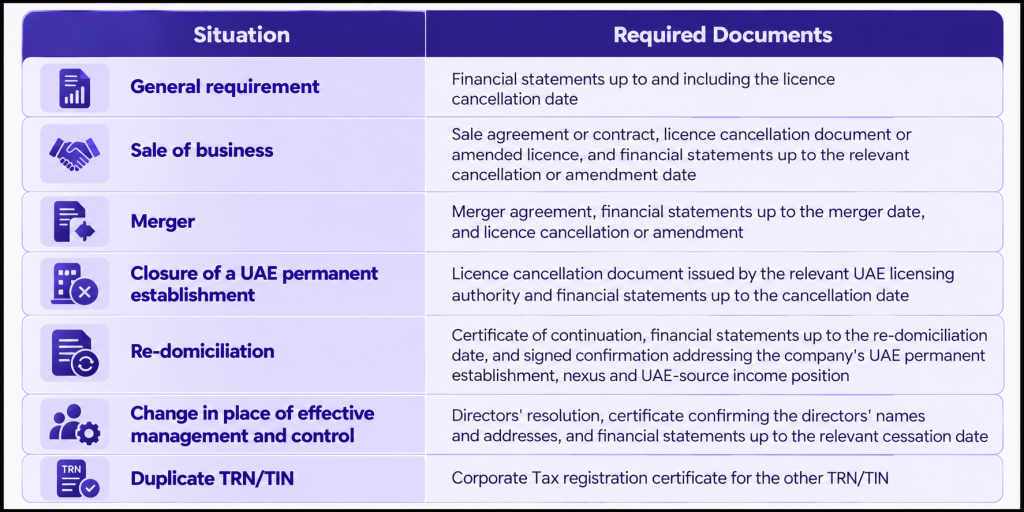
The FTA may request other relevant documents depending on the application. Check the current EmaraTax requirements before submitting.
How Do You Apply for Corporate Tax Deregistration Through EmaraTax?
The application is submitted online through the taxpayer’s EmaraTax account. Follow these steps:
| Step | What to do |
| 1 | Log in to your EmaraTax account |
| 2 | Open the relevant taxable person account |
| 3 | Select the Corporate Tax section and locate the available deregistration action |
| 4 | Choose the appropriate reason for deregistration |
| 5 | Enter the requested details, including the relevant dates |
| 6 | Upload the supporting documents for your selected reason |
| 7 | Review the application to check that the information is accurate |
| 8 | Submit the application to the FTA |
| 9 | Check the application status through your EmaraTax account |
| 10 | Respond to any request for additional information within the specified period |
Keep a copy of the submitted application and its supporting documents. If the FTA requests more information, respond promptly. An application that is not resubmitted within 60 calendar days after a request for additional information may be rejected.
Do You Need to File a Final Corporate Tax Return?
Yes. Deregistration does not remove the obligation to file outstanding Corporate Tax returns or pay tax due.
Before the FTA approves deregistration, the business must address its outstanding tax compliance obligations. This includes filing required returns and settling Corporate Tax liabilities and administrative penalties due.
The final Corporate Tax Return must cover the relevant final Tax Period under the applicable rules. The business should confirm the effective deregistration date and applicable filing deadline, and retain its financial records and supporting documents in line with UAE record-keeping requirements.
What Are the Corporate Tax Deregistration Fees in the UAE?
The FTA’s Corporate Tax deregistration service is free of government service charges. However, businesses may incur professional fees if they appoint a tax consultant or business service provider to prepare documents, review compliance or submit the application.
| Cost component | What to expect |
| FTA deregistration fee | No government service fee |
| Professional assistance | Depends on the provider and the complexity of the case |
| Outstanding tax or penalties | Payable where applicable |
| Document preparation | May involve additional costs depending on the documents required |
Before appointing a service provider, confirm what the quoted fee covers and whether it includes reviewing outstanding returns, preparing documents and responding to FTA queries.
How Long Does Corporate Tax Deregistration Take?
The FTA’s published processing estimate is 40 working days from receipt of a completed application. This is an estimate, not a guarantee. If the FTA requests additional information, the review may take longer. After receiving the updated application, the FTA may take up to another 40 working days to respond.
The timeline can depend on whether the application is complete, the reason for deregistration and whether the business has unresolved tax matters. Submitting the correct documents at the beginning can help avoid unnecessary delays.
What Happens After the FTA Approves Deregistration?
Once the FTA approves the application, the business should check its EmaraTax account and retain the deregistration certificate.
After approval:
- Check that the Corporate Tax registration status has been updated
- Download and keep the deregistration certificate
- Complete any remaining tax filing or payment obligations
- Retain the relevant accounting records and supporting documents
- Review whether separate VAT, trade licence or liquidation procedures are still required
Deregistration from Corporate Tax does not automatically cancel other registrations or licences.
What Happens If You Miss the Deregistration Deadline?
Missing the applicable deadline can lead to an administrative penalty. The exact consequences depend on the relevant rules and the circumstances of the business.
If the deadline has passed, identify the date on which the deregistration obligation arose and review the applicable requirements. Prepare the necessary documents, check outstanding returns and liabilities, and submit the application as soon as possible. If the case involves liquidation, a restructuring or unresolved tax matters, professional advice may help clarify the next steps.
Do Free Zone Companies and Natural Persons Need to Deregister?
Free Zone companies are not automatically exempt from Corporate Tax registration or deregistration requirements. Their obligations depend on their circumstances and status under UAE Corporate Tax law. Cancelling a Free Zone licence does not, by itself, confirm that the Corporate Tax registration has been cancelled.
Natural persons who conduct business activities must assess whether they remain within the scope of Corporate Tax. If they operate more than one business, stopping one activity may not be enough to justify deregistration. They should consider their remaining activities and applicable tax obligations before applying.
What Mistakes Should You Avoid During Corporate Tax Deregistration?
Common mistakes include:
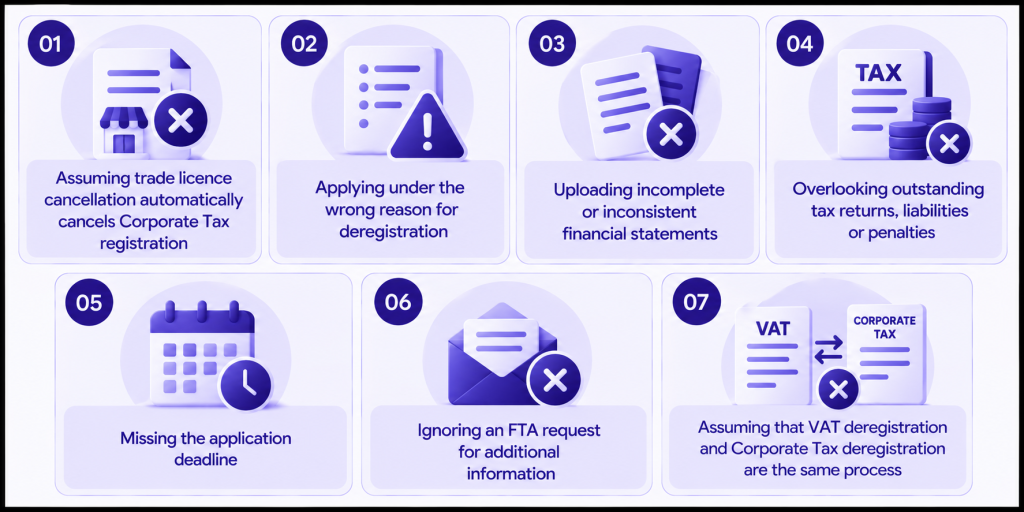
Checking these points before submission can reduce the risk of delays or rejection.
How Can Arnifi Help With Corporate Tax Deregistration?
Corporate Tax deregistration involves more than completing an online form. The reason for deregistration, supporting documents and outstanding tax obligations all need to be reviewed before submission.
Arnifi can assist businesses with understanding the deregistration requirements, preparing the relevant documents and navigating the application process. Support can also help businesses identify outstanding compliance matters that need attention before the application is submitted.
FAQs
1. Is Corporate Tax deregistration free in the UAE?
Yes. The FTA does not charge a government service fee for Corporate Tax deregistration. Professional assistance and document preparation may involve separate costs.
2. How long does FTA deregistration take?
The FTA’s published estimate is 40 working days after it receives a completed application. Requests for additional information can extend the timeline.
3. Can I deregister if my company has outstanding Corporate Tax?
Outstanding returns, Corporate Tax liabilities and administrative penalties due must be addressed before deregistration can be approved. Review your compliance position before applying.
4. Does cancelling my trade licence cancel Corporate Tax registration?
No. Trade licence cancellation and Corporate Tax deregistration are separate processes. You must submit the relevant deregistration application to the FTA.
5. Can a Free Zone company apply for Corporate Tax deregistration?
Yes, if it meets the applicable eligibility conditions. The company’s tax position and reason for deregistration should be reviewed before submitting the application.
6. What happens if the FTA requests additional documents?
You should provide the requested information and resubmit the application within the specified period. If the application is not resubmitted within 60 calendar days of the request, the FTA may reject it.
7. Do I need to deregister from VAT separately?
Yes, if the business is eligible or required to deregister from VAT, it must follow the separate VAT deregistration process. Corporate Tax deregistration does not automatically cancel VAT registration.
8. Can I register for Corporate Tax again after deregistration?
If the business later becomes subject to Corporate Tax, it should review the applicable registration requirements and submit a new registration application when required.
Conclusion
Corporate Tax deregistration in the UAE requires the correct reason, supporting documents and attention to outstanding tax obligations. Businesses should confirm the applicable deadline and submit a complete application through EmaraTax. If you are planning to close or restructure your business, Arnifi can help you understand the requirements and prepare for the deregistration process.
References
Top UAE Packages
Related Articles



Top UAE Packages
Get in Touch
