
UAE Business Consultants for Singapore Entrepreneurs | Guide 2026

Zahira Shaik
SEO Content Writer
Zahira Shaik is an SEO Content Writer and Published Author specializing in research-based content. She excels at analyzing market trends, regulations, and industry developments… Read more

Tulika Saxena
AVP, Sales & Marketing | IIM Nagpur
Tulika Saxena specializes in business finance, sales strategy, and market positioning. Leads growth and partnerships, ensuring seamless business setup experiences and client success across… Read more


Key Fact: As a result of the increasing trade in the economic corridor connecting Singapore and the UAE (where the value of non-oil bilateral trade has exceeded $5.2 billion in 2024), Singapore companies are swiftly developing in the Emirates to penetrate the MEASA region.
Table of contents
- The Singapore–UAE Business Corridor: Why Expand Now?
- Choosing the Right UAE Business Structure for Your Singapore Company
- UAE Corporate Tax, VAT, and Singapore–UAE DTAA Considerations
- Singapore-to-UAE Document Legalisation: Understanding the SAL-to-MOFAIC Chain
- UAE Corporate Banking for Singapore Companies: Requirements and Challenges
- UAE Residency Options for Singapore Entrepreneurs: Visas and Golden Visa Rules
- UAE Business Setup Costs: Understanding the Total Outlay
- How Arnifi Helps Singapore Entrepreneurs Establish and Operate in the UAE
- Step-by-Step UAE Market Entry Roadmap for Singapore Founders
- Conclusion: Planning a Compliant UAE Expansion From Singapore
- Frequently Asked Questions
- What do business consultants in the UAE help Singapore entrepreneurs with?
- References
The Singapore–UAE Business Corridor: Why Expand Now?
The UAE represents a chance for Singapore enterprises to gain access to the Middle East, Africa, and South Asia (MEASA) regions. Nevertheless, to become successful in the expansion process, there is much more than just having a business license.
Growing Bilateral Trade and Regional Opportunities
Trade relations between Singapore and the UAE are constantly evolving, which can be seen in the high volume of bilateral trade amounting to S$27.94 billion in 2025. Being positioned in the middle of international transport routes, the UAE appears to be a natural platform for the expansion of Singapore companies into fast-growing markets of the Gulf Cooperation Council (GCC), East Africa, and India.
Sectors With Expansion Potential
Competencies cultivated in the Singapore business environment resonate with current market demands in the UAE in key sectors:
- Fintech: Online payments, wealth management, and blockchain technology.
- Supply Chain and Logistics: Cold-chain monitoring, automated warehousing, and cross-border logistics tech.
- Technology, AI, and Digital Services: Enterprise SaaS, cybersecurity, and smart city infrastructure.
- Healthcare: Healthtech platforms, biotech, and specialized medical diagnostic services.
- Renewable Energy: Cleantech, solar integration, and sustainability software.
- Food Technology: Urban farming systems, alternative proteins, and agritech.
Government-Backed Market Entry Support
Government organizations provide formal assistance in mitigating market entry risks:
- Enterprise Singapore (EnterpriseSG): Offers market entry readiness support, connections through networks within the country, and co-funding facilities for relevant internationalization projects.
- GIA Abu Dhabi Discovery Programme: A unique program under Global Innovation Alliance helping Singapore technology start-ups enter the UAE market environment.
- Equity Eligibility Requirement: The technology start-ups have to hold at least 30% of their equity in the form of Singaporean equity for participating in relevant government-backed market entry initiatives.
Key Takeaway: Market analysis, business opportunities, and support services should be considered by entrepreneurs from Singapore when choosing the type of UAE setup.
Choosing the Right UAE Business Structure for Your Singapore Company
Mainland companies, free zones, financial free zones, offshore structures, and representative offices serve distinct commercial purposes. The right choice depends on market access, ownership, activities, and operational requirements.
Mainland LLC: Accessing the Domestic UAE Market
- Direct Market Access: Complete market access to conduct business freely throughout UAE Mainland and bid for lucrative B2G (government) procurement deals.
- Foreign Ownership Rules: In accordance with the Federal Decree-Law No. 32 of 2021, foreign investors have complete freedom of 100% ownership in all commercial and industrial activities and are not required to have an Emirati majority stakeholder.
- Emirati Sponsor Requirements: Generally, a local service agent /sponsorship is not required for most commercial/professional licenses.
- Setup Costs & Real Estate: Setup cost indication for the first year is AED 23,005 to AED 60,000 and above. A Mainland company should have its own office space through Ejari registration.
- Emiratisation (Nafis): Companies registered on the Mainland having 50 or more skilled employees need to comply with the Emiratisation quota requirement.
Free Zone Companies: Flexible Structures for Regional Expansion
- Flexible Corporate Setup: Established in the form of a Free Zone Establishment (FZE – single owner) or a Free Zone Company (FZCO – several owners).
- Foreign Ownership: Offers 100% foreign ownership, full repatriation of capital/profit, and no import/export customs duties in the free zone area.
- Regional Hub Alignment: Well-suited for re-exporting, international service delivery, software distribution, and holding operations.
- Free Zone Spectrum: Entry-level free zones such as Ajman Free Zone, SHAMS, RAKEZ, and IFZA; top-quality free zones such as DMCC and JAFZA.
- Licensing Costs: Approximate fees to be paid for licensing: from AED 5,500 to AED 45,000+ depending on visa needs and facilities requirements.
- Mainland Access Restrictions: Free zone companies cannot engage in trade with the mainland market directly; they have to use the services of a local mainland distributor or get a dual licensing permit according to applicable UAE economic development frameworks.
DIFC and ADGM: Financial Free Zones for Specialized Businesses
- Legal System: Dubai International Financial Centre (DIFC) and Abu Dhabi Global Market (ADGM) are English Common Law jurisdictions with separate judicial systems.
- Target Sectors: Appropriate for asset management, venture capital funds, fintech platforms, family offices, and complex business holding companies.
- Budget Allocations: Involve higher costs for regulation and administration. Starting budgets are estimated to be around AED 155,000+ (USD 42,000+) for running financial companies.
Offshore Companies and Representative Offices
- Offshore (RAK ICC): Suitable for holding companies, property investors, or intellectual property (IP) companies. Offshore companies are not allowed to conduct business activities in the UAE.
- Representative Offices: Serve exclusively as non-commercial research or liaison centers for the parent company located in Singapore. As of 2024, after the changes in the local service agent regulations and the introduction of a bank guarantee requirement, representatives are not allowed to earn money in the UAE.
Summary Comparison of Legal Structures
| Structure | Primary Use | Ownership | Key Consideration |
| Mainland LLC | Domestic UAE operations & B2G | 100% Foreign ownership generally permitted | Requires mainland office lease (Ejari) & licensing |
| Free Zone Company | Regional hubs & international service | 100% foreign ownership | Restricted direct trading with UAE mainland without local distributor |
| DIFC / ADGM | Financial services, funds, & holding structures | 100% foreign ownership | Higher capital setup costs & Common Law compliance framework |
| RAK ICC (Offshore) | Asset holding & IP protection | Foreign ownership permitted | Pure holding vehicle; cannot conduct active business in UAE |
| Representative Office | Non-revenue market research & liaison | Parent entity branch | Prohibited from invoicing or earning revenue in the UAE |
UAE Corporate Tax, VAT, and Singapore–UAE DTAA Considerations
The sole comparison of tax rates is not an indication of the tax effectiveness of the cross-border operation. It is important to analyze issues like corporate tax, qualifying income, VAT, withholding taxes, and necessary treaty terms for Singaporean companies.
Singapore vs. UAE Corporate Tax
- Singapore Corporate Tax: Fixed 17% rate for chargeable income, partially exempted for startups and low-income brackets.
- UAE Corporate Tax:
- 0% on taxable income up to AED 375,000.
- 9% on taxable net profit exceeding AED 375,000.
- Taxable Income vs. Revenue: Tax is determined based on the net accounting profit after deducting allowable expenses incurred by the business from its turnover.
Qualifying Free Zone Person: When Can 0% Corporate Tax Apply?
Registration in a UAE free zone does not necessarily mean that the business will be exempt from paying corporate tax. To qualify for QFZP status and have a tax rate of 0% applied, the business must:
- Have income generated through “Qualifying Activities” or transactions between other free zones.
- Have sufficient economic activity (employees, premises, expenses) within the free zone.
- Observe international standards in relation to transfer pricing.
- Ensure that non-Qualifying income is below de minimis amount (5% of total income or AED 5 million, whichever is smaller).
- Produce annual audited financial statements.
Not complying with these requirements results in having to pay the normal 9% corporate tax rate.
VAT Registration and Cross-Border Tax Planning
- Standard VAT Rate: 5% applied to taxable goods and services.
- Mandatory Threshold: Registration is required when taxable supplies and imports exceed AED 375,000 in a trailing 12-month period.
- Voluntary Threshold: Optional registration at AED 187,500 to reclaim input VAT during early-stage setups.
Singapore–UAE Double Taxation Avoidance Agreement (DTAA)
The bilateral DTAA helps protect cross-border entities from double taxation:
- Dividends & Interest: Subject to 0% withholding tax at source under applicable treaty provisions.
- Royalties: Capped at a 5% withholding tax rate.
- Singapore Foreign Dividend Exemption: Under Section 13(8) of the Singapore Income Tax Act, foreign-sourced dividends received by a Singapore resident company may be tax-exempt if headline foreign tax criteria and economic substance conditions are met.
Key Takeaway: A Singapore company should evaluate its complete cross-border tax position rather than comparing headline corporate tax rates in isolation.
Singapore-to-UAE Document Legalisation: Understanding the SAL-to-MOFAIC Chain
Entrepreneurs based in Singapore may face issues relating to document legalisation when registering a company in the UAE, opening a bank account, or going through corporate immigration processes.
Why Singapore Apostilles May Not Be Sufficient
Both Singapore and the UAE are signatories of the Apostille Convention; however, it is often necessary to go through full diplomatic attestation at the MOFAIC and other UAE financial institutions in relation to legal incorporation documents issued by foreign corporate parents.
Documents Commonly Required for Legalisation
- ACRA BizFile+ Company Profile
- Memorandum and Articles of Association (MOA/AOA)
- Board Resolution authorizing UAE expansion and appointing signatories
- Certificate of Incorporation
- Power of Attorney (POA) documents
The 5-Step Attestation Process
1. Singapore Notarisation: Pre-Legal Procedure in Singapore
Proceed to the notarisation and certification of corporate documents by the certified Public Notary in Singapore.
2. SAL Legalisation: S$10.70 standard fee per document
Send the notarised documents to the Singapore Academy of Law (SAL) for certification.
3. Singapore MFA Attestation: Ministry Endorsement
Obtain the clearance and official stamp of the Singapore Ministry of Foreign Affairs (MFA).
4. UAE Embassy Certification: Diplomatic Validation
Send your documents to the UAE Embassy in Singapore for certification.
5. UAE MOFAIC Verification: AED 150 – AED 2,000 per document
Proceed to the final verification at the UAE Ministry of Foreign Affairs and International Cooperation (MOFAIC) once you arrive in the UAE.
Common Document Legalisation Mistakes
- Submission of an old ACRA BizFile+ document (older than 30-90 days).
- Skipping required intermediate authority (i.e., SAL certification).
- Inaccurate budgeting for governmental fees for multi-page documents.
- Overlooking the requirement of legal Arabic translation for particular authorities on the mainland.
- Waiting for document preparation after the corporate reservation, which blocks the banking application process.
UAE Corporate Banking for Singapore Companies: Requirements and Challenges
Being a part of a UAE corporation does not always mean you will be able to open a corporate banking account. There is an impact of foreign investment, non-resident directors, and conducting business affect the procedure of onboarding.
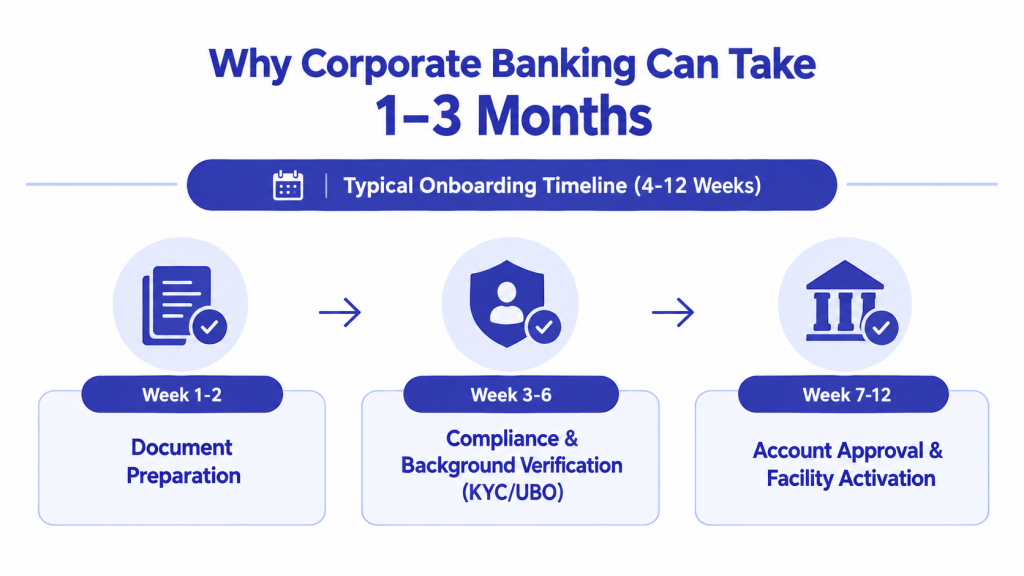
Why Corporate Banking Can Take 1–3 Months
The banks in the UAE function according to the compliance directives of CBUAE. Onboarding takes place due to:
- Thorough verification of the KYC and UBO backgrounds.
- Strict verification of the source of funds of cross-border nature.
- On-the-spot verification of physical presence and Ejari.
- Examination of business models that involve high-risk jurisdictions or foreign holding structures.
Traditional Banks vs. Digital Business Banking Platforms
| Factor | Traditional Banks (e.g., Emirates NBD, HSBC UAE) | Digital Platforms (e.g., Wio Business, RAKBANK Digital) |
| Primary Use Case | Large-scale trade finance, treasury, & cross-border FX | Fast everyday digital banking & operational payments |
| Onboarding Process | Requires physical branch meetings & extensive physical documentation | Streamlined app-based or video-based KYC verification |
| Minimum Balance | Higher (often AED 50,000 to AED 200,000+) | Low or no minimum balance options |
| Physical Services | Chequebooks, trade credit letters, & dedicated relationship managers | Mostly digital transfers; limited physical counter services |
| Trade Finance | Full suite of LC, BG, and corporate credit lines | Limited or non-existent trade finance facilities |
Global Referral Tip: Existing business customers of HSBC Singapore and/or Standard Chartered Singapore can take advantage of global relationship banking referral channels for their UAE branch network KYC referrals.
Corporate Bank Account Opening Checklist
Prepare the following documentation before meeting banking compliance officers:
- UAE Trade License and UAE Incorporation Certificate
- Ejari lease registration or free zone lease agreement
- ACRA Legalized Company Profile along with the profile of the parent company
- 6 months of parent company bank statements in Singapore
- UBO Declaration form and passports of all significant shareholders (>25%)
- Business plan describing revenue model, top clients, and cash flow forecast
- Proof of existing agreements, invoices, or supply agreements
UAE Residency Options for Singapore Entrepreneurs: Visas and Golden Visa Rules
A residency strategy plays an important role in setting up your presence in the UAE on a long-term basis. You need to differentiate between a regular employment visa and other residency programs.
Standard UAE Employment Visas
- Validity: Issued for 2 years (renewable) under company sponsorship.
- Cost Range: Indicative all-in processing costs run AED 3,700 to AED 7,000 per applicant.
- Process Flow: Entry permit issuance Status change Medical fitness examination Emirates ID biometrics Visa stamping.
UAE Entrepreneur Golden Visa
UAE Golden Visa includes a 5-year or 10-year self-residency visa that does not require any company sponsor. The advantages of obtaining the visa include:
- Free movement without restriction on spending more than 6 months outside the UAE without affecting the residency.
- Family sponsorship of spouses, children regardless of age, and domestic helpers.
Entrepreneur Golden Visa Qualification Routes
- SME Revenue Route: Minimum annual business income of AED 1 million to be certified by an accredited UAE financial auditor.
- Incubator & Innovation Route: Certification or nomination by an accredited UAE technological incubator (such as Hub71, Area 2071, or Dubai Future Foundation) of a project worth AED 500,000.
- Venture Founder Exit Route: Previous founders of innovative technology ventures that have been sold both inside and outside the UAE.
Golden Visa Budget Planning
- Government Processing Costs: Estimated main applicant costs range from AED 6,600 to AED 9,600.
- Variable Fees: These include the costs of a VIP health checkup, Emirates ID process, and translation costs.
UAE Business Setup Costs: Understanding the Total Outlay
While a headline license fee could be low, it may only reflect one of several fees necessary to start a UAE business.
Why Headline License Fees Can Be Misleading
Promotional offers often cover only the base trade license. A realistic budget must account for:
- Foreign Establishment Card registration
- Visa quota allocations & processing fees
- Physical office lease or virtual desk fees (Ejari)
- Mandatory medical fitness exams and Emirates ID cards
- Singapore-to-UAE document attestation fees
- Municipal and immigration portal registration charges
Indicative UAE Setup Cost Packages
- Ajman Free Zone Virtual Office: From AED 5,555
- SHAMS Standard Package: From AED 6,885
- Meydan Free Zone: From AED 12,520
- IFZA License and Visa Package: From AED 12,900
- Dubai Mainland Standard Professional: From AED 23,005
- DIFC Prescribed SPV: From USD 5,000
- ADGM Tech Startup Package: From USD 11,230
PRO and Administrative Expenses
The Corporate Public Relations Officer (PRO) is responsible for continuous submission of documents to the government, renewing visas, services at typing centers, and obtaining permission for any activities. Outsourcing the PRO reduces costs of having permanent employees and also helps avoid fines for late renewals.
Employer of Record (EOR) as an Alternative to Immediate Incorporation
For Singaporean companies conducting market research without the need to incorporate in the short run:
- Market Testing: EOR will enable companies to employ sales managers or engineers in the country within the current legal system.
- Cost Efficiency: No license, rental office, or corporate registration expenses incurred in the process of researching the market.
- Turnkey Compliance: Covers local employment contracts, visa sponsorship, payroll processing, and statutory benefits.
How Arnifi Helps Singapore Entrepreneurs Establish and Operate in the UAE
Arnifi provides a platform that makes cross-border market entry easier for clients as legal incorporation, legalization of documents, banking, and HR services become one execution platform.
Transparent Pricing and Flexible Payment Options
- Fixed-Fee Packages: Fully transparent packages that start from AED 5,500 without any extra administrative charges.
- Flexible Payments: No-interest “Pay in 4” schemes on eligible advisory and business formation services.
Digital Tools for Planning a UAE Business Setup
Arnifi offers proprietary tools for the planning of market entry:
- Arni Cost Calculator: Provides estimates of the expenses required for the first year, including licenses, visa quota, office rental, and document attestation.
- Arni Organogram: Helps in visualizing shareholding structure, structure of ownership by foreign parent companies, and management tiers before registration.
- Arni AML Checker & Arni Docs: Performs automated sanctions checks and KYC checks and prepares bilingual templates for business agreements.
Tailored UAE Incorporation Packages
Arnifi assists Singaporean firms across all major jurisdictions:
- Free Zones: Cost-effective setup packages (Ajman from AED 5,555, SHAMS from AED 6,885, IFZA from AED 12,900).
- Mainland: Full-service mainland professional and commercial incorporation (Dubai Mainland from AED 23,005).
- Financial Free Zones: Structuring for venture funds, fintechs, and family offices (DIFC SPVs from USD 5,000, ADGM Tech packages from USD 11,230).
Arnifi HR: Employer of Record and Market Testing
- Hire UAE-based teams for business development and technology support without having to incorporate.
- Manage employment contracts, visas, and local payroll operations.
Document Legalisation and Residency Support
- End-to-end management of the Singapore-to-UAE attestation chain (Notary SAL MFA UAE Embassy MOFAIC).
- Complete residency onboarding for founders, employees, and families, including Investor and Golden Visa applications.
Ongoing Compliance, Accounting, and Banking Support
- Help with corporate tax registrations and filings through FTA, and VAT compliance.
- Guidance with UBO and Economic Substance Regulation (ESR) issues.
- Direct support in dealing with bank KYC for corporate account approvals.
Step-by-Step UAE Market Entry Roadmap for Singapore Founders
- Assess UAE Client demand for business, determine licensing requirements for the chosen sector, and decide whether to have an EOR structure or incorporate directly.
- Pull up ACRA BizFile+ information, notarize corporate documentation, and get through the SAL, MFA, and UAE Embassy attestation process in Singapore.
- Trade name reservation, selecting business activities, preparing incorporation documentation, and Ejari lease arrangements for the office.
- Prepare bank KYC documents, obtain visas for investors/employees, conduct medical examinations, get Emirates ID, and prepare for taxation.
- Stay on top of licensing renewal, pay corporate taxes and VAT, update UBO registers, and look at growth metrics.
Conclusion: Planning a Compliant UAE Expansion From Singapore
Going from Singapore to the UAE means having the potential to access exciting markets in the MEASA region. But for a sustainable journey ahead, choosing the right destination, calculating the real costs of setup beyond licensing costs, and making sure everything is legalized and taxed correctly is crucial.
Through the help of proper guidance for business setup, document legalization, banking, and EOR services, founders from Singapore can effectively expand.
Frequently Asked Questions
What do business consultants in the UAE help Singapore entrepreneurs with?
The business consultants in the UAE help Singaporean entrepreneurs with jurisdiction selection (Mainland/Free Zone), incorporation, ACRA attestation, opening a corporate bank account, UAE taxes, visa applications, and market testing using the Employer of Record services.
How much does it cost to set up a UAE company from Singapore?
Basic virtual free zones cost around AED 5,500 to AED 12,900. The cost of incorporation in the mainland starts from AED 23,005. Specialized financial incorporation such as ADGM/DIFC usually costs from USD 5,000 to USD 11,230+, and this excludes operational costs.
Should a Singapore company choose a UAE mainland company or a free zone?
Opt for the Mainland option if you want to conduct your business directly with UAE nationals, bid for governmental contracts, and run your own retail shops. Opt for the Free Zone if your business is international trade, regional hubs, software sales, and re-exportation.
Can Singapore citizens own 100% of a UAE company?
Yes. Non-resident investors, including Singapore citizens, can possess 100% shareholding in Free Zone companies and all types of business activities in the Mainland, as per Federal Decree-Law No. 32 of 2021.
What documents need to be legalised before incorporating in the UAE?
Typically, necessary parent company documents comprise ACRA BizFile+ Company Profile, Certificate of Incorporation, Memorandum & Articles of Association (MOA/AOA), Resolutions of the Board, and POA.
How long does it take to open a UAE corporate bank account?
Opening of Corporate Bank Accounts normally takes 4-12 weeks, depending on the business type, foreign ownership structure, and meeting of KYC/UBO bank conditions.
Can a Singapore company hire UAE employees without setting up a local entity?
Yes. With the help of an Employer of Record (EOR) service such as Arnifi HR, Singapore-based companies can legally hire, sponsor, and remunerate UAE workers without the need to incorporate immediately.
What UAE tax obligations should Singapore businesses consider?
Businesses need to take into account the requirement of paying a Corporate Tax of 9% on net profits above AED 375,000 (0% in case of income that qualifies for the QFZP program), VAT of 5% in case of taxable supplies over AED 375,000, and compulsory registration at the Federal Tax Authority.
Can Singapore entrepreneurs apply for a UAE Golden Visa?
Yes. Singapore entrepreneurs will be eligible for 5- or 10-year Golden Visas on the basis of annual SME revenues of AED 1 million and above, getting a go-ahead from any accredited UAE incubator (such as Hub71), or having a successful venture exit in the past.
How can Arnifi help with UAE company formation and compliance?
Arnifi provides full-service assistance, which includes fixed-cost setup packages, legal documentation attestation, banking onboarding, corporation tax registration, residency services, and compliance management services.
References
- Government & Official Trade Bodies:
- Bilateral Economic Frameworks:
Top UAE Packages


Related Articles


Top UAE Packages
Get in Touch