
Best Businesses to Start in Dubai for Singapore Entrepreneurs

Anushka
Content Writer
Anushka Basu is a business content writer specialised in global business market insights. She aims to simplify complex regulatory, financial, and business concepts into… Read more

Tulika Saxena
AVP, Sales & Marketing | IIM Nagpur
Tulika Saxena specializes in business finance, sales strategy, and market positioning. Leads growth and partnerships, ensuring seamless business setup experiences and client success across… Read more



Key Fact: The UAE identifies sectors including fintech, e-commerce, healthcare, tourism, logistics, ICT and manufacturing among its promising foreign-investment sectors.
Table of contents
- Introduction
- Why Should Singapore Entrepreneurs Consider Dubai?
- What Are the Best Businesses to Start in Dubai for Singapore Entrepreneurs?
- How Should a Singapore Entrepreneur Choose a Business to Start in Dubai?
- Mainland or Free Zone | Which Works for Your Business?
- What Licences Might a Singapore Entrepreneur Need?
- How Can a Singapore Entrepreneur Set Up a Business in Dubai?
- What Should Singapore Entrepreneurs Check Before Starting?
- How Can Arnifi Help?
- FAQs
- Conclusion
- References
Introduction
Dubai has become a potential expansion market for Singapore entrepreneurs looking to take their businesses beyond Southeast Asia. With established trade links, international connectivity and access to the wider UAE and GCC markets, the city offers opportunities across several industries.
For a Singapore entrepreneur, however, the question is not simply, “Can I start a business in Dubai?” It is also about choosing a business model that fits the market, the entrepreneur’s expertise and the applicable licensing framework.
Singapore already has strengths in technology, trade, logistics, financial services, e-commerce and professional services. These capabilities can provide a useful foundation for entrepreneurs exploring opportunities in Dubai and the wider Middle East.
The right opportunity will ultimately depend on the entrepreneur’s expertise, target customers, business activity, licensing requirements, mainland or free-zone requirements and intended market.
Why Should Singapore Entrepreneurs Consider Dubai?
Dubai is an international business and trade centre with access to the UAE market and potential access to the wider GCC region. Its location also connects Asian, European, and African markets.
For Singapore entrepreneurs, this can create opportunities to extend an existing business model into a different regional market while using Dubai’s established logistics, transportation and digital infrastructure.
The city’s multicultural business environment also supports international companies across sectors such as technology, financial services, logistics, e-commerce, professional services and manufacturing.
The UAE government identifies technology-related sectors, e-commerce, healthcare, tourism, logistics, ICT and manufacturing among promising foreign-investment sectors.
What Are the Best Businesses to Start in Dubai for Singapore Entrepreneurs?
The following are business categories worth considering rather than objectively “best” businesses. Their suitability depends on the entrepreneur’s business model, experience, available capital, target customers and licensing requirements.
1. Technology and Software Businesses
Singapore entrepreneurs with experience in technology can explore opportunities such as:
- SaaS businesses
- Software development
- AI solutions
- Digital transformation services
- Enterprise technology
- IT consulting
- Regional expansion of Singapore technology companies
Dubai’s focus on the digital and knowledge economy can create opportunities for technology businesses serving companies and consumers across the UAE and wider region.
Singapore’s established technology ecosystem can also provide a foundation for companies looking to expand their existing solutions into the Middle East.
Identify the exact technology activity before incorporation, as certain technology or regulated activities may require additional approvals.
2. Fintech and Financial Technology Services
Fintech is another area Singapore entrepreneurs may consider when entering Dubai. Potential business models include:
- Payment technology
- Financial software
- Digital financial solutions
- Regtech
- Fintech consulting
- Technology supporting financial institutions
However, operating a fintech business does not automatically give a company permission to conduct regulated financial services.
Certain activities require approval from the relevant UAE financial regulator. The appropriate licence should therefore be determined by the actual services the business intends to provide.
3. E-Commerce Businesses
Singapore brands and entrepreneurs can also explore Dubai’s e-commerce market through models such as:
- Online retail
- Singapore brands entering the UAE
- Regional e-commerce platforms
- B2B online marketplaces
- Digital consumer businesses
- Cross-border online sales
Dubai’s developed digital-commerce ecosystem can provide access to UAE consumers while also creating potential regional distribution opportunities.
Before launching, entrepreneurs should consider the appropriate commercial or e-commerce activity, product-specific approvals where relevant, import and customs requirements for physical products and the suitability of a mainland or free-zone structure.
4. Trading and Import-Export Businesses
Singapore’s established position in international trade makes trading and distribution another area entrepreneurs may consider in Dubai.
Possible models include:
- General trading
- Product distribution
- Regional sourcing
- Re-export
- Singapore-UAE trade opportunities
- Distribution into GCC markets
Dubai’s logistics infrastructure and location can support businesses involved in moving products between different markets.
The exact goods being traded will determine licensing and regulatory requirements. Certain products may also require additional approvals, while customs requirements should be assessed before the business begins operations.
5. Logistics and Supply-Chain Businesses
Singapore entrepreneurs with experience in logistics and supply-chain management may explore:
- Freight and logistics services
- Supply-chain management
- Warehousing
- Distribution
- Shipping-related services
- Technology-enabled logistics
Dubai’s ports and airports, combined with its regional distribution capabilities, can provide opportunities for businesses serving customers across the UAE and neighbouring markets.
The UAE government specifically identifies logistics services as a promising foreign-investment sector.
6. Professional and Business Consulting
Entrepreneurs with established expertise can consider service-based businesses such as:
- Management consulting
- Business advisory
- Marketing consulting
- Technology consulting
- Accounting and financial advisory where appropriately licensed
- Corporate services
A consulting business can allow entrepreneurs to leverage existing knowledge and professional experience while serving companies operating in Dubai.
There can also be demand from international companies entering the UAE that require professional support as they establish local operations.
The professional or service activity selected must match the actual services being provided. Regulated professional activities may require additional approvals.
7. Manufacturing and Industrial Businesses
Manufacturing can be relevant for Singapore entrepreneurs looking to establish a production or regional distribution base.
Potential areas include:
- Light manufacturing
- Industrial production
- Assembly
- Regional manufacturing
- Product distribution linked to manufacturing
The UAE’s manufacturing ambitions, regional market access and specialised industrial and free-zone infrastructure can create opportunities for businesses with suitable operating models.
The UAE government lists manufacturing among its promising foreign-investment sectors.
8. Healthcare and Health-Tech Businesses
Healthcare and health technology can also present opportunities for entrepreneurs with relevant industry experience.
Potential models include:
- Health technology
- Healthcare services
- Medical technology
- Digital health solutions
- Healthcare consulting
Healthcare is a regulated sector, so the relevant activity may require approvals from specialised authorities. Licensing requirements should therefore be established before operations begin.
The UAE identifies healthcare and medical tourism among promising foreign-investment sectors.
9. Tourism and Hospitality-Related Businesses
Dubai’s international tourism ecosystem can also support business opportunities related to travel and hospitality.
Potential areas include:
- Travel services
- Tourism technology
- Hospitality services
- Travel management
- Tourism-related consulting and solutions
Dubai’s established international visitor base creates opportunities around travel, hospitality and tourism-related services.
However, tourism-related activities may require sector-specific approvals depending on the business model.
How Should a Singapore Entrepreneur Choose a Business to Start in Dubai?
Instead of choosing a business purely because it appears popular, entrepreneurs should assess the following factors:
| Factor | What to Consider |
| Existing expertise | Does the entrepreneur already have experience in the sector? |
| Target customer | UAE consumers, businesses or regional customers? |
| Business model | Product, service, technology, trading or manufacturing? |
| Regulation | Does the activity require additional approval? |
| Location | Mainland or specialised free zone? |
| Infrastructure | Does the business require an office, warehouse or industrial facility? |
| International operations | Will the business import, export or re-export? |
| Scalability | Can the structure support regional expansion? |
This approach helps connect the business idea to the practical requirements of operating in Dubai.
Mainland or Free Zone | Which Works for Your Business?
Dubai businesses can generally consider mainland and free-zone structures, although the appropriate option depends on the activity and operating model.
| Mainland | Free Zone |
| Direct UAE mainland commercial presence | Jurisdiction-specific operating framework |
| Suitable for businesses targeting local UAE operations | Can suit specialised and regional/international models |
| Licence issued through the relevant mainland authority | Licence issued by the selected free-zone authority |
| Activity-specific requirements apply | Activity and facility options vary by free zone |
| Relevant for businesses requiring mainland operations | Can provide sector-specific infrastructure and services |
The UAE government advises investors to identify the business activity first and then select the appropriate legal form and licence.
Free zones also differ in the sectors, legal entities, facilities and services they support.
What Licences Might a Singapore Entrepreneur Need?
The licence required depends on the business activity and the jurisdiction selected. Depending on the business model, an entrepreneur may require:
- Commercial licence
- Professional/service licence
- Industrial licence
- E-commerce-related activities
- Sector-specific licences or approvals
There is no single generic “Dubai business licence” that covers every business model.
The business activity should therefore be determined before selecting the licence and jurisdiction.
How Can a Singapore Entrepreneur Set Up a Business in Dubai?
A practical setup process can include the following steps:
1. Identify the business activity
Determine exactly what the business will sell or provide
2. Validate the business model
Identify target customers and whether the business will operate locally or regionally
3. Choose mainland or free zone
Match the jurisdiction to the operating model
4. Select the legal form
Choose the appropriate entity structure
5. Register the trade name
Complete the applicable naming requirements
6. Obtain initial approval and other approvals
Complete any approvals required for the activity
7. Secure the business premises
Choose the appropriate office, warehouse or facility
8. Apply for the licence
Complete the relevant licensing process
9. Complete tax and banking requirements
Assess UAE Corporate Tax and VAT obligations and establish business banking where required
The UAE’s official mainland setup process similarly begins with identifying the activity, followed by legal-form selection, trade licensing, trade-name registration, approvals, premises and documentation.
What Should Singapore Entrepreneurs Check Before Starting?
Before establishing a business in Dubai, Singapore entrepreneurs should review:
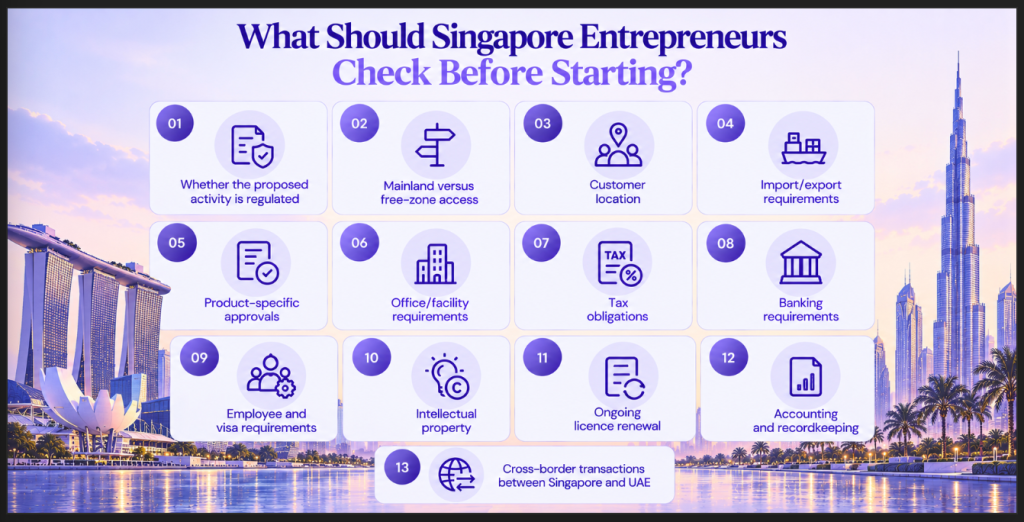
These considerations can help entrepreneurs assess the complete operating model before committing to a particular structure.
How Can Arnifi Help?
Arnifi can support Singapore entrepreneurs exploring Dubai as a business destination by helping with:
- Assessing suitable Dubai business structures
- Activity and jurisdiction selection
- Mainland and free-zone incorporation
- Licensing and corporate documentation
- Tax-registration considerations
- Banking and ongoing compliance
- Establishing a UAE base for regional expansion
The right setup can depend on the entrepreneur’s intended activity, customers and expansion plans, so understanding these requirements early can make the incorporation process more structured.
FAQs
What are the best businesses to start in Dubai for Singapore entrepreneurs?
Business categories worth considering include technology, fintech, e-commerce, trading, logistics, professional services, manufacturing, healthcare and tourism. Suitability depends on the entrepreneur’s expertise, target market, capital, business model and licensing requirements.
Can a Singapore entrepreneur own 100% of a business in Dubai?
Ownership rules depend on the business activity and jurisdiction. Entrepreneurs should check the applicable ownership framework for the specific mainland or free-zone structure before incorporation.
Should I start my Dubai business in a mainland or free zone?
The choice depends on factors such as the business activity, target customers, operating model, premises and regulatory requirements. Mainland and free-zone structures serve different business needs.
What licence do I need to start a business in Dubai?
The required licence depends on the activity. Commercial, professional/service, industrial and e-commerce-related activities can have different licensing requirements, while regulated sectors may require additional approvals.
Can a Singapore business use Dubai as a base for entering the GCC market?
Dubai can provide a potential base for businesses seeking access to the UAE and wider GCC markets. However, the appropriate structure and ability to operate in specific markets will depend on the business activity and applicable regulations.
Conclusion
Dubai offers opportunities across technology, fintech, e-commerce, trading, logistics, professional services, manufacturing, healthcare and tourism.
The most suitable business depends on the entrepreneur’s existing expertise, target market and operating model. Singapore entrepreneurs should identify the activity before choosing a licence or jurisdiction.
Mainland and free zones serve different business requirements, while regulated and sector-specific activities may require additional approvals.
Proper planning around licensing, tax, banking and ongoing compliance should form part of the expansion strategy.
References
Top Singapore Packages


Related Articles


Top Singapore Packages
Get in Touch