
Dubai Business Hub for Singapore Businesses | Opportunities, Benefits & Setup Options

Anushka
Content Writer
Anushka Basu is a business content writer specialised in global business market insights. She aims to simplify complex regulatory, financial, and business concepts into… Read more

Tulika Saxena
AVP, Sales & Marketing | IIM Nagpur
Tulika Saxena specializes in business finance, sales strategy, and market positioning. Leads growth and partnerships, ensuring seamless business setup experiences and client success across… Read more



Key Fact: Dubai can serve as a regional base for Singapore businesses looking to access the UAE, GCC and wider Middle Eastern markets, with options including mainland and free-zone company structures
Table of contents
- Introduction
- Why Is Dubai Considered a Business Hub for Singapore Businesses?
- What Business Opportunities Can Singapore Companies Explore in Dubai?
- What Are the Benefits of Using Dubai as a Regional Business Hub?
- Should a Singapore Business Choose Dubai Mainland or a Free Zone?
- What Business Setup Options Are Available in Dubai?
- What Licences Might a Singapore Business Need in Dubai?
- What Are the Tax Considerations for Singapore Businesses Expanding to Dubai?
- How Can a Singapore Business Set Up in Dubai?
- What Should Singapore Businesses Consider Before Expanding to Dubai?
- Dubai Business Hub | A Practical Decision Framework
- How Can Arnifi Help?
- FAQs
- Conclusion
- References
Introduction
Dubai has become an important commercial centre for businesses looking beyond their home markets. For Singapore-based companies, the city can offer a practical base for exploring opportunities across the UAE, the GCC and wider Middle Eastern markets.
The connection between Singapore and the UAE also creates opportunities beyond simply establishing a company. Businesses can explore trade, technology, logistics, professional services, investment and other sectors while using Dubai’s established infrastructure and international business ecosystem.
For a Singapore business considering expansion, the key questions are usually practical: which structure should be used, where should the company be established, what licence is required and what tax and compliance obligations will apply?
This guide covers the main business opportunities, benefits, setup options and considerations for Singapore companies looking at Dubai as a regional business hub.
Why Is Dubai Considered a Business Hub for Singapore Businesses?
Dubai’s location and infrastructure make it an important commercial and logistics centre for companies operating across multiple markets. A Singapore business entering Dubai can potentially access the UAE market while also exploring opportunities across the wider GCC region.
Dubai also provides connectivity with markets across Asia, Europe and Africa. Its established transport, logistics, financial and professional-services ecosystem can support companies managing regional activities from the city.
Businesses from Singapore can explore opportunities across sectors such as:
- Technology
- Financial services
- Logistics
- E-commerce
- Professional services
- Manufacturing and trading
This can complement Singapore’s position as an Asian business and financial centre. A company that already has an established presence in Singapore may therefore consider Dubai when developing a Middle Eastern or wider regional expansion strategy.
What Business Opportunities Can Singapore Companies Explore in Dubai?
Singapore companies can explore opportunities across several sectors, depending on their business model, target customers and licensing requirements.
1. Technology and Digital Businesses
Dubai’s technology ecosystem can provide opportunities for Singapore-based technology companies looking to expand internationally.
Potential areas include:
- Software and technology services
- Fintech and digital solutions
- AI and emerging technology businesses
- Regional expansion of Singapore-based technology companies
Companies should still determine whether their specific technology or financial activity requires additional regulatory approval before beginning operations.
2. Trade and Logistics
Dubai’s logistics infrastructure can be relevant for Singapore businesses involved in international trade and supply-chain activities.
Potential opportunities include:
- Re-export activities
- Regional distribution
- Supply-chain services
- Shipping and logistics services
- Access to GCC markets
The appropriate licence and customs requirements will depend on the nature of the goods and the intended business activity.
3. Financial and Professional Services
Singapore businesses operating in professional services can also consider Dubai for regional expansion.
Potential areas include:
- Consulting
- Corporate services
- Investment-related businesses where appropriately licensed
- Accounting
- Advisory services
- Professional services
Regulated financial activities may require approval from the relevant UAE regulatory authority in addition to the underlying business licence.
4. E-commerce and Consumer Businesses
Dubai can provide a commercial base for Singapore businesses seeking to reach customers in the UAE and surrounding markets.
Businesses may establish a UAE presence for regional sales, distribution and customer acquisition while using Dubai’s established digital-commerce ecosystem.
5. Manufacturing and Industrial Businesses
Manufacturing and industrial companies can explore Dubai and the wider UAE for regional distribution and production opportunities.
Free zones may offer specialised infrastructure depending on the activity and facilities required.
What Are the Benefits of Using Dubai as a Regional Business Hub?
Dubai can offer several practical advantages for a Singapore business planning international expansion.
Strategic Market Access
A Dubai presence can provide access to the UAE market and create opportunities to explore the wider GCC region.
The city’s location can also support businesses looking at markets connecting Asia, Europe and Africa.
International Connectivity
Dubai has established air and maritime connectivity, which can be useful for businesses managing regional operations from one location.
This can be particularly relevant for trading, logistics, distribution and international service businesses.
Business Infrastructure
Dubai has an established commercial ecosystem that includes professional service providers, financial institutions, technology infrastructure and business support services.
This infrastructure can help international businesses establish and operate regional activities.
Foreign Investment Environment
The UAE has a framework that allows foreign investors to establish businesses in different jurisdictions.
However, ownership rules depend on the applicable business activity and jurisdiction. Businesses should therefore confirm the requirements applicable to their specific licence rather than assuming that the same ownership rules apply everywhere.
Digital Business Environment
Dubai and the wider UAE have developed digital government services and online processes for various business activities.
Technology-focused infrastructure and an established digital ecosystem can also be relevant for Singapore companies operating in technology and digital sectors.
Should a Singapore Business Choose Dubai Mainland or a Free Zone?
Singapore businesses generally need to compare the mainland and free-zone options before selecting a structure.
| Setup Option | What It Generally Offers | Potential Fit for Singapore Businesses |
| Dubai Mainland | Licence issued through the relevant Dubai mainland authority, allowing businesses to operate within the UAE market subject to activity-specific requirements | Businesses seeking a direct UAE commercial presence, local market activity or broader mainland operations |
| Dubai Free Zone | Jurisdiction-specific company structures, licensing and operating frameworks | Businesses seeking a specialised ecosystem, regional/international operations or activities suited to the selected free zone |
Neither option is automatically suitable for every business. The choice depends on factors such as:
- Business activity
- Target customers
- Office requirements
- Local-market operations
- Licensing requirements
- Import/export needs
- Ownership structure
A Singapore company should therefore determine its intended operating model before selecting a jurisdiction.
What Business Setup Options Are Available in Dubai?
A Singapore business can consider several possible structures depending on its expansion plans and the applicable regulations.
These can include:
- Mainland company
- Free-zone company
- Branch of a Singapore company, where permitted and appropriate
- Subsidiary or new UAE entity
The legal form and licence will depend on the intended business activity and the selected jurisdiction.
A Singapore company does not necessarily need to establish an entirely new standalone business model in Dubai. Depending on its objectives, it may consider a branch, subsidiary or another permitted entity structure.
What Licences Might a Singapore Business Need in Dubai?
The required licence generally depends on what the business intends to do in Dubai.
Potential categories include:
- Commercial licence for relevant trading activities
- Professional licence for applicable professional and service activities
- Industrial licence for qualifying manufacturing activities
- Activity-specific regulatory approvals where applicable
Certain sectors may also require approval from specialised UAE or Dubai regulators.
Therefore, determine the business activity before selecting the licence and jurisdiction. Choosing the jurisdiction first and attempting to fit the business activity around it can create unnecessary licensing and compliance issues.
What Are the Tax Considerations for Singapore Businesses Expanding to Dubai?
Singapore businesses establishing a Dubai presence should consider both UAE and Singapore-side tax implications.
The main UAE considerations can include:
- UAE Corporate Tax
- UAE VAT
- Corporate Tax registration where applicable
- VAT registration where applicable
- Taxable income
- Transfer pricing where relevant
- Cross-border transactions
Corporate Tax applies subject to the relevant UAE legislation, thresholds, exemptions and conditions. VAT considerations will depend on whether the business makes taxable supplies in the UAE and whether the applicable registration requirements are met.
Businesses should also assess how transactions between the Singapore and UAE entities are treated and whether the Singapore-UAE tax framework creates additional obligations.
Dubai should therefore not be described simply as a “tax-free” jurisdiction. The actual tax position depends on the company’s activities, structure, income and applicable legislation.
Singapore businesses should consider UAE requirements alongside relevant Singapore tax rules and guidance, including those administered by the Inland Revenue Authority of Singapore.
How Can a Singapore Business Set Up in Dubai?
A Singapore company can approach the setup process through a series of practical steps.
1. Define the Business Activity
Determine exactly what the UAE entity will sell, provide, manufacture or otherwise conduct in Dubai.
2. Select the Jurisdiction
Compare Dubai mainland with suitable free-zone options based on the intended activity and operating model.
3. Select the Legal Structure
Choose the appropriate entity, branch or subsidiary structure based on the company’s expansion plans.
4. Apply for the Business Licence
Complete the relevant incorporation and licensing requirements with the applicable authority.
5. Arrange Corporate Documentation
Prepare incorporation, shareholder, director and Singapore-company documents where required.
6. Establish the Operating Setup
Arrange office, facility or other operating requirements applicable to the selected licence.
7. Complete Tax and Compliance Registrations
Assess Corporate Tax, VAT and other applicable registrations and compliance requirements.
8. Open a Corporate Bank Account
Approach suitable UAE banking institutions with the required corporate documentation and information.
9. Obtain Sector-Specific Approvals
Complete any additional regulatory approvals required for the chosen business activity.
What Should Singapore Businesses Consider Before Expanding to Dubai?
Before establishing a Dubai presence, Singapore businesses should assess how the proposed UAE operation will actually function. Important considerations include:
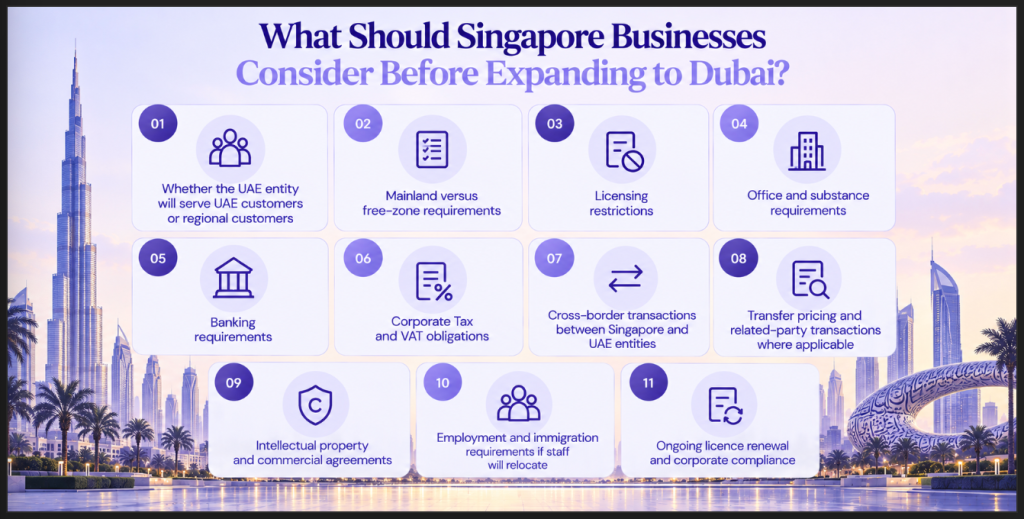
The company’s intended customers and operating model should be considered alongside the setup costs. A structure that works for a regional technology business may not be appropriate for a trading or manufacturing company.
Dubai Business Hub | A Practical Decision Framework
The following framework can help Singapore businesses connect their expansion objective with the type of setup they may need.
| Business Requirement | Consider |
| UAE local-market operations | Mainland structure |
| Regional/international operations | Relevant free-zone structure |
| Existing Singapore company expansion | Branch or UAE subsidiary options |
| Regulated activity | Relevant regulator and licence |
| Trading/import-export | Licence and customs requirements |
| Professional services | Appropriate professional/service activity |
| Technology business | Technology-compatible jurisdiction and activity |
| Manufacturing | Industrial licensing and suitable facilities |
This is a starting framework rather than a substitute for checking the specific licensing requirements of the proposed activity.
How Can Arnifi Help?
Singapore businesses entering Dubai may need support across several stages of the setup process.
Arnifi can help with:
- Assessing suitable UAE setup structures
- Mainland and free-zone incorporation
- Licensing and corporate documentation
- Understanding UAE tax-registration requirements
- Banking and ongoing corporate compliance requirements
- Establishing Dubai as a practical regional expansion base
The right setup depends on the Singapore company’s activity, target market and operating model. Getting these decisions clear at the beginning can make the rest of the incorporation and compliance process more straightforward.
If your Singapore business is considering Dubai as a regional base, Arnifi can support you in assessing the available UAE setup options and the requirements relevant to your proposed activity.
FAQs
Why should Singapore businesses consider Dubai as a business hub?
Dubai can provide Singapore businesses with access to the UAE market and potential opportunities across the GCC and wider Middle East. Its international connectivity, logistics infrastructure and business ecosystem can also support regional operations.
Can a Singapore company set up a business in Dubai?
Yes, a Singapore company can explore several UAE structures, including a mainland company, free-zone company, branch or subsidiary where permitted. The appropriate option depends on the business activity and expansion model.
Should a Singapore business choose Dubai mainland or a free zone?
The choice depends on the company’s activity, customers, operating requirements, licensing needs and intended market. Mainland and free-zone structures have different regulatory and operational frameworks.
What taxes should Singapore businesses consider when expanding to Dubai?
Businesses should consider UAE Corporate Tax and VAT where applicable, along with Singapore-side tax considerations and the treatment of cross-border transactions between the two jurisdictions.
How long does it take to set up a business in Dubai from Singapore?
The timeframe depends on the selected jurisdiction, business activity, documentation, approvals and any additional regulatory requirements. Businesses should confirm the current processing requirements with the relevant licensing authority before planning their launch.
Conclusion
Dubai can provide Singapore businesses with a strategic base for entering the UAE and exploring wider regional markets. Its connectivity, infrastructure and established business ecosystem can make it relevant for companies considering international expansion.
The appropriate structure, however, depends on the business activity, customers, operating model and regulatory requirements. Mainland, free-zone, branch and subsidiary structures can serve different expansion objectives.
Tax, licensing, banking and ongoing compliance should all be considered before incorporation. Businesses should assess the complete operating model rather than selecting a jurisdiction solely because the setup appears convenient.
For Singapore companies considering the UAE, understanding the business activity and regional expansion objective is the first step towards choosing an appropriate Dubai setup structure. Arnifi can help businesses assess those requirements and plan their UAE market entry accordingly.
References
Top Singapore Packages


Related Articles


Top Singapore Packages
Get in Touch