
The Complete Checklist for Company Dissolution in KSA

Zahira Shaik
SEO Content Writer
Zahira Shaik is an SEO Content Writer and Published Author specializing in research-based content. She excels at analyzing market trends, regulations, and industry developments… Read more

Tulika Saxena
AVP, Sales & Marketing | IIM Nagpur
Tulika Saxena specializes in business finance, sales strategy, and market positioning. Leads growth and partnerships, ensuring seamless business setup experiences and client success across… Read more


Key Fact: The geographical location of the organization may impact the practical implementation and coordination of closure activities; however, statutory compliance will always be at the heart of the company’s dissolution.
Table of contents
- Introduction
- Understanding Company Dissolution in Saudi Arabia
- Voluntary vs. Mandatory Liquidation in Saudi Arabia
- The 9-Step Checklist for Company Dissolution in KSA
- The Essential Role of a Company Liquidator
- Regional Nuances: Managing Company Closure in Riyadh, Jeddah, and Dammam
- Common Pitfalls to Avoid During Saudi Corporate Liquidation
- How Arnifi Simplifies Corporate Liquidation and Compliance in KSA
Introduction
In addition to ending the operations of a company in Saudi Arabia, the process requires its dissolution and liquidation. It also involves clearing liabilities, dealing with employees and taxes, and obtaining approval of the final dissolution. In this guide, you will learn about the 9 most important steps of Company Dissolution in KSA, starting from the resolution to receive the liquidation certificate.
Knowledge of company dissolution in KSA is important for all those who would like to understand how the process is performed in the Saudi business environment. Dissolution means the decision of the parties to start the process of closing the business; in the Saudi commercial environment, de-registration refers to the cancellation of business registrations and licenses, whereas liquidation is the process of asset realization, liability settlement, and profit distribution.
It is not possible for a business to just decide to stop operating. Failure to deal with any corporate debts, failure to file tax papers, and failure to settle labor papers will attract huge penalties, operational constraints from government websites, and even expose the board members of the corporation or even shareholders to possible legal action. Settlement of all tax, labor, and financial matters guarantees a smooth exit strategy.
Understanding Company Dissolution in Saudi Arabia
Company dissolution in Saudi Arabia is the point that marks the transition of an operational corporate entity into the process of dissolving itself. When a company goes into the dissolution stage, its legal powers become limited to those operations necessary for liquidation only.
A thorough clearance of all corporate commitments is necessary. All outstanding assets should be gathered, all liabilities and debts of creditors settled, taxes and Zakat paid to the relevant agencies, EOSB of the employees paid in full, and government platform accounts closed. By doing so, not only will one protect oneself against any legal liabilities, but the business executives will stay in good standing with Saudi authorities regarding any future business dealings.
Going through all these steps requires multifunctional management. Here, Arnifi provides a special corporate compliance ecosystem that helps in managing the closure process.
Voluntary vs. Mandatory Liquidation in Saudi Arabia
There are two major routes for closing businesses under the Saudi Companies Law. The determination of the route to be taken determines the documentation and statutory processes to be followed during the entire process.
- Voluntary Liquidation: The voluntary route is started by the shareholders, partners, or the members of the board. It can be adopted when the business has reached its business goals or if it has decided to leave the market due to certain business-related reasons.
- Mandatory Liquidation: This can be referred to as a statutory method of liquidation. Mandatory liquidation can happen due to statutory insolvency, operational misconduct, court orders, or if the business has suffered losses that have been established under Saudi Companies Law and there is no recapitalisation of the shareholders.
A skilled liquidator needs to be appointed in both processes for the protection of the creditors’ rights, the management of asset sales, and the proper allocation of debts.
| Metric / Aspect | Voluntary Liquidation | Mandatory Liquidation |
| Initiation | Shareholders, owners, or board members | Regulatory authorities, courts, or creditors |
| Common Circumstances | Strategic exit, commercial pivot, project completion | Insolvency, legal non-compliance, statutory loss thresholds |
| Primary Decision-Maker | General Assembly / Shareholder Body | Judicial Authority / Government Body |
| Liquidator Role | Appointed by shareholders to manage orderly closure | Court-appointed or mandated to prioritize creditor settlement |
The 9-Step Checklist for Company Dissolution in KSA
1. Pass the Board of Directors Resolution: Prerequisite for formal filing.
An extraordinary general meeting or board of directors should be convened where a resolution is passed explicitly for the purpose of dissolving the business. It will be done in complete compliance with the Articles of Association and the Companies Law of the Kingdom of Saudi Arabian country.
2. File the Liquidation Application: Multi-agency regulatory alignment.
For those business entities that are registered under the Ministry of Investment’s (MISA) investment system, MISA becomes the first port of call to get liquidation permission. An application is submitted along with relevant corporate papers to secure the MISA liquidation letter.
The MISA clearance serves as the required document that is essential in coordinating closure in other governmental departments and portals in Saudi Arabia:
- Ministry of Investment (MISA): License cancellation and liquidation clearance for foreign companies.
- Ministry of Commerce (MOC): Commercial Registration (CR) status updates and corporate closure filings.
- Zakat, Tax and Customs Authority (ZATCA): Zakat/tax and VAT return filing and Tax Identification Number (TIN) deregistration.
- General Organization for Social Insurance (GOSI): Settlement of social insurance accounts and employment record closures.
- Ministry of Human Resources and Social Development (MHRSD): Labor office establishment files closure and quota clearance.
- Saudi Passports (Jawazat): Visa cancellation, exit permission, and transfer of residency.
- Corporate Banking Institutions: Bank account closure and settlement.
Practical Note: It is important to prepare all relevant documents from corporates, tax, labor, and banks before lodging your first application to avoid delays and further correspondence.
3. Publish the Dissolution Decision: Statutory public record.
Announce the decision to dissolve in the statutory form either in approved national newspapers or through proper channels in accordance with Saudi business regulations. This will serve to inform creditors, suppliers, employees, and other stakeholders about the dissolution procedure in a statutory manner.
4. Appoint the Liquidator and Obtain Acceptance: Transfer of management authority.
The next step is the appointment of an approved liquidator who will be assigned the task of managing the company during the period of liquidation. The written acceptance of the liquidator will transfer all responsibilities in the process of asset management, debt payment, reporting, and accounting to the liquidator.
5. Observe the Statutory Notice Period for Creditor Claims: Protection of outstanding liabilities.
Wait for the statutory claim period for third parties such as creditors and stakeholders to make claims against the company. The liquidator will then process these claims and settle all of them before the distribution of remaining assets among the stockholders.
6. Close Corporate Bank Accounts: Financial account reconciliation.
Collect all monetary payments outstanding, settle all bills to suppliers, make payments to all utilities and vendors, and reconcile the books. Once all the financial transactions have been settled, close the entity’s corporate bank accounts and keep the financial documents as per statutory requirements.
7. Complete Final Tax Returns and Tax Deregistration: ZATCA tax clearance phase.
Tax closure should be well integrated into the overall liquidation process timeline. Keep making VAT returns on a regular basis until the entity is deregistered from the VAT system. In case of starting the liquidation process in the middle of a quarter, first complete the VAT return of the current quarter and then deregister for VAT on the ZATCA portal.
Once all the VAT issues are sorted out, file final corporate tax or Zakat returns, sort out balance issues, and get TIN cancellation by ZATCA.
8. Cancel Employee Visas and Settle Outstanding Dues: Labor office & GOSI compliance.
Clear all outstanding arrears of the employees, which include payment of salaries, vacation pay, and end-of-service benefits (EOSB) as per Saudi Labor Law. Issue the final exit visa, transfer the sponsorship, update the labor portal at MHRSD, and clear the company status with GOSI. Keep copies of discharge papers for all employees.
9. Submit the Final Liquidator Audit Report and Obtain Liquidation Certificate: Final legal termination.
The liquidator prepares a final audit report that includes the valuation and sale of company assets, clearing the liabilities, and fulfilling all requirements. Present this final audit report with evidence of clearance from ZATCA, MOC, MHRSD, and GOSI to get the Liquidation Certificate and legally dissolve the company.
The Essential Role of a Company Liquidator
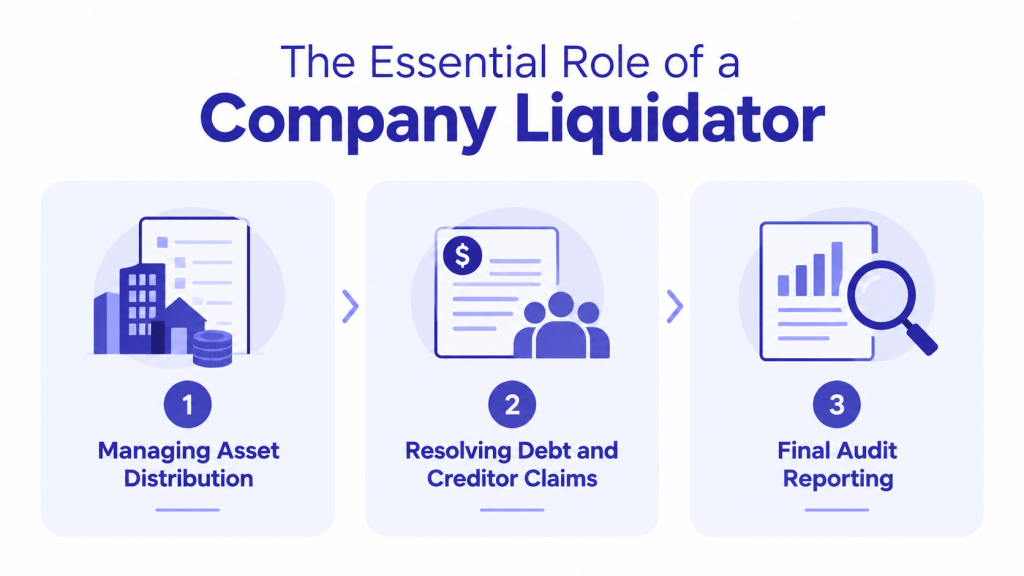
The liquidator becomes the de jure custodian of the organization during the entire dissolution process. Upon appointment of the liquidator, all the executive authority is passed from the Board of Directors to the liquidator, and he/she takes up the fiduciary responsibility of handling the dissolution:
- Managing Asset Distribution: The liquidator assesses the assets and liquidates them accordingly. The proceeds thus obtained from the asset liquidation are held in an exclusive liquidation account.
- Resolving Debt and Creditor Claims: The liquidator evaluates the claims submitted during the statutory notice period; priority is given to statutory claims first, then the secured claimants, and finally, all corporate debts are settled.
- Final Audit Reporting: The liquidator writes the final audit report about the realization of assets and settlement of liabilities and taxes. This report forms the main document for issuance of the Liquidation Certificate.
Regional Nuances: Managing Company Closure in Riyadh, Jeddah, and Dammam
Even though liquidation laws via statutes are uniform throughout the Kingdom as per Saudi Companies Law, localized enforcement of the administrative execution will depend on the location of your business operation as follows:
- Riyadh: As the capital of Saudi Arabia, Riyadh is home to the headquarters for regulatory authorities such as MISA, MOC, and ZATCA. Businesses that have their headquarters in Riyadh usually conduct themselves with corporate filings and a multi-authority approval process through ministry headquarters.
- Jeddah: Being the commercial hub of the Western region, business closure in Jeddah will necessitate coordination with regional port, customs, and commerce authorities, especially for businesses that are involved in trading and maritime sectors.
- Dammam: Businesses based in the Eastern Region usually engage in special regional authorities’ processes, industrial city regulations (MODON), in addition to municipality requirements.
Whatever may be your base, coordination with online portals and local authorities is essential for seamless operations.
Common Pitfalls to Avoid During Saudi Corporate Liquidation
Unnecessary errors that occur during liquidation will lead to financial and legal consequences:
- Missing Tax Filing Deadlines: It is an erroneous move to assume that filing for liquidation exempts one from paying taxes. VAT and Zakat filing deadlines not met automatically incur penalties that prevent deregistration of the business.
- Leaving Employee Dues Unsettled: Not clearing the EOSB and not having the signed copies of these documents, as well as not updating the employee’s files at the labor office, may block the MHRSD portal.
- Closing Bank Accounts Too Early: If you close your corporate bank account before paying off all the dues of the ZATCA, the liquidator, and any utility bills, there will be a deadlock in paying.
- Incomplete Creditor Settlement: Distributing the capital to the shareholders before the resolution of statutory notice claims makes directors personally responsible for such claims.
- Incorrect or Incomplete Liquidation Documentation: If there are differences in the shareholder’s name, Commercial Registrations, and what is listed by the ministry, the liquidation application is instantly rejected.
- Treating Business Inactivity as Formal Closure: If the business stops its operations but fails to file for liquidation formally, there will be liability for other fees, licenses, and statutory filings.
How Arnifi Simplifies Corporate Liquidation and Compliance in KSA
Corporation Liquidation in the Kingdom of Saudi Arabia is not simply one form filing in front of the government; it is rather a complicated process of filing in many governmental departments that needs to be done systematically.
Arnifi acts as a one-stop shop service provider for all legal entity strike-offs, liquidations, and compliance in the Kingdom of Saudi Arabia. Arnifi can assist in closing down legal entities in many forms, such as:
- Sole Proprietorships
- Limited Liability Companies (LLCs)
- Foreign Branch Offices and MISA-licensed entities
Arnifi assists in the preparation of documentation as well as filing regarding shareholder resolution, liquidation filing, MISA application, engagement of liquidators, ZATCA tax/VAT registration, labor/visa cancellation, and closure of corporate bank accounts. Apart from documentation assistance, Arnifi can assist by meeting governmental representatives (MISA, MOC, ZATCA, MHRSD, GOSI) in person to solve any procedural issues and ensure filing in an efficient manner.
References
For official guidelines, regulatory frameworks, and portal access regarding corporate dissolution in KSA, refer to the following governing bodies:
- Ministry of Investment (MISA)
- Ministry of Commerce (MOC)
- Zakat, Tax and Customs Authority (ZATCA)
- Ministry of Human Resources and Social Development (MHRSD)
- General Organization for Social Insurance (GOSI)
Are you planning to wind up or close your business in Saudi Arabia? Arnifi can handle the entire process for you, including documentation, authorization coordination, taxation and VAT issues, employee and visa termination procedures, banking procedures, and the liquidation or closing of your business. With the help of our expertise with the respective Saudi authorities and any further follow-up that may be needed, we help you wind up your business hassle-free.
Top UAE Packages


Related Articles

Top UAE Packages
Get in Touch