
Oman Vision 2040 Investment Opportunities: The Complete Guide for Investors 2026

Zahira Shaik
SEO Content Writer
Zahira Shaik is an SEO Content Writer and Published Author specializing in research-based content. She excels at analyzing market trends, regulations, and industry developments… Read more

Tulika Saxena
AVP, Sales & Marketing | IIM Nagpur
Tulika Saxena specializes in business finance, sales strategy, and market positioning. Leads growth and partnerships, ensuring seamless business setup experiences and client success across… Read more


Key Fact:
Objectives of Oman Vision 2040: Non-Oil Economic Growth through Investment in Sectors worth $50B or more, which includes 100% Foreign Ownership, Zero Personal Income Tax, Free Trade Zones in Duqm, Sohar, and Salalah, and Increased GCC.
Table of contents
- Introduction
- Understanding Oman Vision 2040 and the 11th Five-Year Development Plan (2026–2030)
- Primary Growth Sectors Under Oman Vision 2040
- High-Potential Supporting Sectors Driving Oman’s Long-Term Growth
- Best Investment Locations in Oman Under Vision 2040
- What International Investors Need to Know Before Investing in Oman
- How to Evaluate an Oman Investment Opportunity Before Entering the Market
- Common Mistakes International Investors Should Avoid in Oman
- How Foreign Businesses Can Align Their Oman Strategy With Vision 2040
- How Arnifi Helps Businesses Explore Investment Opportunities in Oman
- Frequently Asked Questions (FAQs)
- Conclusion
- References
Introduction
Oman has become a country that is undergoing economic restructuring. Following the Oman Vision 2040 concept, the Sultanate of Oman makes an effort to shift from the hydrocarbon-based economy of the past towards an economy that is flexible, diverse, and based on private entrepreneurship.
In the period of the 11th Five-Year Development Plan (2026-2030), the Sultanate moves from policymaking to its implementation. The current stage involves the allocation of substantial public resources and efforts to develop non-oil sectors such as manufacturing, technology, tourism, logistics, renewable energy, and mining. For foreign companies, firms, and businessmen interested in the GCC region, the current period can be considered an opportunity to enter the Middle East market.
To conduct business successfully in Oman, one should consider not only the opportunities of sector growth but also the actual conditions, including the company’s structure according to the Foreign Capital Investment Law, licensing in specific sectors, Omanisation requirements, geographical advantages of certain economic zones, and involvement in the local supply chains.
The present work aims to provide a comprehensive overview of the investment environment in Oman following the Oman Vision 2040.
Understanding Oman Vision 2040 and the 11th Five-Year Development Plan (2026–2030)
What Is Oman Vision 2040?
The Oman Vision 2040 is the national policy for the Sultanate, intended to develop the economic and social fabric of the country within two decades. It was conceived as an attempt to tackle structural weaknesses related to fluctuations in oil prices, and thus Oman Vision 2040 attempts to meet specific economic criteria:
- Increase the share of the non-oil sector in the GDP to above the historical level.
- Increase the level of Foreign Direct Investment to be a basic percentage of the national GDP.
- Move away from the state-dominated economy in terms of employment to a competitive and private sector-led labor market.
Consciously decreasing the reliance on hydrocarbons, the government has allowed foreign investment and the transfer of technology into the areas that were under government control before.
How the 11th Five-Year Development Plan Supports Vision 2040
The 11th Five-Year Development Plan (2026-2030) is the actionable plan for the current phase of the Vision 2040. While Vision 2040 sets out the long-term vision, the 11th Plan specifies the immediate capital investment, infrastructure development, and legislative requirements.
It is during the 2026-2030 period that government spending will favor investments in improving In-Country Value (ICV) creation, developing the industrial supply chain, growing digital infrastructure and building international trade routes. As far as foreign businesses are concerned, an approach that aligns with the particular goals of the 11th Plan will be instrumental in accessing sector-specific incentives and industrial land allocations.
What Oman’s Foreign Investment Reforms Mean for International Investors
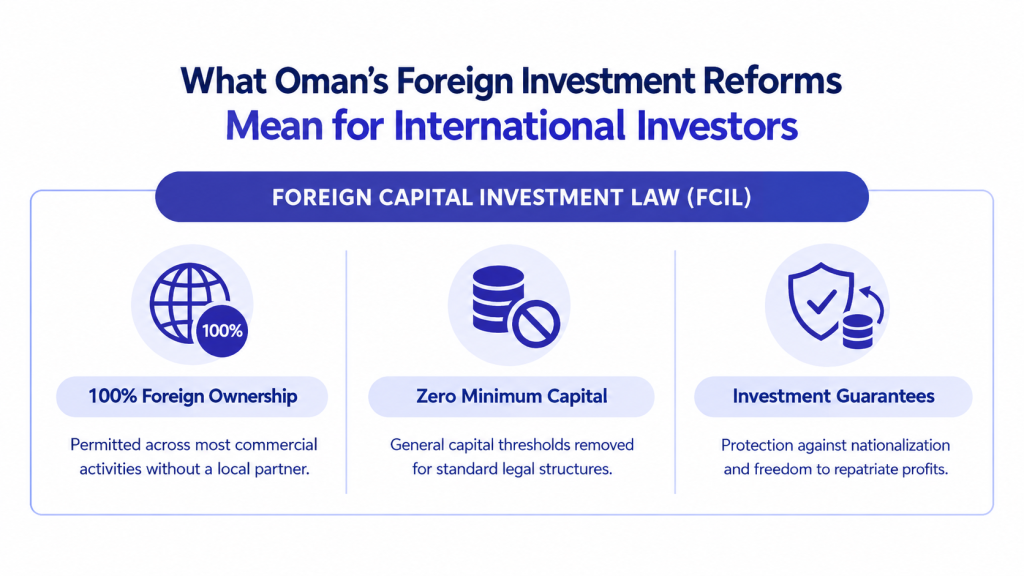
The cornerstone of Oman’s economic modernization is the Foreign Capital Investment Law (FCIL) (Royal Decree No. 50/2019). The FCIL systematically removed historic entry barriers, introducing several key reforms for international businesses:
Can foreigners own 100% of a business in Oman?
Yes. Pursuant to the Foreign Capital Investment Law, foreign investment is allowed to form entities with 100% foreign shareholdings in the majority of commercial, industrial, and service sectors. There is a negative list that sets aside a small number of activities for Omani nationals only (like some retail, staffing, and handicrafts activities), but the vast majority of core economic sectors are still open for international investment.
Although the general requirement for minimum capital has been abolished, foreign investors should be aware that there are sectoral requirements for capital and licenses in certain regulated sectors like banking, insurance, specialized logistics, and industrial processing.
Primary Growth Sectors Under Oman Vision 2040
The focus of Oman Vision 2040 is on those sectors that produce consistent revenue other than oil, create export capabilities, provide local jobs, and use sophisticated technology.
1. Manufacturing & Advanced Industry
Industry development is at the heart of Oman’s efforts to diversify its economy. The MOCIIP has created a policy framework that focuses on value-added and import substitution within manufacturing.
- Industrial Automation & Smart Manufacturing: Use of the Internet of Things (IoT), robotics, and automation within existing industries to boost efficiency in production.
- Local Material Processing: Conversion of locally produced minerals, petrochemical products, and raw materials into intermediate or finished products.
- Import Substitution: Creation of local factories for producing construction materials, packaged goods, and industrial parts.
- Export-Oriented Production: Setting up manufacturing facilities in special economic zones to serve GCC, East Africa, and South Asia using Oman’s trade agreements.
2. Digital Economy & ICT
The National Strategy for the Digital Economy of Oman is looking to see an impressive boost in ICT’s share of the GDP. Digital transformation in the public sector and companies provides openings for foreign technology players.
- Software & SaaS: Software development, localized cloud computing services, SaaS applications for logistics, finance, and energy.
- Cloud Infrastructure & Data Centers: Creating localized data centers that conform with national laws on data sovereignty and cater to rising needs for cloud computing resources.
- AI & Cybersecurity: Deployment of AI systems for energy management and infrastructure protection based on advanced cybersecurity measures.
- Digital Transformation Services: Systems integration, upgrading of legacy IT infrastructure, and managed services for governments and businesses.
3. Tourism & Hospitality
Oman’s geography, consisting of coastline, mountains, and heritage structures, forms the foundation of its tourism development plans under Vision 2040.
- Eco-Tourism & Nature-Based Resorts: Sustainable luxury resorts built in unique ecosystems such as Jebel Akhdar, Jebel Shams, and Dhofar Coast.
- Cultural & Heritage Projects: Restoration of historic monuments, development of cultural centers, and heritage programs.
- MICE Infrastructure: Development of facilities for meetings, incentives, conferences, and events around Oman Convention & Exhibition Centre (OCEC) at Muscat.
- Specialized & Adventure Tourism: Establishment of diving centers, mountain trekking infrastructure, wellness centers, and cultural event management.
High-Potential Supporting Sectors Driving Oman’s Long-Term Growth
Renewable Energy & Clean Technology
The nation has set its sights on achieving Net Zero carbon emissions by 2050; as a result, clean energy is becoming an increasingly capital expenditure-focused market.
- Green Hydrogen Infrastructure: Allocation of billions of dollars through Hydrom to make Oman the major producer of green hydrogen and green ammonia.
- Solar & Wind IPPs: Large-scale Independent Power Producer (IPP) tenders along with commercial and industrial solar roof installations.
- Circular Economy & Resource Recovery: Facilities for municipal solid waste management, industrial wastewater management, and electronic recycling.
Logistics, Shipping & Regional Trade
Being outside the Strait of Hormuz, Oman has access to international maritime transport via deep-water ports in Duqm, Sohar, and Salalah.
- Warehousing & Distribution: Multi-modal logistics facilities with cold chain facilities, hazardous material storage, and bonded warehouses.
- Freight & Supply Chain Services: Integrated freight forwarding, customs clearance processing, and third-party logistics (3PL) management.
- Re-Export Hubs: Value addition, re-packaging, and regional distribution focusing on East Africa, India, and GCC countries.
Food Security, Agriculture & Sustainable Fisheries
The Omani government’s approach to ensuring food security, spearheaded by Nitaj (Oman Food Investment Holding Company), depends largely on integrating private sector technology.
- Aquaculture & Commercial Fisheries: Farming of high-value organisms such as abalone, shrimp, and seabream, and state-of-the-art offshore fish farms.
- Agritech & Smart Farming: Hydroponic farming, vertical farming, controlled environment agriculture, and irrigation automation suitable for arid regions.
- Food Processing & Cold-Chain Logistics: Food processing plants and packaging facilities, and cold chain logistics.
Mining & Downstream Processing
Oman has untapped mineral resources, both high-grade metallic minerals like copper, chromite, and iron ore, and non-metallic minerals used industrially like gypsum, limestone, and silica.
- Exploration & Mineral Extraction: Utilization of geophysical mapping technology in exploring and mining minerals through commercial concessions.
- Value-Addition Processing: Value-addition processing of extracted minerals such as gypsum for drywall, or processing of copper.
Healthcare, Education & the Knowledge Economy
Demographic increase and the process of modernization in the country result in constant need for private health care and educational services.
- Specialized Healthcare & MedTech: Specialized surgical centers, diagnostics labs, rehabilitation clinics, and digital healthcare platforms.
- Technical & Vocational Education: Private schools concentrating on teaching technical knowledge, green technologies, automation, and safety of industries.
- R&D and Innovation Ecosystems: Research laboratories collaborating with regional universities to commercialize inventions in the fields of water purification, agriculture, and material science.
Best Investment Locations in Oman Under Vision 2040
Selecting an optimal operating location requires matching business requirements with available regional infrastructure, regulatory frameworks, and market proximity.
| Location | Key Infrastructure & Features | Target Business Activities |
| Muscat Capital Region | Muscat International Airport, central government ministries, corporate headquarters networks, OCEC. | Corporate HQs, financial services, legal and advisory firms, ICT software hubs, specialized private healthcare. |
| Duqm Special Economic Zone (SEZAD) | Deep-sea port, oil refinery, drydock, dedicated hydrogen blocks, airport, 0% corporate tax incentives. | Heavy manufacturing, petrochemical downstream refining, green hydrogen production, maritime repair, bulk logistics. |
| Sohar Port & Freezone | Deep-water port, direct multimodal links to GCC road networks, proximity to UAE border. | Metals manufacturing, plastics processing, automotive logistics, containerized freight, export-oriented industrial plants. |
| Salalah Free Zone | Deep-sea container port on the Indian Ocean, direct routes to East Africa and Asia, airport, cool summer monsoon climate. | Transshipment, pharmaceutical manufacturing, food processing, cold-chain operations, international hospitality. |
| Khazaen Economic City | Strategic inland location linking Muscat Port, Sohar Port, and Muscat Airport; dry port facilities; central fruit/vegetable market. | Warehousing, light industrial assembly, e-commerce fulfillment hubs, inland freight transport, regional distribution. |
What International Investors Need to Know Before Investing in Oman
Foreign Ownership and Business Structures
International investors usually structure their operations through one of three primary corporate forms:
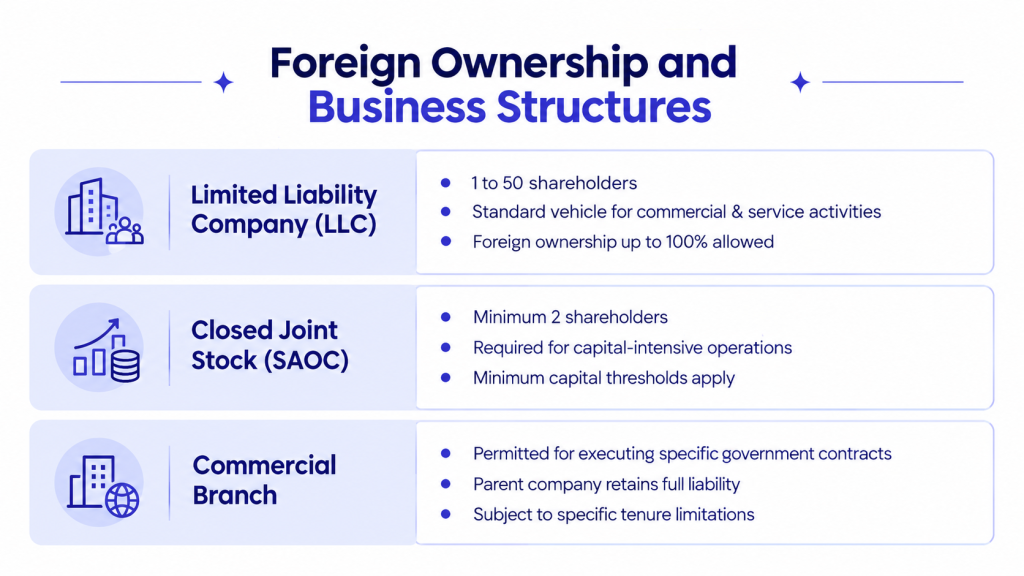
Activity-specific restrictions apply under the “Negative List” issued by MOCIIP. Investors must verify whether their exact Commercial Registration (CR) codes are open to 100% foreign equity before starting formation steps.
Licensing and Regulatory Approvals
Establishing an operational presence involves a multi-step licensing workflow:
- Commercial Registration (CR): Issued by MOCIIP via the Invest Easy online portal.
- Chamber of Commerce Membership: Mandatory registration with the Oman Chamber of Commerce and Industry (OCCI).
- Municipal Licensing: Location approvals, lease validation, and site safety inspections from the local municipality.
- Sector Regulator Permits: Specialized approvals depending on the activity (e.g., Environment Authority permits for industrial plants, Ministry of Health approvals for clinics/pharmaceuticals, Telecommunications Regulatory Authority for IT infrastructure).
Tax and Compliance Considerations
Oman is characterized by a competitive tax system, as compared to other nations in the world:
- Corporate Income Tax: General rate of 15 percent on net taxable income for domestic corporations and foreign branch. Specific tax exemptions are granted in particular free economic zones such as Duqm, Sohar and Salalah.
- Value Added Tax (VAT): General rate of 5 percent is applicable on wide range of commodities and services, except for exempted essential products, export, and health and education.
- Personal Income Tax: Oman currently does not have a personal income tax system.
- Withholding Tax (WHT): Withholding tax of 10 percent is applicable on payment made to non-resident persons for royalties, management fees, software licensing and particular services.
Labour Laws and Omanisation
It is important to understand the local labor situation in terms of operational compliance. According to the Omani Labor Law (Royal Decree No. 53/2023), foreign companies are required to control the workforce allocation system called Omanisation.
- Target Quotas: Required Omanis’ percentage in the staff differs drastically depending on industry (the quota level is higher for the financial sector compared to specialized construction).
- Restricted Positions: Some positions are limited to Omani citizens only (mainly positions in Human Resources, administration, relations with the government, and operations).
- Work Permit Approvals: Obtaining the visa requires compliance with the Omanisation requirements from the Ministry of Labor.
How to Evaluate an Oman Investment Opportunity Before Entering the Market
Step 1: Validate Actual Market Demand
Do not take for granted the assumption that Vision 2040 documentation means there is potential demand in the market.
- Perform market validation at the field level with intended customers in the targeted private sector B2B market, or the government purchasing department.
- Look at existing capacity within the country, levels of dependency on imports, and competitor density in the area.
- Find out whether the company fills a void or operates based on government incentives.
Step 2: Calculate Unit Economics and Total Capital Requirements
Construct financial models with specific operational assumptions:
- Include costs of municipal permits, commercial rents depending on different zones, utilities, and visa and work permit processing fees.
- Construct realistic blended labor costs, including salaries of expatriates and Omanis according to national quota.
Step 3: Compare Locations Before Establishing the Entity
Consider mainland activities in contrast to specialized free zones before filing the incorporation paperwork:
- Mainland: Appropriate for companies that intend to provide services for the domestic market, undertake government tenders in the area, or open retail outlets across several governorates.
- Free Zones (Duqm, Sohar, Salalah): Appropriate for exporting manufacturing businesses, logistical activities, and companies that can benefit from longer corporate tax holidays, duty-free imports and exports, and more liberal Omanisation rules.
Step 4: Verify Incentives Before Building the Business Case
Think of incentives provided by the government as an added advantage, not the standard financial support:
- Confirm eligibility requirements from the MOCIIP, OPAZ (Public Authority for Special Economic Zones and Free Zones), or local zone authorities.
- Confirm that the incentives are applicable only for the Commercial Registration (CR) codes that you intend to use.
- Create preliminary financial projections based on regular business activities, not incentives yet confirmed.
Common Mistakes International Investors Should Avoid in Oman
- Choosing a Sector Solely Because It Appears in Vision 2040 Strategy Documents: Policy backing means macro-direction, but individual models still have to be economically feasible and viable in the market.
- Selecting a Location Without Assessing Logistics and Customer Access: Creating an entity in a faraway free zone to get tax breaks means additional freight charges if your market is based in mainland Muscat.
- Underestimating Omanisation Quotas and Hiring Deadlines: Lack of planning around required national quotas may mean that you don’t secure enough work visa allocations, delaying the entire project.
- Assuming Every Commercial Activity Qualifies for 100% Foreign Ownership: Not checking the “Negative List” for the MOCIIP in advance of incorporating your business may result in a required local partnership.
- Commencing Operations Before Securing Final Municipal & Ministry Approvals: Having a Commercial Registration certificate doesn’t necessarily mean that you can begin commercial operations – the license has to be secured first.
- Constructing Financial Models Around Unverified Incentive Schemes: Projections Assumption of tax or other incentives can make projections inaccurate. Verified costs of operation should be used.
- Neglecting Local Supplier and In-Country Value (ICV) Criteria: Bidding on state-level industrial contracts without having ICV in place means lower scores against competitors.
How Foreign Businesses Can Align Their Oman Strategy With Vision 2040
Build Local Value Into the Business Model
Organizations that show ICV receive preference when it comes to tendering opportunities, industrial agreements, and institutional collaboration.
- Local Sourcing: Obtain raw materials, input goods, and packing supplies from local Omani businesses.
- Workforce Development: Establish a program for developing Omani labor into managerial roles through technical training.
- Technology Transfer: Bring your own intellectual property, proprietary software, or industrial processes to Oman.
Use Oman as a Regional Expansion Base
Set up the Omani company not only as a localized operation but also as a base for expansion within the region.
- Take advantage of the geographic positioning of Oman outside the Strait of Hormuz to open up shipping connections between Oman, East Africa, India, and East Asia.
- Take advantage of the FTA between the US and Oman to enjoy duty-free exports of goods to the US.
- Make use of the GCC trade integration system to export goods duty-free to other Gulf states after meeting origin conditions.
Prioritize Digitalisation and Sustainability
Make sure that business processes reflect the national environmental and digital policies of Vision 2040:
- Adopt processes involving digital-first, automation, and cloud-based enterprise software.
- Have ESG policies in place, including energy management, water conservation technology, and a circular waste system.
How Arnifi Helps Businesses Explore Investment Opportunities in Oman
From identifying an initial opportunity to becoming a legal operation in Oman is accompanied by regulation process, a company registration process, and a compliance process.
Arnifi makes the market access process easier for international investors, business consortiums, and entrepreneurs who plan to expand into Oman and the GCC region.
Arnifi streamlines the compliance process, eliminates bureaucratic bottlenecks, and guarantees that foreign businesses will conduct legally compliant operations.
Frequently Asked Questions (FAQs)
What are the biggest investment opportunities under Oman Vision 2040?
Major opportunities exist in manufacturing and industrial automation, green hydrogen and renewable energy infrastructure, logistics and cold storage warehousing, ecotourism and cultural hospitality, agritech, and specialized ICT.
Is Oman open to 100% foreign ownership?
Yes. Under FCIL (Foreign Capital Investment Law), foreign investors may hold up to 100% of the shares in their companies in all kinds of commercial and industrial or service activities, without the requirement for a local partner.
Which sectors are prioritized under Oman Vision 2040?
Sectors that are prioritized by Oman’s Vision 2040 include non-oil growth sectors such as manufacturing, logistics, tourism, tech/ digital economy, agriculture/ fisheries, renewable energy, and mining.
What are the best industries for foreign investors in Oman?
Sectors to invest in include technology/SaaS, renewable energy infrastructure, logistics services, food processing, specialized healthcare, mineral downstream processing, and ecotourism development.
Is Oman a good location for manufacturing businesses?
Yes. This is due to Oman providing inexpensive access to energy, deep-water ports such as Duqm, Sohar, and Salalah that are not located in the Strait of Hormuz, industrial free zones with tax benefits, and direct trade connections with GCC, Asia, and Africa.
What opportunities does Oman offer in renewable energy?
There are plans in Oman to develop large-scale green hydrogen and green ammonia projects using Hydrom allocations. Other areas include utility solar projects, wind energy projects, rooftop commercial solar projects, and energy efficiency technologies.
Why is Oman attractive for logistics and regional trade?
This is because of Oman’s location on the Arabian Sea, which gives direct access to international waterways, thus avoiding maritime chokepoints. There are modern ports, free zones, and road connections that reach the GCC region.
Which economic zones are best for foreign investors in Oman?
Ideal zones are determined by business processes:
- Duqm (SEZAD): Heavy industry, refining, renewable energy, and megaprojects.
- Sohar Port & Freezone: General manufacturing, metals, plastics, and export logistics.
- Salalah Free Zone: Pharmaceuticals, food processing, transshipment, and logistics.
- Khazaen Economic City: Inland logistics, warehousing, distribution, and light assembly.
What are the Omanisation requirements for foreign companies?
There are Omanisation requirements stipulating that a certain percentage of employees in foreign-owned companies must be Omani nationals. The percentages depend on the industry sectors and employee categories. There are some administrative and HR positions that can only be filled by Omani nationals.
What licenses are required to start a business in Oman?
There are three licenses needed, namely the CR issued by MOCIIP and membership of the Oman Chamber of Commerce and Industry (OCCI). Moreover, there are industry- and sector-specific licenses that are issued by local municipalities, the Ministry of Labour, the Environmental Authority, or other relevant regulatory bodies.
Can foreign companies use Oman as a base for GCC expansion?
Yes, companies operating in Oman can export products without any duty fees to GCC countries, provided that all the criteria are fulfilled. In addition, the logistics system in Oman will allow for easy shipment to Saudi Arabia, the UAE, and overseas countries.
How can international investors establish a business in Oman?
The investor chooses the desired business activity code, the legal entity form (for instance, LLC), reserves the name of the company through the MOCIIP online portal, obtains all necessary licenses for the sector, rents an approved commercial facility, registers with the Ministry of Labour, and creates a corporate bank account. This can be performed with professional corporate service providers such as Arnifi.
Conclusion
Oman Vision 2040, along with its 11th five-year development plan (2026-2030) opens the door to an unprecedented possibility for international investors to benefit from the transformational economic changes in the Sultanate of Oman. Through the combination of reforms on 100% foreign investment and the use of special free zones, along with the support of the state in sectors of manufacturing, logistics, clean energy, and tourism, Oman provides a highly stable, low-tax environment for long-term development in the GCC region.
References
- Ministry of Commerce, Industry and Investment Promotion (MOCIIP)
- Public Authority for Special Economic Zones and Free Zones (OPAZ)
- Invest in Oman Portal
- Oman Vision 2040 Implementation Follow-up Unit
- Ministry of Economy – Sultanate of Oman
Top UAE Packages


Related Articles
Top UAE Packages
Get in Touch