
UAE Announces Exit from OPEC After 50 Years

Anushka
Content Writer
Anushka Basu is a business content writer specialised in global business market insights. She aims to simplify complex regulatory, financial, and business concepts into… Read more


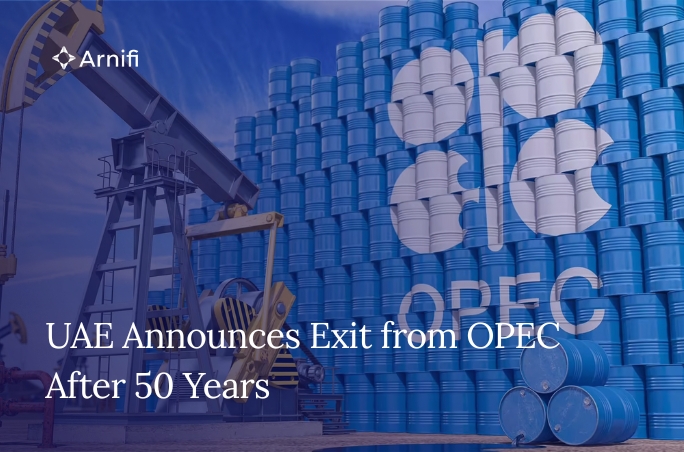
The United Arab Emirates has publicly disclosed its decision to leave the Organisation of Petroleum Exporting Countries. This has resulted in worldwide financial markets experiencing changes. The nation has officially ended its OPEC membership after five decades. This brings a fundamental change to its economic policy. The UAE energy market will experience greater production independence and faster capacity growth. Now the country establishes its own production limits, which it will use to detach from OPEC.
Table of contents
- The Context Behind the UAE’s Exit from OPEC
- Impact on Global Oil Market Volatility
- Acceleration of Upstream Energy Investment
- Sovereignty and Independent Energy Policy
- What This Means for UAE Energy Businesses
- The Shift Toward Low-Carbon Hydrocarbons
- Strategic Realignment with Global Partnerships
- Long-Term Economic Implications for 2026 and Beyond
- Conclusion
- FAQs
The Context Behind the UAE’s Exit from OPEC
The announcement follows years of underlying tension regarding production baselines. The UAE exits OPEC at a time when its domestic investment in production capacity has reached record highs. The group imposed restrictive quotas that impeded UAE efforts to monetise its Murban crude reserves and finance its extensive non-oil diversification initiatives. The UAE can now establish its production levels through a national needs assessment since it left the group that restricted its production rights.
Impact on Global Oil Market Volatility
Market instability increased after the announcement that the UAE would leave OPEC. The UAE, which serves as the cartel’s third-largest producer, will weaken the cartel’s ability to control worldwide oil production. The analysts believe that this action will create a situation where prices become more competitive against each other. The elimination of OPEC+ price protection will lead to more price swings as the UAE will focus on preserving market position through extended production periods instead of maintaining price stability.
Acceleration of Upstream Energy Investment
Energy businesses are closely watching the UAE’s production trajectory. The UAE will speed up its production growth to 5 million barrels per day after its OPEC membership ends, according to current projections. The oilfield service companies, technology providers, and infrastructure developers will benefit from this surge in upstream activity because they will need to support the rapid expansion.
Sovereignty and Independent Energy Policy
The move demonstrates a shift toward a more UAE-first energy policy. The UAE will improve its oil production capacity through exit because it needs to stop exporting oil to serve its growing hydrogen market and domestic gas needs. The UAE exits OPEC to establish an independent approach, which enables it to sign contracts with Asian and European partners without restrictions from quota-related emergencies.
What This Means for UAE Energy Businesses
The UAE exits OPEC brings intense operational growth for local and international firms that operate in the Emirates. The production limits that previously restricted production have been lifted, which allows ADNOC and its partners to operate their assets at maximum capacity. The decrease in production costs per barrel will make UAE crude one of the world’s most cost-effective and profitable crude oils.
The Shift Toward Low-Carbon Hydrocarbons
The UAE has consistently argued that if the world is to use oil during the energy transition, it should be the lowest-carbon, lowest-cost oil available. It will increase its Carbon Capture and Storage investment following its departure from OPEC. The UAE uses its oil resources as responsibly sourced energy products because they match the ESG requirements of global customers who need fossil fuels for industrial operations.
Strategic Realignment with Global Partnerships
The decision to leave is not an isolationist move. The UAE will exit OPEC to establish more direct and bilateral energy partnerships with other countries. The new Strategic Partnership Agreements (SPAs) will emerge between the UAE and major importing nations. These agreements will extend beyond oil sales because they will enable cross-investment in refining and petrochemicals and renewable energy technology, which will make the UAE a multi-polar energy superpower.
Long-Term Economic Implications for 2026 and Beyond
The UAE exits OPEC will have significant fiscal consequences. The higher production volumes, which may be offered at reduced prices, will generate increased revenue for the government. The volume-over-price strategy provides necessary funding for the UAE Vision 2031 and Net Zero 2050 achievement. The UAE will continue to spend heavily on infrastructure and technology through the final decade of this century.
Also Read:
Conclusion
The UAE’s departure from OPEC is a defining moment in modern energy history. The nation has advanced beyond the boundaries that a 20th-century cartel established and now possesses the ability to compete in a 21st-century market according to its own standards. Arnifi assists energy firms and investors who need to understand regulatory and structural changes that will occur after this monumental exit from OPEC. Contact Arnifi today to secure your business operations for the upcoming phase of UAE energy independence.
FAQs
1. Is the UAE still part of OPEC+?
The announcement indicates a complete withdrawal from the OPEC organisation.
2. Will this cause oil prices to drop significantly?
The UAE’s disciplined approach suggests it will manage production to maximise revenue, but it will create downward price pressure because of increased supply.
3. When does the exit become official?
The formal process has begun, with the transition expected to be completed within the current 2026 fiscal year.
4. Does this affect the UAE’s climate change commitments?
The UAE remains committed to Net Zero 2050. The exit allows them to fund that transition more effectively through their own production profits.
5. How can oilfield service companies benefit?
The expected increase in drilling and infrastructure projects to hit the 5 million bpd target will create a significant pipeline of new contracts.
Top UAE Packages


Related Articles



Top UAE Packages
Get in Touch