
Mauritius Personal Income Tax | Rates, Residency & Filing Guide

Zahira Shaik
SEO Content Writer
Zahira Shaik is an SEO Content Writer and Published Author specializing in research-based content. She excels at analyzing market trends, regulations, and industry developments… Read more

Tulika Saxena
AVP, Sales & Marketing | IIM Nagpur
Tulika Saxena specializes in business finance, sales strategy, and market positioning. Leads growth and partnerships, ensuring seamless business setup experiences and client success across… Read more


Key Fact: Effective 1 July 2026, Mauritius introduced a 35% top tax band on individual chargeable income above MUR 12 million. For Year of Assessment 2026–2027, the MRA e-filing deadline is 15 October 2026.
Table of contents
- Introduction
- How Does Mauritius Personal Income Tax Work?
- What Are the Current Mauritius Personal Income Tax Rates?
- Who Qualifies as a Tax Resident in Mauritius?
- What Income Is Taxable Under Mauritius Personal Income Tax?
- What Exemptions, Allowances, and Deductions Are Available?
- Step-by-Step: How to Calculate Your Mauritius Personal Tax
- How Does the 2026 Mauritius Tax Filing Process Work?
- Special Tax Rules: Expats, Remote Workers, and Golden Visa Holders
- Cross-Border Considerations for Entrepreneurs
- Common Mauritius Personal Tax Mistakes
- Pre-Filing Checklist for 2026
- How Arnifi Supports Tax and Business Decisions
- Frequently Asked Questions
- References
Introduction
What Is Mauritius Personal Income Tax?
Mauritius personal income tax is a form of direct taxation imposed on the chargeable income of individuals. Under the Income Tax Act 1995, the tax applies to income earned in the country, as well as certain foreign income brought to Mauritius by a resident taxpayer.
How the Mauritius Personal Tax System Works
The tax system of Mauritius is based on the principle of a progressive tax structure in which income is divided into fixed slabs, and taxes are imposed at different rates. Taxes are paid at source by employers using the PAYE system, whereas self-employed people and other income earners pay directly through APS or their yearly returns.
Why Tax Residency Determines Income Treatment
Tax residency is the fundamental concept that will dictate your extent of tax liability in Mauritius. Whereas non-residents are liable to pay taxes only on the income sourced from Mauritius, tax residents are subject to taxation on their worldwide income under certain provisions of remittances, foreign tax credits, and statutory exemptions.
How Does Mauritius Personal Income Tax Work?
Meaning and Scope
Personal Income Tax covers all persons receiving income sourced in or arising from Mauritius, as well as persons who are residents and receiving foreign-source income.
Who Is Subject to Personal Income Tax?
1. Mauritius-Sourced Income Earners
- It covers all natural persons, no matter whether they are non-resident or resident of Mauritius, who earn wages, fees or business profits in Mauritius.
- Non-residents will be taxed in relation to Mauritius-derived income irrespective of the place where the payment is made.
2. Resident Individuals
- Subject to tax in relation to their total income from all sources.
- Foreign income is liable for tax in Mauritius only up to the extent that it is either received or remitted to Mauritius.
- Eligible for statutory allowance, dependants’ deduction, tertiary education relief, and Foreign Tax Credit (FTC).
3. Non-Resident Individuals
- Subject to tax in relation to their income derived from or sourced in Mauritius.
- Not entitled to claim personal allowances and dependants’ deductions available to resident individuals.
Income Year vs. Year of Assessment
It is essential to differentiate between the year in which income is earned and the year in which it is assessed:
- Income Year: The 12 months starting from 1 July to 30 June during which the income is derived
- Year of Assessment (YA): The following 12 months during which the tax in respect of such income is assessed and paid.
For instance, the tax return due on or before 15 October 2026 refers to the Year of Assessment 2026-2027, relating to the Income Year ending 30 June 2026.
What Are the Current Mauritius Personal Income Tax Rates?
Tax Rates Schedule
For the current assessment period, chargeable income is taxed under progressive bands:
| Chargeable Income Bracket (MUR) | Applicable Tax Rate |
| First MUR 500,000 | 0% |
| Next MUR 500,000 (MUR 500,001 – 1,000,000) | 10% |
| Next MUR 11,000,000 (MUR 1,000,001 – 12,000,000) | 20% |
| Remainder (Exceeding MUR 12,000,000) | 35% |
How Progressive Taxation Works
Under a progressive tax system, taxation of income occurs in stages. Being in a higher tax bracket means that the entire income is not taxed at that rate, but only the income falling in that particular bracket is taxed at the higher rate.
Who Qualifies as a Tax Resident in Mauritius?
To be classified as a tax resident in Mauritius for a given income year, an individual must satisfy at least one of the statutory residency tests under the Income Tax Act:
- The 183-Day Rule: Being physically present in Mauritius for 183 days or more in total during an income year.
- The 270-Day Rule: Being physically present in Mauritius for 270 days or more in total over three consecutive income years (which include the income year being considered).
- The Permanent Home Test: Having a permanent home in Mauritius, with the exception of where the individual concerned is deemed to be resident elsewhere.
Tax Residence Certificate (TRC)
A Tax Residence Certificate (TRC) is an official certificate from the Mauritius Revenue Authority (MRA) certifying an individual’s tax residence status. It is necessary for tax planning on a global scale, tax protection from double taxation, and availing benefits of DTAA with Mauritius.
What Income Is Taxable Under Mauritius Personal Income Tax?
Personal taxes in Mauritius cover income that comes from various sources as follows:
- Employment Income: Basic salary, directors’ fees, bonuses, and allowances as well as non-cash fringe benefits (like a company car and housing).
- Business and Professional Income: The profit from trade or business and services carried out in the capacity of a freelancer or sole proprietorship.
- Rental Income: The gross rental income from property rental less any statutory allowable maintenance expenses.
- Dividends: Dividends from Mauritius-based companies are not taxable for the recipient (personal tax) nor liable to FSC.
- Foreign Income: Foreign employment, business profits, and foreign investment income of a resident shall be subject to tax in Mauritius only if received.
- Pensions and Annuities: Pension payable to a resident is taxable in accordance with statutory exemptions.
What Exemptions, Allowances, and Deductions Are Available?
The taxpayers may reduce their taxable income by virtue of statutory exemptions/reliefs:
- Personal & Dependent Deductions: Statutory fixed deductions depending on one’s marital status and dependants who may include eligible dependants such as children undertaking studies and disabled dependants.
- Pension and Savings Contributions: Eligible contributions to retirement schemes or approved pension schemes.
- Education & Tertiary Education Relief: Deductions for costs incurred on post-secondary education for dependent children in Mauritius and abroad.
- Medical & Health Insurance Premiums: Medical insurance premiums paid for oneself and family members.
- Lump-Sum Retirement Exemption: The statutory tax threshold for exemption in the case of lump-sum retirement relief has increased from MUR 3 million to MUR 3.5 million.
- Foreign Tax Credits (FTC): Taxpayers earning income that has been taxed in other jurisdictions have a choice of claiming FTCs to relieve themselves of double taxation.
Step-by-Step: How to Calculate Your Mauritius Personal Tax
1. Determine Tax Residency: Establish resident or non-resident status.
Use either the 183-day rule, 270-day rule, or permanent home test to determine if you have to be taxed on your worldwide income or just the income coming from Mauritius.
2. Identify All Income Sources: Gather worldwide earnings documentation.
Produce evidence of your gross income earned through employment, business, rents, dividends, investment, and income from other sources.
3. Subtract Exempt & Non-Remitted Income: Isolate assessable gross income.
Exclude income from exempt dividends and foreign income that is not remitted to Mauritius.
4. Apply Deductions & Reliefs: Calculate Chargeable Income.
Deduct allowable Personal Allowances, Dependent Allowances, Education Reliefs, Pension contributions, and Medical Insurance Premiums.
5. Apply Progressive Tax Bands: Compute preliminary tax liability.
Compute tax payable on your last computed chargeable income using the 0%, 10%, 20%, and 35% slabs.
6. Deduct Credits & Taxes Paid at Source: Determine net balance or refund.
SubtrAllowable FTC, PAYE deducted by employers, and APS prepayments will help to determine your net amount payable or refund.
How Does the 2026 Mauritius Tax Filing Process Work?
Who Needs to File an Individual Income Tax Return?
Individuals must file tax returns if they qualify for any of the following criteria for the income year ending 30 June 2026:
- Received net income above MUR 500,000.
- Received gross business income above MUR 2 million.
- Received income that was subject to PAYE or TDS.
- All self-employed and freelancers working in Mauritius.
Key Filing Deadlines for YA 2026–2027
- End of the 12 months for collecting income records, PAYE certificates, and expense receipts.
- The MRA opens facilities for electronic return preparation, pre-filled data reviews, and draft savings.
- Final statutory due date to electronically file standard, simplified, or presumptive tax returns and settle outstanding tax liabilities.
Return Types Available on MRA Portal
- Standard Tax Return (IT01): Applicable to those whose net income is more than MUR 500k, gross income from business is above MUR 2 million, or who have complicated deductions or credits.
- Presumptive Tax Return: Available for traders or self-employed people eligible within the specified turnover ranges using the 1% presumptive tax system on gross income.
- Simplified Tax Return: Applicable to self-employed individuals whose gross income is below MUR 2 million and net income below MUR 500,000 and who do not file a Standard return.
Penalties for Late Filing and Payment
| Offence | Standard Fine / Penalty | Cap for Small Enterprise / Non-Business Individual |
| Late Filing Penalty | MUR 2,000 per month (or part of month) until return is filed | Capped at MUR 5,000 maximum |
| Late Payment Penalty | 5% of the unpaid tax balance | Standard statutory rate applies |
| Late Payment Interest | 0.5% per month accrued on unpaid balance | Accrues until full settlement |
Special Tax Rules: Expats, Remote Workers, and Golden Visa Holders
Expats and Remote Workers
- Foreign Employment Income: The citizens working in Mauritius shall pay taxes for their earnings. Yet remote workers within particular visa regimes shall have foreign income taxable only when paid into a local bank account.
Golden Visa Holders
Due to the Golden Visa tax regime expansion as of 2026 aimed at attracting HNWIs, the eligible ones will have an individualized tax regime:
- Taxed on foreign income from employment only when remitted to Mauritius.
- Expenses made using foreign debit or credit cards are not considered remitted income.
- Capital transferred into Mauritian bank accounts is non-taxable, upon providing a formal confirmation of foreign taxation.
Cross-Border Considerations for Entrepreneurs
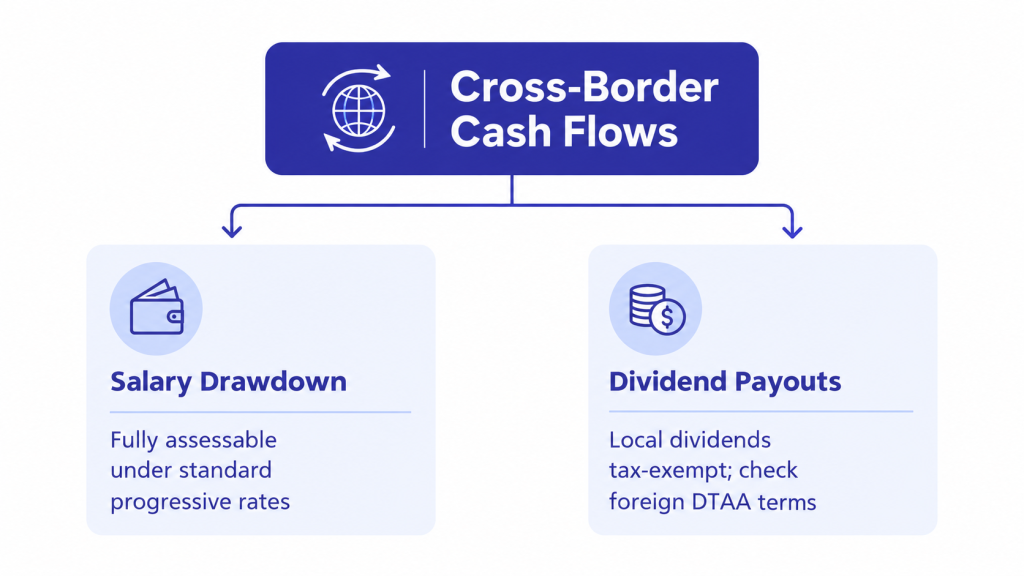
For international entrepreneurs with holding companies in relation to Mauritius, the Middle East, India, or Singapore:
- Salary vs. Dividend Mix: Local company dividends are normally exempt from tax for individuals in Mauritius, but executive salaries are taxed at progressive rates up to 35%.
- Foreign Company Dividends: If dividends are sent to Mauritius from offshore companies, they will be taxed as resident local income, except where valid Foreign Tax Credits apply.
- Remittance Timing: The timing of foreign profits remitted to Mauritius can impact annual chargeable income.
Common Mauritius Personal Tax Mistakes
- Assuming the 183-Day Rule Is the Only Test: Ignoring the 270-day over multiple years test or permanent home test.
- Misunderstanding Remittance Rules: Thinking that use of an offshore card will lead to remittance tax (Golden Visa is exempt).
- Selecting the Wrong Return Type: Choosing a simplified return while a standard return (IT01) is required due to net income limits.
- Overlooking DTAA Foreign Tax Credits: Getting taxed twice on foreign source income due to lack of tax credit claim.
Pre-Filing Checklist for 2026
- Ensure that your tax residency is correctly stated for the income year ending 30 June 2026.
- Add up all income statements from employment, business, rental income, and foreign income repatriated.
- Check the correctness of personal and dependent deductions.
- Collect receipts for pension, medical insurance, and tertiary education expenses.
- Confirm foreign tax credits by collecting proof of foreign taxes paid.
- Compare the pre-populated figures on the MRA portal with your PAYE statements from the employer.
- Choose the right form (Standard, Simplified, or Presumptive).
- Do not miss the 15 October 2026 submission deadline.
How Arnifi Supports Tax and Business Decisions
Planning in regard to cross-border income structure, residency, and annual tax return filing is an exacting process. Arnifi offers holistic services for companies and individuals within Mauritius and internationally at key centers:
- Mauritius Company Formation & Structuring: Setting up efficient corporate structures and entities.
- Cross-Border Tax Advisory: Harmonizing founders’ compensation, dividends, and compliance with residency.
- Tax Filing & Compliance: Helping foreign founders, residents, and businesses prepare MRA tax returns.
Frequently Asked Questions
What is the personal income tax rate in Mauritius in 2026?
In 2026, Mauritius has a progressive income tax system where personal income is taxed at 0%, 10%, 20%, and 35%, according to income bands.
What is the 35% tax rate in Mauritius?
The 35% tax rate is the top rate in a progressive system implemented in 2026 on personal chargeable income above MUR 12 million.
What is the Mauritius income tax filing deadline for 2026?
Filing and paying income tax electronically by tax residents for the 2026–2027 year of assessment (income until 30 June 2026) is due by 15 October 2026.
Is foreign income taxable in Mauritius?
Foreign income is taxable in Mauritius only if it is brought to the country by tax residents.
Does Mauritius have capital gains tax?
There is no capital gains tax imposed by the government of Mauritius for any transfer of personal property, shares, and assets.
References
- Mauritius Revenue Authority (MRA): The official portal for e-filing, tax guides, and communique updates.
- Economic Development Board (EDB) Mauritius: Government agency regulating investment schemes, Golden Visas, and residency permits.
- Ministry of Finance, Economic Planning and Development: Authoritative source for national budget speeches, Finance Acts, and legislative updates.
Top UAE Packages


Related Articles



Top UAE Packages
Get in Touch