
How Corporate Tax Affects Shareholders: The 2026 Guide to Owner Compliance

Zahira Shaik
SEO Content Writer
Zahira Shaik is an SEO Content Writer and Published Author specializing in research-based content. She excels at analyzing market trends, regulations, and industry developments… Read more

Tulika Saxena
AVP, Sales & Marketing | IIM Nagpur
Tulika Saxena specializes in business finance, sales strategy, and market positioning. Leads growth and partnerships, ensuring seamless business setup experiences and client success across… Read more



Key Fact: Shareholders directly influence a corporate tax profit through their transactions, such as dividends, loans, salaries, and related-party pricing, requiring strict, real-time legal documentation and accounting proof to avoid audit friction and tax penalties.
Table of contents
- Introduction
- Why Do Shareholders Feel the Impact of Corporate Tax?
- How Do Shareholders Influence Taxable Profit?
- Dividend Planning and Owner Payouts
- Shareholder Loans and Interest Payments
- Equity Injection vs. Shareholder Loan for Funding
- Family Foundations and Multi-Tier Ownership Structures (Post-June 2026)
- Related-Party Transactions That Need Extra Care
- How to Prepare Related-Party Schedules Before Filing
- The Corporate Tax Registration Piece Owners Often Miss
- Accounting Records That Protect Shareholders
- How Funding Rounds Change Shareholder Compliance
- Can Small Owner-Managed Businesses Benefit From R&D Credits?
- What Good Shareholder Compliance Looks Like Day to Day
- The Biggest Owner Mistake: Mixing Personal and Business Transactions
- Shareholder Corporate Tax Compliance Checklist
- How Arnifi Helps
- Credible Resources & References
- Frequently Asked Questions
- References
Introduction
The corporate tax is officially paid by the firm, but the shareholders are the ones who control and dictate the amount of taxable profit a firm earns. Each and every time a shareholder removes money from the firm, or even adds money, the firm ends up paying tax. In 2026, the tax authorities will be watching out for all the owners’ activities, demanding an audited trail of the transactions.
This guide analyzes the actual compliance issues you need to deal with as a shareholder and the 2026 concerns in this area.
Why Do Shareholders Feel the Impact of Corporate Tax?
Although shareholding itself is not taxable to shareholders, ownership decisions play a crucial role in the financial dealings of the firm. Transactions generate taxable income, which ultimately determines the tax liability of the company.
The Key Shareholder Decisions:
- Timing of dividends
- Loans from shareholders
- Capital contributions
- Interest payments
- Inter-corporate dealings
- Owner withdrawals
How Do Shareholders Influence Taxable Profit?
Shareholders dictate taxable profit through the avenues they use to move money into and out of the business.
| The Profit Lever | How It Impacts Corporate Tax | Documentation Reality |
| 1. Dividend Payments | Paid from post-tax profits. They are not a deductible business expense and do not reduce taxable income. | Requires board resolutions and profit confirmation. |
| 2. Salary & Compensation | Deductible expense that lowers corporate profit, provided it reflects actual work. | Needs employment contracts, WPS compliance, and commercial justification. |
| 3. Shareholder Loans | Creates a liability on the balance sheet. Does not impact the P&L directly but dictates future cash flows. | Cannot be an informal cash transfer; needs a signed agreement. |
| 4. Interest Payments | Deductible expense that reduces taxable profit, making it a high-target area for tax audits. | Requires clear, market-rate terms in a formal loan document. |
| 5. Related-Party Pricing | Transacting with connected entities shifts profits between businesses. | Must strictly adhere to arm’s-length pricing and require heavy commercial support. |
Dividend Planning and Owner Payouts
It should be understood that dividends should be considered formal distributions from the corporation, rather than a simple bank transfer. As they are paid out of after-tax earnings, they cannot be written off as an operating cost of the business.
The Risk of “Label Only” Dividends:
Transferring money and labeling it “dividend” in the accounting system without any legal support is a huge risk during the audit. Without a formal resolution, without checking for distributable profits, and without updating the share register, it will be possible for the tax authorities to change the nature of the payment.
What Documentation Should Support a Dividend?
- Formal resolution of the board or shareholders.
- Statements confirming that distributable profits exist.
- Proof of the payment that corresponds to the resolution exactly.
Before making an owner payout, verify exactly what it is: a dividend, a salary payment, a loan repayment, or a business reimbursement. Document it accordingly before the cash moves.
Shareholder Loans and Interest Payments
If the shareholder loans money to the business, the deal should appear and function like any other genuine business transaction.
The terms and conditions for a valid shareholder loan contract are as follows:
- Specific amount of principal.
- Specific repayment schedule and terms.
- Terms for interest (if any; or a clear statement that there is no interest charged on the loan).
Since interest decreases net income (therefore decreasing tax liability), it is very closely reviewed by the tax authorities. A vague interest contract is subject to revision and even reversal. The shareholder loan should clearly indicate that the company intends to repay the loan.
Equity Injection vs. Shareholder Loan for Funding
When funding your business, the structure you choose dictates both your legal rights and the company’s tax profile.
| Feature | Option A: Equity Injection | Option B: Shareholder Loan |
| Mechanism | Increases capital or share premium. | Creates a company liability (debt). |
| Ownership | Alters ownership registers and cap tables. | Does not change ownership percentages. |
| Best For | Long-term, permanent capital support. | Short-to-medium-term cash flow gaps. |
| Repayment | No expectation of direct repayment. | Clear expectation of repayment. |
To choose correctly, ask yourself: Am I expecting to be paid back? If yes, use a loan. If you are permanently capitalizing the business, use equity. Ensure your legal paperwork perfectly matches this commercial intent.
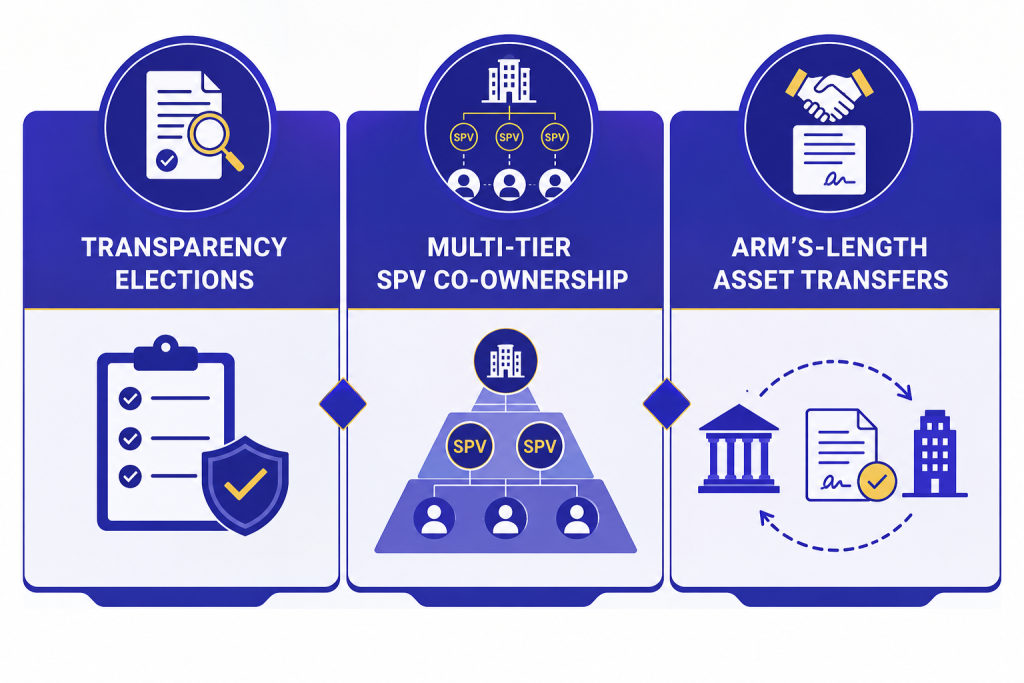
Family Foundations and Multi-Tier Ownership Structures (Post-June 2026)
As businesses become family foundations or family holding companies for estate planning purposes, there is a greater expectation for precision in the management of these multi-layered organizations.
- Transparency Elections: Business owners need to scrutinize tax transparency elections for family foundations and trusts, making sure that the corporate form matches its tax treatment.
- Multi-Tier SPV Co-Ownership: Asset ownership in various Special Purpose Vehicles needs consistency in documentation of the entire portfolio.
- Arm’s-Length Asset Transfers: Transfers of assets amongst family member-owned organizations involve connected party principles. Documentation on commercial terms and valuations from independent third parties is necessary.
Structure Review Checklist:
- Review existing beneficial ownership records.
- Identify all past and future asset transfers.
- Provide supporting inter-company agreements.
- Evaluate related-party tax issues before any restructuring.
Related-Party Transactions That Need Extra Care
Transactions that are conducted among shareholders, directors, or family connections take place in a highly risky environment. Such transactions may be rental payments made by an owner, management fees paid by sister companies, or director payments.
The Commercial Test:
- Would a third party unrelated to the transaction agree to pay the same amount?
- Is there a clear commercial reason for conducting the transaction?
- Can one prove that the service or asset was indeed supplied?
For safe deduction of such expenses, a signed contract, a basis of the price, receipts, and proof of performance must be available.
How to Prepare Related-Party Schedules Before Filing
Do not wait for tax preparation time to record connected person transactions. They will be easy to detect in the 2026 audit climate.
Before completing your tax return:
- Check all ledger entries associated with the owner.
- Isolate all transactions with connected parties.
- Correlate each transaction with a signed contract.
- Examine the basis for pricing and supporting delivery documentation.
- Prepare a complete related party schedule.
Early preparation prevents the panic of untangling owner withdrawals that were hastily classified as general expenses during the year.
The Corporate Tax Registration Piece Owners Often Miss
The responsibility for tax registration legally lies with the corporation, but failure to meet deadlines and the resulting financial repercussions are on the owner.
What Owners Must Track:
- Tax registration deadline dates (linked to trade licence months).
- Directions and updates related to the FTA (Federal Tax Authority) portal.
- Dates for returns and final payments.
Registration via the official FTA portal, matching your tax profile to your trade license, keeping a record of your registration certificate, and maintaining a strict calendar of compliance.
Accounting Records That Protect Shareholders
Developing companies cannot continue to use outdated and unprofessional bookkeeping practices. The real-time bookkeeping system will be your number one shield against the tax audit.
Key Defensive Records:
- Up-to-date share register that covers all transfers of ownership.
- Resolutions of the board for all dividends and capital transactions.
- Proper mapping of the general ledger.
- Narrative bank statements that match the accounting ledger.
The Owner Drawings Problem: Any money that is drawn out by an owner should never end up in some obscure expense accounts. Bad record keeping makes tax audits difficult and greatly impairs the company valuation at sale.
How Funding Rounds Change Shareholder Compliance
Involvement in investing activities involves changes in shareholding, which need to conform to the documentation.
Clean Equity Accounting: All investments need to be correctly identified. The most common mistake, and an extremely harmful one, is classifying a cash influx under “Other Income” rather than equity. As a result, you artificially inflate your profit level and end up with an extremely exaggerated corporate tax bill.
Can Small Owner-Managed Businesses Benefit From R&D Credits?
Tax incentives are not limited to huge corporations only. Small owner-operated businesses should consider if their qualifying operations make them eligible for available tax incentives, such as R&D tax credits or tax exemptions from a particular free zone. Know how to use any unused qualifying credits in carry-forward or refund, monitor qualifying expenses, and check your eligibility before filing.
What Good Shareholder Compliance Looks Like Day to Day
High-quality compliance relies on operational rhythm, not year-end accounting miracles.
| Frequency | Action Items |
| Weekly | Record shareholder-related cash movements immediately. Save supporting files in dedicated folders. |
| Monthly | Review owner-related ledger entries. Check loan balances and connected-person transactions. Reconcile bank movements. |
| Before Filing | Prepare related-party schedules. Confirm all documentation is complete. Verify transaction classifications. |
The Biggest Owner Mistake: Mixing Personal and Business Transactions
By far the biggest mistake that one can make is using a business bank account for their personal cash flow as well. This greatly complicates the accounting process and makes it difficult to know the amount of taxable income, among other challenges.
It is therefore important to have different accounts for both purposes.
Shareholder Corporate Tax Compliance Checklist
- Ownership Records: Updated share register, current shareholder info, supporting structural documents.
- Dividend Records: Proof of distributable profit, formal board resolution, matching payment evidence.
- Loan Records: Signed agreements, repayment schedules, defined interest terms.
- Related-Party Records: Arm’s-length contracts, commercial pricing support, proof of delivery.
- Tax Compliance: Registration confirmation, filing calendar, completed related-party schedules.
How Arnifi Helps
Precision is essential when it comes to compliance. With Arnifi, business owners will be assisted in forming their companies in a professional way as well as in organizing documents in an efficient manner in order to fulfill corporate taxes.
Credible Resources & References
- Federal Tax Authority (FTA) UAE: Official guidelines on Corporate Tax Registration and Compliance.
- OECD Transfer Pricing Guidelines: Global standards for arm’s-length pricing in related-party transactions.
- Ministry of Economy (UAE): Regulations regarding share registers, beneficial ownership, and commercial company laws.
Frequently Asked Questions
Why does corporate tax affect shareholders?
This is due to the fact that decisions made by the shareholders on the distribution of dividends, injection of capital, or payment of interest determine the cash flow and taxable profit of the firm.
Are dividends deductible for corporate tax purposes?
No, because dividends are distributed after taxation; thus, they cannot lower the taxable income of the company.
Can a shareholder lend money to their company?
Yes, but it needs to be documented with a loan agreement specifying the terms and conditions of the loan.
What is the difference between shareholder equity and a shareholder loan?
Equity permanently increases the capital and changes the ownership ratio, whereas the loan becomes an obligation to pay back, and the ownership is not affected.
How should shareholder loans be documented?
By means of a written agreement indicating the amount, currency, repayment period, and interest terms (if it does not carry interest).
Do related-party transactions require special documentation?
Yes. There must be evidence that such a transaction is based on arm’s length pricing and commercial justification through written agreements and shipment of goods.
What happens if personal and business expenses are mixed?
It will cause distorted tax income, create classification errors, bring about enormous bookkeeping costs, and raise numerous alarm signals during the tax audit.
How should a shareholder record a dividend payment?
A resolution from the Board, accounting documents to support the existence of profits, and a wire transfer in the exact amount.
Can a funding injection affect taxable profit?
It should not, but if it is incorrectly booked as “income” and not “equity,” it will inflate taxable profit unnecessarily and create an unjustified tax liability.
What records should shareholders maintain for corporate tax compliance?
Stock register, minutes of the board of directors, loan agreement, related party agreement, and proper general ledger allocations for all withdrawals.
How often should owner-related transactions be reviewed?
Weekly for cash transactions and monthly for ledger checking and reconciliation.
What should businesses check before filing their corporate tax return?
Make sure that all withdrawals from the owner are booked properly, related party statements are prepared, and each transaction has a corresponding legal agreement or resolution.
References
Federal Tax Authority (FTA) UAE
Top UAE Packages


Related Articles



Top UAE Packages
Get in Touch