
UAE Precious Metals VAT Changes in 2026 | Reverse Charge & New Rules

Shethana P
SEO Content Writer
Shethana specialises in creating content that simplifies complex business, compliance, and regulatory topics for global business incorporation. She focuses on SEO strategy, content accuracy,… Read more

Tulika Saxena
AVP, Sales & Marketing | IIM Nagpur
Tulika Saxena specializes in business finance, sales strategy, and market positioning. Leads growth and partnerships, ensuring seamless business setup experiences and client success across… Read more


Key Facts: The UAE has expanded VAT reverse charge rules for precious metals, stones and qualifying jewellery. This guide explains the latest UAE precious metals VAT changes, including treatment of gold, silver, platinum, and palladium; zero-rated investment metals; B2B eligibility; invoicing requirements; and key compliance considerations for businesses.
Table of contents
- Introduction
- What Changed in UAE VAT for Precious Metals and Stones?
- How Does the Reverse Charge Mechanism Work?
- Which Precious Metals Are Covered Under the New VAT Rules?
- Does the 5% UAE VAT Still Apply to Gold and Precious Metals?
- What Is the Difference Between Zero-Rated VAT and Reverse Charge?
- Who Can Use the Precious Metals VAT Reverse Charge?
- What Are the VAT Compliance Requirements for Precious Metals Businesses?
- How Should Businesses Issue Invoices Under the Reverse Charge?
- What Happens When Selling Precious Metals to Consumers?
- How Does the New Rule Affect Jewellery Businesses?
- What Should Precious Metals Businesses Do to Stay Compliant?
- What Are the Common VAT Mistakes in Precious Metals Trading?
- What Does This VAT Change Mean for UAE Precious Metals Businesses?
- How Can Arnifi Help With UAE VAT Compliance?
- FAQs
- Conclusion
Introduction
UAE has widened VAT scope for the precious metals and stones industry. The decision of the Cabinet of Ministers 127/2024 expanded the scope of the reverse charge mechanism in transactions mainly for gold and diamonds. Some of the new regulations are of particular importance to companies that are engaged in gold trading, jewellery, precious stones, wholesale distribution and manufacturing. The key issue is that not every gold or jewellery transaction has a one-size-fits-all solution for the VAT treatment. A supply can be zero rated, subject to reverse charge, or treated under the normal VAT rules, depending on the product, the customer and the nature of the supply. Identifying these differences is important for companies to correctly issue invoices, report the VAT accordingly, and prevent any unnecessary compliance issues.
What Changed in UAE VAT for Precious Metals and Stones?
Cabinet Decision No. 127 of 2024 expanded the reverse charge mechanism to a wider range of precious metals, precious stones and qualifying jewellery.
The covered items include:
- Gold
- Silver
- Platinum
- Palladium
- Natural and manufactured diamonds
- Pearls
- Rubies
- Sapphires
- Emeralds
- Qualifying jewellery
Jewellery may be part of the mechanism if it includes the named precious metal or stone elements and the value of the metal or stone is greater than the value of the other elements in the piece. The new rules, therefore, mandate companies to consider more than the broad product category and determine if the individual transaction falls within the conditions.
How Does the Reverse Charge Mechanism Work?
Under normal VAT treatment, the seller charges VAT to the customer, collects it and reports the output VAT to the Federal Tax Authority.
Under reverse charge, the responsibility for accounting for VAT shifts to the buyer.
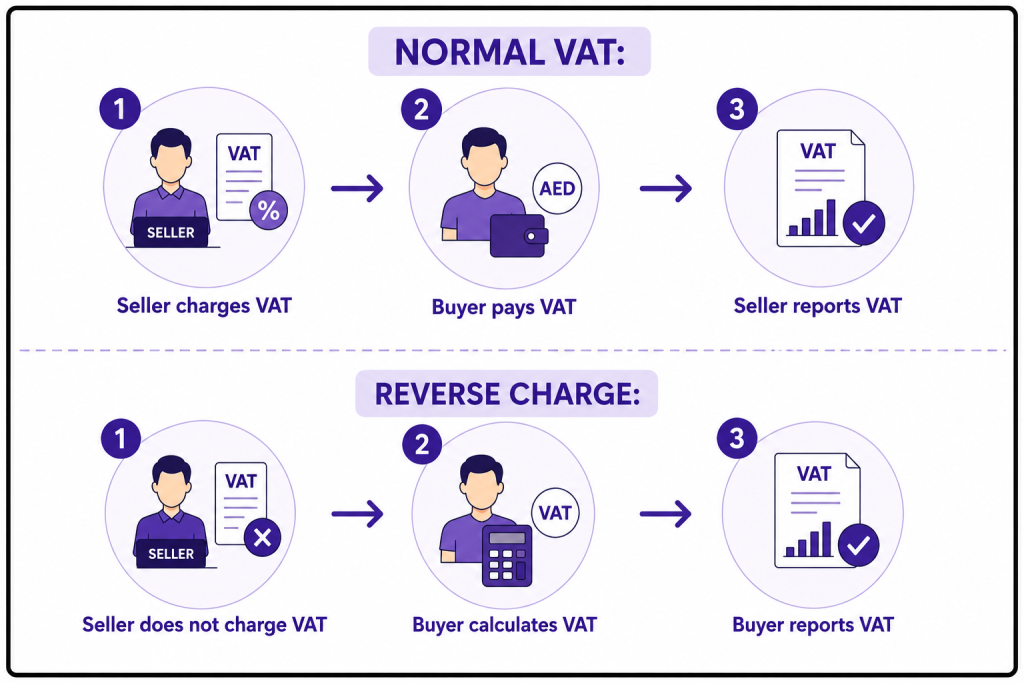
For qualifying precious metals and stones transactions, the VAT-registered buyer accounts for the VAT instead of the seller, provided the conditions for the mechanism are satisfied. The reverse charge is therefore not an exemption from VAT. It changes who accounts for the VAT.
Which Precious Metals Are Covered Under the New VAT Rules?
| Category | Covered items |
| Precious metals | Gold, silver, platinum, palladium |
| Precious stones | Diamonds, pearls, rubies, sapphires, emeralds |
| Jewellery | Qualifying jewellery containing covered metals or stones |
The expanded scope is broader than the earlier reverse charge framework and affects businesses across the precious metals and jewellery supply chain.
Does the 5% UAE VAT Still Apply to Gold and Precious Metals?
Not every gold or precious metal transaction is automatically subject to 5% VAT, zero-rated or covered by reverse charge. The treatment depends on the transaction. Certain investment precious metals can be zero-rated. Under the UAE VAT rules, investment precious metals include gold, silver and platinum with at least 99% purity and in a form that can be traded in global bullion markets.
Qualifying B2B transactions involving covered precious metals and stones may instead fall under the reverse charge mechanism. Jewellery and retail sales need to be considered separately. This is why the statement “gold is VAT-free in the UAE” can be misleading. Businesses must assess the actual product and transaction before applying a VAT treatment.
What Is the Difference Between Zero-Rated VAT and Reverse Charge?
| Point | Zero-rated VAT | Reverse charge |
| VAT rate | 0% | Buyer accounts for applicable VAT |
| Seller charges VAT | No | No, where conditions apply |
| Buyer reports VAT | Generally no output VAT | Yes |
| Input VAT recovery | Subject to normal rules | Subject to normal rules |
The zero rate is where the supplier charges zero VAT on an eligible supply. Reverse charge means that the supplier does not charge VAT and the buyer who is eligible to pay the VAT pays the VAT instead. These mechanisms should NOT be viewed interchangeably.
Who Can Use the Precious Metals VAT Reverse Charge?
The expanded reverse charge is intended for qualifying transactions between VAT-registered businesses. The goods must fall within the scope of the relevant rules, and the transaction must satisfy the applicable conditions. Businesses should also verify the customer’s VAT registration before applying reverse charge. Simply selling gold, silver, jewellery or gemstones does not automatically mean that reverse charge can be used.
What Are the VAT Compliance Requirements for Precious Metals Businesses?
Businesses should build proper VAT checks into their sales and accounting processes.
Important areas include:
- Maintaining valid VAT registration
- Verifying the customer’s VAT status
- Identifying covered products
- Confirming whether reverse charge conditions are met
- Issuing correct tax invoices
- Applying the correct VAT treatment
- Reporting transactions accurately in VAT returns
- Maintaining accounting and supporting records
- Reviewing input VAT recovery
Businesses should also keep purchase invoices, sales records and other documents that support the VAT treatment applied to each transaction.
How Should Businesses Issue Invoices Under the Reverse Charge?
When determining whether a transaction is one that is suitable for the reverse charge mechanism, the seller should first establish that the customer is also VAT registered before issuing an invoice without VAT. The invoice must include the necessary data of a tax invoice and specify that the transaction is in reverse charge regime, if applicable. The VAT treatment in the accounting/invoicing system should also be correct, thus ensuring the transaction will be correctly entered in the VAT return.
What Happens When Selling Precious Metals to Consumers?
The expanded reverse charge is not a blanket exemption for consumer sales. The mechanism is designed for qualifying transactions between VAT-registered businesses. A consumer buying jewellery or precious metals is therefore not treated in the same way as a VAT-registered business purchasing qualifying goods. Retail businesses should assess consumer transactions separately and apply the VAT treatment relevant to the product and circumstances.
How Does the New Rule Affect Jewellery Businesses?
Jewellery businesses need to pay close attention to the value condition. Qualifying jewellery can fall within the expanded mechanism when it contains the specified precious metals or stones and the value of those metals or stones exceeds the value of the other components. This can affect jewellery manufacturers, wholesalers and dealers carrying out B2B transactions. Businesses should maintain appropriate product, pricing and valuation records to support the VAT treatment applied.
What Should Precious Metals Businesses Do to Stay Compliant?
A practical checklist includes:
- Review VAT registration status
- Identify products covered by the rules
- Separate B2B and B2C transactions
- Verify customer VAT registration
- Confirm reverse charge eligibility
- Update invoicing systems
- Update accounting and VAT codes
- Review VAT return reporting
- Maintain supporting documents
- Train finance and sales teams
Businesses should also review contracts and billing processes if they regularly trade precious metals or jewellery with other VAT-registered businesses.
What Are the Common VAT Mistakes in Precious Metals Trading?
Common mistakes include treating every gold transaction as zero-rated or assuming every B2B sale qualifies for reverse charge. Other errors include failing to verify the customer’s VAT registration, issuing invoices with incorrect VAT treatment, incorrectly reporting reverse-charge transactions, and confusing zero-rated supplies with reverse charge. Jewellery businesses should also ensure that they properly assess the value condition applicable to qualifying jewellery.
What Does This VAT Change Mean for UAE Precious Metals Businesses?
For qualifying B2B transactions, reverse charge can reduce the need for the seller to collect VAT from the buyer and may help ease cash-flow pressure. At the same time, the buyer takes on greater responsibility for calculating and reporting VAT correctly. For businesses involved in wholesale, manufacturing and retail, the biggest practical change is the need for stronger transaction-level VAT controls. Different products and customers may require different VAT treatments.
How Can Arnifi Help With UAE VAT Compliance?
Arnifi can support businesses with UAE VAT registration, accounting, VAT return support and ongoing tax compliance. For precious metals and jewellery businesses, Arnifi can also help review the business setup and compliance requirements around their activities, while supporting proper accounting and VAT processes. The objective is to ensure that VAT is handled correctly across sales, purchases, invoices and returns.
FAQs
1. What are the latest UAE VAT changes for precious metals?
The UAE expanded the reverse charge mechanism to specified precious metals, precious stones and qualifying jewellery for eligible transactions between VAT-registered businesses.
2. Is gold VAT-free in the UAE?
Not all gold is VAT-free. Qualifying investment-grade gold can be zero-rated, while certain B2B transactions may fall under reverse charge.
3. What is the reverse charge mechanism for gold?
The seller does not charge VAT on a qualifying transaction. Instead, the eligible VAT-registered buyer calculates and reports the VAT.
4. Does reverse charge apply to silver and platinum?
Yes. The expanded mechanism covers silver and platinum, as well as gold and palladium, subject to the applicable conditions.
5. Does the new rule apply to jewellery?
Yes. Certain jewellery can qualify where the specified precious metals or stones meet the required value condition.
6. Can the reverse charge be used for B2C sales?
No. The expanded mechanism is intended for qualifying transactions between VAT-registered businesses and is not a general treatment for consumer sales.
7. What is the VAT rate on investment gold in the UAE?
Qualifying investment gold is zero-rated when it meets the applicable criteria, including the required purity and form.
8. What purity qualifies as investment precious metal?
Gold, silver and platinum generally need to have at least 99% purity and be in a form tradeable in global bullion markets.
9. Do both buyer and seller need to be VAT registered?
For the expanded domestic reverse charge, the relevant transaction must be between VAT-registered businesses and meet the conditions of the applicable rules.
10. How should reverse-charge transactions be reported in a VAT return?
The buyer is responsible for accounting for the applicable VAT under reverse charge and reporting it according to the UAE VAT return requirements.
Conclusion
The UAE precious metals VAT framework now provides different treatments depending on the product, transaction type and parties involved. The expanded reverse charge brings more precious metals, precious stones and qualifying jewellery within its scope for eligible B2B transactions, while qualifying investment gold, silver and platinum can remain zero-rated. Businesses should therefore avoid assuming that every gold, precious metal or jewellery transaction receives the same VAT treatment. Correct product classification, customer verification, invoicing, accounting and VAT reporting are essential for staying compliant.
References:
UAE Ministry of Finance – Cabinet Decision No. 127 of 2024
UAE Federal Tax Authority – Reverse Charge on Precious Metals and Stones
UAE Federal Tax Authority – VAT Legislation
UAE Federal Tax Authority – Zero-Rating of Investment Precious Metals
Top UAE Packages
Related Articles



Top UAE Packages
Get in Touch
