
Saudi VAT Registration 2026 | ZATCA Process, Requirements & Approval

Shethana P
SEO Content Writer
Shethana specialises in creating content that simplifies complex business, compliance, and regulatory topics for global business incorporation. She focuses on SEO strategy, content accuracy,… Read more

Tulika Saxena
AVP, Sales & Marketing | IIM Nagpur
Tulika Saxena specializes in business finance, sales strategy, and market positioning. Leads growth and partnerships, ensuring seamless business setup experiences and client success across… Read more


Key Facts: Saudi VAT registration is handled online through ZATCA. Mandatory registration generally applies when taxable supplies exceed SAR 375,000, while eligible businesses can voluntarily register once taxable supplies exceed SAR 187,500.
Table of contents
- Introduction
- What Is Saudi VAT Registration?
- Who Needs to Register for VAT in Saudi Arabia?
- What Is the Saudi VAT Registration Threshold in 2026?
- What Are the Saudi VAT Registration Requirements?
- What Documents Are Required for Saudi VAT Registration?
- How to Register for VAT in Saudi Arabia?
- How Long Does Saudi VAT Registration Take?
- How Much Does VAT Registration Cost in Saudi Arabia?
- What Happens After Saudi VAT Registration?
- What Is the Saudi VAT Certificate?
- What Happens If You Register for VAT Late?
- How Do You File VAT Returns After Registration?
- What Is the Difference Between Saudi VAT Registration and VAT Filing?
- Can You Cancel Saudi VAT Registration?
- Common Mistakes During Saudi VAT Registration
- Saudi VAT Registration Checklist
- How Can Arnifi Help With Saudi VAT Registration?
- FAQs
- Conclusion
Introduction
If your business carries out taxable economic activities in Saudi Arabia, VAT registration is an important compliance step. The registration process is managed by the Zakat, Tax and Customs Authority (ZATCA). Registration, however, is only the beginning. Once registered, a business must issue compliant tax invoices, maintain VAT records, submit returns and pay any VAT due within the applicable deadlines.
What Is Saudi VAT Registration?
Saudi VAT registration is the process of registering a taxable person with ZATCA so the business can meet its VAT obligations. After successful registration, ZATCA provides the business with a VAT account and VAT number. Registration should not be confused with VAT filing. Registration establishes the business’s VAT status, while filing involves regularly reporting taxable sales, purchases and VAT amounts to ZATCA.
Who Needs to Register for VAT in Saudi Arabia?
Businesses Above the Mandatory Threshold
A resident business generally needs to register when the value of its taxable supplies exceeds SAR 375,000.
Businesses Eligible for Voluntary Registration
Businesses that do not reach the mandatory threshold may still register voluntarily if their taxable supplies exceed SAR 187,500, subject to the applicable conditions.
Non-Resident Businesses
Non-resident businesses can be subject to different VAT registration rules where they are required to pay VAT in Saudi Arabia. The normal resident-business threshold should not automatically be applied to every non-resident business.
Individuals Carrying Out Economic Activities
Individuals carrying out an economic activity may also have VAT registration obligations depending on their taxable supplies and circumstances.
What Is the Saudi VAT Registration Threshold in 2026?
| Registration type | Threshold |
| Mandatory registration | More than SAR 375,000 |
| Voluntary registration | More than SAR 187,500 |
| Non-resident liable to VAT | Special rules may apply |
The threshold is based on taxable supplies, rather than simply adding every amount received by the business.
What Are the Saudi VAT Registration Requirements?
Before applying, the business should have its basic company and financial information ready. This can include an active economic activity, taxable supplies, ZATCA account details, commercial registration information, business activity details and financial information. ZATCA’s registration workflow can also require supporting documents and financial representative information, where applicable.
What Documents Are Required for Saudi VAT Registration?
Company Documents
You may need:
- Commercial Registration
- Company details
- Ownership information
- Business activity details
Financial Information
Keep relevant financial information available, including:
- Revenue details
- Sales information
- Purchase information
- Expected turnover, where applicable
Representative Documents
Where required, the application may also ask for authorised representative and financial representative details, along with identification documents.
ZATCA can request additional information depending on the applicant and application.
How to Register for VAT in Saudi Arabia?
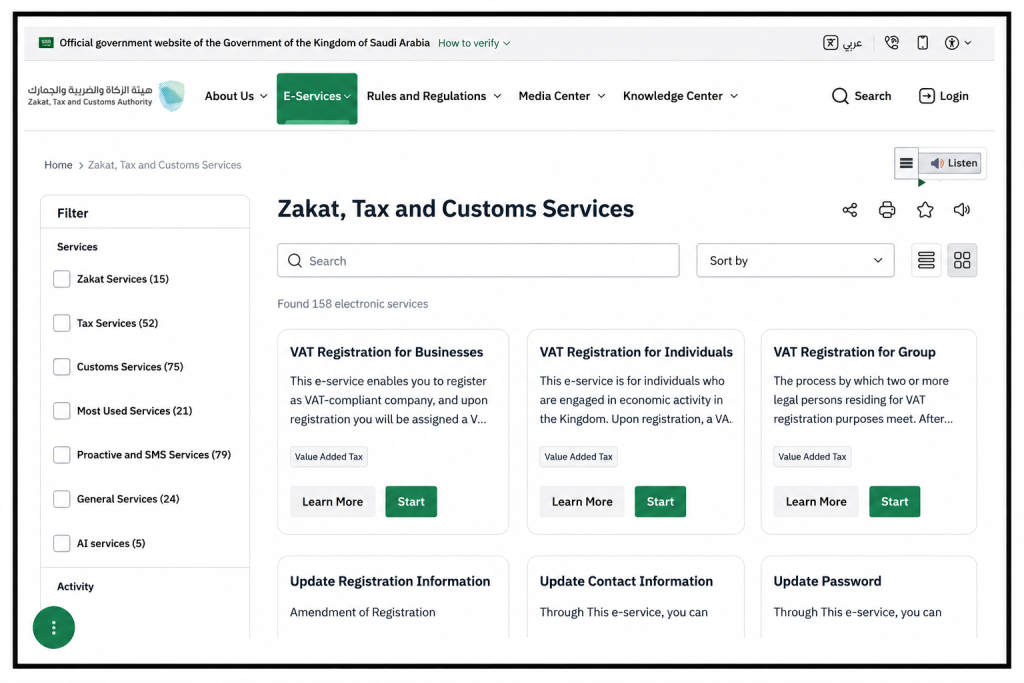
The application is completed electronically through the ZATCA platform.
Step 1: Check Whether Registration Is Required
Review your taxable supplies and determine whether mandatory or voluntary registration applies.
Step 2: Create or Access Your ZATCA Account
Access the ZATCA portal using the applicable taxpayer or company credentials.
Step 3: Open VAT Services
Select the relevant VAT registration service.
Step 4: Enter Taxpayer Details
Provide the requested company and registration information.
Step 5: Enter Financial Information
Add the sales, purchases and other financial details requested by ZATCA.
Step 6: Upload Supporting Documents
Attach the documents required for your application.
Step 7: Add Financial Representative Details
Complete this section where applicable.
Step 8: Review and Submit
Check the information carefully before submitting. Incorrect financial or company information can lead to additional questions or delays.
Step 9: Receive the VAT Certificate
Once registration is completed, ZATCA provides the VAT certificate and relevant VAT account details.
How Long Does Saudi VAT Registration Take?
VAT registration is completed electronically through ZATCA. There is no need to promise a fixed approval time because straightforward applications can move differently from those requiring additional information or clarification. Incomplete documents, incorrect information or additional verification can extend the process.
How Much Does VAT Registration Cost in Saudi Arabia?
ZATCA’s VAT registration service itself does not carry a separate registration fee according to its published service information. Businesses may, however, incur professional fees if they appoint a tax adviser or representative to handle the application. This should also be kept separate from the VAT a registered business collects and pays on taxable transactions.
What Happens After Saudi VAT Registration?
Once registered, VAT compliance becomes an ongoing responsibility. Businesses should:
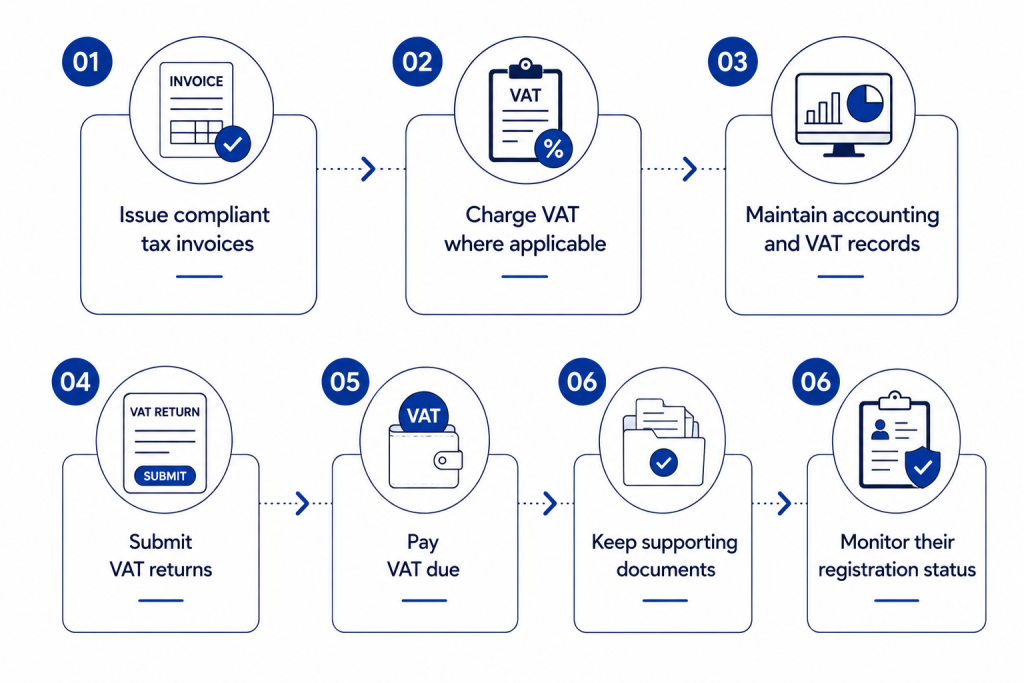
Proper record-keeping is an important part of remaining compliant after registration.
What Is the Saudi VAT Certificate?
The VAT certificate confirms the business’s VAT registration with ZATCA. It may be requested when dealing with customers, suppliers, banks or government authorities. The VAT number, VAT account and VAT certificate are related but not identical. The VAT number identifies the registered taxpayer, the VAT account is maintained within ZATCA’s system, and the certificate provides evidence of registration.
What Happens If You Register for VAT Late?
Failing to register when required can create compliance problems. Depending on the circumstances, a business may face penalties, tax assessments or additional liabilities. Late registration can also make it harder to correct earlier transactions and establish the correct VAT treatment for past periods.
How Do You File VAT Returns After Registration?
VAT registration does not end your obligations. Registered businesses need to report their VAT transactions through the applicable filing process.
The basic process is:
- Determine the assigned tax period
- Record taxable sales and purchases
- Calculate output and input VAT
- Submit the VAT return
- Pay any VAT due
ZATCA provides electronic VAT return filing through its platform.
What Is the Difference Between Saudi VAT Registration and VAT Filing?
| VAT Registration | VAT Filing |
| Registers the business with ZATCA | Reports VAT transactions |
| Provides a VAT number | Calculates VAT payable or refundable |
| Generally completed once | Repeated according to the assigned tax period |
| Establishes VAT compliance status | Meets ongoing reporting obligations |
Can You Cancel Saudi VAT Registration?
VAT deregistration may be available when a business stops its economic activity or no longer meets the applicable registration conditions. ZATCA provides a specific service for cancelling VAT registration for eligible taxpayers.
Cancellation should not be treated as a way to avoid existing VAT liabilities or outstanding filing obligations.
Common Mistakes During Saudi VAT Registration
Some of the most common problems include:
- Using total revenue instead of taxable supplies
- Registering after the applicable deadline
- Ignoring voluntary registration
- Entering incorrect financial information
- Uploading incomplete documents
- Selecting incorrect business information
- Overlooking non-resident VAT rules
- Assuming registration ends compliance
- Missing VAT return deadlines
- Failing to maintain proper VAT records
Saudi VAT Registration Checklist
Before Registration
- Check the applicable threshold
- Review taxable supplies
- Confirm company information
- Prepare financial figures
- Gather supporting documents
During Registration
- Complete taxpayer details
- Enter financial information
- Upload documents
- Add representative information where required
- Review and submit
After Registration
- Download the VAT certificate
- Update invoices
- Set up VAT accounting
- Track filing deadlines
- Maintain VAT records
How Can Arnifi Help With Saudi VAT Registration?
Arnifi can support businesses through the practical side of Saudi VAT compliance, from assessing whether registration is required to preparing information for the ZATCA application. Support can include VAT registration, document preparation, VAT compliance setup, return support, accounting and bookkeeping, and ongoing tax compliance.
FAQs
What is Saudi VAT registration?
It is the process of registering a taxable business with ZATCA and obtaining a VAT account and VAT number.
What is the VAT registration threshold in Saudi Arabia?
The mandatory registration threshold is more than SAR 375,000 in taxable supplies.
Is VAT registration mandatory in Saudi Arabia?
It is mandatory when a resident business crosses the applicable taxable-supply threshold.
Can I voluntarily register for VAT?
Yes. Eligible businesses can voluntarily register when taxable supplies exceed SAR 187,500, subject to applicable conditions.
What is the voluntary VAT registration threshold?
The voluntary threshold is SAR 187,500 in taxable supplies.
How do I register for VAT with ZATCA?
Registration is completed online through the relevant VAT service on the ZATCA portal.
What documents are required for VAT registration?
Common requirements include the Commercial Registration, company information, ownership details, financial information and representative details where applicable.
How long does Saudi VAT registration take?
The process is electronic, but the actual completion time can vary depending on the application and whether ZATCA requests additional information.
How much does VAT registration cost in Saudi Arabia?
ZATCA’s registration service itself does not have a separate registration fee, although professional advisers may charge for their services.
What is a Saudi VAT number?
It is the identification number assigned to a business registered for VAT with ZATCA.
What is a Saudi VAT certificate?
It is evidence that the business has completed VAT registration with ZATCA.
Do non-resident companies need to register for Saudi VAT?
They may need to register under rules that apply specifically to non-resident businesses.
Can individuals register for VAT in Saudi Arabia?
Individuals conducting economic activities may have VAT obligations depending on their circumstances and taxable supplies.
What happens after VAT registration?
The business must meet ongoing requirements such as invoicing, record keeping, VAT return filing and payment of VAT due.
Do VAT-registered businesses need to file returns?
Yes. Registered businesses must file VAT returns according to their assigned tax period.
How often do Saudi businesses file VAT returns?
The filing frequency depends on the tax period assigned to the business.
Can I cancel my Saudi VAT registration?
Eligible taxpayers can apply for VAT deregistration through the relevant ZATCA service.
What happens if I register for VAT late?
Late registration can expose the business to penalties and other tax-compliance consequences.
Is VAT registration different from VAT filing?
Yes. Registration establishes the business’s VAT status, while filing reports VAT transactions for each applicable tax period.
Can Arnifi help with ZATCA VAT registration?
Yes. Arnifi can assist with VAT registration, documentation, compliance setup and ongoing VAT support.
Conclusion
Saudi VAT registration starts with understanding whether your business has crossed the SAR 375,000 mandatory threshold or qualifies for voluntary registration above SAR 187,500. From there, the application is completed through ZATCA by providing business, financial and supporting information. Getting the registration details right matters because VAT compliance continues after the certificate is issued. Businesses must keep accurate records, issue proper invoices, file returns and meet their payment obligations on time.
References:
Top UAE Packages


Related Articles



Top UAE Packages
Get in Touch