
Saudi Arabia Zakat Filing Guide: Rules, Calculations, and Compliance for Businesses

Zahira Shaik
SEO Content Writer
Zahira Shaik is an SEO Content Writer and Published Author specializing in research-based content. She excels at analyzing market trends, regulations, and industry developments… Read more

Tulika Saxena
AVP, Sales & Marketing | IIM Nagpur
Tulika Saxena specializes in business finance, sales strategy, and market positioning. Leads growth and partnerships, ensuring seamless business setup experiences and client success across… Read more



Key Fact: Zakat in Saudi Arabia applies a 2.5% rate on the Zakatable base of Saudi and GCC-owned equity, while foreign ownership shares are subject to 20% Corporate Income Tax (CIT).
Table of contents
- Introduction
- What is Zakat Filing in Saudi Arabia?
- Who Needs to File Zakat in Saudi Arabia?
- Zakat vs. Corporate Income Tax: How Ownership Changes Your Liability
- Zakat Rules: Old vs. New Regulation (MR 1007/1445H)
- How is Zakat Calculated in Saudi Arabia?
- Zakat Filing Process in Saudi Arabia: Step-by-Step
- Zakat Filing Readiness: Cost Calculator, Organogram & AML Checks
- Zakat Filing Deadline and Compliance Requirements
- Benefits of Timely Zakat Filing
- Common Zakat Filing Challenges
- Zakat Filing for Startups: What to Prepare From Day One
- How Arnifi Can Help With Saudi Zakat Compliance
- Frequently Asked Questions (FAQs)
- Conclusion
- References
Introduction
Understanding the taxation system in Saudi Arabia is crucial due to the presence of various specific tax and compliance systems in Saudi Arabia. For any business entity operating in the Kingdom of Saudi Arabia, Zakat is a vital element of compliance.
- What Zakat Filing Means in Saudi Arabia: Zakat is a religious duty among Muslims for purifying one’s wealth, and at the same time, it is a statutory regulation that is enforced by the government.
- Who is Subject to Zakat vs. Corporate Income Tax (CIT): Nationals of Saudi and Gulf Cooperation Council countries (or entities entirely owned by them) are required to file for Zakat, while corporate income tax (CIT) is required to be filed by foreign individuals.
- Why Ownership Structure Matters: The entity’s ownership structure will decide the portion of the net assets and profits liable for either Zakat or CIT.
- Impact of Recent Zakat Rules: Recent changes in the laws by ZATCA have changed the way startups and businesses calculate the zakatable base and working capital.
What is Zakat Filing in Saudi Arabia?
Religious and Regulatory Nature
Zakat plays dual roles in Saudi Arabia:
- Religious Obligation: An important component of Islamic finance aimed at redistributing financial resources and promoting social well-being.
- Regulatory Requirement: A statutory requirement for the commercial businesses that operate within the territory of the Kingdom.
Role of ZATCA
The Zakat, Tax and Customs Authority (ZATCA), formerly known as GAZT) is the body that assesses and collects Zakat and tax obligations of all commercial businesses registered in Saudi Arabia.
Importance of Maintaining Compliance
It is important to stay compliant with Zakat obligations as it will help maintain business activities. Being fully compliant provides protection for business reputation, prevents penalties, and is required in order to receive permits.
Zakat vs. Corporate Income Tax (CIT)
- Zakat: 2.5% assessed on the net working capital / Zakatable base of Saudi/GCC ownership.
- Corporate Income Tax (CIT): Common tax of 20% assessed on the net adjusted income of non-Saudi/non-GCC foreign ownership.
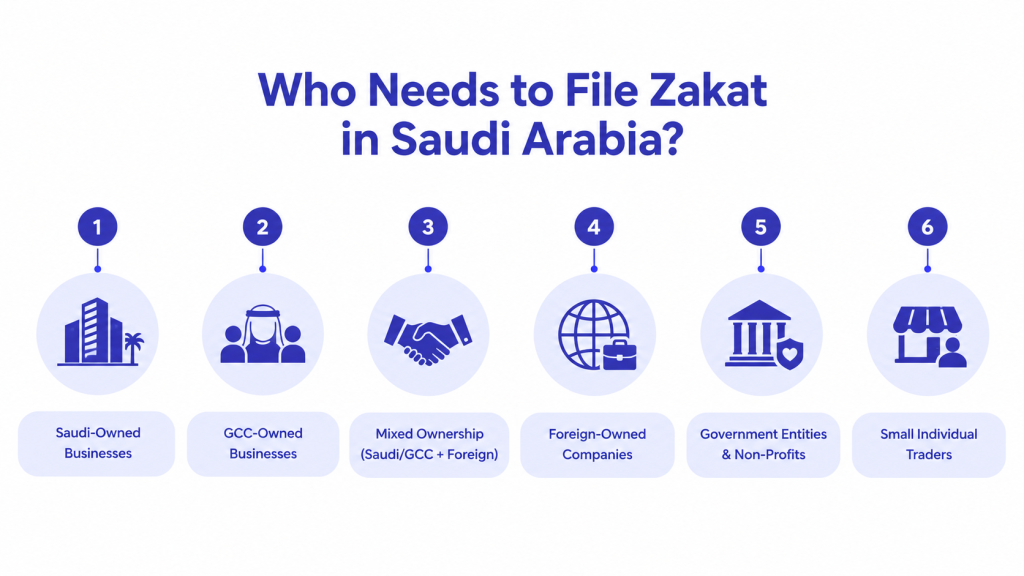
Who Needs to File Zakat in Saudi Arabia?
- Saudi-Owned Businesses: Entirely taxable under Zakat.
- GCC-Owned Businesses: On an equal footing with firms owned in Saudi Arabia and taxable under Zakat.
- Mixed Ownership (Saudi/GCC + Foreign): Subject to a mixed system where the Saudi/GCC part is taxable under Zakat, and the foreign part is taxed under CIT.
- Foreign-Owned Companies: Fully taxable under CIT.
- Government Entities & Non-Profits: Not taxable under the rules of business Zakat.
- Small Individual Traders: May be eligible for exemption depending on the criteria of ZATCA.
Practical Note: Each firm should consult ZATCA about its status with respect to Zakat and taxes.
Zakat vs. Corporate Income Tax: How Ownership Changes Your Liability
The ownership structure that is selected during the establishment of the company has a direct bearing on your future tax obligations.
Saudi and GCC Ownership
Zakat is payable solely based on the Saudi/GCC ownership percentage. This percentage of local ownership dictates what portion of the company’s Zakatable Base will be utilized in the calculation.
Foreign Ownership
The foreign equity portion is completely excluded from the Zakat calculation and assessed separately according to the CIT provisions at the standard 20% rate on net profit.
Mixed Ownership
For mixed companies, the financial records must specify the ownership share:
- Zakat Portion: Assessed based on the Saudi/GCC ownership of the Zakatable base.
- CIT Portion: Assessed based on the foreign ownership of the adjusted net income.
- An accurate and updated shareholder register is crucial for compliance purposes.
Company Formation and Regional Headquarters (RHQ) Planning
Selecting the right ownership structure prior to company incorporation can help avoid any future tax conflicts. While considering the establishment of a Saudi company or RHQ, companies have to assess the impact of their ownership on their Zakat and CIT liability starting with Day One.
Zakat Rules: Old vs. New Regulation (MR 1007/1445H)
Regulations have been amended (Ministerial Resolution MR 1007/1445H) by ZATCA to simplify computation approaches and offer further clarifications to businesses.
For Companies Established Before 1 January 2024
Such companies will operate under the traditional approach of assessment or as provided for by ZATCA under transitional guidelines. Existing businesses are encouraged to look at their Zakat assessments in accordance with amended reporting requirements.
For Companies Established On or After 1 January 2024
Such companies will be subject to new guidelines concerning asset categorization and working capital. The new companies need to develop their accounting practices immediately after their establishment.
Impact Comparison: Old vs. New Regulation
| Area | Companies Before 1 January 2024 | Companies From 1 January 2024 |
| Applicable Zakat Treatment | Legacy rules / transitional guidelines | Updated regulations under MR 1007/1445H |
| Ownership Impact | Proportional Saudi/GCC vs. foreign split | Proportional Saudi/GCC vs. foreign split with stricter documentation |
| Startup Considerations | Focus on aligning existing compliance records | Focus on setup, entity structuring, and day-one readiness |
| Working-Capital Treatment | Standard Zakatable base formulas | Refined asset/liability inclusion rules |
Practical Note: The exact Zakat treatment should be determined based on the applicable ZATCA rules and the company’s ownership and financial circumstances.
How is Zakat Calculated in Saudi Arabia?
Basic Zakat Formula
Zakat is generally assessed at 2.5% of the Zakatable Base (or net working capital):
Zakat = 2.5% × (Zakatable Assets – Zakatable Liabilities)
Assets Included in the Zakatable Base
- Cash and bank balances
- Accounts receivable (net of bad debts)
- Inventory and goods held for sale
- Short-term financial investments
Assets Generally Excluded
- Fixed assets (land, buildings, equipment, machinery)
- Long-term investments and holdings
- Uncollectible bad debts or bad debt provisions
- Prepaid expenses
Working-Capital Calculation Example
Consider a company with the following financial figures:
- Current Assets: SAR 5,000,000
- Current Liabilities: SAR 2,000,000
- Zakatable Base: SAR 5,000,000 – SAR 2,000,000 = SAR 3,000,000
- Zakat Liability: 2.5% × SAR 3,000,000 = SAR 75,000
Ownership-Based Example
If the company above has 60% Saudi ownership and 40% Foreign ownership:
- Saudi Share of Zakatable Base: 60% × SAR 3,000,000 = SAR 1,800,000
- Zakat Due: 2.5% × SAR 1,800,000 = SAR 45,000
- Foreign Share: Subject to 20% Corporate Income Tax (CIT) on net taxable profits rather than Zakat.
Zakat Filing Process in Saudi Arabia: Step-by-Step
1. Register with ZATCA:
Register yourself officially in the ZATCA portal to get a unique Zakat file number.
2. Prepare Financial Statements:
Prepare financial statements at the year-end. If your company qualifies for that then you need to prepare the audited statements.
3. Determine Ownership and Zakat Position:
Find out the shareholding percentage of the entity (Saudi/GCC or foreign). This will determine the Zakat & CIT percentages.
4. Prepare the Zakat Return:
Fill in the calculation templates in the portal with accurate data about your assets, liabilities and equity components.
5. Submit the Return Online:
Check everything and submit your Zakat form online from the ZATCA portal.
6. Pay the Zakat Liability:
Pay your liability online through SADAD or any commercial banking channel.
7. Track Filing Deadline:
Your submission and payment should be done within 120 days from the fiscal year-end date.
Zakat Filing Readiness: Cost Calculator, Organogram & AML Checks
Compliance is made possible by linking up the financial planning process with corporate governance mechanisms.
Live Cost Calculator
Use dynamic setup and compliance calculators to get an estimate of the cost of the setup process and filing fees. Linking up the structure of ownership with the Zakat planning helps to model the overheads appropriately.
Organogram Mapping
Mapping up the structure of ownership through dynamic organograms makes it possible to know immediately whether the ownership comprises Saudi/GCC ownership or foreign ownership, thus identifying the Zakat/CIT threshold for the business before filing any tax returns.
AML Checker
An AML readiness review of the shareholder background, source of funds document, and corporate documents would help to ensure that they are in line with the regulatory requirements in Saudi Arabia.
Practical Note: Zakat filing readiness ought to be reviewed together with ownership, finance, and other aspects of regulation.
Zakat Filing Deadline and Compliance Requirements
- Filing Window: Returns should be made within a period of 120 days after the company’s fiscal year closure.
- Financial Record Keeping: Keep audited or checked records of financial transactions in the ledger and receipts.
- Documentation Requirements: Keep up-to-date Commercial Registration (CR) records, Articles of Association, and Cap Tables.
- Classification Accuracy: Proper asset classification to avoid wrong calculations between current and long-term assets.
- Monitoring Regulations: Know the latest ZATCA Circulars and Tax Resolutions.
Benefits of Timely Zakat Filing
- Avoiding Penalties: Avoid financial penalties, late payment penalties, and any possible freezing of the service portal.
- Regulatory Compliance: Helps keep your commercial registrations valid and active.
- Business Credibility: Improves the corporate image with business partners and banks.
- License Renewals: Helps in obtaining the Commercial Registration (CR) licenses and SAGIA/MISA licenses easily.
- Banking Access: Helps in conducting smooth banking activities and in getting lines of credit and loans.
- Social Impact: Helps in the development of the country socially through social development projects in the country.
Common Zakat Filing Challenges
- Calculation Complexity: Understanding subtleties in formulas for asset inclusion/exclusion.
- Incomplete Documentation: Insufficient supporting documents resulting in rejection of filings or questions at audits.
- Incorrect Asset Classification: Wrong classification of long-term or short-term assets causing wrong liability bases.
- Misinterpreting Exemptions: Wrong interpretation of exemptions lacking precedent from ZATCA.
- Ownership Classification Errors: Failure to adjust mid-year ownership changes.
- Regulatory Updates: Adapting to frequent circulars and regulatory changes.
- Late Submissions: Missing 120 days filing window due to audit delay.
Zakat Filing for Startups: What to Prepare From Day One
- Careful Entity Structuring: Assess the split of ownership before incorporation to take care of future Zakat and CIT issues.
- Understand Tax Liability Early: Determine early on if your business pays Zakat, CIT or both.
- Maintain Clean Shareholder Records: Keep capitalization tables and documents up-to-date.
- Track Working Capital Regularly: Track your current assets and liabilities monthly to prevent year-end surprises.
- Prepare for ZATCA Portal Registration: Register on the ZATCA portal once you receive the Commercial Registration (CR).
- Review Effective Dates: Understand how regulatory provisions such as MR 1007/1445H apply to your date of incorporation.
How Arnifi Can Help With Saudi Zakat Compliance
Arnifi helps companies in the GCC with all types of services regarding Zakat, tax, and corporate structure:
- Zakat Assessment & Calculations: Proper calculation of Zakatable bases and completion of returns.
- End-to-End ZATCA Portal Support: Direct assistance in all types of registration, filing, and issue resolution.
- Ownership Structure Review: Professional analysis of corporate structure for Zakat/CIT position optimization.
- Integrated Tools: Use of Cost Calculators, Organograms for ownership structure analysis, and AML checks for business preparedness.
- Regulatory Monitoring: Make sure that your business remains up-to-date on all policies of ZATCA.
- RHQ & Formation Packages: Assistance in business registration and RHQ establishment in Saudi Arabia.
Frequently Asked Questions (FAQs)
What is Zakat tax in Saudi Arabia?
Zakat in Saudi Arabia is an obligatory tax amounting to 2.5% applied to the Zakatable net working capital of Saudi and GCC companies, which is administered by ZATCA.
Who needs to file Zakat in Saudi Arabia?
Any commercial entity that is owned either wholly or partially by Saudi or GCC nationals, carrying out operations in Saudi Arabia, must pay Zakat.
What is the Zakat rate in Saudi Arabia?
Zakat rate is set at 2.5%, and it is applied to the Zakatable base for a lunar year (or slightly adjusted for a Gregorian fiscal year).
How is Zakat calculated in Saudi Arabia?
It can be done by multiplying the rate of 2.5% by the Zakatable Base (Zakatable Assets – Zakatable Liabilities).
What is the difference between Zakat and CIT in Saudi Arabia?
Zakat (2.5%) is levied on Saudi and GCC shares based on net working capital, while Corporate Income Tax (CIT, 20%) is levied on foreign non-GCC shares based on net adjusted profit.
Do foreign-owned companies pay Zakat in Saudi Arabia?
No. Foreign-owned companies must pay Corporate Income Tax (CIT) equal to 20% of their net taxable profits instead of Zakat.
Do GCC-owned companies pay Zakat in Saudi Arabia?
Yes. GCC-owned companies and their shareholders are considered Saudi nationals when it comes to Zakat requirements.
How does mixed ownership affect Zakat in Saudi Arabia?
Mixed-owned companies are taxed based on the Saudi/GCC share under Zakat rules, while the foreign share is subject to Corporate Income Tax (CIT).
What is the Zakat filing deadline in Saudi Arabia?
The deadline to file Zakat is 120 days after the end of the company’s financial year.
What is MR 1007/1445H?
It means ZATCA Ministerial Resolution, which includes updated Zakat regulations and guidelines.
How do the new Zakat rules affect startups?
The new regulations include definitions of what is required to be included in or excluded from the asset base. Startups founded on or after January 1, 2024, have to maintain compliant financial records right from the start.
What changed for companies established before and after 1 January 2024?
Companies registered after January 1, 2024 are subject to the new MR 1007 rules, while others are registered following specific ZATCA rules.
Can Zakat be filed online in Saudi Arabia?
Zakat filings are made online through the ZATCA portal.
What documents are required for Zakat filing?
Documents needed include audited statements, commercial registration records, share registers, and asset and liability statements.
What happens if a company misses its Zakat filing deadline?
Penalties can include fines, late payment fees, and even a suspension of the portal service.
How does company ownership affect Zakat liability?
Ownership determines if the liability is Zakat liability (Saudi/GCC ownership) or corporate income tax liability (foreign ownership).
How can I check my Zakat filing status with ZATCA?
It is possible to log in to one’s account on the ZATCA e-portal and check submission status, assessment status, and issued certificates.
Conclusion
Zakat is a critical regulatory requirement that all relevant businesses in Saudi Arabia must fulfill, where the type of ownership will define whether the liabilities of the business will be subject to Zakat, CIT, or both. Uninterrupted operations in the business will depend on ensuring compliance right from the beginning through accurate record-keeping and filing of returns during the 120 days after the year-end. For new businesses, understanding the changes made to the framework recently, particularly the amended Implementing Regulations for Zakat Collection through the Ministerial Resolution No. 1007/1445H, is key in ensuring compliance from the very start. Finally, the use of modern readiness tools, including ownership structure mapping and setup cost calculations, makes compliance with ZATCA filing processes easier.
References
- Zakat, Tax and Customs Authority (ZATCA) Official Portal – Primary governing body for Zakat and tax regulations in Saudi Arabia.
- Ministry of Investment Saudi Arabia (MISA) – Official authority for foreign investment rules and business licensing.
- Saudi Ministry of Commerce – Governing body for commercial registration and corporate governance.
Top Saudi Arab Packages
Related Articles



Top Saudi Arab Packages
Get in Touch
