
WPS in the UAE | Rules, Compliance, Salary Payments & Employer Requirements

Anushka
Content Writer
Anushka Basu is a business content writer specialised in global business market insights. She aims to simplify complex regulatory, financial, and business concepts into… Read more

Tulika Saxena
AVP, Sales & Marketing | IIM Nagpur
Tulika Saxena specializes in business finance, sales strategy, and market positioning. Leads growth and partnerships, ensuring seamless business setup experiences and client success across… Read more



The Wage Protection System (WPS) is the UAE’s electronic system for monitoring salary payments by employers. It helps ensure that employees receive their wages on time and that employers follow the applicable salary payment requirements.
For UAE private-sector employers, understanding WPS is important for maintaining compliance and avoiding payment-related restrictions.
This guide explains how WPS works, who needs to comply, whether employees need a salary card or a UAE bank account, how salaries are processed, what happens when payments are delayed and how employers can avoid common WPS compliance issues.
Table of contents
- What Is the Wage Protection System (WPS) in the UAE?
- Who Needs to Comply With WPS in UAE?
- Is a Salary Card or UAE Bank Account Mandatory for WPS?
- How Does WPS Salary Payment Work for Employers?
- When Should Salaries Be Paid Through WPS?
- What Happens If Salary Is Not Paid on Time?
- What Happens If a Company Is Blocked on WPS?
- What Happens If Salary Is Paid Through a Personal Account?
- Consequences of WPS Non-Compliance
- Common WPS Compliance Mistakes
- WPS Compliance Checklist
- FAQs
- Conclusion
What Is the Wage Protection System (WPS) in the UAE?
The Wage Protection System is an electronic salary payment system used to monitor whether employers are paying employees according to their employment and salary records.
WPS connects salary information with the Ministry of Human Resources and Emiratisation (MoHRE) and authorised financial institutions. Employers can process salary payments through approved banks, exchange houses and other financial institutions authorised for WPS payments.
The system allows salary payments and employee wage information to be monitored electronically.
The UAE has also introduced an updated WPS with expanded digital payment channels and greater integration between MoHRE systems and participating financial institutions. The update is intended to make salary registration, verification and payment processes more digitally integrated.
The practical purpose remains the same: employers need to make salary payments through an approved WPS-compliant route and ensure that the salary information submitted is accurate.
A WPS-compliant payment does not automatically mean that every employee must have a salary card or a UAE bank account. The applicable payment route depends on the approved WPS arrangements and the relevant requirements.
Who Needs to Comply With WPS in UAE?
WPS generally applies to establishments in the UAE private sector that are registered with MoHRE and are required to pay employee wages through the system.
Employers need to ensure that:
- The establishment is properly registered for WPS.
- Employee salary information is correctly recorded.
- Salaries are processed through an approved WPS payment channel.
- Payments are made within the applicable payment period.
- Any payment issues are identified and corrected promptly.
There are specific exemptions for certain employees and establishments depending on their circumstances. Employers should therefore check whether a particular employee or establishment falls within an applicable exemption rather than assuming that every worker is subject to the same WPS requirements.
Is a Salary Card or UAE Bank Account Mandatory for WPS?
A salary card is not automatically mandatory for every employee simply because the employer uses WPS.
Similarly, WPS compliance does not mean that every employee must have a personal UAE bank account.
The important requirement is that the employer uses an approved WPS-compliant salary payment route and follows the applicable requirements for submitting and processing employee salary information.
Employers should therefore focus on whether the selected payment method is approved for WPS rather than assuming that a particular type of salary card or bank account is compulsory for every employee.
How Does WPS Salary Payment Work for Employers?
The WPS process involves registering the establishment, maintaining accurate employee salary information and processing salaries through an approved payment channel.
Register Company for WPS
The employer first needs to have the establishment properly registered and set up for WPS.
The company and employee information used for salary processing should match the records maintained with MoHRE.
Prepare Employee Salary Information
Employers need to maintain accurate salary information for their employees.
This includes ensuring that the employee’s salary details correspond with the employment records and that any changes to salary information are properly updated.
Incorrect or outdated salary information can create payment and compliance issues.
Process Salary Through WPS
Once the salary information is ready, the employer processes the salary payment through an approved WPS channel.
WPS salary payments can be made through authorised banks, exchange houses and financial institutions. The employer should ensure that the payment is processed correctly and within the applicable salary payment period.
MoHRE Salary Information and Automatic Updates
The updated WPS system provides greater digital integration between MoHRE and participating financial institutions.
This means salary payment information can be processed and verified through integrated electronic systems, helping reduce manual delays and improving monitoring of salary payments.
Employers should still monitor their WPS records and payment status rather than assuming that every update will automatically resolve an issue.
When Should Salaries Be Paid Through WPS?
Employers need to pay salaries within the applicable payment period under the current WPS rules.
Under the current UAE framework, salaries for the previous month become due on the first day of the following Gregorian month. Employers are required to transfer at least 85% of the total wages due on time, subject to applicable lawful deductions and the specific rules governing the payment process.
The system begins electronic monitoring from the relevant due date. Further measures can apply when salary payments remain unpaid.
Employers should therefore avoid treating a particular calendar date as a universal WPS deadline without checking the current applicable rules for their establishment and employees.
What Happens If Salary Is Not Paid on Time?
WPS monitors salary payments and can trigger different measures when an employer does not make the required salary payments on time.
The measures become progressively stronger when the payment remains outstanding.
| Timing | WPS action |
| From the salary due date | Electronic monitoring of the establishment |
| From the second day | Electronic alerts and notifications |
| Day 5 | Suspension of new work permit issuance and warning |
| Day 11 | Administrative fine and reclassification to Third Category for repeated violations within the applicable period |
| Day 16 | Automatic labour dispute for affected workers and suspension of work permits for specified establishments meeting the applicable conditions |
The exact consequences depend on the applicable WPS rules and the circumstances of the establishment.
What Happens If a Company Is Blocked on WPS?
A WPS issue can affect an employer’s ability to carry out certain employment-related processes.
WPS Blocking After Salary Not Paid by Relevant Deadline
If the required salary payment remains outstanding, the employer can receive notifications and face restrictions under the applicable WPS process.
Employers should not wait for the issue to escalate. Once a payment problem is identified, the salary issue should be corrected, and the WPS status checked.
Employer Permit / Company Status
WPS non-compliance can result in restrictions on the establishment, including restrictions on the issuance of new work permits in accordance with the applicable measures.
The impact depends on the stage of the violation and the circumstances of the company.
Resolving WPS Issue
To resolve a WPS issue, the employer should:
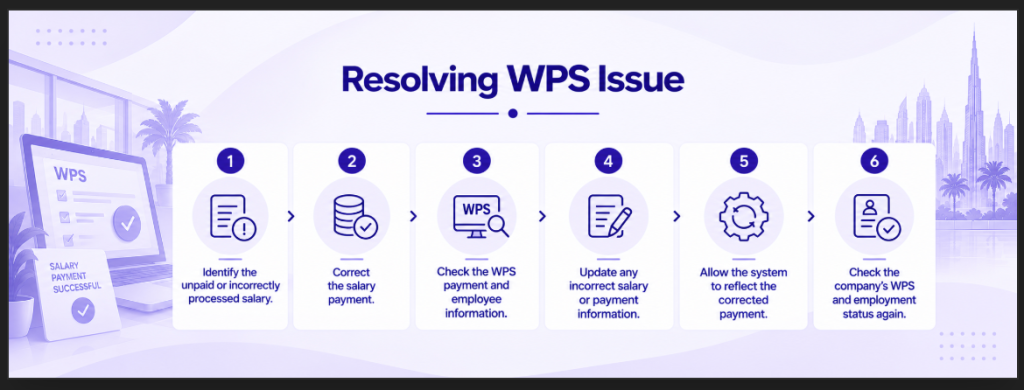
The employer should also keep records showing that the salary issue was corrected.
What Happens If Salary Is Paid Through a Personal Account?
Employers should use the approved WPS payment route for employee salaries.
If salary has been paid through a personal account or through a payment route that does not properly reflect the WPS salary payment, the employer should correct the payment process and ensure that the relevant WPS information is properly updated.
The key issue is not simply which bank account was used. The employer needs to ensure that the salary payment is properly recorded through the applicable WPS process.
Employers should also avoid relying on informal payment arrangements as a substitute for WPS compliance.
Consequences of WPS Non-Compliance
Failure to comply with WPS requirements can result in:
- Salary payment delays.
- Electronic notifications and monitoring.
- Restrictions on issuing new work permits.
- Administrative fines.
- Reclassification of the establishment in applicable cases.
- Labour disputes for affected employees.
- Suspension of work permits in cases covered by the relevant rules.
- Other administrative restrictions depending on the nature and duration of the violation.
The consequences can become more serious when an employer does not correct the salary issue promptly.
Common WPS Compliance Mistakes
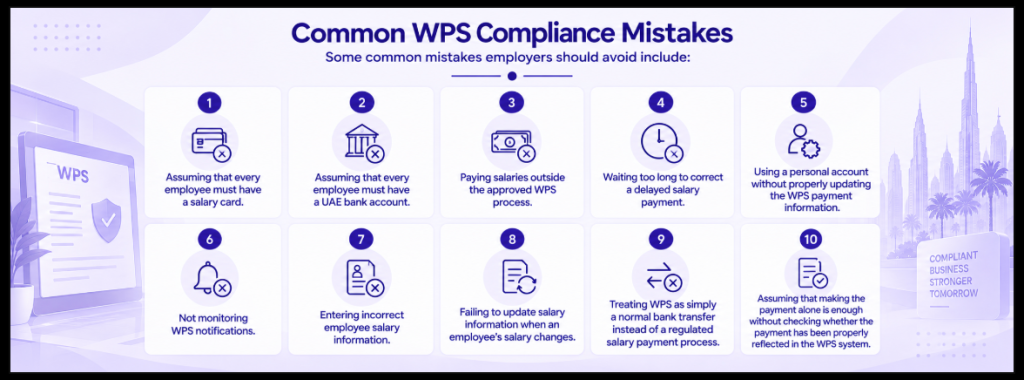
WPS Compliance Checklist
Employers can use the following checklist to manage their WPS compliance:
- Register the company correctly for WPS.
- Add and maintain accurate employee salary information.
- Use an approved WPS payment channel.
- Process salaries within the applicable payment period.
- Monitor salary payment status.
- Check WPS notifications and alerts.
- Correct failed or delayed payments promptly.
- Update incorrect salary or employee information.
- Check the WPS status after correcting an issue.
- Maintain records of salary payments and related corrections.
FAQs
Is WPS mandatory in the UAE?
WPS generally applies to UAE private-sector establishments registered with MoHRE, subject to the applicable exemptions and rules.
Is a salary card mandatory for WPS?
No. WPS compliance does not automatically mean that every employee must receive their salary through a salary card. Employers should use an approved WPS-compliant payment route.
Does an employee need a UAE bank account for WPS?
Not necessarily. A UAE bank account is not automatically mandatory for every employee. The relevant requirement is to use an approved WPS payment method.
What happens if salary is paid late?
Late salary payments can trigger electronic monitoring, notifications and progressively stronger administrative measures, including work-permit restrictions and other consequences depending on the circumstances.
What happens if a company is blocked on WPS?
The employer should identify the salary or payment issue, correct it, update the relevant information and check the WPS and establishment status after the correction.
What happens if salary is paid through a personal account?
The employer should ensure that the payment is properly corrected and reflected through the applicable WPS process rather than relying on the personal-account payment as a substitute for WPS compliance.
How long does a WPS update take?
The time required for a WPS update can depend on the type of correction and the payment or financial institution involved. Employers should check the system after correcting the issue rather than assuming that the status has already been updated.
Does MoHRE automatically update WPS information?
The updated WPS provides greater electronic integration between MoHRE and participating financial institutions. However, employers should continue to monitor their records and resolve discrepancies when they arise.
What if an employer does not comply with WPS?
An employer may face monitoring, notifications, work-permit restrictions, administrative fines, reclassification and other measures depending on the nature and duration of the non-compliance.
Conclusion
WPS compliance in the UAE is not limited to transferring salaries from one account to another. Employers need to maintain accurate salary information, use an approved payment channel, pay employees within the applicable period and monitor the WPS status of the establishment.
Understanding the payment process and addressing issues quickly can help employers avoid unnecessary salary disputes, work-permit restrictions and other compliance consequences.
Arnifi can help businesses understand the WPS setup and compliance process and coordinate the required steps for managing UAE employment requirements.
Official references
Top UAE Packages


Related Articles



Top UAE Packages
Get in Touch