
Top 10 Regulated Trading Platforms in the UAE 2026 Corporate Guide

Nishant
Content Writer
Nishant Kumar is a technical content writer, he shares global business insights and bridges the gap between complex regulatory frameworks and actionable growth strategies.… Read more

Tulika Saxena
AVP, Sales & Marketing | IIM Nagpur
Tulika Saxena specializes in business finance, sales strategy, and market positioning. Leads growth and partnerships, ensuring seamless business setup experiences and client success across… Read more


Key Facts: Trades in corporate treasuries in the UAE should comply with the regulatory system of the federal government or the financial free zone. Companies that trade with their own money have the benefit of having 100 percent foreign ownership (subject to some activity restrictions and strategic sectors). Financially regulated companies have strong anti-money laundering regulations and determination of the ultimate beneficial owner before establishing corporate treasuries.
Table of contents
- Introduction
- What Are the Regulatory Frameworks for Trading Platforms in the UAE?
- Why Do Corporate Entities Need to Have Completely Regulated Platforms?
- What Are the Top 10 Trading Platforms to Use in 2026?
- How to Form a Proprietary Trading Firm in the UAE?
- How Does Arnifi Help Businesses Set Up the Entity Behind a Trading Account?
- Conclusion
- FAQs
- References
Introduction
The United Arab Emirates offers highly regulated financial systems for institutional investors, proprietary traders, and corporate treasuries. The expansion of capital investment activities calls for the availability of quality trading platforms.
Investors need to consider the regulatory environment, diversification of asset classes, and liquidity when selecting brokerages. Being in such a jurisdiction will ensure that corporate funds are safe with top-notch financial governance.
What Are the Regulatory Frameworks for Trading Platforms in the UAE?
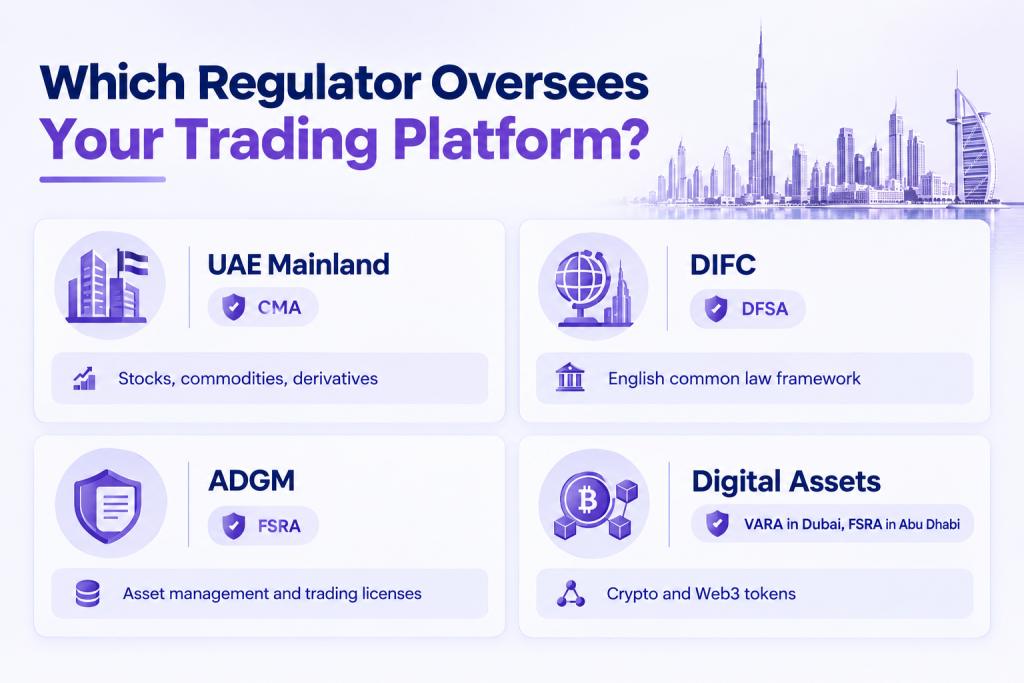
Brokers dealing in the local market need to obtain approval from the relevant authorities. CMA governs the trading platforms that deal in stocks, commodities, and derivatives on the mainland UAE and ensures that the strict capital requirements and customer segregation policies are met.
Free zones (DIFC and ADGM) follow the English common law. The trading platforms in the Dubai International Financial Centre get approval from the Dubai Financial Services Authority. This ensures that the business organizations have access to a secure and internationally recognized financial system.
Why Do Corporate Entities Need to Have Completely Regulated Platforms?
The utilization of institutional capital needs a much greater level of protection than the one needed by retail accounts. Unregulated offshore brokers expose corporate capital to unsecured counterparties and the possibility of liquidity lock.
- Segregation of Funds: Regulated brokers keep their corporate clients’ funds in segregated client accounts with authorised banks to safeguard against any brokerage failure
- Compliance Features: The licensed platforms offer tax documents and transaction logs, which are mandatory for auditing by the corporate tax department
- High Liquidity Access: The high-end platforms give access to deep liquidity pools that can reduce, but not eliminate, slippage
- Protection of Assets: Regulated firms apply client-money segregation and insolvency-distribution rules; there is no general statutory compensation scheme
Prioritizing regulatory compliance over leverage limits protects the corporate treasury from catastrophic financial exposure.
What Are the Top 10 Trading Platforms to Use in 2026?
Corporate treasuries and proprietary trading organizations have to pick the trading platforms according to their specific needs and capital. The following table shows the top trading platforms regulated for UAE companies.
| Sl No. | Trading Platform | Primary UAE/Global Regulator | Supported Asset Classes |
| 1 | Interactive Brokers | DFSA | Global Equities, Options, FX |
| 2 | Saxo Bank | Central Bank of the UAE (rep. office) / DFSA (rep. office) / Danish FSA | Equities, Bonds, Commodities |
| 3 | IG Group | DFSA / FCA | Indices, Forex, Commodities |
| 4 | Swissquote | DFSA / FINMA | Forex, Equities, Digital Assets |
| 5 | eToro | FSRA / FCA | Equities, Crypto, ETFs |
| 6 | XTB | DFSA / FCA | Forex, Indices, Commodities |
| 7 | AvaTrade | FSRA / ASIC | Forex, CFDs, Options |
| 8 | Pepperstone | DFSA / FCA | Forex, CFDs, Commodities |
| 9 | Binance MENA | VARA / FSRA | Digital Assets, Web3 Tokens |
| 10 | Plus500 | DFSA / FCA | CFDs, Forex, Equities |
Finance managers have to consider recurring maintenance fees, overnight swaps, and non-activity fees of corporations while choosing their main brokerages.
Almost all institutional accounts on the platforms above require a UAE-based entity. Proprietary trading firms also require proper regulatory approval apart from a general trade license. The section below discusses how to do that.
How to Form a Proprietary Trading Firm in the UAE?
To establish a company for proprietary trading, it is essential for the founders to choose the country that will offer opportunities for proprietary trading and investment. The financial free zones in the UAE, such as Abu Dhabi Global Market, have special trading and asset management licenses. At the stage of filing, it is important to compose a Memorandum of Association and clearly state the asset classes to be traded.
After registration, it is vital for the company to comply with all banking and anti-money laundering requirements. To open a bank account, the founders have to prove the ultimate beneficial owner, prepare business plans, and clarify the sources of funds. Compliance is monitored by the respective regulatory body (SCA/CMA, DFSA or FSRA); Banking by the Central Bank of the UAE.
How Does Arnifi Help Businesses Set Up the Entity Behind a Trading Account?
Most of the platforms listed above will not allow you to open an institutional account through an unincorporated offshore vehicle. This is because they require that a UAE-based company is set up, that there is a clear chain of UBOs, that there is proper AML compliance, and, in the case of proprietary trading, proper regulatory clearance. We do this for businesses.
We organize both mainland and free zone firms for trading or treasury purposes, liaise with authorized consultants for any SCA/CMA, DFSA, or FSRA licenses required for the transaction, and compile the shareholding structure and compliance documents requested by the platform for due diligence purposes. Our Arni AML checker checks the shareholdings and counterparties against sanctions and compliance lists, and our banking services help with the corporate bank account setup.
Reach out to us at Arnifi, and our team will walk you through the setup.
Conclusion
Setting up corporate trading in the UAE offers access to highly regulated markets as well as financial free zones with taxation advantages. Opting for one of the best regulated trading platforms helps mitigate counterparty, custody and conduct risk.
With modern compliance infrastructure used at the incorporation stage, trading companies will be able to carry out complicated market operations without any hassle.
Get in touch with us at Arnifi for personalized setup and cost calculation.
FAQs
What is the Capital Market Authority (CMA)?
Capital Market Authority (CMA), formerly SCA, is the primary federal regulatory body responsible for supervising and monitoring financial markets, commodities, and trading platforms across the UAE mainland.
Can foreign founders own 100 percent of a UAE trading company?
Yes. Recent commercial legislation allows international investors to retain complete equity in proprietary trading firms and investment holding companies (subject to activity-specific restrictions and strategic-sector approvals).
What is the Dubai Financial Services Authority?
The DFSA is the independent financial regulator for entities and trading platforms operating within the Dubai International Financial Centre.
Do corporate trading accounts require higher minimum deposits than retail accounts?
Yes. Brokers generally require higher initial capitalization for corporate entities to cover institutional compliance checks and enhanced market access requirements.
Are digital assets and cryptocurrencies regulated in the UAE?
Yes. Digital assets are highly regulated by authorities such as the Virtual Assets Regulatory Authority in Dubai and the Financial Services Regulatory Authority in Abu Dhabi.
Why do platforms require Ultimate Beneficial Owner verification?
Regulated brokers must identify all individuals holding significant equity to comply with federal anti-money laundering and counter-terrorism financing laws.
Do proprietary trading companies pay UAE Corporate Tax?
Mainland companies pay a 9% on profits exceeding AED 375,000, while free zone trading entities may secure a 0% on qualifying income only if they qualify as a Qualifying Free Zone Person (Qualifying Income, adequate economic substance, audited statements).
What documents are necessary to open an institutional trading account?
Brokers mandate the submission of the trade license, corporate constitutional documents, shareholder passports, and active corporate bank account statements.
How long does it take to establish a proprietary trading firm?
Commercial licensing generally completes within two to four weeks, while securing corporate banking and institutional brokerage accounts requires additional due diligence processing.
References
Dubai Financial Services Authority
Top UAE Packages
Related Articles


Top UAE Packages
Get in Touch
