
Saudi Arabia Withholding Tax (WHT) Guide (2026 Edition)

Anushka
Content Writer
Anushka Basu is a business content writer specialised in global business market insights. She aims to simplify complex regulatory, financial, and business concepts into… Read more

Tulika Saxena
AVP, Sales & Marketing | IIM Nagpur
Tulika Saxena specializes in business finance, sales strategy, and market positioning. Leads growth and partnerships, ensuring seamless business setup experiences and client success across… Read more



Key Fact: Saudi withholding tax generally applies to specified Saudi-source payments to non-residents, with the applicable rate depending on the income category and relevant tax rules. ZATCA issued its latest General Guideline in May 2026.
Table of contents
- What is withholding tax in Saudi Arabia?
- Who is required to withhold tax in Saudi Arabia?
- When does withholding tax apply in KSA?
- What are the Saudi Arabia withholding tax rates for 2026?
- How do you calculate withholding tax in Saudi Arabia?
- How does Saudi Arabia determine whether a payment is Saudi-sourced?
- How are technical and consulting services treated for Saudi WHT?
- How are royalties and intellectual property payments treated?
- How are management fees, dividends, interest and other payments taxed?
- Does a permanent establishment change Saudi WHT treatment?
- Can a double tax treaty reduce Saudi withholding tax?
- What documents are needed to support Saudi WHT?
- How do you file and pay withholding tax in Saudi Arabia?
- What are the annual WHT reporting and recordkeeping requirements?
- What WHT certificates should Saudi businesses provide?
- What are the penalties for late or incorrect Saudi WHT?
- How can businesses build a Saudi WHT compliance process?
- How does Saudi WHT compare with UAE withholding tax?
- How can Arnifi help with Saudi withholding tax compliance?
- FAQs
- Conclusion
What is withholding tax in Saudi Arabia?
Saudi Arabia withholding tax (WHT) is a tax collection mechanism that applies to specified Saudi-source payments made to non-residents. Unlike ordinary income tax, which is generally calculated on taxable income or profit, WHT is generally calculated on the gross payment. The Saudi payer or other person required to withhold deducts the applicable amount and remits it to ZATCA.
The basic mechanism is:
Saudi payer → deducts WHT → pays balance to non-resident → remits WHT to ZATCA
For example, if a payment of SAR 100,000 is subject to a 5% WHT rate:
- Gross payment: SAR 100,000
- WHT: SAR 5,000
- Amount paid to non-resident: SAR 95,000
- Amount remitted to ZATCA: SAR 5,000
The key compliance questions are whether WHT applies, how to classify the payment, which rate applies, and when to report the tax.
Who is required to withhold tax in Saudi Arabia?
The withholding obligation generally falls on a person resident in Saudi Arabia who makes a Saudi-source payment to a non-resident. This can include taxpayers and non-taxpayers, as well as government departments, ministries, public authorities and other resident entities. A permanent establishment of a non-resident in Saudi Arabia can also have a withholding obligation.
- Resident legal persons
- Resident individuals conducting commercial activity, where the payment relates to that activity
- Government departments and ministries
- Public authorities and other resident entities
- Permanent establishments of non-resident entities in Saudi Arabia
The focus is therefore on who makes the payment and the nature and source of the payment, rather than simply who receives it.
When does withholding tax apply in KSA?
Saudi WHT generally applies where a person required to withhold makes a payment from a source in Saudi Arabia to a non-resident, and the payment falls within the specified income categories. ZATCA’s May 2026 guidance explains that the provisions cover specified Saudi-source payments and require the relevant income category to be identified before determining the rate.
- The recipient is a non-resident.
- The payment has a Saudi source.
- The payment falls within an income category subject to WHT.
- No applicable exemption or reduction removes or changes the obligation.
- A relevant tax treaty may modify the domestic rate where its conditions are satisfied.
A payment to a foreign company therefore does not automatically mean the same WHT treatment applies to every transaction.
What are the Saudi Arabia withholding tax rates for 2026?
The May 2026 ZATCA General Guideline provides the following domestic statutory rates.
| Payment / income category | Standard WHT rate |
| Management fees | 20% |
| Royalties | 15% |
| Dividends | 5% |
| Rent | 5% |
| Loan charges / income from debt claims | 5% |
| Insurance/reinsurance | 5% |
| Technical and consulting services | 5% |
| Air tickets or air/sea freight | 5% |
| International telecommunications services | 5% |
| Land transport within KSA | 15% |
| Any other payments | 15% |
These are domestic statutory rates. A double tax agreement may provide a reduced rate or exemption if the relevant treaty conditions are met.
The classification of the payment is therefore critical. Businesses should not automatically apply the 15% “other payments” rate to every cross-border service.
How do you calculate withholding tax in Saudi Arabia?
The calculation generally starts with the gross payment and the applicable statutory rate.
Gross payment × applicable WHT rate = WHT amount
For example:
| Calculation | Amount |
| Gross payment | SAR 100,000 |
| Applicable WHT rate | 5% |
| WHT deducted | SAR 5,000 |
| Net amount to non-resident | SAR 95,000 |
Businesses should then determine whether a tax treaty provides a different treatment and whether the required documentation supports the treaty position.
Where a contract guarantees a non-resident a specific net amount, a gross-up calculation may be required. For example, if the recipient must receive SAR 100,000 after 5% WHT, the contractual gross amount would need to be calculated so that the recipient receives the agreed net amount after withholding.
How does Saudi Arabia determine whether a payment is Saudi-sourced?
The source of income depends on the nature of the payment. The location of the invoice or bank transfer alone does not determine whether income has a Saudi source.
ZATCA’s May 2026 guidance addresses several situations, including services provided to Saudi residents, services performed wholly or partly in the Kingdom, management services, rent and other specified income.
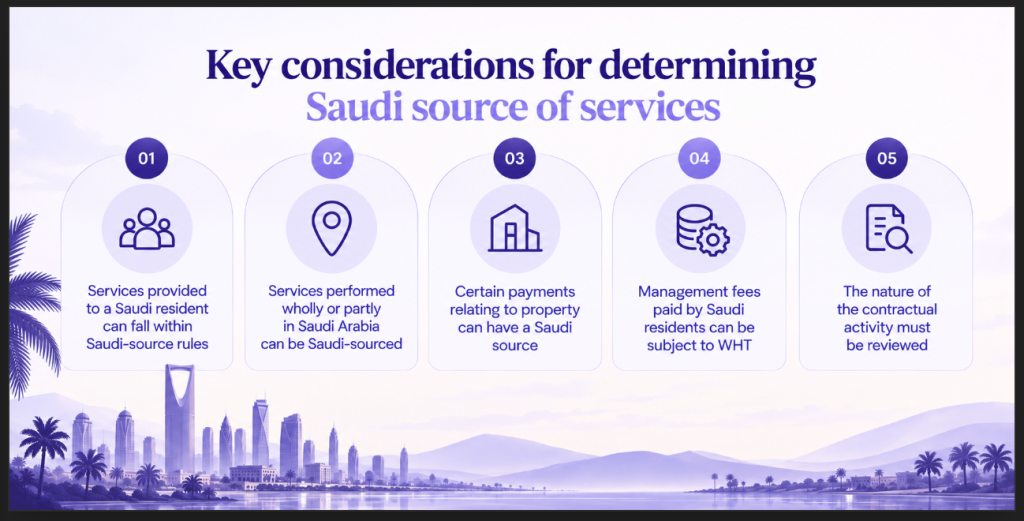
This means the underlying transaction and contractual arrangement should be examined before determining the WHT treatment.
How are technical and consulting services treated for Saudi WHT?
Technical and consulting services are specifically addressed in the Saudi WHT framework. ZATCA defines technical and advisory services broadly to include scientific, technological, industrial, geological, engineering, consultancy and advisory services.
The domestic WHT rate for technical and consulting services is 5%. ZATCA’s 2026 guidance also states that payments for technical and consulting services are subject to WHT regardless of where the services are performed when they are provided to a Saudi resident.
- Engineering services
- Scientific and technological services
- Consultancy
- Advisory services
- Research
- Geological studies
- Certain technical studies and designs
Simply using technology in delivering a service does not automatically make the payment a technical service. The actual nature of the service and contractual arrangement should be assessed.
How are royalties and intellectual property payments treated?
Royalties are generally payments for the use of, or right to use, intellectual property and certain related rights. The May 2026 ZATCA guideline covers patents, copyrights, trademarks, trade names, industrial secrets, know-how, goodwill and certain information or rights connected with intellectual or industrial property.
The domestic WHT rate for royalties is 15%.
- Patents
- Copyrights
- Trademarks
- Trade names
- Know-how
- Trade or industrial secrets
- Certain intellectual-property rights
- Rights to exploit natural or mineral resources
The payment method does not determine whether an amount is a royalty. ZATCA specifically notes that royalties can be regular, irregular or one-time payments.
The 2026 guidance also distinguishes several payments from royalties, including certain equipment rentals, implementation or design services, maintenance payments, technical consultancy and some software-related services.
How are management fees, dividends, interest and other payments taxed?
The applicable WHT rate depends on the income category.
| Payment | Domestic WHT rate |
| Management fees | 20% |
| Dividends | 5% |
| Loan charges / income from debt claims | 5% |
| Rent | 5% |
| Insurance/reinsurance | 5% |
| Technical and consulting services | 5% |
| Other payments | 15% |
Management fees include amounts paid under management service arrangements, such as hotel and ship management contracts.
Businesses should classify each payment based on its substance and the applicable provisions rather than relying only on the description used on an invoice.
Does a permanent establishment change Saudi WHT treatment?
Payments to a non-resident that are directly connected with its Saudi permanent establishment are generally not subject to WHT; the relevant income is instead dealt with under the income-tax framework applicable to the permanent establishment.
- Identify whether the non-resident has a Saudi PE.
- Determine whether the payment is connected with that PE.
- Review the applicable income-tax treatment.
- Do not assume every payment to a foreign company should simply be subject to WHT.
PE status should therefore be assessed before finalising the tax treatment of a significant cross-border payment.
Can a double tax treaty reduce Saudi withholding tax?
Yes, an applicable double tax agreement may reduce or exempt a payment from the domestic WHT rate if its conditions are satisfied. ZATCA provides a process for claiming treaty benefits, including information on beneficial ownership, tax residency and the relevant treaty article.
- Check whether Saudi Arabia has a treaty with the recipient’s jurisdiction.
- Identify the relevant income article.
- Confirm the recipient’s tax-residency position.
- Review beneficial ownership requirements.
- Check PE or fixed-base conditions where relevant.
- Maintain the required supporting documentation.
- Apply the treaty rate only where its conditions are met.
There is no universal treaty rate for dividends, interest, royalties or services because the result depends on the specific agreement and facts.
What documents are needed to support Saudi WHT?
Businesses should maintain an evidence file connecting the payment to its tax treatment.
- Contract or master service agreement
- Statement of work
- Invoice
- Payment evidence
- Beneficiary details
- WHT calculation
- WHT return and payment record
- WHT certificate
- Tax Residency Certificate where treaty relief is claimed
- Beneficial-ownership declarations where relevant
- Documents supporting payment classification
ZATCA requires withholding agents to maintain records sufficient to demonstrate compliance, including the type and value of payments, the amount withheld and beneficiary information.
How do you file and pay withholding tax in Saudi Arabia?
The withholding agent must register with ZATCA and submit a monthly WHT statement where required.
- Identify the payment and beneficiary
- Classify the payment
- Determine the applicable rate
- Calculate the WHT
- Deduct the tax from the payment
- Submit the monthly WHT statement
- Pay the withheld amount
- Provide the beneficiary with the WHT certificate
The monthly statement and payment are due within the first 10 days of the following month. ZATCA’s e-service allows withholding agents to submit their monthly WHT returns through the ZATCA portal.
What are the annual WHT reporting and recordkeeping requirements?
In addition to monthly reporting, the withholding agent must submit an annual WHT statement. The general deadline is within 120 days after the fiscal year-end, while partnerships have 60 days.
- Submit the annual WHT statement within the applicable deadline.
- Include the required beneficiary and payment information.
- Maintain records supporting the reported amounts.
- Retain relevant records for at least 10 years.
- Submit the annual statement even where the amount reported is zero, where the withholding obligation existed during the year.
The annual statement summarises the WHT statements submitted during the year and does not itself create an additional tax payment for amounts already paid through the monthly process.
What WHT certificates should Saudi businesses provide?
A WHT certificate documents the tax withheld from a payment made to a non-resident. It can be important to the recipient when establishing that Saudi tax was paid or withheld, including for purposes of claiming relief or a foreign tax credit where permitted by the recipient’s home-country rules.
The certificate should support the underlying transaction and reflect:
- Beneficiary information
- Gross payment
- Tax withheld
- Relevant payment details
- Applicable reporting information
ZATCA also provides an online service for verifying WHT certificates.
What are the penalties for late or incorrect Saudi WHT?
Late payment of WHT can result in a penalty of 1% of the unpaid tax for every 30 days of delay. The 2026 guideline also describes additional consequences for certain incorrect or fraudulent information.
- Late payment: 1% of unpaid tax for every 30 days of delay.
- Incorrect or concealed information can trigger additional penalties.
- Fraud or tax-evasion-related conduct can result in a penalty of 25% of the tax difference in specified circumstances.
- Failure to maintain proper records can increase compliance risk.
ZATCA’s current guidance therefore goes beyond the commonly quoted “1% monthly penalty” and addresses additional consequences for serious non-compliance.
How can businesses build a Saudi WHT compliance process?
Businesses can incorporate WHT into their accounts-payable and month-end processes.
This turns WHT into a repeatable finance control instead of an end-of-month tax exercise.
How does Saudi WHT compare with UAE withholding tax?
Saudi Arabia and the UAE use different domestic approaches to withholding tax. Saudi Arabia applies statutory WHT rates to specified Saudi-source payments to non-residents, while the UAE’s domestic withholding tax rate under its corporate tax framework is currently 0%. Businesses comparing the two jurisdictions should therefore assess cross-border payment treatment separately in each country.
The comparison is particularly relevant when a group has Saudi and UAE entities making payments to the same foreign service provider or related party.
How can Arnifi help with Saudi withholding tax compliance?
Arnifi can support businesses with the practical administration and documentation involved in Saudi WHT compliance.
- Payment classification support
- WHT calculation and gross-up support
- Treaty-relief documentation review
- Monthly filing coordination
- WHT certificates and documentation
- Recordkeeping and audit-readiness
- Cross-border payment compliance support
The appropriate tax treatment should be determined based on the applicable Saudi rules, treaty provisions and specific facts of the transaction.
FAQs
What is withholding tax in Saudi Arabia?
It is a tax collection mechanism applied to specified Saudi-source payments made to non-residents.
Who is required to withhold tax in Saudi Arabia?
Residents and certain permanent establishments making qualifying Saudi-source payments to non-residents generally have the withholding obligation.
What are the Saudi withholding tax rates for 2026?
Rates range from 5% to 20%, depending on the payment category under the domestic rules.
How is withholding tax calculated in KSA?
WHT is generally calculated by multiplying the gross payment by the applicable statutory rate.
Is Saudi WHT calculated on gross or net payment?
Saudi WHT is generally calculated on the gross payment rather than the recipient’s net profit.
What is the Saudi WHT rate for technical and consulting services?
The domestic WHT rate for technical and consulting services is generally 5%.
What is the WHT rate for management fees in Saudi Arabia?
The domestic WHT rate for management fees is generally 20%.
Can a tax treaty reduce Saudi withholding tax?
Yes, an applicable tax treaty may reduce or exempt WHT if its conditions are satisfied.
When is Saudi WHT due to ZATCA?
The monthly WHT statement and payment are generally due within the first 10 days of the following month.
What records must businesses keep for Saudi WHT?
Records should support payment classification, amounts, beneficiaries, WHT calculations and compliance, generally for at least 10 years.
What happens if Saudi WHT is filed late?
Late payment can trigger a penalty of 1% of unpaid tax for every 30 days of delay.
Does a Saudi permanent establishment affect WHT?
Yes. PE status and whether income is connected with the PE can affect the applicable tax treatment.
Conclusion
Saudi WHT applies to specified Saudi-source payments to non-residents, with the payer generally responsible for withholding and remitting the tax. The correct treatment depends on payment classification, Saudi-source rules, PE status and any applicable treaty provisions. ZATCA’s May 2026 General Guideline provides updated detail on rates, classification, filing, certificates, records and penalties. Businesses should review cross-border payments before release, maintain supporting documentation and complete monthly and annual compliance within the applicable deadlines.
Official references
Top Saudi Arab Packages
Related Articles



Top Saudi Arab Packages
Get in Touch
