
What Exactly Must Be E-Invoiced in the UAE? A Clear Breakdown of Standard, Simplified & Self-Billing Invoices
by Rifa S Laskar Dec 20, 2025  7 MIN READ


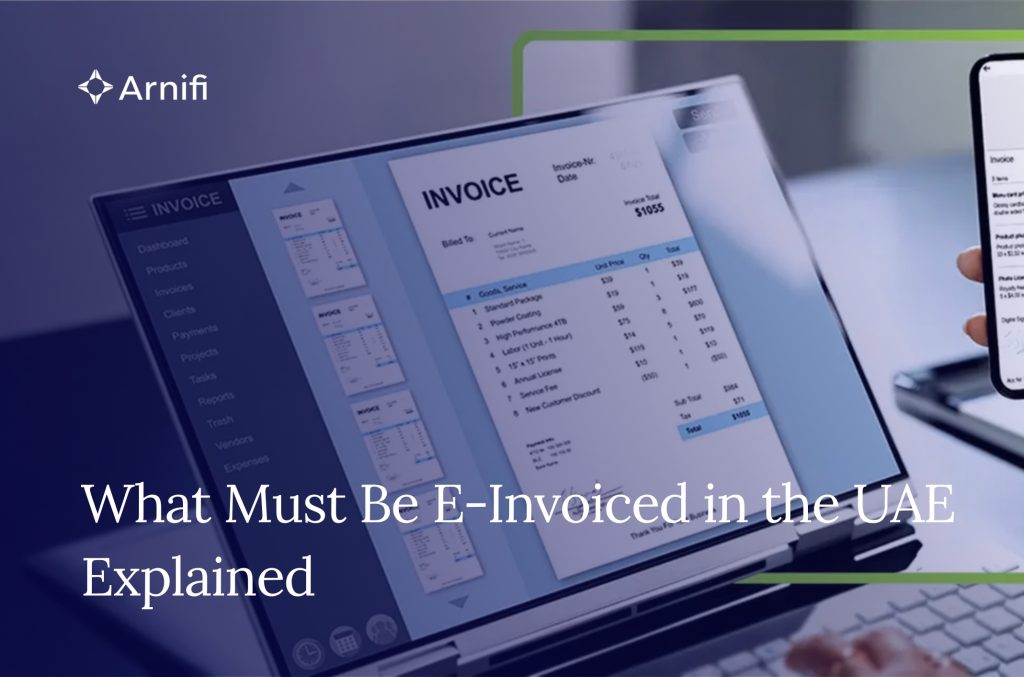
E-invoicing in Dubai, UAE is no longer limited to large enterprises or tax specialists. Standard invoices, simplified invoices, and self-billing invoices now sit at the centre of how transactions are recorded, validated, and trusted. Understanding what exactly must be e-invoiced is not optional anymore. It is operational knowledge that separates prepared businesses from reactive ones.
Table of contents
- 1. Introduction
- 2. Understanding E-Invoicing in Dubai, UAE
- 3. Why Invoice Type Classification Matters
- 4. Standard Tax Invoices Under E-Invoicing in Dubai, UAE
- 5. Simplified Tax Invoices Explained
- 6. Self-Billing Invoices and Their Role
- 7. What Transactions Must Be E-Invoiced
- 8. How E-Invoicing Changes Daily Operations
- 9. Common Misconceptions That Create Risk
- 10. Where Arnifi Fits In
- 11. Conclusion
1. Introduction
Pause before treating E-invoicing in Dubai, UAE as another compliance checkbox. The shift is towards the structured digital invoicing & is not about replacing paper with PDFs. It is about redefining how transactions are created, transmitted, and verified across the UAE economy. Businesses that understand what must be e-invoiced and why tend to adapt faster, avoid errors, and operate with greater confidence when regulators ask questions.
This breakdown focuses on the three invoice types that matter most under E-invoicing in Dubai, UAE: standard tax invoices, simplified tax invoices, and self-billing invoices. Each serves a different purpose. Each follows different rules. And each has direct implications for VAT reporting, audit readiness, and daily operations.
2. Understanding E-Invoicing in Dubai, UAE
E-invoicing in Dubai, UAE refers to the structured electronic creation and exchange of invoices between suppliers, buyers, and tax authorities. These invoices are not static documents. They are data files designed to be read, validated, and stored by systems rather than people.
Unlike emailed PDFs or scanned invoices, true E-invoicing in Dubai, UAE relies on structured formats that allow invoice data to move automatically into accounting, ERP, and tax reporting systems. This approach reduces manual entry, improves accuracy, and increases transparency across transactions.
The UAE model aligns closely with global e-invoicing frameworks while retaining local VAT requirements set by the Federal Tax Authority. That balance explains why invoice classification matters so much.
3. Why Invoice Type Classification Matters
Not every transaction requires the same invoice format. Under E-invoicing in Dubai, UAE, the type of invoice issued depends on the nature of the transaction, the value involved, and the VAT status of the parties.
Misclassifying an invoice creates risk. A standard invoice issued where a simplified invoice applies can cause reporting inconsistencies. A simplified invoice issued incorrectly can invalidate VAT claims. A self-billing invoice issued without proper authorisation can trigger penalties.
Understanding invoice categories is not administrative trivia. It is risk management.
4. Standard Tax Invoices Under E-Invoicing in Dubai, UAE
Standard tax invoices form the backbone of E-invoicing in Dubai, UAE. These invoices apply to most business-to-business transactions where VAT is chargeable, and the recipient is VAT registered.
What Makes an Invoice Standard
A standard tax invoice must include detailed information such as supplier details, VAT registration numbers, invoice date, unique invoice number, description of goods or services, taxable amount, VAT rate applied, VAT amount, and total payable value.
Under E-invoicing in Dubai, UAE, this information must be generated and transmitted in a structured electronic format. The invoice data should be capable of being validated by tax systems without manual intervention.
When Standard Invoices Are Mandatory
Standard tax invoices are required when the recipient intends to reclaim VAT. This makes them essential in supply chains involving registered businesses, cross-border trade, professional services, and high-value transactions.
Failure to issue a compliant standard invoice under E-invoicing in Dubai, UAE can lead to denied VAT recovery for customers and compliance exposure for suppliers.
Common Mistakes Seen in Practice
Many businesses mistakenly assume that sending a PDF via email qualifies as e-invoicing. Under E-invoicing in Dubai, UAE, that assumption does not hold. A valid standard e-invoice must be structured, machine-readable, and aligned with approved data formats.
5. Simplified Tax Invoices Explained
Simplified tax invoices exist for speed and practicality. Under E-invoicing in Dubai, UAE, these invoices apply mainly to low-value transactions or supplies made to non-VAT registered customers.
Key Features of Simplified Invoices
Simplified invoices contain fewer details than standard invoices. They still include supplier information, VAT registration number, invoice date, VAT-inclusive amount, and VAT rate. However, customer details are often limited or excluded.
Despite their simplicity, these invoices must still comply with E-invoicing in Dubai, UAE requirements when issued electronically. Structure and data integrity remain essential.
Where Simplified Invoices Are Common
Retail sales, hospitality services, transport, and other consumer-facing sectors rely heavily on simplified invoices. These sectors process high transaction volumes, making automation critical.
Under E-invoicing in Dubai, UAE, simplified invoices must still be captured digitally and retained for audit purposes.
Risk Areas to Watch
Using simplified invoices for transactions that exceed value thresholds or involve VAT-registered recipients can invalidate VAT treatment. Classification discipline remains critical.
6. Self-Billing Invoices and Their Role
Self-billing invoices operate differently. Under E-invoicing in Dubai, UAE, these invoices are issued by the buyer rather than the supplier, based on prior agreement.
How Self-Billing Works
In a self-billing arrangement, the buyer generates the invoice on behalf of the supplier. This approach is common in industries where buyers control pricing or measurement, such as commodities, logistics, or commission-based services.
E-invoicing in Dubai, UAE allows self-billing, but only when specific conditions are met, including written agreements and proper authorisation.
Compliance Conditions
The supplier must agree to the self-billing arrangement. Both parties must be VAT registered. The invoice must clearly state that it is a self-billing invoice. Structured electronic data requirements still apply.
Improper self-billing under E-invoicing in Dubai, UAE is one of the fastest ways to attract regulatory scrutiny.
Why Authorities Monitor Self-Billing Closely
Self-billing shifts invoice control to the buyer. This increases the risk of manipulation if systems are weak. Structured e-invoicing reduces that risk by creating audit trails and real-time visibility.
7. What Transactions Must Be E-Invoiced
Under E-invoicing in Dubai, UAE, most taxable supplies fall within scope. This includes domestic supplies of goods and services, B2B transactions, B2C transactions where applicable, and self-billing arrangements.
Exports, zero-rated supplies, and exempt supplies may have different reporting treatments, but invoice creation still follows structured rules where e-invoicing applies.
The direction of policy is clear. Paper-based and unstructured invoicing models are being phased out in favour of data-driven compliance.
8. How E-Invoicing Changes Daily Operations
E-invoicing in Dubai, UAE reshapes workflows. Invoice creation becomes a system function rather than a manual task. Validation happens before invoices are issued, not after audits begin.
Finance teams spend less time fixing errors and more time analysing numbers. Procurement gains clearer records. Leadership benefits from cleaner data.
The businesses that adapt fastest tend to treat e-invoicing as infrastructure rather than obligation.
9. Common Misconceptions That Create Risk
One misconception is that E-invoicing in Dubai, UAE applies only to large enterprises. SMEs are equally affected.
Another is assuming compliance can be postponed until enforcement deadlines approach. System changes take time. Data mapping takes effort. Waiting increases cost and stress.
Finally, many believe that existing accounting software automatically meets e-invoicing standards. That assumption often proves wrong.
10. Where Arnifi Fits In
E-invoicing in Dubai, UAE requires more than software installation. It demands alignment between legal structure, tax registration, accounting processes, and technology.
Arnifi supports businesses navigating this shift by connecting company formation, compliance structuring, and operational readiness under one framework. From ensuring VAT-ready entity setups to guiding system alignment for e-invoicing obligations, Arnifi helps reduce friction during transition.
Instead of treating e-invoicing as an isolated IT project, Arnifi positions it as part of a broader compliance and growth strategy.
11. Conclusion
E-invoicing in Dubai, UAE is redefining how transactions are recorded and trusted. Standard invoices protect VAT recovery. Simplified invoices support speed without sacrificing control. Self-billing invoices demand discipline and documentation.
Understanding what must be e-invoiced is no longer optional knowledge. It is foundational to operating confidently in the UAE market.
Businesses that approach E-invoicing in Dubai, UAE with clarity rather than urgency tend to gain more than compliance. They gain structure, credibility, and operational calm. With the right guidance and setup support from partners like Arnifi, the transition becomes less about regulation and more about running cleaner, stronger businesses.
Top UAE Packages


Related Articles


Top UAE Packages
Get in Touch