
What Does VAT Number in UAE Mean for Invoices and Compliance?

Shethana P
SEO Content Writer
Shethana specialises in creating content that simplifies complex business, compliance, and regulatory topics for global business incorporation. She focuses on SEO strategy, content accuracy,… Read more


Key Facts: The VAT number in the UAE, commonly known as the Tax Registration Number (TRN), identifies a business registered for VAT. This guide explains when VAT registration is required, how the TRN is used on invoices, what it means for VAT compliance, and how VAT registration differs from Corporate Tax registration.
Table of contents
- Introduction
- What Is a VAT Number in UAE?
- What Does a UAE VAT Number Look Like?
- Why Is the VAT Number Important on an Invoice?
- What Information Must a UAE VAT Invoice Include?
- Does Every UAE Business Need a VAT Number?
- What Is the UAE VAT Registration Threshold?
- Does Having a VAT Number Mean You Must Charge 5% VAT?
- What Happens If a VAT Number Is Missing or Incorrect on an Invoice?
- Can You Verify a UAE VAT Number?
- How Does a VAT Number Affect UAE VAT Compliance?
- What Records Should Businesses Maintain for VAT Compliance?
- What Is the Difference Between VAT Number, TRN and Corporate Tax TRN?
- What Happens If Your VAT Registration Details Change?
- What Happens When a Business Cancels Its VAT Registration?
- Common VAT Invoice Mistakes in the UAE
- UAE VAT Invoice Compliance Checklist
- How Can Arnifi Help With UAE VAT Compliance?
- Conclusion
- FAQs
Introduction
If you have ever received a tax invoice from UAE, you have seen a number that is designated as a UAE TRN or Tax Registration Number. This will be the business’s VAT registration number and is important for VAT reporting and documentation. In the UAE, a VAT number is not merely a formality for businesses; it is a key piece of information that holds significant meaning. It links the company with its VAT records with the Federal Tax Authority (FTA) and is applied in issuing tax invoices, submitting VAT returns and keeping of supporting documents.
But it doesn’t mean that you have to add 5% VAT to all your invoices. The proper treatment will depend on the type of supply and the rules of UAE VAT. If businesses are able to grasp the mechanics of the VAT number, they can help to avoid issues with VAT compliance and make their invoices accurate.
What Is a VAT Number in UAE?
A VAT number in the UAE is commonly referred to as a Tax Registration Number (TRN). It is issued by the FTA to businesses and other persons that are registered for VAT. Once registered, the business receives a VAT registration certificate containing its TRN and other registration information. The number is used to identify the taxable person in VAT-related transactions and dealings with the FTA.
The UAE VAT number should not be confused with a trade licence number. A trade licence identifies the business for licensing purposes, while the TRN identifies it for VAT. Not every business operating in the UAE has a TRN. A business generally needs to register for VAT when it meets the mandatory registration conditions. Eligible businesses that do not meet the mandatory threshold may also choose voluntary registration.
What Does a UAE VAT Number Look Like?
A UAE VAT registration number, commonly called a TRN, is a unique number issued by the FTA to businesses registered for VAT. You can usually find the TRN on your VAT registration certificate or in your FTA/EmaraTax account. It should also be included on tax invoices and other VAT-related documents where required. When preparing an invoice, always use the TRN registered with the FTA rather than your trade licence or company registration number.
Why Is the VAT Number Important on an Invoice?
The VAT number on invoice documents helps identify the supplier as a VAT-registered business.
It is important because it:
- Identifies the VAT-registered supplier
- Supports VAT reporting and record keeping
- Helps connect invoices with the business’s VAT records
- Provides customers with the supplier’s VAT registration details
- Supports documentation for input VAT recovery where the relevant conditions are met
For a VAT-registered business, using the correct TRN is therefore an important part of preparing compliant tax invoices.
What Information Must a UAE VAT Invoice Include?
The exact requirements depend on whether the business is issuing a full tax invoice or a simplified tax invoice. A full tax invoice generally contains key information about the supplier, customer, transaction and VAT charged.
| Invoice Detail | What It Shows |
| Supplier name | Legal name of the VAT-registered business |
| Supplier address | Registered or relevant business address |
| Supplier TRN | VAT registration number |
| Customer details | Customer name and relevant details |
| Invoice number | Unique invoice reference |
| Invoice date | Date the invoice is issued |
| Supply details | Goods or services supplied |
| Taxable amount | Value before VAT |
| VAT rate | Applicable VAT treatment |
| VAT amount | VAT charged on the supply |
| Total amount | Total amount payable |
Businesses should ensure that their invoices contain the information required under the applicable UAE VAT invoice requirements.
Does Every UAE Business Need a VAT Number?
No. A business licence does not automatically mean that a company must register for VAT. VAT registration depends on the business’s taxable supplies and other transactions covered by the UAE VAT registration rules.
Registration can be:
- Mandatory: When the value of taxable supplies and imports requiring registration exceeds the mandatory threshold.
- Voluntary: When a business does not meet the mandatory threshold but meets the conditions for voluntary registration.
A business that remains below the voluntary registration threshold may generally operate without VAT registration, provided no other registration obligation applies. This is why a company can legally operate in the UAE without having a VAT number, depending on its circumstances.
What Is the UAE VAT Registration Threshold?
The UAE VAT registration thresholds are:
- AED 375,000: Mandatory VAT registration threshold
- AED 187,500: Voluntary VAT registration threshold
These thresholds relate to the value of relevant taxable supplies and imports under UAE VAT rules. Businesses should assess their transactions based on the applicable rules rather than simply comparing their total revenue with the threshold.
A business approaching the threshold should monitor its taxable turnover regularly so that it does not miss a registration obligation.
Does Having a VAT Number Mean You Must Charge 5% VAT?
Not necessarily. The standard UAE VAT rate is 5%, but different supplies can have different VAT treatments.
Standard-rated supplies
These are generally subject to VAT at 5%.
Zero-rated supplies
VAT is charged at 0%, but the supply remains within the VAT system and may allow recovery of eligible input VAT subject to the applicable rules.
Exempt supplies
VAT is not charged on an exempt supply, and the input VAT treatment can differ from zero-rated supplies.
Therefore, the TRN itself does not decide whether a transaction is subject to 5% VAT. The business must determine the correct VAT treatment for each supply.
What Happens If a VAT Number Is Missing or Incorrect on an Invoice?
An incorrect or missing TRN can create invoice and record-keeping problems, particularly where the document is intended to serve as a tax invoice. For example, a business may need to correct or reissue an invoice if the VAT registration details are wrong. Customers may also face difficulties when relying on the invoice as supporting documentation for an input VAT claim, where the relevant requirements are not met. Businesses should therefore check their TRN before issuing invoices and ensure that their VAT details remain consistent with their FTA registration.
Can You Verify a UAE VAT Number?
Businesses can use the FTA’s available services to check VAT registration information where verification is required. Checking a supplier’s VAT registration number UAE can be useful when entering into B2B transactions, particularly where VAT treatment and supporting documentation are important. Businesses should not rely only on a number printed on an invoice when verification is necessary. The registration details should be checked through the appropriate FTA channels.
How Does a VAT Number Affect UAE VAT Compliance?
The TRN becomes part of the business’s wider VAT compliance process.
A VAT-registered business generally needs to:
- Issue compliant tax invoices
- Maintain appropriate VAT records
- Record output VAT on taxable supplies
- Track eligible input VAT
- File VAT returns
- Pay VAT due within the applicable deadlines
The TRN itself does not create all these obligations, but it identifies the business within the VAT system.
What Records Should Businesses Maintain for VAT Compliance?
Proper records help businesses support the figures reported in their VAT returns.
Depending on the business, records can include:
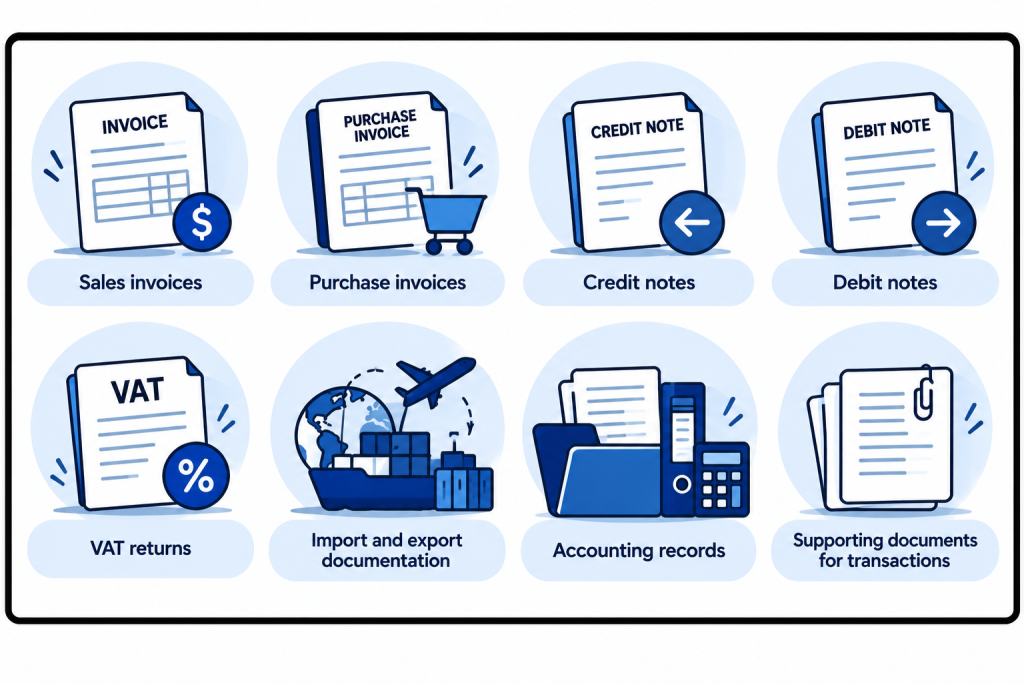
Businesses should ensure that their accounting records and invoices contain consistent information, including the correct TRN where required.
What Is the Difference Between VAT Number, TRN and Corporate Tax TRN?
The terminology can be confusing because businesses may have more than one tax-related registration number.
| Number | Purpose |
| VAT TRN | Identifies a business registered for UAE VAT |
| Corporate Tax TRN | Identifies a business registered for UAE Corporate Tax |
| Trade Licence Number | Identifies the business licence issued by the relevant licensing authority |
| Company Registration Number | Identifies the company within the applicable corporate registry |
A VAT TRN and Corporate Tax TRN are therefore not interchangeable. A business should use the appropriate registration number for the relevant tax or government process.
What Happens If Your VAT Registration Details Change?
Businesses should keep their FTA registration information accurate.
Changes may involve:
- Business name
- Registered address
- Business activity
- Contact details
- Other registration information
Where a change affects the information held by the FTA, the business should update its records through the applicable FTA/EmaraTax process.
What Happens When a Business Cancels Its VAT Registration?
VAT deregistration does not simply mean that the TRN disappears from the business’s records.
Depending on the circumstances, the business may need to:
- Apply for VAT deregistration
- Complete the required final VAT return
- Settle outstanding VAT liabilities
- Retain required VAT records
- Stop issuing tax invoices as a VAT-registered business once deregistration takes effect
The business should follow the FTA’s applicable deregistration process and confirm the effective deregistration date before changing its invoicing practices.
Common VAT Invoice Mistakes in the UAE
Some of the most common errors include:
- Using the wrong or missing TRN
- Calculating VAT incorrectly
- Missing the invoice number or date
- Entering incorrect customer details
- Applying the wrong VAT treatment
- Failing to maintain supporting records
- Using outdated VAT details after a registration change
These errors can usually be reduced by reviewing invoice templates and accounting processes regularly.
UAE VAT Invoice Compliance Checklist
Before issuing a tax invoice, businesses can check:
- Correct TRN is included
- Supplier details are accurate
- Customer details are correct where required
- Invoice number and date are included
- Goods or services are clearly described
- Correct VAT treatment is applied
- VAT amount is calculated correctly
- Total amount is clearly shown
- Supporting records are retained
How Can Arnifi Help With UAE VAT Compliance?
Managing VAT involves more than obtaining a TRN. Arnifi can support businesses throughout the VAT compliance cycle, including VAT registration and deregistration, ongoing VAT compliance, VAT return preparation and filing, and guidance on UAE VAT invoice and record-keeping requirements. Arnifi also provides accounting and bookkeeping support, Corporate Tax and other tax compliance services, and ongoing compliance assistance and reminders to help businesses stay on top of their filing and reporting responsibilities.
Conclusion
A VAT number in the UAE is an important identifier for businesses registered for VAT. Also known as a TRN, it is used on applicable tax invoices and helps link a business’s transactions to its VAT records and reporting. Having a TRN does not mean that every sale is automatically charged at 5% VAT. Businesses still need to check the correct VAT treatment for each transaction and keep their invoices and supporting records accurate. Keeping registration details, invoices and accounting records consistent also makes day-to-day VAT compliance much easier and helps avoid common errors.
FAQs
1. What is a VAT number in UAE?
A VAT number, commonly called a TRN, is issued by the FTA to businesses registered for UAE VAT.
2. Is a VAT number the same as a TRN in UAE?
Yes. In the UAE VAT context, the VAT registration number is commonly referred to as the Tax Registration Number or TRN.
3. Where can I find my UAE VAT number?
You can find your TRN on your VAT registration certificate and through your FTA/EmaraTax account.
4. Is a VAT number required on UAE invoices?
VAT-registered businesses must include the required VAT registration details on applicable tax invoices.
5. Does every business in UAE need a VAT number?
No. VAT registration depends on the business’s taxable supplies, imports and applicable registration rules.
6. What is the VAT registration threshold in UAE?
The mandatory threshold is AED 375,000, while the voluntary registration threshold is AED 187,500, subject to the applicable rules.
7. Does having a TRN mean I charge 5% VAT?
No. The applicable VAT treatment depends on the transaction. Supplies may be standard-rated, zero-rated or exempt.
8. Can I issue an invoice without a VAT number?
A business that is not VAT registered should not present itself as VAT registered or charge VAT. Tax-invoice requirements depend on the business’s VAT status.
9. Can customers verify a UAE VAT number?
Yes. VAT registration information can be checked through the FTA’s available verification services.
10. What happens if the VAT number on an invoice is incorrect?
The invoice may need to be corrected or reissued, depending on the error and applicable VAT requirements.
11. Is the VAT number different from the Corporate Tax TRN?
Yes. VAT and Corporate Tax are separate tax registrations and use different TRNs.
12. How do I update my VAT registration details?
Changes should be updated through the applicable FTA/EmaraTax process, depending on the type of information being changed.
References:
Top UAE Packages
Related Articles



Top UAE Packages
Get in Touch
