
Financial Year in Mauritius | Dates, Tax Year & Filing Obligations

Nishant
Content Writer
Nishant Kumar is a technical content writer, he shares global business insights and bridges the gap between complex regulatory frameworks and actionable growth strategies.… Read more

Tulika Saxena
AVP, Sales & Marketing | IIM Nagpur
Tulika Saxena specializes in business finance, sales strategy, and market positioning. Leads growth and partnerships, ensuring seamless business setup experiences and client success across… Read more



Table of contents
Key Facts
- The official Mauritius fiscal year is from 1 July to 30 June, providing a basis for individual taxation assessments and Mauritius tax calendars
- Profits made between 1 July 2026 and 30 June 2027 belong to YA 2027-2028, whereby the standard corporate profits rate is set at 15%
- Starting from 1 January 2027, only MRA-registered tax agents (or exempted professionals) may submit returns on behalf of clients, and the mandatory CSR remittance to the MRA increases back to 75% (from 50%)
- Mandatory VAT registration applies at an annual taxable turnover of MUR 3 million (with immediate registration for specified professions), while late corporate tax payments incur a 2.5% penalty (1% for small enterprises) plus 0.25% monthly interest
Introduction
Harmonization of the corporate accounts of the company with the financial year of Mauritius helps to protect the founders and financial directors from avoidable Mauritius Revenue Authority (MRA) penalties. Since the tax year and Year of Assessment (YA) in Mauritius are distinct years, any confusion regarding the timelines would adversely affect cash flows and compliance.
In 2027, there are several significant changes that are brought into effect under the Finance Act 2026. Companies operating under Mauritius tax will need to be prepared for mandatory agent registration, phased climate levies, and reduced VAT recovery periods.
What Is the Financial Year in Mauritius?
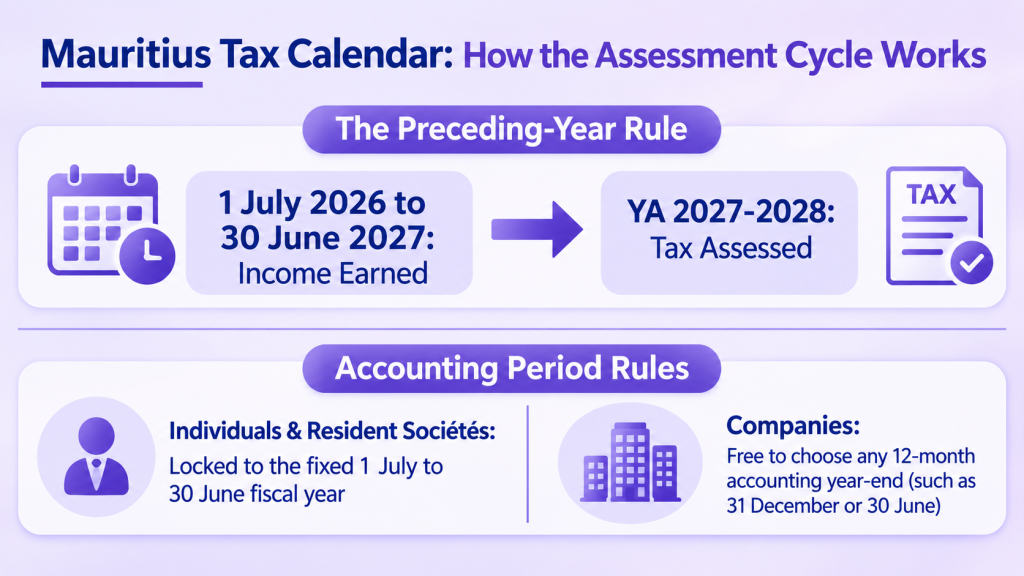
The financial and standard tax year in Mauritius spans 12 months, commencing from 1st July and ending on 30th June. As per the Income Tax Act 1995, MRA uses the preceding year assessment system wherein the earnings that fall between 1st July 2026 and 30th June 2027 would be assessed in the Year of Assessment 2027-2028.
While individuals and resident sociétés have to comply with this fixed 1st July to 30th June period, companies can select any 12 months of their choice within a year, such as 31st December or 30th June.
What Mauritius Tax Changes Take Effect in 2027?
Corporate tax continues at 15% for standard corporate income, and 3% for qualified goods export companies (excluding live animal exports). Qualified GBL companies can still claim the 80% exemption on qualifying foreign source income provided they meet the substance requirements.
The Finance Act of 2026 provides five important amendments in the filing of 2027 returns:
- MRA-Registered Tax Agents (from 1 January 2027): The MRA will require the representative to be a registered tax agent to make submissions or attend hearings before the authority
- CSR Remittance Reversion (from 1 January 2027): Businesses required to pay 2% CSR must remit at least 75%, an increase from 50% required in 2026
- CCR Levy APS Phase-In: Businesses with a turnover of more than MUR 50 million will pay the 2% CCR levy by way of quarterly Advance Payment System (APS) filings, which will reach 50% in fiscal year 2027-2028
- Fair Share Contribution: Mauritius-based companies with chargeable income in excess of MUR 24 million will make a 5% contribution until 30 June 2028 (GBCs and SMEs are exempted), abolishing the previous test for turnover
- Amended TDS Provisions: Non-individual payers are required to deduct 1% TDS in relation to ICT services in excess of MUR 300,000 and 5% TDS on digital promotional services
Key Mauritius Tax Filing Deadlines for 2027
The Corporate tax return, Payroll Tax return, and Value Added Tax returns are done electronically using the MRA e-services portal. For companies whose previous year’s gross income exceeded MUR 10 million, the quarterly APS statement must be prepared.
| Tax Obligation | Applicable Taxpayers | 2027 Statutory Deadline |
| Corporate Tax Return (Standard) | Companies with non-June/December year-ends. | Within 6 months after the accounting year-end month. |
| Corporate Return (June / Dec) | Companies closing books on 30 June or 31 December. | Two business days before 31 December or 30 June (15 January for June nil/loss returns; 2 February 2027 for June Q4 APS filers) |
| Advance Payment System (APS) | Firms with prior gross income above MUR 10 million | Quarterly, within 3 months of quarter-end (March quarters due two business days before 30 June) |
| Individual Return (YA 2027-2028) | Resident and Mauritius-sourced individual earners | 30 September 2027 (15 October 2027 for e-filing and payment) |
| VAT, PAYE, CSG, and TDS | VAT-registered firms, employers, and withholding payers | End of the following month for e-filers (monthly or quarterly for VAT) |
| QDMTT Return (Pillar Two) | MNE groups with global revenue of EUR 750 million+ | Within 15 months after the fiscal year-end month |
What Are the VAT and Late Filing Penalty Rules?
Domestic companies and overseas B2C online providers will need to register for VAT (standard rate at 15%) when their taxable turnover exceeds MUR 3 million on an annual basis. The maximum period for claiming back input VAT credit that is due but not claimed has been reduced to 24 months from 36 months. The provision of management services to eligible global business structures, trusts, and foundations is exempt from VAT rather than being zero-rated.
For late submission of the return, the penalty is MUR 2,000 per month up to MUR 20,000 or up to MUR 5,000 for domestic small enterprises. For late payment of company tax, APS, or QDMTT, the penalty is 2.5% plus interest at 0.25% monthly.
How We at Arnifi Simplify Mauritius Tax Compliance
We provide our customers at Arnifi with a digital-first global expansion platform for building businesses through the globe with efficiency, transparency, and operational clarity. Our CSP and business infrastructure platform enables cross-border business setup, operations, and compliance in Mauritius and around the world.
Our Mauritius Bookkeeping and Accounting Services keep statutory ledgers audit-ready for annual financial closes. Compliance teams also manage quarterly APS calculations, VAT submissions, and annual MRA returns through Mauritius Corporate Tax and VAT Compliance Services, backed by Arni Docs and the Arni AML Checker for standardized templates and compliance screening. Expanding entities can also coordinate institutional due diligence via our Banking Services to support smooth tax remittances.
Conclusion
Synchronizing the finance function according to the 1 July to 30 June financial year for Mauritius ensures that any unnecessary penalties by the MRA are avoided. This is critical in light of the increased CSR remittance amounts and stricter input VAT ceilings that are set to be implemented in 2027.
Contact us at Arnifi to structure compliant accounting, VAT, and Mauritius tax workflows for 2027.
FAQs
What are the financial year dates in Mauritius?
The financial year and tax year are officially from 1 July to 30 June, meaning that 1 July 2026 to 30 June 2027 is the Year of Assessment 2027-2028.
Can a company have an alternative year-end in Mauritius?
Yes. Any 12-month accounting period can be selected; returns are generally due within six months after the accounting year-end month, except for 30 June and 31 December year-ends, which are due two business days before 31 December and 30 June, respectively.
What is the VAT registration threshold in 2027?
VAT registration becomes obligatory when annual taxable turnover reaches or surpasses MUR 3 million (with exceptions for some professions).
What are the key Mauritius tax updates in 2027?
Starting 1 January 2027, third-party filers need to be registered as tax agents at the MRA, minimum CSR remittances are restored to 75%, and FY 2027-2028 increases the CCR levy APS percentage to 50%.
What are the late filing and late payment penalties at MRA?
For a late return, MUR 2,000 per month (maximum MUR 20,000, or MUR 5,000 for small enterprises); for late payment, a 2.5% penalty (1% for small businesses) plus 0.25% monthly interest.
References
Mauritius Revenue Authority (MRA) – Official Portal
MRA Important Dates & Tax Calendar
Top UAE Packages
Related Articles



Top UAE Packages
Planning Your Next Business Move?
