
UAE Tax Filing Rules 2026 | Deadlines, Requirements & Penalties

Anushka
Content Writer
Anushka Basu is a business content writer specialised in global business market insights. She aims to simplify complex regulatory, financial, and business concepts into… Read more

Tulika Saxena
AVP, Sales & Marketing | IIM Nagpur
Tulika Saxena specializes in business finance, sales strategy, and market positioning. Leads growth and partnerships, ensuring seamless business setup experiences and client success across… Read more



Key Fact: UAE businesses generally have nine months from the end of their Tax Period to file their Corporate Tax return and pay any tax due. For a Tax Period ending on 31 December 2026, the deadline is 30 September 2027, subject to the applicable rules.
Table of contents
- Introduction
- What Are the UAE Tax Filing Rules?
- Who Needs to File a UAE Corporate Tax Return?
- When Is the UAE Corporate Tax Filing Deadline?
- How Can Accounting Services Help With UAE Tax Filing?
- What Information Is Required for a UAE Corporate Tax Return?
- How Do You File a UAE Corporate Tax Return?
- How Can Arnifi Help Businesses Prepare for Corporate Tax Filing?
- What Happens If a Business Misses Its UAE Tax Filing Deadline?
- What Accounting Records Should UAE Businesses Maintain?
- What Is the Difference Between Tax Registration and Tax Filing?
- How Does UAE Accounting Support Tax Compliance?
- Why Choose Arnifi for UAE Accounting and Tax Compliance?
- What Should UAE Businesses Do Before Their Tax Filing Deadline?
- FAQS
- Conclusion
Introduction
UAE tax compliance involves more than registering with the Federal Tax Authority (FTA). Businesses must also maintain accurate accounts, determine their taxable income, file the required return and pay any Corporate Tax due within the applicable deadline.
For most businesses, Corporate Tax returns are generally due within nine months from the end of the relevant Tax Period. Understanding the filing timeline and keeping financial records organised throughout the year can help businesses avoid unnecessary compliance issues.
What Are the UAE Tax Filing Rules?
UAE tax filing refers to reporting a business’s relevant tax information to the FTA for its Tax Period. Corporate Tax operates on a self-assessment basis, meaning businesses are responsible for calculating their taxable income and determining the resulting tax liability.
Corporate Tax is generally calculated and paid through a Corporate Tax Return submitted to the FTA.
Key point: Tax registration does not complete a company’s tax obligations. Businesses must also meet applicable filing and payment requirements.
Who Needs to File a UAE Corporate Tax Return?
UAE taxable persons generally need to file Corporate Tax returns with the FTA. This can include businesses operating from mainland jurisdictions and free zones where they fall within the Corporate Tax regime.
However, not every company automatically pays 9% Corporate Tax. The applicable treatment depends on the entity’s circumstances, taxable income and relevant exemptions or reliefs.
The UAE currently applies 0% on taxable income up to AED 375,000 and 9% on taxable income exceeding AED 375,000, subject to the applicable Corporate Tax rules.
When Is the UAE Corporate Tax Filing Deadline?
Corporate Tax returns are generally due within nine months from the end of the relevant Tax Period. The same general timeframe applies to payment of Corporate Tax due.
For example:
Tax Period ends: 31 December 2026
↓
Nine-month filing period
↓
Corporate Tax return deadline: 30 September 2027
Businesses should calculate their actual deadline based on their own Tax Period rather than assuming that every company has the same filing date.
How Can Accounting Services Help With UAE Tax Filing?
Accurate accounting records provide the foundation for preparing a Corporate Tax return. Businesses may need to maintain:
- Income and sales records
- Expense records
- Bank reconciliations
- Financial statements
- General ledgers
- Supporting invoices
- Contracts and other relevant documents
Arnifi Accounting Services can support businesses in organising their books, reconciling accounts and preparing financial records needed for tax-compliance processes.
Good accounting throughout the year makes Corporate Tax preparation more manageable when the filing deadline approaches.
What Information Is Required for a UAE Corporate Tax Return?
A Corporate Tax return may require information relating to:
- Accounting income
- Taxable income
- Tax adjustments
- Exempt income, where applicable
- Deductible and non-deductible expenses
- Tax losses, where applicable
- Corporate Tax liability
- Relevant supporting records
Taxable income is generally determined by starting with accounting income and applying the adjustments required under Corporate Tax legislation.
Therefore, a Corporate Tax return is not simply a copy of the company’s profit-and-loss statement.
How Do You File a UAE Corporate Tax Return?
The general process involves:
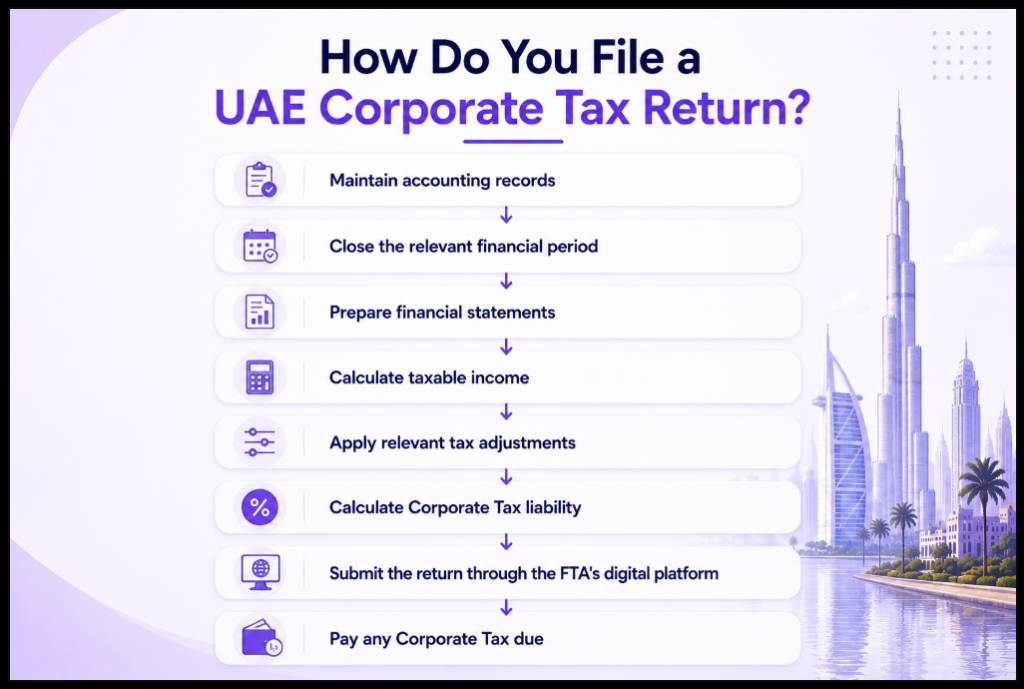
Businesses should begin preparing well before the deadline rather than waiting until the final weeks to reconcile their accounts and collect supporting documents.
How Can Arnifi Help Businesses Prepare for Corporate Tax Filing?
Businesses can benefit from maintaining their accounting records throughout the year rather than treating tax preparation as a once-a-year task.
Arnifi Accounting Services can support areas such as:
- Bookkeeping
- Account reconciliation
- Financial statement preparation
- Revenue and expense tracking
- Tax-ready financial records
- Corporate Tax calculation support
- Filing preparation
- Compliance deadline tracking
A practical workflow can look like:
Monthly bookkeeping → Financial review → Year-end closure → Tax calculation → Return preparation → Timely filing
This approach helps businesses keep their accounts organised and reduces the pressure of preparing everything immediately before the filing deadline.
What Happens If a Business Misses Its UAE Tax Filing Deadline?
Missing a prescribed tax deadline can result in penalties and additional compliance exposure. Late filing and late payment are separate matters, and the applicable consequences depend on the specific obligation and circumstances.
The FTA has reminded taxable persons and certain exempt persons required to register to submit the relevant returns or declarations within the prescribed deadlines.
Businesses should therefore monitor both their filing deadline and payment deadline rather than assuming that filing alone completes the obligation.
What Accounting Records Should UAE Businesses Maintain?
Businesses should maintain records that allow information reported in their tax returns to be supported and reconciled.
These may include:
- Sales and purchase invoices
- Bank statements
- Payroll records
- Expense documentation
- Fixed-asset records
- Contracts
- Credit and debit notes
- General ledger
- Trial balance
- Financial statements
- Other supporting tax records
Proper record-keeping also makes it easier to respond to potential FTA queries or requests for supporting information.
What Is the Difference Between Tax Registration and Tax Filing?
| Tax Registration | Tax Filing |
| Registers the business with the FTA | Reports information for the relevant Tax Period |
| Results in a Tax Registration Number | Determines and reports tax information |
| Follows applicable registration requirements | Must be completed within the applicable deadline |
| Does not complete ongoing compliance | Forms part of ongoing tax compliance |
In simple terms: registration establishes the business’s tax account, while filing reports its tax position for the relevant Tax Period.
How Does UAE Accounting Support Tax Compliance?
Accounting and tax compliance work best as an ongoing process.
Accurate bookkeeping can provide:
- A clear audit trail
- Proper expense classification
- Reliable financial statements
- Easier tax calculations
- Better visibility over potential tax liabilities
- Lower risk of incorrect reporting
- Faster preparation of supporting information
Businesses that keep their accounts updated throughout the year are generally better positioned to handle tax filing when the deadline arrives.
Why Choose Arnifi for UAE Accounting and Tax Compliance?
Businesses can use Arnifi Accounting Services for ongoing accounting support, including bookkeeping, financial reporting, account organisation and tax-ready records.
This can help businesses maintain accurate financial information and stay organised around Corporate Tax and other applicable compliance requirements.
The goal is simple: keep your accounts ready throughout the year instead of turning tax filing into a last-minute exercise.
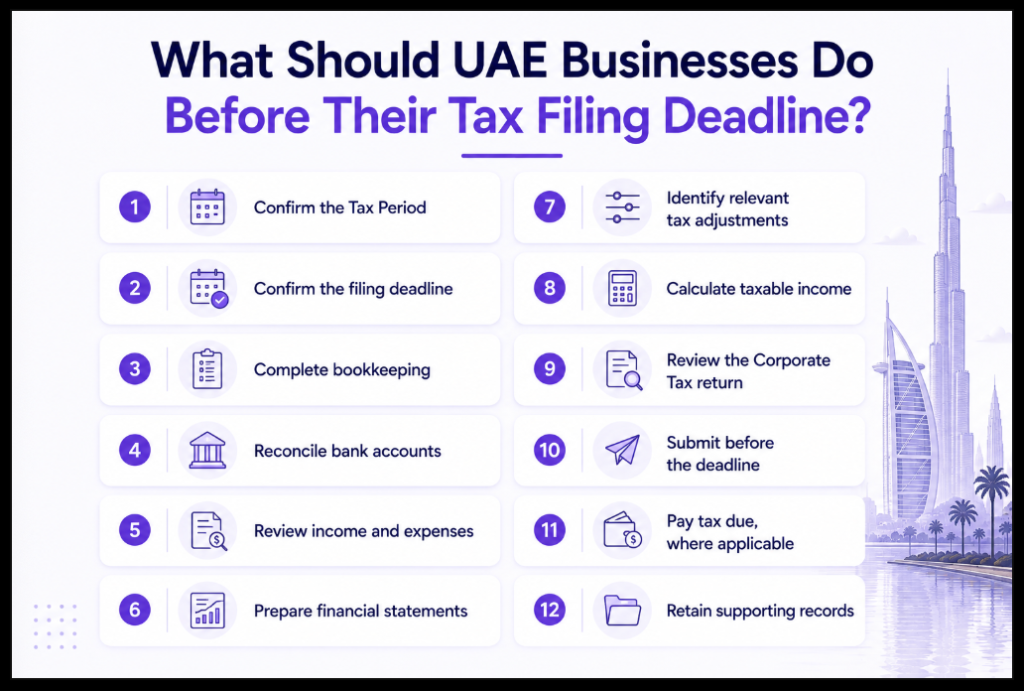
What Should UAE Businesses Do Before Their Tax Filing Deadline?
Use this checklist before submitting the return:
FAQS
What is the UAE Corporate Tax filing deadline?
Corporate Tax returns are generally due within nine months from the end of the relevant Tax Period.
Who needs to file a Corporate Tax return in the UAE?
Taxable persons generally need to file Corporate Tax returns according to the applicable UAE tax rules.
How do I file a Corporate Tax return in the UAE?
Corporate Tax returns are filed electronically through the FTA’s designated digital tax platform.
What happens if I miss the UAE tax filing deadline?
Late filing or payment can result in penalties, depending on the applicable obligation and circumstances.
What accounting records are required for UAE Corporate Tax filing?
Businesses should maintain financial statements, invoices, bank records, ledgers and supporting documents for reported figures.
Can an accounting service help with UAE Corporate Tax filing?
Yes. Accounting support can help businesses organise records, prepare financial information and manage tax-compliance requirements.
Conclusion
UAE tax compliance requires businesses to manage registration, accounting, filing and payment as connected responsibilities. Corporate Tax returns are generally due within nine months of the relevant Tax Period’s end, making preparation important.
Accurate accounting records help businesses calculate taxable income, support their returns and respond to potential FTA requirements. Maintaining accounts throughout the year can also reduce last-minute errors and compliance pressure.
Arnifi Accounting Services can support businesses with bookkeeping, financial reporting, tax-ready accounts and ongoing UAE accounting and compliance requirements.
REFERENCES
UAE Corporate Tax Rules
Top UAE Packages


Related Articles



Top UAE Packages
Get in Touch