
Cyprus IP Box Regime | Eligibility, Tax Benefits and How It Works

Anushka
Content Writer
Anushka Basu is a business content writer specialised in global business market insights. She aims to simplify complex regulatory, financial, and business concepts into… Read more

Tulika Saxena
AVP, Sales & Marketing | IIM Nagpur
Tulika Saxena specializes in business finance, sales strategy, and market positioning. Leads growth and partnerships, ensuring seamless business setup experiences and client success across… Read more



Key Fact: The Cyprus IP Box Regime allows an 80% deduction on qualifying profits from eligible intellectual property. With Cyprus’s corporate tax rate at 15% from 2026, the effective tax rate can reach approximately 3% when the full deduction applies. The benefit depends on the qualifying asset, eligible income and research and development expenditure.
Table of contents
- What Is the Cyprus IP Box Regime?
- What Tax Benefits Does the Cyprus IP Box Regime Offer?
- Which Intellectual Property Assets Qualify for the Cyprus IP Box?
- What Is the Nexus Approach Under the Cyprus IP Box Regime?
- How Is Qualifying IP Profit Calculated?
- Who Can Benefit From the Cyprus IP Box Regime?
- How Can Businesses Prepare to Use the Cyprus IP Box Regime?
- What Records and Compliance Requirements Should Businesses Consider?
- How Does the Cyprus IP Box Regime Compare With Other Jurisdictions?
- FAQs
- Conclusion
What Is the Cyprus IP Box Regime?
The Cyprus IP Box Regime is a tax incentive that applies to qualifying profits earned from eligible intellectual property. It is also known as a patent box or innovation box. Several countries use similar regimes to encourage businesses to invest in research and development.
Under the Cyprus regime, eligible companies can claim a deduction equal to 80% of qualifying profits from approved IP assets. The calculation follows the OECD’s modified nexus approach, which connects the tax benefit to the research and development activity associated with the asset.
This means that a business must assess its IP, the income generated from it and the expenditure incurred to develop it. Ordinary commercial income does not qualify simply because the company owns intellectual property.
The regime is particularly relevant to businesses that develop and commercially exploit eligible technology and other protected intangible assets.
What Tax Benefits Does the Cyprus IP Box Regime Offer?
The main benefit is the 80% deduction on qualifying profits. This can reduce the amount of profit subject to corporate income tax.
The corporate tax rate in Cyprus increased to 15% from 1 January 2026. When the full 80% deduction applies, the effective tax rate on qualifying profits can be approximately 3%.
For example, consider a company with €100,000 in qualifying IP profit.
| Calculation | Amount |
| Qualifying IP profit | €100,000 |
| 80% deduction | €80,000 |
| Remaining taxable profit | €20,000 |
| Tax at 15% | €3,000 |
| Effective tax rate on original qualifying profit | 3% |
This example assumes that the entire profit qualifies for the deduction. The actual result depends on the company’s nexus calculation and other applicable tax rules.
The regime also provides for tax treatment of qualifying IP disposal gains and the amortisation of eligible intangible assets. These provisions have specific conditions, so businesses should confirm the treatment applicable to their circumstances before relying on them.
Which Intellectual Property Assets Qualify for the Cyprus IP Box?
The regime covers certain intangible assets that meet the relevant legal requirements. The asset must fall within the qualifying categories, and the company must satisfy the applicable income and research and development conditions.
Potentially qualifying assets include:
- Patents
- Copyrighted computer software
- Utility models
- Intellectual property protecting plants and genetic material
- Extensions of patent protection
- Certain other legally protected assets that meet the applicable criteria
The rules also distinguish qualifying IP from marketing-related intangible assets. Trademarks, brand names and similar marketing assets generally do not qualify for the IP Box deduction.
Owning a patent or software product does not, by itself, guarantee eligibility. The business must assess the legal status of the asset, its rights over the IP, the income it generates and the expenditure connected with its development.
What Is the Nexus Approach Under the Cyprus IP Box Regime?
The nexus approach determines how much of a company’s IP profit can qualify for the tax deduction. It links the benefit to the research and development expenditure associated with the intellectual property.
In simple terms, a company that carries out eligible development work may qualify for a larger proportion of the benefit than a business that mainly acquires existing IP without undertaking further qualifying development.
The calculation considers:
- Qualifying expenditure on research and development
- Other expenditure connected with the IP asset
- Acquisition costs and relevant related-party expenditure
- The overall income generated by the qualifying asset
Eligible research and development expenditure generally includes qualifying costs incurred directly by the company and certain costs paid to unrelated parties for outsourced research. Other expenditure may affect the calculation without counting as qualifying expenditure.
The nexus approach also places limits on the benefit available where a company relies on acquired IP or certain related-party arrangements. Businesses must keep records that show how the asset was developed and how the relevant costs were incurred.
The aim is to ensure that the tax benefit reflects the company’s qualifying research and development activity.
How Is Qualifying IP Profit Calculated?
The nexus calculation determines the proportion of overall IP income that can receive the preferential tax treatment.
A simplified version of the formula is:
Qualifying profit = Overall IP income × (Qualifying expenditure + permitted uplift) ÷ Overall expenditure
Each part of the calculation has a specific meaning.
- Qualifying expenditure: Eligible research and development costs incurred by the company or through qualifying outsourced arrangements
- Permitted uplift: An additional amount allowed under the nexus rules, subject to the applicable limits
- Overall expenditure: The relevant total expenditure associated with developing or acquiring the IP asset
- Overall IP income: Income attributable to the asset after relevant direct expenses, calculated under the applicable rules
The resulting qualifying profit is the amount to which the 80% deduction may apply.
For example, a company that develops software internally and earns licensing income from that software will need to identify the income attributable to the asset and the qualifying development costs. The nexus calculation then determines the proportion of that income eligible for the regime.
The exact calculation should be prepared using the applicable Cyprus tax rules and supporting financial records.
Who Can Benefit From the Cyprus IP Box Regime?
The regime may suit businesses that develop, own or commercially exploit qualifying intellectual property. Eligibility depends on the company’s tax position, the nature of the asset and the income generated.
Businesses that may wish to assess their eligibility include:
- Software companies developing proprietary applications or platforms
- Technology businesses holding qualifying patents
- Companies earning royalties from eligible IP licensing arrangements
- Businesses developing protected technology through documented research and development
- Companies earning eligible IP income through products or services
A company that purchases an existing IP asset needs to review the position carefully. Acquisition alone does not make all income from that asset eligible for the deduction. The nexus calculation considers the nature and source of the expenditure associated with the IP.
Businesses should also establish their ownership or economic rights over the asset and maintain evidence of the work carried out to develop it.
Incorporating a company in Cyprus does not automatically make its income eligible for the IP Box Regime. The conditions must be assessed for the relevant asset and income stream.
How Can Businesses Prepare to Use the Cyprus IP Box Regime?
Businesses should review their intellectual property and financial records before claiming the deduction. This helps establish whether the assets and income meet the relevant conditions.
A practical preparation process includes:
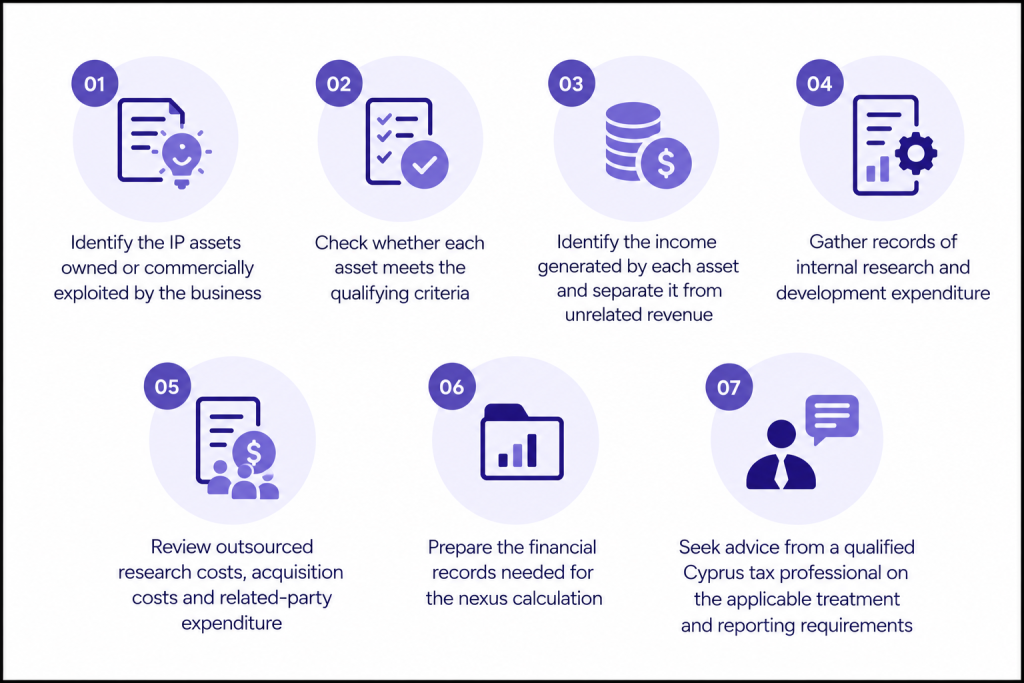
These are practical preparation steps rather than a prescribed statutory application sequence. The precise reporting process depends on the company’s circumstances and the applicable tax requirements.
What Records and Compliance Requirements Should Businesses Consider?
Proper records help a company support its claim under the IP Box Regime. The business should be able to explain which asset qualifies, how it generates income and how the deduction was calculated.
Important records include:
- Documents establishing ownership or economic rights over the IP
- Information describing the asset and its development
- Research and development budgets, invoices and expenditure records
- Contracts covering outsourced research and development
- Licensing agreements and royalty records, where applicable
- Calculations showing overall IP income and qualifying profits
- Accounting records supporting the deduction claimed
Companies should review these records regularly and keep them consistent with their financial statements and tax filings. Changes in ownership, development arrangements or income streams may affect eligibility and the nexus calculation.
A qualified Cyprus tax adviser can help determine the documentation and reporting requirements relevant to the company.
How Does the Cyprus IP Box Regime Compare With Other Jurisdictions?
Cyprus is one of several jurisdictions offering preferential tax treatment for qualifying intellectual property. Businesses may also examine regimes in countries such as Belgium, Hungary and Luxembourg when choosing where to develop or manage their IP.
A useful comparison should look beyond the headline tax rate. Companies should consider:
- Which IP assets qualify
- How qualifying profits are calculated
- The research and development conditions
- The treatment of acquired intellectual property
- Documentation and reporting requirements
- Corporate tax rates and ongoing compliance costs
The most suitable jurisdiction depends on the company’s activities, ownership arrangements and development plans. Comparing current rules on a like-for-like basis can help businesses understand which regime fits their circumstances.
FAQs
1. What is the Cyprus IP Box Regime?
It is a tax incentive that allows an 80% deduction on qualifying profits from eligible intellectual property, subject to the applicable conditions and nexus calculation.
2. What is the effective IP Box tax rate in Cyprus in 2026?
The effective rate can be approximately 3% when the full 80% deduction applies to qualifying profits and the 15% corporate tax rate is used.
3. Does the regime provide an 80% tax deduction?
Yes. The deduction applies to qualifying profits calculated under the regime. It does not automatically apply to all IP income earned by a company.
4. Which intellectual property assets can qualify?
Potentially qualifying assets include patents, copyrighted software, utility models and certain protected assets relating to plants, genetic material and patent extensions. Other assets must meet the relevant legal criteria.
5. Do trademarks and brand names qualify?
Trademarks and brand names are generally excluded because they are marketing-related intangible assets.
6. What is the nexus approach?
It is a method for determining how much IP profit qualifies for the deduction by linking the benefit to eligible research and development expenditure.
7. Can acquired intellectual property qualify?
An acquired asset may require a detailed eligibility assessment. Acquisition costs do not generally count as qualifying expenditure under the nexus approach, which can limit the deduction where little qualifying development work is undertaken.
8. How long can qualifying IP assets be amortised?
An amortisation period of up to 20 years may be available for eligible intangible assets, subject to the applicable tax rules and conditions.
9. Does every Cyprus company automatically qualify for the IP Box Regime?
No. The company must meet the relevant conditions for its IP assets, income, expenditure and tax position.
Conclusion
The Cyprus IP Box Regime can offer a significant tax benefit to businesses earning income from qualifying intellectual property. The 80% deduction may reduce the effective tax rate to approximately 3% under the 2026 corporate tax rate. Businesses should confirm that their assets qualify, calculate the eligible profit under the nexus approach and maintain records to support their claims. Planning to establish or expand your business in Cyprus? Contact us at Arnifi to discuss your company setup requirements and explore professional support available for your international expansion.
References
Top UAE Packages
Related Articles



Top UAE Packages
Get in Touch
