
Top Companies in DIFC UAE | List, Sectors & Why They Chose DIFC

Anushka
Content Writer
Anushka Basu is a business content writer specialised in global business market insights. She aims to simplify complex regulatory, financial, and business concepts into… Read more


Key Facts: DIFC is home to thousands of companies across banking, asset management, fintech, insurance and professional services. Global and regional businesses use DIFC as a base to access investors, talent and markets across the Middle East, Africa and South Asia.
Table of contents
- Introduction
- What Is DIFC and Why Do Top Companies Operate There?
- Sectors Represented by Top Companies in DIFC
- Top Companies Established in DIFC
- What Do These Top Companies Have in Common?
- How Does DIFC Support These Companies’ Growth?
- What This Means for Businesses and Professionals?
- Common Mistakes When Researching “Top Companies in DIFC”
- Checklist: How to Evaluate a “Top Company in DIFC”
- FAQs
Introduction
Dubai International Financial Centre (DIFC) hosts a significant international banking, investment banking and financial services community, including financial technology (fintech) companies, law firms, consultants, insurers and other financial services firms. Many of the most recognised brands have DIFC as the hub of their Middle East and wider operations. It’s not just the location. The dedicated financial regulatory framework, access to investors and talent, and the financial- and professional-services-oriented business environment are just some of the advantages of conducting business in the DIFC. This guide will explore the primary sectors in DIFC, examples of established companies, and the rationale behind selecting DIFC.
What Is DIFC and Why Do Top Companies Operate There?
What is DIFC?
Dubai International Financial Centre (DIFC) is a financial free zone that serves companies from the Middle East, Africa, and South Asian countries. It operates under various regulatory provisions and frameworks; for financial services, the Dubai Financial Services Authority (DFSA) is the regulatory authority. The laws of DIFC also include Common Law, which is derived from the English legal system.
Why do global and regional companies choose DIFC?
For many companies, DIFC is a place, a regulation, and access to the financial community. From 100% ownership to access to international markets, a large group of professional staff and a financial infrastructure comprising banks, investors, asset managers and service providers all work to support the businesses. Furthermore, DIFC is also expected to provide another link to the market in the MEASA region, which proves to be convenient for companies that are interested in managing the business in the region from Dubai.
What are the main sectors in DIFC?
The main areas represented in DIFC include:
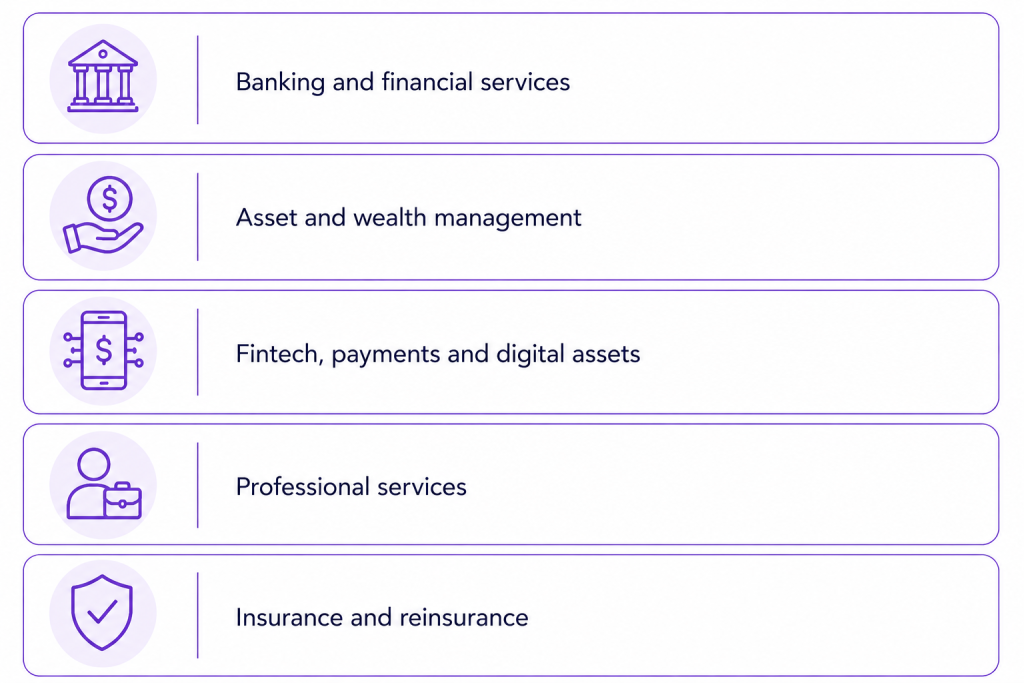
DIFC’s current ecosystem covers traditional financial institutions as well as newer technology-driven businesses.
Sectors Represented by Top Companies in DIFC
Banking and Financial Services
Banking remains one of the core parts of the DIFC ecosystem. International and regional banks use the centre for activities such as corporate banking, private banking, investment banking and capital markets. DIFC reported 327 banking and capital markets firms in H1 2026, showing the scale of this part of the ecosystem.
Asset and Wealth Management
Asset managers, private equity firms, venture capital businesses, hedge funds and family offices are another important part of DIFC. These businesses use DIFC to manage portfolios, investments and private wealth while staying close to investors and clients in the region. DIFC reported 592 wealth and asset management firms in H1 2026.
Fintech, Payments, and Web3
The fintech sector is rapidly expanding in DIFC. Today’s ecosystem encompasses payment businesses, financial technology companies, and those operating in other areas like blockchain and digital assets. The Innovation Hub, a key part of DIFC, saw the emergence of 1,933 AI, FinTech and innovation companies at the end of H1 2026, highlighting the centre’s increasing significance in the world of technology.
Professional Services and Consulting
Law firms, tax advisers and consulting firms are also located at DIFC. They serve businesses with sales and transactions, compliance issues, restructuring, legal questions and other strategic guidance. Professional service providers are an important component of DIFC’s non-financial ecosystem.
Insurance and Reinsurance
Insurance and reinsurance have become another major part of the DIFC ecosystem. Companies operating in this space use the centre for underwriting, risk management, reinsurance and regional operations. DIFC reported 165 insurance and reinsurance entities in H1 2026.
Top Companies Established in DIFC
| Sector | Top Companies | What They Do in DIFC |
| Banking & Financial Services | Standard Chartered, HSBC Middle East and other global/regional banks | Corporate banking, wealth management, lending and regional financial services |
| Investment Banking & Asset Management | Goldman Sachs, global asset managers and family offices | Investment banking, asset management, private equity and wealth management |
| Fintech, Payments & Web3 | Ripple, Stripe, Wise and digital asset firms | Payments, fintech solutions, digital assets and blockchain services |
| Professional Services | International law firms, Big Four firms and global consultancies | Legal, audit, tax, consulting and corporate advisory |
| Insurance & Reinsurance | Global insurers and reinsurers | Insurance, reinsurance and risk management |
What Do These Top Companies Have in Common?
Strategic use of DIFC’s regulatory environment
For financial businesses, DIFC’s regulatory framework is a major reason to establish a presence there. Regulated activities are overseen by the DFSA, giving firms a dedicated financial services framework.
Regional or global footprint
Not all companies restrict their product to the UAE market. They are based in Dubai and travel to their clients and opportunities all over the Middle East, Africa and South Asia.
Focus on innovation and talent
Technology and specialist talent are becoming increasingly important across financial services. DIFC has expanded its innovation ecosystem alongside its traditional financial services base.
Contribution to DIFC’s ecosystem
Large companies add value to the wider business community through a range of activities, such as through their involvement in hiring, partnerships, investment, events and industry initiatives. Their presence also accelerates the attraction of businesses coming into the region to the centre.
How Does DIFC Support These Companies’ Growth?
Innovation programs and fintech support
DIFC has built dedicated programmes around financial innovation. Its Innovation Hub supports startups and established businesses working across AI, fintech and emerging technologies.
Access to capital and investors
The presence of banks, investment firms, family offices, and asset managers can provide businesses with greater ease of access to potential investors and strategic partners.
Networking, events, and community
DIFC’s financial community creates opportunities for companies to meet investors, clients, regulators and other businesses. For firms entering the region, these connections can be valuable when building a local network.
Ease of setup and operations
DIFC provides different licensing and company structures for financial and non-financial businesses. These include options for professional service providers, holding companies, SPVs, family businesses and multinational corporations.
What This Means for Businesses and Professionals?
For companies considering DIFC
DIFC can make sense for businesses that need a regional base for financial services, investment, fintech or professional services. The decision should still come down to the company’s activity, target markets, regulatory requirements, office needs and long-term plans.
For professionals seeking opportunities
The concentration of companies creates opportunities across banking, investment management, compliance, risk, fintech, technology, legal services, audit and consulting. Professionals with financial services experience, regulatory knowledge or technology skills may find a wide range of roles across the DIFC ecosystem.
For investors and partners
Investors should look beyond a company’s name when assessing a DIFC business. Checking its registration, licence, business activity and current presence can provide a clearer picture.
DIFC’s public register can be used as one of the starting points for this type of due diligence.
Common Mistakes When Researching “Top Companies in DIFC”
- Assuming every major Dubai company is based in DIFC.
- Confusing DIFC businesses with companies in DMCC, JAFZA or mainland Dubai.
- Treating third-party lists as official rankings.
- Ignoring the difference between regulated and non-regulated businesses.
- Overlooking smaller fintech and innovation companies.
- Using old lists without checking whether companies are still operating in DIFC.
- Assuming a Dubai office automatically means a DIFC entity.
- Confusing a regional headquarters with a branch or representative office.
- Relying on unverified company information.
- Ignoring recent relocations, closures, or changes in business structure.
Checklist: How to Evaluate a “Top Company in DIFC”
- Check whether the company is registered or licensed in DIFC.
- Identify its business activity and sector.
- Check its DFSA status if it conducts regulated financial activities.
- Look at its regional or international presence.
- Check whether it has a physical presence in DIFC.
- Review its reputation and recent business activity.
- Look at its technology or innovation initiatives where relevant.
- Understand why the company chose DIFC instead of another UAE business centre.
FAQs
1. Which are the top companies in DIFC?
Major banks, asset managers, fintechs, insurers, law firms and consultancies operate in DIFC.
2. What sectors are most common in DIFC?
Banking, wealth management, asset management, fintech, insurance and professional services.
3. Why do global banks choose DIFC over other free zones?
For its financial regulations, skilled talent, investors and regional market access.
4. Are there fintech and Web3 companies in DIFC?
Yes. DIFC has a growing fintech, AI, blockchain and digital assets ecosystem.
5. How can I check if a company is based in DIFC?
Check its details on the DIFC Public Register.
6. Do professional services firms count as “top companies” in DIFC?
Yes. Law, accounting, tax and consulting firms are a key part of the DIFC ecosystem.
7. How does DIFC help companies expand in the Middle East?
It provides access to Dubai’s financial ecosystem and wider MENA, Africa and South Asia markets.
8. Can small and medium companies also set up in DIFC?
Yes. Startups, SMEs and professional firms can set up in DIFC if they meet the requirements.
9. What is the difference between a DIFC company and a mainland Dubai company?
DIFC companies follow DIFC’s legal framework, while mainland companies follow Dubai’s mainland licensing rules.
10. How do I find job opportunities with top DIFC companies?
Check company career pages, recruitment platforms and DIFC’s business community.
11. What is FinTech Hive and which companies are part of it?
FinTech Hive is DIFC’s fintech accelerator connecting startups with investors and financial institutions.
References:
Top UAE Packages


Related Articles
Top UAE Packages
Get in Touch