
Saudi Arabia’s Investment Targets to 2030 | Inside the SAR 12.4 Trillion National Investment Strategy
by Rifa S Laskar Mar 03, 2026  7 MIN READ


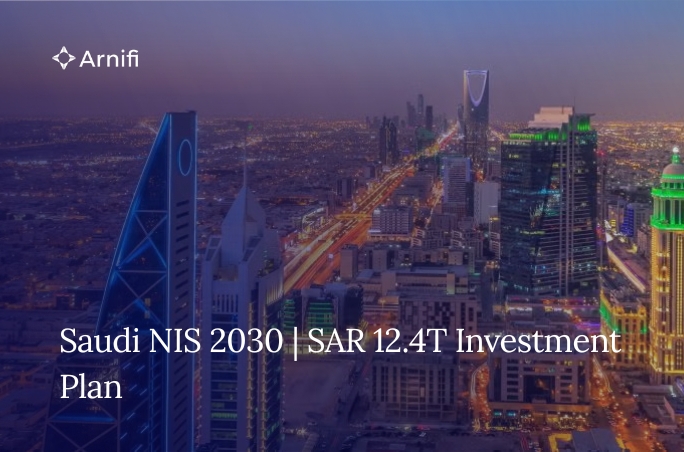
Saudi Arabia has committed SAR 12.4 trillion in cumulative capital deployment by 2030 under its National Investment Strategy. This is not a headline figure for optics. It is a structured capital program reshaping investment in Saudi Arabia across public funds, private giants, foreign inflows & domestic markets.
Table of contents
- 1. Introduction
- 2. Tripling Investment Contribution to GDP
- 3. Doubling Foreign Direct Investment
- 4. The SAR 12.4 Trillion Cumulative Investment Breakdown
- 5. Role of the Public Investment Fund in Capital Expansion
- 6. Shareek Program and Private Sector Mobilisation
- 7. Domestic Investment Evolution to 2030
- 8. SME and Local Investor Participation
- 9. Economic Multiplier Effects
- 10. Implications for Foreign and Local Investors
- 11. How Arnifi Supports Business Entry in Saudi Arabia?
- 12. Conclusion
1. Introduction
Every founder thinking about expansion asks the same quiet question that is the capital really there, or is this just policy that seems as an opportunity
Entering a new market without clarity on funding flow, sector priorities, and state backing can lock capital for years with limited upside. This is where the National Investment Strategy changes the conversation. SAR 12.4 trillion between 2021 and 2030 is not a loose projection. It is defined as a cumulative target with identified sources and sector allocation logic behind it.
The mandate is simple in structure but large in scale. Expand total capital formation, diversify funding channels & embed long-term institutional money into the economy. When capital at this level is structured over a decade, it reshapes the entire conversation around investment in Saudi Arabia because the environment becomes planned rather than reactive.
2. Tripling Investment Contribution to GDP
One of the clearest targets is increasing total investment contribution to GDP from historical levels to 30 percent. That shift alone signals structural change.
For decades, hydrocarbon revenues anchored fiscal flows. Now, capital formation itself becomes the growth engine. Achieving 30 per cent of GDP requires sustained annual expansion of roughly 13 per cent in investment activity. That means larger project pipelines, faster deployment cycles & stronger private sector absorption capacity.
This structural shift creates consistency. When capital intensity rises, supply chains deepen, infrastructure scales & productivity improves. It also creates long-term clarity for those evaluating investment in Saudi Arabia as a strategic allocation rather than a short-term trade.
3. Doubling Foreign Direct Investment
Foreign Direct Investment is targeted to reach SAR 388 billion annually, which is lifting FDI to 5.7 per cent of GDP. That is not just a symbolic benchmark, but it signals that international capital is expected to play a measurable role in the domestic economy.
Global capital inflows bring more than funding. They bring governance frameworks, technology partnerships, operational standards & international networks. In that sense, FDI strengthens the domestic capital base rather than competing with it.
For international groups assessing market entry, this clarity reduces uncertainty. Targets are published. Shares of GDP are defined. Regulatory alignment continues to evolve to accommodate cross-border participation. The scale of investment in Saudi Arabia is therefore linked to deliberate foreign capital expansion, not incidental inflows.
4. The SAR 12.4 Trillion Cumulative Investment Breakdown
The composition of the SAR 12.4 trillion matters as much as the headline figure.
- SAR 5 trillion is expected from the Public Investment Fund
- SAR 3 trillion through the Shareek Program
- SAR 1.8 trillion via FDI
- SAR 2.6 trillion from other domestic investments
This distribution shows diversification of funding sources. No single channel carries the entire burden. Public capital anchors the base, private champions amplify it, foreign investors complement it & domestic markets reinforce it.
This balanced approach strengthens long-term confidence in investment in Saudi Arabia because risk and responsibility are shared across institutional layers.
5. Role of the Public Investment Fund in Capital Expansion
The Public Investment Fund, often referred to simply as PIF, functions as the sovereign capital anchor. Its mandate extends beyond passive holdings. It deploys capital across infrastructure, strategic sectors, giga projects, technology, logistics, tourism & global equities.
With a SAR 5 trillion target contribution to the strategy, PIF becomes the stabilising force in long-term capital expansion. Large sovereigns allow patient investment horizons. That supports sectors that require years of development before any yielding returns.
The presence of institutional capital at this scale sends a signal. Major projects will not depend on fragile funding cycles. They are embedded in a structured capital framework.
6. Shareek Program and Private Sector Mobilisation
If PIF represents sovereign depth, the Shareek Program represents private sector acceleration. The target of SAR 3 trillion is tied to large Saudi companies committing capital into domestic expansion.
This mechanism mobilises national champions. It also strengthens local supply chains and increases corporate participation in non-oil sectors. Rather than leaving growth solely to public institutions, the strategy integrates established private firms into national capital planning.
Private capital participation increases market maturity. It enhances the domestic liquidity and builds a stronger internal funding ecosystem. Over time, this strengthens the foundation for broader investment in Saudi Arabia & across the sectors that are beyond energy.
7. Domestic Investment Evolution to 2030
From 2019 onward, domestic investment levels have shown steady expansion. The trajectory to 2030 involves increasing capital intensity across industries such as manufacturing, renewable energy, logistics, healthcare & digital infrastructure.
The strategy gradually rebalances funding sources. Instead of relying heavily on oil-linked fiscal injections, the economy moves towards the diversified capital channels that include equity markets, sovereign funds, corporate reinvestment & foreign participation.
This structural rebalancing reduces volatility. It also builds an institutional depth & brings more mature capital ecosystem that supports long-term industrial development rather than cyclical growth spikes.
8. SME and Local Investor Participation
Large numbers dominate the headlines, but small and medium enterprises remain central to the sustained expansion. Shareek alignment indirectly benefits the SMEs through supplier contracts, subcontracting pipelines & sector-specific development programs.
As major capital projects roll out, SMEs participate in services, technology integration, logistics & specialised manufacturing. This widens the funding ecosystem and improves capital circulation within the domestic economy.
Local investors also gain exposure to broader sector diversification, strengthening retail and institutional participation in public markets.
9. Economic Multiplier Effects
Capital expansion is not just simply about asset creation. But, it drives multiplier effects across productivity, employment & sector diversification.
Infrastructure projects reduce operating costs for private firms. Strategic sector funding supports advanced manufacturing & renewable energy. Logistics networks improve trade efficiency. Digital infrastructure accelerates enterprise growth.
Each layer compounds the next. That compounding effect explains why investment in Saudi Arabia is tied directly to productivity enhancement and long-term competitiveness rather than short-term stimulus.
10. Implications for Foreign and Local Investors
The National Investment Strategy provides visibility as targets are defined & capital sources are diversified.
For foreign investors, strategic alignment opportunities increase as sector priorities are publicly identified. For domestic founders, starting a business in Saudi Arabia aligns directly with a capital plan that extends to 2030.
Long-term visibility reduces guesswork. Capital certainty lowers planning risk. Structured investment pipelines create predictable entry points across industries. This is where investment in Saudi Arabia transitions from speculative interest to structured allocation.
11. How Arnifi Supports Business Entry in Saudi Arabia?
Entering this environment requires more than just market optimism. It requires correct licensing, regulatory alignment, documentation structuring & sector-specific approvals.
Arnifi supports business setup in Saudi Arabia by guiding company formation, handling licensing processes, structuring ownership models & advising on compliance within the National Investment Strategy framework. Market entry decisions tied to the capital expansion plans require apt clarity on regulatory pathways and entity structuring.
Professional advisory reduces execution risk. Structured entry increases alignment with national capital programs and sector priorities.
12. Conclusion
SAR 12.4 trillion is not an abstract projection. It is a structured capital roadmap supported by sovereign allocation, private mobilisation, foreign participation & domestic reinvestment.
PIF anchors scale. Shareek amplifies private commitment. FDI broadens the capital base. Domestic markets reinforce resilience. Together, they create institutional depth behind investment in Saudi Arabia.
For groups evaluating entry, expansion, or partnership, the direction is visible and the capital is planned. Structured participation aligned with the National Investment Strategy positions businesses inside a decade-long growth cycle.
Arnifi remains positioned to support company formation, licensing & strategic market entry within this evolving capital landscape.
Top Saudi Arab Packages


Related Articles
Top Saudi Arab Packages
Get in Touch