
Saudi-India Visa Exemption Signals a New Era of Diplomatic Mobility
by Rifa S Laskar Dec 19, 2025  6 MIN READ


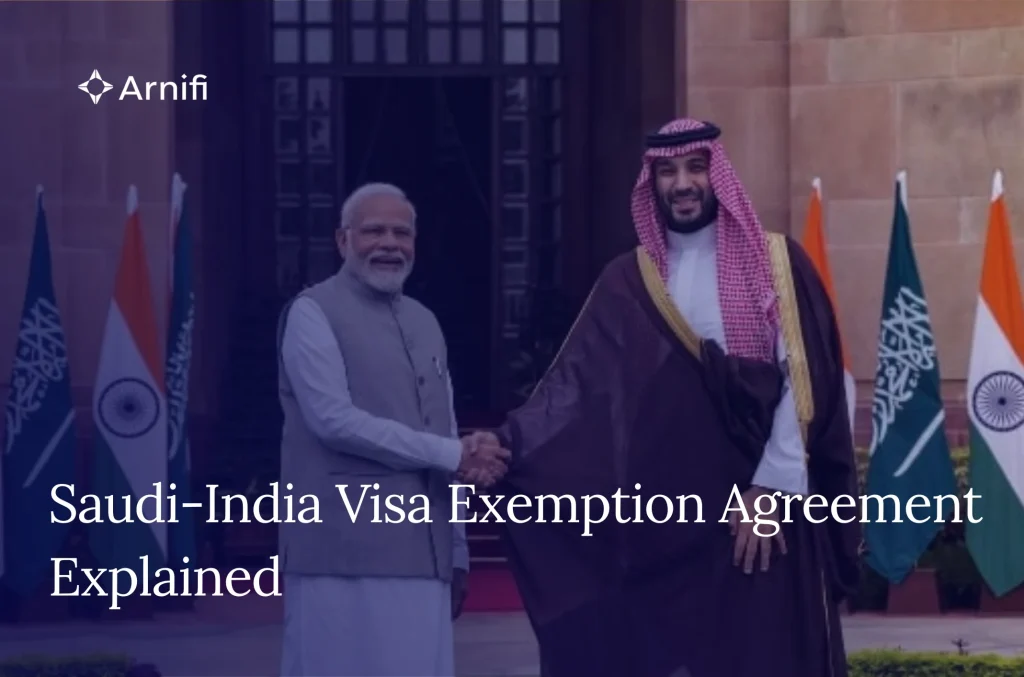
Saudi-India visa exemption is not designed for headlines. It is designed for access by removing short-stay visa requirements for selected passport holders. Both countries signal confidence, intent, and a shared interest in faster engagement.
Table of contents
- 1. Introduction
- 2. What the Saudi-India Visa Exemption Covers
- 3. Why This Decision Matters More Than It Appears
- 4. The Broader Context Behind the Move
- 5. What Saudi-India Visa Exemption Does Not Do
- 6. Implications for Trade and Policy Coordination
- 7. A Regional Signal, Not Just a Bilateral One
- 8. How can Arnifi help?
- 9. What Comes Next?
- 10. Conclusion
1. Introduction
Saudi-India visa exemption is one of those policy decisions that does not aim for public applause yet carries weight far beyond its narrow scope. It changes how officials move, how discussions unfold, and how quickly intent turns into action.
The agreement introduces a mutual exemption from short-stay visa requirements for holders of selected passport categories, primarily diplomatic and official. No application queues. No waiting periods. Entry for short official visits now rests on recognition rather than permission.
Saudi-India visa exemption reflects a broader truth about modern diplomacy. Relationships are no longer judged only by signed memoranda or summit photographs. They are measured by how easily people can cross borders to do the actual work.
2. What the Saudi-India Visa Exemption Covers
At its core, the Saudi-India visa exemption allows eligible passport holders from both countries to enter for short stays without obtaining a visa in advance. The exemption is reciprocal and clearly defined.
It applies to:
- Diplomatic passport holders
- Official and service passport holders
- Government and institutional delegations on short assignments
The duration is limited & the purpose is specific. Employment, residence, and commercial activity remain outside its scope. This is a short-stay visa waiver, not a broad liberalisation of entry rules.
That distinction matters because it highlights intent. Saudi-India visa exemption is not about volume but about velocity.
3. Why This Decision Matters More Than It Appears
Saudi-India visa exemption matters because access at the official level sets the tempo for everything else. Policy coordination, regulatory alignment, and bilateral problem-solving depend on speed and trust. Removing visa friction from that layer changes outcomes quietly but decisively.
Diplomatic travel often operates on short notice. Delays can stall negotiations or push discussions into virtual formats that lack depth. With the Saudi-India visa exemption in place, in-person engagement becomes easier, faster, and more frequent.
There is also symbolism at work also mutual exemptions are rarely extended casually. They reflect confidence in governance systems, border management, and reciprocal treatment. Saudi-India visa exemption places both countries on equal footing in this regard.
4. The Broader Context Behind the Move
India and Saudi Arabia have spent the past decade recalibrating their relationship. Energy cooperation remains central, but it is no longer the sole pillar. Infrastructure investment, technology partnerships, defence coordination, and workforce engagement now form part of a wider framework.
Millions of Indian nationals contribute to the Saudi economy. Saudi capital increasingly looks toward Indian markets and infrastructure opportunities. Against this backdrop, administrative friction at the official level feels outdated.
Saudi-India visa exemption addresses that mismatch. It aligns mobility rules with the reality of an expanding partnership. The mutual exemption is not an isolated gesture. It fits into a broader pattern of institutional trust-building.
5. What Saudi-India Visa Exemption Does Not Do
Clarity avoids false expectations. The Saudi-India visa exemption does not apply to ordinary passport holders. Tourist travel continues under existing visa regimes. Business visas for private sector executives still require formal processing.
The exemption also does not grant the right to work, establish residence, or extend stays beyond defined limits. It is precise by design.
However, history offers context. Diplomatic and official exemptions often act as testing grounds. Once systems prove reliable, discussions around wider facilitation become easier. Saudi-India visa exemption should be read as a foundation, not a ceiling.
6. Implications for Trade and Policy Coordination
Saudi-India visa exemption improves the environment in which decisions are made. Trade agreements, regulatory clarifications, and investment frameworks rely heavily on sustained official dialogue. When that dialogue flows without administrative delay, progress accelerates.
Officials can now travel for short consultations without advance paperwork. Delegations can respond faster to emerging issues. Follow-up meetings no longer stretch across months due to visa scheduling.
The short-stay visa waiver removes a friction point that rarely features in public discourse yet often slows execution behind the scenes. Over time, this efficiency feeds into private sector confidence and cross-border planning.
7. A Regional Signal, Not Just a Bilateral One
Saudi-India visa exemption also sends a signal beyond the two capitals involved. Mobility policy has become a competitive tool in international positioning. Countries that simplify access for partners are often seen as easier to engage, faster to decide, and more predictable.
For India, the agreement reinforces its status as a strategic partner rather than a transactional one. For Saudi Arabia, it aligns with a broader push toward administrative modernisation and targeted facilitation.
The mutual exemption quietly places both countries in a category of trusted counterparts.
8. How can Arnifi help?
Policy signals matter, but interpretation matters more. As cross-border engagement between India and Saudi Arabia deepens, businesses and founders require clarity on how mobility, structuring, and compliance intersect.
Arnifi works precisely at this intersection. Supporting market entry, entity formation, regulatory navigation, and visa strategy across Saudi Arabia and India, Arnifi translates policy movement into operational reality.
While the Saudi-India visa exemption applies to selected passport holders, it reflects a wider shift toward structured facilitation. Arnifi helps organisations move in step with that shift, ensuring expansion plans remain compliant, efficient, and well-timed.
In moments where policy evolves quietly, informed guidance becomes a competitive advantage. Arnifi provides that grounding.
9. What Comes Next?
Saudi-India visa exemption is unlikely to remain static. Such agreements are reviewed, refined, and occasionally expanded as trust deepens and outcomes are assessed.
Future discussions may explore additional categories, longer durations, or complementary facilitation measures. Each step will depend on administrative performance rather than public pressure.
What is already clear is direction. Both countries are choosing to remove friction where it slows cooperation without compromising control.
10. Conclusion
Saudi-India visa exemption is a study in how modern diplomacy operates. It prioritises efficiency over ceremony and trust over process. By enabling short official visits without visas, both governments acknowledge that relationships advance through access as much as through agreements.
This move strengthens the architecture of engagement between two economies that increasingly matter to each other. It also reinforces a broader truth. Borders today are managed not just through restriction, but through intelligent design.
As this landscape evolves, Arnifi remains positioned to help organisations and institutions navigate change with clarity and confidence. Saudi-India visa exemption may begin with selected passports, but its impact reaches far beyond the arrivals hall.
Top UAE Packages


Related Articles


Top UAE Packages
Get in Touch