
Founder’s Guide to Saudi Arabia’s AI Ecosystem and the GAIA Accelerator
Zahira Shaik
SEO Content Writer
Zahira Shaik is an SEO Content Writer and Published Author specializing in research-based content. She excels at analyzing market trends, regulations, and industry developments… Read more

Tulika Saxena
AVP, Sales & Marketing | IIM Nagpur
Tulika Saxena specializes in business finance, sales strategy, and market positioning. Leads growth and partnerships, ensuring seamless business setup experiences and client success across… Read more


Key Fact: Saudi Arabia is making massive investments in artificial intelligence under Saudi Vision 2030, aiming to support more than 300 AI startups and investing SAR 75 billion to position the Kingdom as a leading global hub for Generative and Arabic-oriented AI.
Table of contents
- Introduction
- What SDAIA Does in Saudi Arabia’s AI Landscape
- How the AI Strategy Shapes the Startup Ecosystem in Saudi Arabia
- The Rise of Generative AI and Early-Stage AI Startups
- Inside the GAIA Accelerator Program
- Why AI Is Becoming One of the Best Business Segments in Saudi Arabia
- Eligibility Criteria for GAIA
- Market Advantage for AI Founders in Saudi Arabia
- Capital and Institutional Backing for AI Ventures
- KSA Company Formation vs. Regional HQ Packages for AI Startups
- How to Start an AI Business in Saudi Arabia
- How Arnifi Helps AI Founders Enter Saudi Arabia
- Frequently Asked Questions
- Conclusion
- References
Introduction
According to Saudi Vision 2030, Saudi Arabia is developing an economy wherein AI plays a role of a basic utility in both public and private sectors, as opposed to being an independent software vertical. This economy’s cornerstone is the Saudi Data & Artificial Intelligence Authority (SDAIA), which formulates the country’s strategy, ensures proper governance, and aligns different governmental entities, funding, and private companies to create conditions devoid of any friction for regional and international tech startups. While most discussions in the market are generalized about the economic vision of the country, this guide presents practical step-by-step instructions for those startups that aim to form businesses in the Kingdom. We are looking into the mechanics of developing Generative AI in KSA, discussing GAIA Accelerator Program, benefits of the sovereign data, and the process of licensing your AI startup.
What SDAIA Does in Saudi Arabia’s AI Landscape
For any AI venture or its scaling in Saudi Arabia, it is necessary for founders to be aware of the regulatory and coordinating agency involved, which is known as SDAIA (Saudi Data and Artificial Intelligence Authority).
Role of SDAIA
The SDAIA is the key national authority in Saudi Arabia overseeing data and AI strategy. The SDAIA Mandate includes:
- National AI Strategy Formulation: Formulating short-term and long-term goals for data monetization, infrastructure development, and adoption of AI.
- Digital Policy & Governance: Standardizing policies from various public sector ministries, commercial regulators, research institutions, and sovereign funds, thus making sure that there is a cohesive digital policy.
- National Data Orchestration: Managing the central data repository and creating data-sharing protocols.
Regulatory Environment
Regulatory ambiguity tends to be the key challenge for market entry of deep-tech and generative AI companies. This challenge can be addressed through SDAIA, which offers the following measures to help startups:
- Data Protection Regulations: Regulations regarding data protection that are based on international data privacy standards (for example, KSA Personal Data Protection Law / PDPL) provide assurance to enterprise customers when adopting third-party AI tools.
- Ethical AI Frameworks: Common guidelines regarding algorithmic transparency, mitigation of bias, and ensuring safety.
- Cross-Sector Deployment: Use of active sandboxes to facilitate the deployment of AI systems in healthcare, financial services, electricity grids, and municipal government management.
How the AI Strategy Shapes the Startup Ecosystem in Saudi Arabia
Coordinated Startup Ecosystem
Unlike tech hub fragments where each startup has to deal with regulatory, vendor, and capital issues individually, Saudi Arabia has created an entire pipeline that integrates every stakeholder, including:
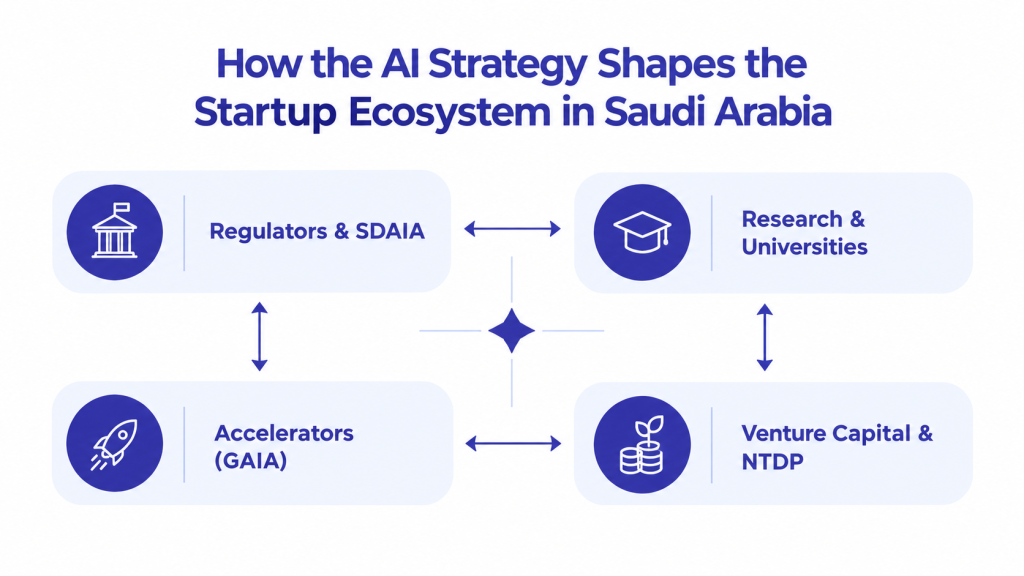
It allows deep-tech businesses to enjoy regulatory alignment, research capabilities, funding, and enterprise distribution in a single package.
How Founders Benefit
- Direct Infrastructure Access: Access to HPC clusters, government-owned cloud infrastructure, and enterprise data sources.
- Regulatory Clarity: Sandboxing allows founders to experiment with the integration of LLMs and enterprise automation software without facing any regulatory shocks along the way.
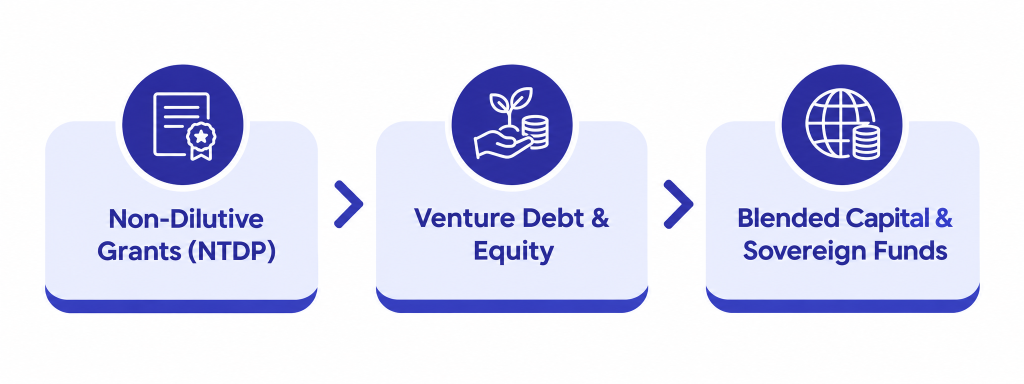
- Streamlined Capital Pipeline: Non-dilutive grants, venture debt, and equity financing are all arranged such that the founders proceed sequentially from the seed stage to Series A and beyond.
- De-Risked Market Entry: Guaranteed government involvement ensures that there is an initial pilot environment and procurement opportunity.
Saudi Vision 2030 Connection
The development of artificial intelligence will be one of the main drivers of economic diversification through Vision 2030 by facilitating automation of major business processes, upgrading logistics, and the digitalization of the state administration system, which will allow for maximizing non-oil GDP growth.
The Rise of Generative AI and Early-Stage AI Startups
Key AI Segments
Generative AI is the current most rapidly growing technology segment in KSA. Key high-demand applications are as follows:
- Large Language Models (LLMs): Fine-tuning of foundation models to support industry-specific search capabilities and administrative assistance.
- Generative Media & Design: Automated systems of content generation, image generation, and spatial visualization in real estate, media, and mega projects like NEOM and Qiddiya.
- Enterprise Automation Engines: Agentic AI that can manage complex B2B transactions, legal analysis, and financial reporting.
Arabic-Focused AI: The Major Market Gap
One major regional advantage is local Arabic AI systems. Foundation models globally are known to have difficulty dealing with the intricacies of Arabic dialects, semantics, and right-to-left UI design.
Developing startups working on highly effective Arabic LLMs or enterprise-grade applications aware of various dialects have instant access to high-margin opportunities among companies and governments in the MENA region.
Inside the GAIA Accelerator Program
If you are an early-stage AI founder seeking entry into the Saudi market, then GAIA Accelerator is your best bet.
What Is GAIA?
GAIA is an accelerator program that is designed by SDAIA in collaboration with tech accelerators and investors from around the world. It has been made to convert high-potential early-stage AI startups into successful enterprise ventures.
Funding Structure
- Total Program Funding Pool: Supported by a dedicated $1.60 million fund structured to back 120 high-potential startups over multiple cohorts.
- Non-Dilutive Grant: Selected participants receive a $40,000 (SAR 150,000) non-dilutive grant backed by the National Technology Development Program (NTDP) (NTDP KSA).
- Zero Equity Loss: The initial grant does not dilute founder equity, providing runway to build local proofs-of-concept (PoCs).
What Participants Receive
- Mentorship from top AI researchers and engineering minds at a global level, along with regional corporate executives.
- Priority access to the partner network of SDAIA that will allow direct access to enterprise sandboxes.
- Direct interaction with venture capital companies, family offices, and sovereign partners for raising further funds.
GAIA Startup Journey
1. Application & Screening:
Technical architecture, credentials of founders, and regional business cases are submitted by international and local founders.
2. Selection & Onboarding:
Top-performing teams are selected to join the cohort and onboarded into the technology landscape of KSA.
3. 10-Week Accelerator:
Refinement of technical aspects, Arabic dialects, product design, and compliance.
4. Mentorship & Partner Network:
Direct engagement with SDAIA’s partner organizations and enterprise partners to validate Proof of Concepts.
5. Grant Disbursement & Demo Day:
Distribution of the $40,000 NTDP non-dilutive grant followed by pitching to top investors in the MENA region.
6. Follow-On Investment Pathways:
Graduates join investment pathways to secure institutional venture capital and sovereign expansion funding.
Why AI Is Becoming One of the Best Business Segments in Saudi Arabia
Enterprise AI Demand
The private sector enterprises in KSA are highly motivated to adopt AI models for margin optimization:
- Financial Services: Automated fraud detection, algorithmic credit scoring, and Arabic language banking assistants.
- Healthcare: Predictive diagnostics, data orchestration, and resource allocation.
- Energy & Utilities: Predictive maintenance for oil, gas, and renewable assets, as well as carbon footprint optimization.
- Logistics & Supply Chain: Route optimization for logistics in the region and automated warehouse management.
Public Sector Demand & Procurement
The public sector in Saudi Arabia is seeking commercial AI tools. Smart city projects, cybersecurity solutions, and digitization programs necessitate continuous innovation from vendors. Government agencies regularly procure commercial contracts to AI startups that can deliver on their digital needs.
Eligibility Criteria for GAIA
| Criterion | Target Profile & Requirements |
| Company Stage | Pre-emerging to early-stage technology-driven companies with an existing functional prototype or Minimum Viable Product (MVP). |
| Founding Team | Technical co-founders with deep expertise in machine learning, software architecture, data science, or specialized vertical domains. |
| Tech Focus | Priority given to solutions built around LLMs, Generative AI, natural language processing (NLP), and scalable enterprise automation. |
| Global Access | Open to international founders worldwide, provided they are committed to establishing a legal corporate presence in KSA and hiring/scaling locally. |
Market Advantage for AI Founders in Saudi Arabia
Sovereign Market Advantages
Accessing Saudi Arabia offers advantages that are rarely seen in a typical emerging market. The sovereign backing ensures the early-stage team enjoys financial and regulatory stability owing to the long-term capital commitment from the state.
National Data Infrastructure
In order to train their AI models, companies need access to high-quality and structured data. Companies operating in the KSA enjoy the benefits of having a national data infrastructure program and data sets specific to that location.
September 2026 Strategy Roadmap
There is a national roadmap targeting over 300+ scaling of AI startups and SAR 75 billion in direct AI investments.
For international founders, it indicates ongoing government procurement, venture debt, and regulatory policies favorable for generative AI and localized machine learning platforms.
Capital and Institutional Backing for AI Ventures
Multi-Tiered Capital Structure
Saudi Arabia’s financing landscape offers multiple layers of capital designed to preserve founder equity while enabling rapid scaling:
The Scaling Pipeline
Initial Prototype & PoC
Phase 1
Self-funded or angel-backed MVP development combined with initial entry into KSA accelerator pipelines.
Accelerator & Non-Dilutive Grant
Phase 2
Admission to programs like GAIA, securing $40,000 in non-dilutive NTDP grant funding to build local PoCs.
Seed & Early-Stage Institutional Equity
Phase 3
Securing equity investment from local VC networks and regional institutional investors to establish Saudi operations.
Growth Capital & Enterprise Contracts
Phase 4
Scaling through venture debt, blended finance, and long-term public/private procurement contracts across the GCC.
KSA Company Formation vs. Regional HQ Packages for AI Startups
When entering the Saudi market, founders must choose the corporate structure that best fits their operational scope.
KSA Company Formation
Perfect fit for young AI businesses that have localization and commercialization within the domestic market as their primary goal and direct involvement in local accelerators.
- Core Requirements: MISA foreign investment license, Commercial Registration (CR), opening of a local bank account, and tax registration (ZATCA).
- Operational Scope: Direct commercial engagement with local private entities and government agencies.
Regional HQ (RHQ) Package
Targeted at international technology companies or venture-backed scale-ups that use KSA as their executive, strategic, and administrative center for the wider Middle East.
- Core Requirements: Opening of an executive regional office in KSA to manage regional subsidiaries.
- Operational Scope: Provides strategic management, treasury management, and regional coordination. Mandatory for technology companies to become government contract winners within the regional HQ framework.
- Entry Cost: Professional setup packages starting from SAR 16,000 to SAR 24,000, depending on corporate complexity and scope.
How to Start an AI Business in Saudi Arabia
Step 1: Choose the Legal Framework
Select the corporate form (LLC or branch of a foreign company) based on goals related to foreign ownership, requirements of the investors, and plans for commercial activities.
Step 2: Complete Entity Formation
Obtain the MISA Investment License, get registered at the Ministry of Commerce to acquire Commercial Registration (CR), join the Chamber of Commerce, and get registered for tax and VAT with ZATCA.
Step 3: Address Regulatory Compliance
Make sure to follow data governance regulations from the start. Ensure that all data handling, training of models, and storage of user data are consistent with the Personal Data Protection Law (PDPL) and ethical AI principles by SDAIA.
Step 4: Establish Saudi Operations
Create an office or virtual office, set up corporate banking, register for Saudization (Nitaqat), and hire your engineering/management teams.
Step 5: Access the AI Ecosystem
Apply for the structured acceleration programs like GAIA, approach venture capital funds, and pitch enterprise PoCs to procurement departments.
How Arnifi Helps AI Founders Enter Saudi Arabia
Licensing, cross-border structuring, and compliance within new tech sectors may require time away from the development of your core technology. Platforms such as Arnifi enable easy market access, thus allowing entrepreneurs to concentrate on the core technology.
- End-to-End Setup & Licensing: Full-service setup of MISA investment licensing, Commercial Registration, and bank account setup.
- Regulatory & Data Compliance: Advising on corporate localization that meets SDAIA requirements as well as local data protection laws.
- Tax & Post-Setup Support: Accountancy and tax services along with VAT filing and Saudization requirements.
- Specialized Guidance for Accelerator Participants: Moving seamlessly from acceptance into the program (such as GAIA) to setting up a corporation and becoming compliant.
Frequently Asked Questions
What is SDAIA in Saudi Arabia?
SDAIA refers to the Saudi Data and Artificial Intelligence Authority, which serves as the sovereign entity leading the nation’s strategy on data and AI, establishing data privacy laws and AI ethics principles.
What is the GAIA accelerator program?
GAIA is a 10-week AI accelerator program conducted by SDAIA that assists early-stage, promising AI startups scale up in Saudi Arabia by providing mentorship, funding, and ecosystem access.
Who is eligible for the GAIA program?
GAIA seeks early-stage AI startups that have a working MVP, a technical founder team, and innovative solutions in LLMs, Generative AI, or enterprise automation. International founders are also encouraged to apply.
How much funding does the GAIA program provide?
The selected startups receive a $40,000 (SAR 150,000) non-equity grant provided by the National Technology Development Program (NTDP). In addition to that, there are $ 1.60 million in available funds.
Is GAIA open to international AI founders?
Yes. As long as the international founders are interested in having a physical presence within Saudi Arabia.
What types of AI startups does GAIA support?
GAIA focuses on startups that offer generative AI solutions, LLMs, Arabic natural language processing, computer vision, and enterprise automation.
How is Saudi Arabia supporting generative AI startups?
Support to generative AI startups by KSA includes non-dilutive grants, access to sovereign data infrastructure, clear data protection sandboxes, procurement programs, and venture capital networks.
What is the role of SDAIA in Saudi Arabia’s AI ecosystem?
The role of SDAIA in the KSA AI landscape is to be a regulatory and strategic orchestrator. SDAIA regulates data protection laws, ethical AI, and connects researchers, startups, investors, and public ministries.
How can I start an AI business in Saudi Arabia?
Founders will have to decide on a legal structure for incorporation, secure an MISA license for foreign investments, obtain a CR, ensure ZATCA tax compliance, and align software architecture to national data protection laws.
What licenses does an AI startup need in Saudi Arabia?
An AI startup will need an MISA Foreign Investment License (for international founders), Commercial Registration (CR) issued by the Ministry of Commerce, and data compliance clearances under SDAIA / PDPL regulations.
Can international founders establish an AI company in Saudi Arabia?
Yes, through MISA licensing, international tech entrepreneurs can own 100% of their Saudi company in terms of ownership within technology and software operations.
What are the funding options for AI startups in Saudi Arabia?
The funding sources include grants that are non-dilutive (NTDP), funds raised from accelerators (GAIA), regional venture capital firms, venture debt, and innovation initiatives with public and private collaboration.
What is the Nusdi AI startup strategy roadmap?
The roadmap describes national ambitions for growing over 300+ AI startups and investing SAR 75 billion in AI-related capital, reinforcing Saudi Arabia’s position as a regional hub for generative AI development.
How does the 300+ AI startups target affect AI founders in Saudi Arabia?
The target serves as an incentive for aggressive public procurement, more grants, smoother regulatory processes, and increased funding of venture capital companies.
What is the difference between KSA company formation and a Regional HQ package?
KSA Company Formation is a procedure for establishing a local entity in order to provide products and services directly in the country. Regional HQ (RHQ) Package is intended for those who manage several regional offices in the Middle East.
Conclusion
In the near future, Saudi Arabia will become one of the best ecosystems for artificial intelligence globally. Thanks to sovereign orchestration by SDAIA, equity-preserving acceleration through the GAIA Program, and transparent regulation under Vision 2030, Saudi Arabia provides deep-tech entrepreneurs with an environment where rapid execution and expansion throughout the region are possible.
Corporate structuring, foreign investment licensing, and data privacy regulation should be considered at an early stage in order to create a legitimate presence in KSA.
References
- Saudi Data and Artificial Intelligence Authority (SDAIA): sdaia.gov.sa
- National Technology Development Program (NTDP): ntdp.gov.sa
- Ministry of Investment Saudi Arabia (MISA): misa.gov.sa
- Saudi Vision 2030 Official Portal: vision2030.gov.sa
Top Saudi Arab Packages
Related Articles
Top Saudi Arab Packages
Get in Touch
