
Representative Office vs Financial Licence | What Can You Actually Do?

Anushka
Content Writer
Anushka Basu is a business content writer specialised in global business market insights. She aims to simplify complex regulatory, financial, and business concepts into… Read more

Tulika Saxena
AVP, Sales & Marketing | IIM Nagpur
Tulika Saxena specializes in business finance, sales strategy, and market positioning. Leads growth and partnerships, ensuring seamless business setup experiences and client success across… Read more



Key Fact: A UAE Representative Office supports and promotes an overseas parent but cannot independently conduct commercial or financial transactions or earn its own revenue. A CMA-authorised UAE company can operate independently within its approved activities and earn revenue in its own name.
Table of contents
- Introduction
- Why does the distinction matter?
- What is the core difference between the two routes?
- What is a Representative Office in Dubai Mainland?
- What can a Representative Office actually do?
- What can a Representative Office not do?
- How does revenue work for a Representative Office?
- What does a Representative Office need to be set up?
- What is a CMA-licensed company?
- What changed from SCA to CMA?
- Which CMA authorisation applies to this business model?
- What can a CMA-licensed company do?
- What are the key requirements?
- How does revenue work under the CMA route?
- When is a Representative Office the better fit?
- When is a CMA-licensed company the better fit?
- What is the real trade-off?
- What about UAE Corporate Tax?
- What mistakes should financial businesses avoid?
- How Arnifi helps
- FAQs
- Conclusion
Introduction
For an overseas financial business entering the UAE, choosing between a Representative Office and a financial-licensed company depends on what the UAE presence actually needs to do.
A Representative Office is designed to represent and support an overseas parent through activities such as promotion, market research, communication and client introductions. It does not function as an independent financial business.
A separately established UAE company with the required Capital Market Authority (CMA) authorisation has a broader role. It can enter agreements, provide authorised financial services and generate revenue in its own name.
The real question is therefore not simply, “Do I need a financial licence?” It is, “What does my UAE presence need to be able to do?”
Why does the distinction matter?
Consider an overseas financial business establishing a Dubai presence to reach UAE-resident and NRI clients.
It may want to promote its investment products, conduct market research, generate leads and direct prospective investors to its overseas platform. That is very different from establishing a UAE company that signs distribution agreements, provides investment guidance and earns commissions directly.
The intended activities, contracting arrangements and revenue model should therefore be established before choosing the structure.
What is the core difference between the two routes?
| Factor | Representative Office | CMA-licensed company |
| Legal structure | Extension of overseas parent | Separate UAE entity |
| Parent liability | Parent remains responsible | UAE entity operates independently |
| Product promotion | Yes | Yes |
| Client introductions | Yes | Yes |
| Investment guidance | No | Yes, within authorisation |
| Distribution agreements | No | Yes, within authorisation |
| UAE/global commissions | No | Yes, within authorised scope |
| Indian AMC revenue | Remains with parent | Can be earned by UAE entity |
| Independent UAE revenue | No | Yes |
| Own commercial contracts | No | Yes, within authorised scope |
| Indicative setup | 4–8 weeks | 3–6 months |
The fundamental difference is the level of independence the UAE entity is expected to have.
What is a Representative Office in Dubai Mainland?
A Representative Office is a mainland UAE presence established by a foreign company under the UAE Commercial Companies Law.
The framework includes Federal Decree-Law No. 32 of 2021, as amended by Federal Decree-Law No. 20 of 2025, together with Ministerial Decision No. 138 of 2024.
The setup involves initial approval from the Ministry of Economy and a local trade licence from the Dubai Department of Economy and Tourism (DET).
The Representative Office remains an extension of the overseas parent, and the parent remains responsible for its obligations.
What can a Representative Office actually do?
A Representative Office can support the overseas business through:
- Promoting the parent’s investment products and services to UAE residents, including NRIs
- Conducting market research and gathering business intelligence
- Acting as a communication and liaison point
- Facilitating introductions between prospective clients and the overseas parent
- Assisting with account-opening and investment processes through the parent’s platform
- Supporting client acquisition and lead generation
- Maintaining a limited UAE staff presence through permitted work visas
These functions support the overseas parent’s business and do not turn the Representative Office into an independent financial-services operation.
What can a Representative Office not do?
A Representative Office cannot independently:
- Conduct trading or commercial transactions in its own name
- Enter distribution agreements with UAE or international fund houses
- Enter referral or introducing-broker agreements
- Earn independent UAE revenue, commissions or trail fees
- Issue invoices in its own name
- Sign financial contracts on its own behalf
- Enter financial arrangements independently
In practical terms, it can promote, research, communicate and facilitate introductions, but the underlying commercial or financial transaction remains with the overseas business.
How does revenue work for a Representative Office?
The revenue model is one of the biggest limitations of this structure.
For example, an NRI client may be introduced to the overseas parent’s platform and invest in an Indian mutual fund through that platform. Any applicable commission from the Indian AMC is received by the Indian parent.
The Dubai Representative Office therefore operates as a marketing and business-development cost centre rather than an independent revenue-generating entity.
It cannot independently earn:
- UAE or international fund-house trail fees
- Referral commissions from UAE financial institutions
- Independent UAE financial-service revenue
- Other commissions or income in its own name
What does a Representative Office need to be set up?
Typical requirements include:
- Parent-company incorporation documents with required attestation
- Board resolution authorising the UAE office
- Board resolution appointing a UAE-based manager
- Physical leased office in Dubai
- Ejari registration
- Ministry of Economy initial approval
- DET trade licence
- UAE work visas for staff
A virtual office is not accepted for the Representative Office structure described here.
The indicative establishment period is approximately 4–8 weeks, subject to documentation and processing.
What is a CMA-licensed company?
The alternative is to establish a separate UAE mainland company, such as an LLC, as a subsidiary or other appropriate legal entity.
This company has its own legal identity and can maintain its own bank accounts and commercial identity. It can enter contracts and earn revenue independently, provided the relevant financial activities are authorised by the CMA.
This route is therefore suited to businesses that want more than a representative presence.
What changed from SCA to CMA?
From 1 January 2026, the UAE’s capital-market regulatory framework transitioned from the Securities and Commodities Authority (SCA) to the Capital Market Authority (CMA).
Federal Decree-Law No. 32 of 2025 and Federal Decree-Law No. 33 of 2025 form part of the current framework.
Businesses relying on older SCA materials should therefore check the applicable CMA requirements when planning a regulated financial-services operation.
Which CMA authorisation applies to this business model?
For the proposed model, Category 5 – Arranging and Advice is relevant.
It covers:
| Sub-activity | What it covers |
| Financial Consulting | Investment consultations and financial guidance |
| Introducing | Referring clients to licensed entities and earning applicable commissions |
| Promotion | Marketing and promoting financial products and services to UAE residents |
The required authorisation should always correspond to the activities the UAE company actually intends to undertake.
What can a CMA-licensed company do?
Within its authorised scope, the company can:
- Enter distribution agreements with UAE and international fund houses
- Earn permitted trail fees
- Enter introducing-broker agreements with appropriately licensed UAE brokers
- Provide investment guidance
- Recommend suitable investment products
- Earn eligible IPO-related commissions
- Earn commissions from Indian AMCs for NRI investments
- Receive revenue directly through the UAE entity
- Maintain its own UAE bank accounts and commercial identity
This creates the possibility of earning both UAE/international and Indian revenue through the UAE company.
What are the key requirements?
For the proposed Category 5 structure, key requirements include:
- AED 500,000 minimum paid-up capital
- Physical Dubai mainland office
- Ejari registration
- Qualified UAE-resident personnel
- Designated responsible officer
- Relevant professional qualifications
- 100% foreign ownership, subject to the applicable activity framework
- Disclosure of relevant commission and trail-fee arrangements before investment recommendations
- AML/CFT policies and procedures
- Designated Money Laundering Reporting Officer (MLRO)
The indicative timeline is approximately 3–6 months, with CMA authorisation being the primary driver.
How does revenue work under the CMA route?
The UAE company can potentially earn revenue from multiple sources, including:
- UAE and international fund-house trail fees
- Referral commissions from appropriately licensed UAE brokers
- Eligible IPO-related commissions
- Indian AMC trail commissions relating to NRI investments
Unlike the Representative Office, the UAE company can receive and book its own revenue within the authorised structure.
When is a Representative Office the better fit?
A Representative Office may suit a business that primarily wants to:
- Establish a UAE market presence
- Promote overseas investment products
- Conduct market research
- Generate leads
- Introduce clients to the overseas parent
- Support account-opening processes
- Keep investment-related revenue with the parent
When is a CMA-licensed company the better fit?
A CMA-licensed company may be more appropriate when the business needs to:
- Operate independently in the UAE
- Enter contracts in its own name
- Sign distribution agreements
- Establish introducing-broker relationships
- Provide investment guidance
- Earn revenue directly in the UAE
- Receive UAE/global fund-house commissions
- Earn Indian AMC commissions through the UAE entity
What is the real trade-off?
The choice comes down to independence versus regulatory requirements.
A Representative Office provides a narrower support and market-development role. A CMA-authorised company provides greater commercial independence but requires additional capital, qualified personnel, regulatory approval and compliance infrastructure.
The more independently the UAE entity needs to operate, contract and generate revenue, the more extensive its regulatory requirements become.
What about UAE Corporate Tax?
The Representative Office model does not independently book revenue, while a CMA-licensed company earns and records its own revenue. This creates different Corporate Tax considerations for the two structures.
Corporate Tax treatment should be assessed separately based on the actual entity, revenue and applicable UAE tax rules rather than assumed solely from the licensing structure.
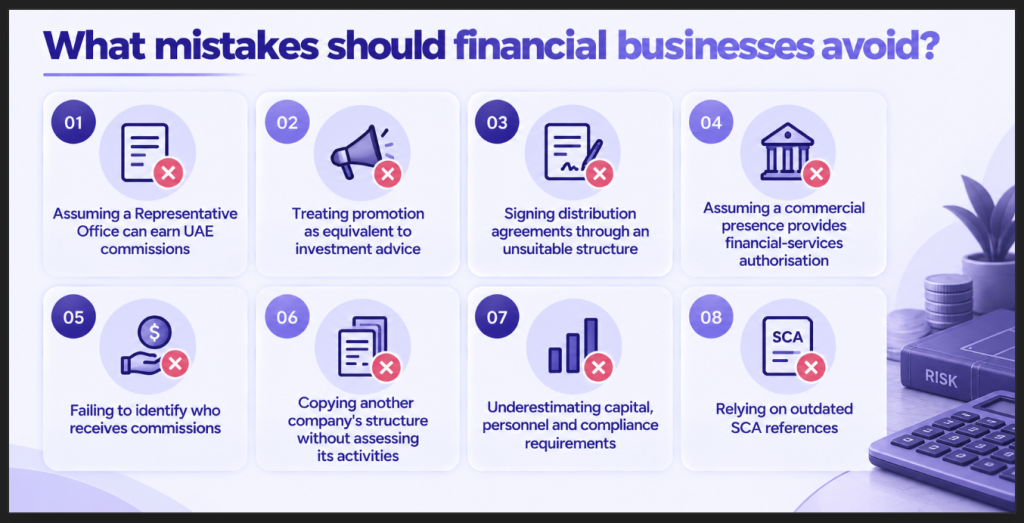
What mistakes should financial businesses avoid?
How Arnifi helps
Arnifi can help financial businesses assess and establish an appropriate UAE presence by supporting:
- Business-model and structure assessment
- Representative Office versus independent-company evaluation
- Mainland company incorporation
- Establishment documentation
- Office and licensing coordination
- Pre-authorisation setup requirements
- Alignment of the UAE structure with intended activities
FAQs
What is the difference between a Representative Office and a CMA-licensed company?
A Representative Office represents and supports an overseas parent, while a CMA-licensed company is a separate UAE entity that can conduct authorised activities and earn revenue independently.
Can a Representative Office earn commissions in the UAE?
No. It cannot independently earn UAE commissions, trail fees or other revenue in its own name.
Can a Representative Office sign distribution agreements?
No. It cannot independently enter distribution, referral or introducing-broker agreements with UAE or international financial institutions.
Can a Representative Office provide investment advice?
Not under the representative model described here. Investment guidance falls within the regulated activities available through the appropriate CMA authorisation.
What activities fall under Category 5?
For this business model, Category 5 – Arranging and Advice includes Financial Consulting, Introducing and Promotion.
Can a CMA-licensed UAE company earn Indian AMC commissions?
Yes. The UAE entity can potentially earn trail commissions from Indian AMCs relating to NRI investments, subject to the applicable structure and authorisation.
How long does each setup take?
A Representative Office takes approximately 4–8 weeks, while a CMA-licensed company generally takes around 3–6 months, primarily because of the financial regulatory authorisation process.
Conclusion
A Representative Office and a CMA-licensed company are designed for very different levels of UAE operations. The first supports and represents an overseas parent, while the second can operate independently and generate revenue within its authorised scope. Businesses should determine their activities, contracts, revenue model and desired level of independence before selecting the appropriate structure.
Official references
Top UAE Packages
Related Articles



Top UAE Packages
Get in Touch
