
Qatar Financial Centre vs Mainland | When Should a Company Change Its Operating Structure?

Anushka
Content Writer
Anushka Basu is a business content writer specialised in global business market insights. She aims to simplify complex regulatory, financial, and business concepts into… Read more

Tulika Saxena
AVP, Sales & Marketing | IIM Nagpur
Tulika Saxena specializes in business finance, sales strategy, and market positioning. Leads growth and partnerships, ensuring seamless business setup experiences and client success across… Read more



Key Fact: The Qatar Financial Centre (QFC) is an onshore business centre with its own legal, regulatory and tax framework. Companies must operate within their licensed activities, so changes to a business model may require a review of its existing licence and structure.
Table of contents
- What Is the Difference Between QFC and Mainland Qatar?
- Which Business Activities Can a QFC Company Carry Out?
- When Is a Mainland Company Structure More Suitable?
- How Do QFC and Mainland Structures Differ in Ownership and Licensing?
- How Do Tax and Compliance Requirements Compare?
- What Business Changes Can Trigger a Review of Your Existing QFC Structure?
- Can a QFC Company Expand Its Activities Without Changing Structure?
- When Should a Company Consider Moving From QFC to Mainland?
- What Should You Check Before Changing Your Company’s Operating Structure?
- How Can Arnifi Help With Business Setup in Qatar?
- FAQs
- Conclusion
What Is the Difference Between QFC and Mainland Qatar?
| Aspect | Qatar Financial Centre (QFC) | Mainland Qatar |
| Legal framework | Independent legal and regulatory framework | Qatar’s wider commercial and legal framework |
| Regulatory authority | QFC Authority and QFCRA for regulated financial activities | MOCI and relevant competent authorities |
| Foreign ownership | Up to 100% foreign ownership | Up to 100% may be permitted under applicable investment rules |
| Licensing | Activities must fall within the company’s approved QFC licence | Activities must meet applicable commercial and sector licensing requirements |
| Business activities | QFC-permitted professional, corporate and financial activities | Broader commercial activities subject to relevant licensing rules |
| Operating requirements | Must comply with QFC regulations and licence conditions | Must comply with applicable Qatari laws, regulations and licensing conditions |
| Suitability | Businesses whose activities fit the QFC licensing framework | Businesses requiring licences or approvals under the mainland framework |
Which Business Activities Can a QFC Company Carry Out?
QFC-permitted activities cover a range of professional, corporate and financial services. Businesses must identify the activities they intend to conduct and confirm that these fall within the QFC’s licensing scope.
Examples of activities commonly supported through QFC include:
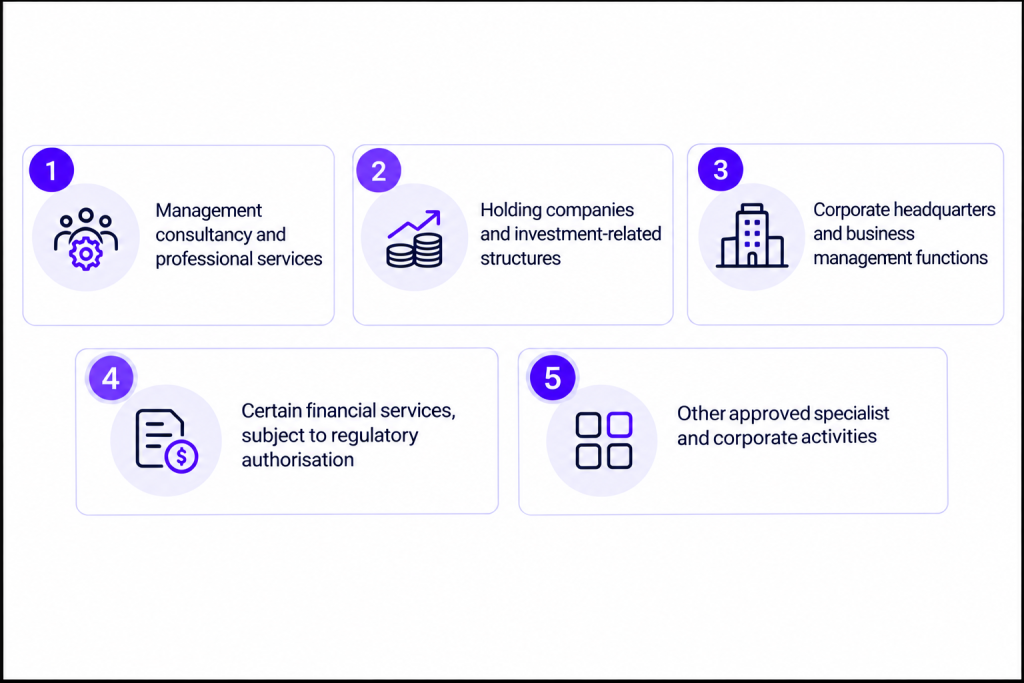
QFC distinguishes between regulated and non-regulated activities. Non-regulated businesses require a QFC licence for their approved activities. Regulated financial services require additional authorisation from the Qatar Financial Centre Regulatory Authority (QFCRA).
A company should review its licence before introducing a new service, entering another market segment or changing how it earns revenue. A business description that appears similar to its original activity may still require approval if the actual service falls outside the licence.
When Is a Mainland Company Structure More Suitable?
A mainland structure may be appropriate when the proposed business activities do not fall within QFC’s permitted scope or when the company’s operating model requires licences from other Qatari authorities.
This can be relevant for businesses involved in sectors with specific regulatory or operational requirements. Depending on the activity, a company may need approvals from MOCI or another competent authority before it can begin operations.
The assessment should consider:
- The exact commercial activity and its licensing classification
- Whether sector-specific approvals are required
- The locations and nature of the company’s operations
- The intended customer base and delivery model
- Any restrictions or conditions attached to the proposed activity
Mainland incorporation is not automatically the better option for every business. The structure should be selected after assessing the company’s requirements and the rules governing its intended operations.
How Do QFC and Mainland Structures Differ in Ownership and Licensing?
Ownership rules and licensing procedures differ between the two frameworks.
| Area | QFC | Mainland Qatar |
| Foreign ownership | Up to 100% | Up to 100% may be permitted under applicable investment rules |
| Licensing authority | QFC Authority | MOCI and relevant competent authorities |
| Legal framework | QFC regulations and common law-based framework | Qatar’s wider commercial and legal framework |
| Activity approval | Activities must fall within the QFC licence | Activities must satisfy applicable commercial and sector licensing rules |
| Regulated financial services | QFCRA authorisation may be required | Relevant financial-sector authority approvals apply |
Foreign investors can also access up to 100% ownership in eligible mainland activities under Qatar’s foreign investment framework. Restrictions and approval requirements continue to apply to certain sectors, including banking, insurance and commercial agencies.
For QFC entities, the licensing process begins with an assessment of the proposed activities and business model. Regulated firms may undergo additional scrutiny covering governance, capital, risk management and regulatory arrangements.
How Do Tax and Compliance Requirements Compare?
The QFC has a corporate tax framework that applies to taxable profits sourced in Qatar. Its standard corporate tax rate is 10% on local-source taxable profits. The treatment of income depends on the relevant tax rules and how the business earns its profits.
Mainland businesses are subject to Qatar’s tax legislation and applicable reporting requirements. Their tax position depends on ownership, business activities, income sources and relevant exemptions or treaty provisions.
Companies should assess more than the headline rate when comparing structures. Tax registration, accounting, reporting, audits where applicable and ongoing regulatory obligations can influence the cost and complexity of operating in Qatar.
A structure should therefore be evaluated using the company’s actual income model and compliance responsibilities rather than assuming that one framework always provides a better tax outcome.
What Business Changes Can Trigger a Review of Your Existing QFC Structure?
A business change can create a licensing issue even when the company remains legally incorporated under QFC.
Common triggers include:
- Adding a service that is not covered by the current licence
- Entering a sector with different regulatory requirements
- Changing the company’s principal business model
- Expanding into activities requiring another authority’s approval
- Altering the scope of operations or corporate structure
These developments should prompt a review of the existing licence and regulatory position. They do not automatically require the company to move to mainland Qatar.
The first question is whether the new activity can be approved under the QFC framework. A company may be able to amend its licence or obtain additional permissions while retaining its existing structure.
Can a QFC Company Expand Its Activities Without Changing Structure?
Yes, potentially. A company should first establish whether its proposed activity is already included in its licence or can be added through the relevant approval process.
The review generally involves:
- Comparing the proposed service with the company’s existing licensed activities
- Confirming whether a licence amendment or additional permission is needed
- Identifying any QFCRA or external regulatory approval requirements
- Preparing supporting business information and documentation
- Obtaining approval before carrying out activities that require it
Companies should consult QFC before launching a new service or materially changing their business model. Operating outside the approved scope can create compliance concerns and may affect the company’s ability to continue its activities.
When Should a Company Consider Moving From QFC to Mainland?
A company may consider another operating structure when its core activities cannot be licensed through QFC or when its intended business model requires a different legal or regulatory arrangement.
A restructuring assessment may be appropriate where:
- The company’s main activity falls outside QFC’s permitted scope
- Sector approvals or operational requirements point towards a mainland licence
- The business needs a legal presence under another commercial framework
- The proposed expansion cannot be accommodated through QFC licence amendments
The decision requires careful assessment. A change of structure may involve incorporation procedures, contracts, assets, employees, banking arrangements, tax registrations and ongoing obligations.
The company should establish whether a new mainland entity, a revised QFC licence or another arrangement is legally and commercially appropriate before proceeding.
What Should You Check Before Changing Your Company’s Operating Structure?
A structured review can help businesses identify the implications of expansion before committing to a change.
| Review area | What to examine |
| Existing licence | Approved activities, restrictions and conditions |
| Proposed business model | New services, revenue streams and operational scope |
| Regulatory approvals | QFC, QFCRA, MOCI or other authority requirements |
| Contracts and assets | Customer agreements, property, intellectual property and liabilities |
| Employees and operations | Employment arrangements and operational continuity |
| Tax and reporting | Registrations, filing obligations and potential tax consequences |
| Corporate procedures | Licence amendments, incorporation or restructuring steps |
Businesses should also consult the relevant authorities and qualified professional advisers where the proposed change affects licensing, tax or regulated activities.
How Can Arnifi Help With Business Setup in Qatar?
Arnifi can support businesses assessing their Qatar incorporation options by guiding company formation, documentation and administrative requirements.
Reviewing the planned activities at an early stage can help businesses understand which licensing framework may suit their operating model. This can also help identify questions that need clarification before an application or restructuring process begins.
The appropriate structure ultimately depends on the company’s circumstances and the applicable regulations. Businesses should confirm licensing decisions with the relevant Qatari authorities.
FAQs
What is the difference between QFC and mainland Qatar?
QFC is an onshore business centre with its own legal, regulatory and tax framework. Mainland companies operate under Qatar’s wider commercial framework through MOCI and other competent authorities.
Can a QFC company serve customers in Qatar?
Yes. QFC companies can transact with customers in Qatar, subject to their licensed activities and any relevant regulatory restrictions.
Can a QFC company add new business activities?
Potentially. The company must confirm whether the activity is already covered by its licence or requires an amendment, additional permission or regulatory authorisation.
Does a QFC company need to move to mainland if its business expands?
No. Expansion does not automatically require a move. The company should first assess whether its new activities can be accommodated under QFC licensing rules.
Can foreign investors own 100% of a QFC company?
Yes. QFC permits up to 100% foreign ownership, subject to its incorporation and licensing requirements.
What should a company check before changing its operating structure?
It should review its existing licence, proposed activities, regulatory approvals, contracts, employees, tax obligations and the procedures required for any new entity or restructuring.
Conclusion
Qatar Financial Centre QFC and mainland Qatar offer different operating frameworks for businesses entering or expanding in the country. The appropriate choice depends on the activities a company intends to conduct and the licensing requirements that apply to them.
A change in services, business model or regulatory exposure should prompt a review of the existing licence. Companies should assess whether an amendment or additional approval can support the change before considering a new operating structure. Early planning can help businesses make informed decisions and maintain compliance as their operations evolve.
Top UAE Packages
Related Articles



Top UAE Packages
Get in Touch
