
Beneficial Ownership Disclosure in Mauritius: Rules & Requirements for 2026


Corporate transparency in Mauritius has moved beyond mere administrative paperwork to become an absolute requirement of financial accountability. Authorities such as the Financial Services Commission (FSC) and the Registrar of Companies have increased their focus on the ownership structure in both domestic and international businesses, including GBCs, partnerships, and offshore structures.
The key to managing BO compliance is having exact knowledge of the 20% beneficial ownership requirement, the multi-level test for identifying beneficial ownership, the narrow reporting period, and the appointment of statutory officers.
What Is Beneficial Ownership in Mauritius?
The definition of a Beneficial Owner (also called an Ultimate Beneficial Owner) in Mauritius is the natural person who ultimately owns or controls the legal entity or structure, or the natural person on whose behalf the deal is done.
Mauritian corporate law specifically stipulates that neither the corporate entity nor the foundation or trust can be identified as the ultimate UBO. The regulators penetrate beyond the intermediate corporate holding companies, corporate entities, and nominee structures to uncover the real individuals who pull the strings and derive economic benefit from the entity.
Definition and Scope of Beneficial Ownership in Mauritius
The definition of a beneficial owner in Mauritius under corporate law is that of the natural person who ultimately owns or controls the legal entity. The individual may either own the equity directly or indirectly through intermediary corporate layers and nominees/trusts.
Why Is Beneficial Ownership Disclosure Important in Mauritius?
The reporting of beneficial ownership is the cornerstone of the country’s AML/CFT system. Non-compliance has severe consequences for the entity’s survival:
- Licensing and Regulatory Oversight: The FSC and Registrar of Companies assess the UBO reporting process while issuing licenses and during supervision.
- Banking Operations: Banks conduct thorough Customer Due Diligence (CDD). Inaccurate BO reports will immediately result in the freezing of the company’s account and hindered international transfers.
- Risk Mitigation: Full disclosure protects companies from large fines (up to MUR 300,000).
What Is the Beneficial Ownership Threshold in Mauritius?
Determining the exact ownership criteria will clarify who should be reported to the authorities and registered in internal registers.
What is the 20% Ownership Threshold?
Mauritius establishes 20% as its main criterion of equity, putting itself above the international average of 25%. Any natural person owning a share of 20% or more of the economic rights, share capital, or profit of an entity is regarded as a UBO.
Direct and Indirect Ownership
- Direct Ownership: If an individual owns 20% or more of the shares directly under his or her name.
- Indirect Ownership: If an individual owns the shares through an intermediate parent company, holding vehicle, or investment fund based in a different jurisdiction, with ownership of 20% or more.
Significant Interest and Effective Control in Mauritius
In addition to the ownership criteria established by the FSC, other criteria apply to licensed or regulated entities such as GBCs or financial services providers. Regardless of the percentage of shares that an individual owns, he or she would be considered a UBO if he or she holds a significant interest or has ultimate effective control over the business.
Legal Thresholds for Beneficial Ownership in Mauritius
The common criteria for determining an ultimate beneficial owner (UBO) in Mauritius are a 20% equity interest or shareholding and voting rights. Further, in the case of FSC-regulated entities, an individual will be considered a beneficial owner if he or she holds a “significant interest” or operates the organization and does not meet the 20% criterion.
Who Needs to Declare Beneficial Ownership in Mauritius?
The obligations to identify, record, and report on UBOs are applicable in almost all legal structures in Mauritius:
- Domestic Companies: Companies both private and public, registered under the Companies Act.
- Global Business Companies (GBCs): Offshore companies possessing the GBC license and managed through Management Companies (MCs).
- Authorised Companies: Companies working in foreign jurisdictions and managed from within Mauritius.
- Partnerships, LLPs, and LPs: Limited Partnerships and Limited Liability Partnerships.
- Foundations: Covering founders, councils, protection applicants, and ultimate beneficiaries.
- Foreign Companies and Registered Branches: Foreign companies carrying out business operations or registering branches in Mauritius.
- Sociétés: Civil and commercial partnerships (Sociétés Civiles and Sociétés Commerciales) registered under Mauritian law.
Who Qualifies as an Ultimate Beneficial Owner (UBO)?
A UBO is strictly a natural person. To qualify, an individual must fit into one or more of the following categories:
| UBO Qualification Category | Description |
| Equity Holder | Natural person owning $\ge$20% direct or indirect equity stake. |
| Control Holder | Natural person controlling $\ge$20% voting rights or governing decisions. |
| Protector/Beneficiary | Settlors, trustees, protectors, or beneficiaries of controlling trusts/foundations. |
| Senior Managing Official | Executive directors or C-suite officers defaulted when no equity/control UBO exists. |
How Is a UBO Identified in Mauritius?
For ascertaining the true identity of the person behind the ownership trail, Mauritius law requires a three-tier cascade test in the following manner:
1. Direct or Indirect Equity Ownership
The first test checks if any natural person has an aggregated ownership interest or economic benefit of 20% or more.
2. Voting Rights and Control
Where none of the individuals have 20% or more equity, the next test for control is:
- Having 20% or more voting rights.
- Possessing the legal right to appoint and/or dismiss a majority of the Board of Directors.
- Dominant influence over shareholders’ decision-making processes.
3. Control Through Other Means
Control may not always be based on equity or voting. The authorities can check agreements, personal connections, debt instruments, or contracts providing the right of veto that may legally empower the individual to guide management decision-making.
4. Senior Managing Officials as a Default
In complicated structures where the ownership is highly fragmented and none of the individuals satisfy the equity or control criteria above, the law requires reporting of Senior Managing Officers (like Executive Directors, Managing Director, and Chief Executive Officer) as the UBOs by default. In this way, no beneficial ownership fields in corporate registers remain vacant.
Can a Company or Trust Be a Beneficial Owner?
No. No corporation, holding vehicle, foundation, or trust shall ever be entered in the register as the beneficial owner.
Where a company is held by corporate vehicles or a trust:
- Corporate Chain: You have to penetrate all companies above until you find out who the real physical owners are.
- Trust Structure: You have to reveal the real persons behind the trust, which includes the settlor, the trustee, the protector, the beneficiaries, and any other person having control of the trust property.
How Are Beneficial Owners Identified in Complex Ownership Structures?
Multi-Layer Corporate Structures
When an entity is held through multiple corporate layers spread across various international jurisdictions, beneficial ownership is determined by calculating indirect ownership percentage across the chain. For instance, if Individual A owns 100% of HoldCo Alpha, which owns 60% of HoldCo Beta, which in turn owns 50% of a Mauritius Entity. Because 30% exceeds the 20% threshold, Individual A must be declared as a reportable UBO.
Trust and Foundation Structures
For entities controlled by trusts or foundations, the sequential 20% threshold is bypassed. The entity must report all natural persons holding key roles:
- Settlor(s) and Founder(s)
- Trustee(s) or Council Members
- Protector(s) or Enforcer(s)
- Identified Beneficiaries (or the class of beneficiaries)
Nominee Shareholders and Nominee Directors
Nominee structures are recognized legally in Mauritius; however, it is prohibited for nominees to be used as UBOs. Nominee shareholders act on behalf of another person. Information will have to go through the nominee in order to identify the true underlying individual who is controlling the shares.
What Information Must Be Recorded for Beneficial Owners?
The company should hold complete and confirmed personal details of all identified UBOs in its internal register of beneficial ownership:
Mandatory Date of Birth Requirements
- Full legal name including any aliases
- Date of birth (mandatory requirement)
- Country of citizenship/nationality
- Residential address and official address for receiving documents
Ownership and Control Details
- Date at which the person became a beneficial owner
- Type and amount of beneficial interest (in terms of number of shares, number of voting rights, or control information)
- Date on which a person was no longer a beneficial owner (kept in history files for 7 years)
Supporting Identification Information
- An officially certified copy of a valid passport or national identity card
- Proof of residential address (utility bill not older than 3 months)
- Signed Beneficial Owner Declaration Form
How Does the Beneficial Ownership Filing Process Work?
- Identify the Ultimate Beneficial Owner: Execute the 3-step cascading test across all ownership levels.
- Obtain the Beneficial Owner Declaration: Secure a signed written declaration form alongside certified supporting ID documentation from each identified UBO.
- Record Information Internally: Enter complete UBO profile details into the company’s internal Register of Beneficial Owners maintained at its registered office.
- Submit Information to the Central Register: File the verified details electronically with the Registrar of Companies central database.
- Maintain Updated Beneficial Ownership Records: Periodically review ownership structures and execute immediate updating filings whenever changes occur.
Who Is Responsible for Beneficial Ownership Compliance?
The compliance responsibilities are assigned to various stakeholders in the organizational context as follows:
- The Company or Legal Entity: It has a statutory liability for setting up, maintaining, and updating the BO register.
- Beneficial Owners: Statutory obligation to inform the organization about their position and provide the signed declaration along with identification papers.
- Authorised Officer: The officer appointed to be a resident individual who will communicate with the regulators and access the internal BO register.
- Alternate Officer: This person will perform all statutory obligations of an Authorised Officer in his/her absence.
- Management Companies (MCs): In the case of GBCs and Authorised Companies, the management companies are the main administrators.
When Must Changes in Beneficial Ownership Be Reported?
Update of beneficial ownership information requires compliance with deadlines of updates.
The 14-Day Reporting Requirement
In case of any changes in beneficial ownership information, the company needs to submit the updated filing within 14 days from the date of change to the Registrar of Companies.
Changes in Ownership or Voting Rights
- Transfer, allotment, or buy-back of shares that bring or remove the individual above or below the 20% level.
- Changes in shareholders’ agreement resulting in changes in effective voting rights distribution.
Changes in Ultimate Control
- Appointment or resignation of directors with veto rights.
- Rearrangement of the intermediate parent company or trusts with ultimate control.
- Change in personal information of the current beneficial owners (address, name, renewal of passport).
Compliance Deadlines for Beneficial Ownership in Mauritius
Legal entities in Mauritius, including Global Business Companies, domestic companies, and partnerships, have the legal obligation to collect and verify information about every beneficial owner. In case of any material changes in the beneficial ownership or control structure, it should be updated and filed with the central register within 14 days.
Are Beneficial Ownership Registers Public in Mauritius?
Access by Competent Authorities
No, access to the BO register is not available to the general public. The BO information that has been provided to the central register is kept confidential. Access to such registers can only be given to:
- Registrar of Companies (Corporate and Business Registration Department)
- Financial Services Commission (FSC)
- Bank of Mauritius (BoM)
- Financial Intelligence Unit (FIU)
- Independent Commission Against Corruption (ICAC) and Law Enforcement Agencies
Public and Third-Party Access Restrictions
Third parties, media houses, and the general public do not have access to central or internal BO registers. But banks, financial institutions, and auditing firms are bound by law to check UBO information independently during the CDD and AML process.
What Are the New Beneficial Ownership Requirements for 2026?
Regulators have strengthened compliance standards heading into 2026:
- Mandatory Date-of-Birth Information: All filings must explicitly register the exact date of birth for every listed UBO to prevent identity confusion across global databases.
- Appointment of Authorised Officer and Alternate Officer: Entities must designate a resident Authorised Officer and an Alternate Officer responsible for holding and reporting UBO data.
- Extended Compliance Deadlines for Partnerships: Standardized filing windows and strict update timelines apply equally to Partnerships, LPs, and LLPs.
- Additional Beneficial Ownership Information Deadlines: Standardized 14-day update rules are strictly enforced across all corporate categories with zero administrative grace periods.
- Extended Scope Covering Sociétés: Full mandatory beneficial ownership record-keeping and central registry reporting obligations cover Sociétés Civiles and Sociétés Commerciales.
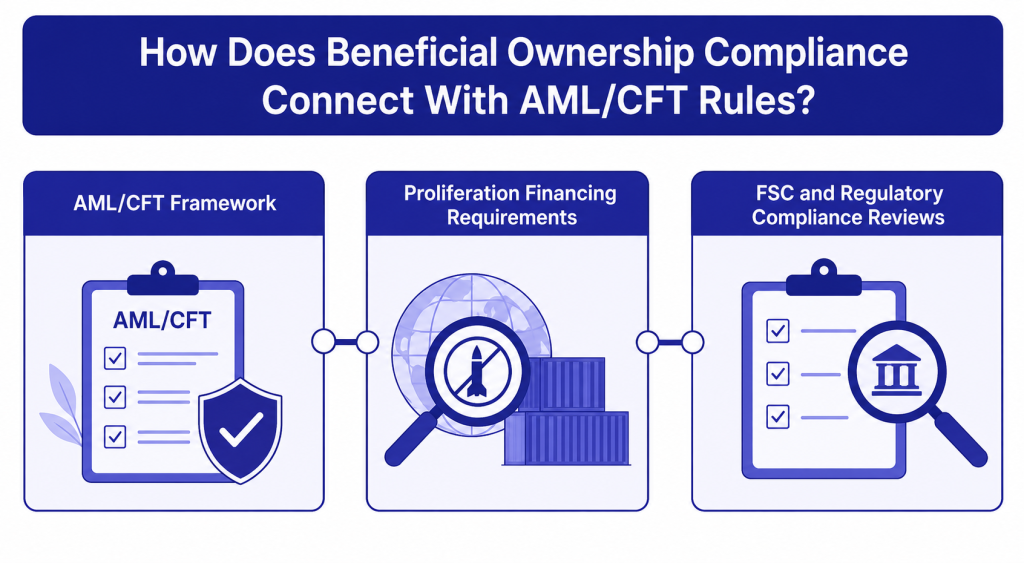
How Does Beneficial Ownership Compliance Connect With AML/CFT Rules?
AML/CFT Framework
UOB reporting ties in with the legislative requirements for Mauritius’s AML/CFT regime. Errors in UOB reporting or an incomplete ownership chain are seen as non-compliance violations.
Proliferation Financing Requirements
Increased transparency ensures that there are no illicit financial transactions and Proliferation financing issues; this ensures compliance with FATF international standards.
FSC and Regulatory Compliance Reviews
FSC conducts regular visits and desk checks on all licensed organizations. Discrepancies between the organization’s internal register, central submissions, and controls bring about administrative fines or warning notices.
What Are the Penalties for Non-Compliance?
Not maintaining, updating, or filing up-to-date and true beneficial ownership data results in penalties that include:
Financial Penalties
- Fines going as high as MUR 300,000 for not maintaining or filing up-to-date BO data.
- Recurring daily fines until non-conforming data is corrected.
Regulatory and Operational Consequences
- Inability to be issued a Certificate of Good Standing by the Registrar.
- Non-acceptance of any corporate application or nominations.
Banking and Licensing Risks
- Freezing of all domestic and international corporate bank accounts immediately by the compliance unit.
- Regulatory checks resulting in license suspension or revocation by the FSC
Common Beneficial Ownership Compliance Mistakes in Mauritius
- Relying Only on Nominee Shareholders: Stopping disclosures at the nominee level without identifying the underlying natural person.
- Failing to Trace Indirect Ownership: Looking only at immediate shareholders and missing individual owners positioned higher up in multi-tier holding structures.
- Missing Reporting Deadlines: Exceeding the strict 14-day filing window following share transfers or changes in UBO details.
- Maintaining Incomplete Beneficial Ownership Records: Failing to store supporting identification documents (passports, proof of address, DOB verification) alongside the internal register.
Beneficial Ownership Compliance Checklist for Mauritius
- Identify all direct and indirect shareholders holding $\ge$20% equity or voting rights.
- Perform the cascading control test if no single individual meets the 20% equity mark.
- Obtain signed Beneficial Owner Declarations and certified ID/passport copies for every UBO.
- Confirm mandatory date of birth (DOB) details are collected for all listed UBOs.
- Formally appoint a resident Authorised Officer and an Alternate Officer.
- Establish and update the internal Register of Beneficial Owners at the registered office.
- File verified UBO details electronically with the Registrar of Companies central register.
- Set up automated monitoring to ensure changes to ownership or control are filed within 14 days.
How Arnifi Can Help With Mauritius Business Compliance
Navigating corporate transparency regulations requires clear operational support. Arnifi assists businesses, fund structures, and global entities in remaining compliant with Mauritian corporate law:
- UBO Identification & Structure Analysis: Tracing complex multi-tiered corporate and trust arrangements to identify reportable UBOs.
- Authorised Officer Provision: Assisting with the appointment of resident Authorised Officers and Alternate Officers.
- Regulatory Filings: Managing central submissions, updates, and maintenance with the Registrar of Companies and the FSC.
- Compliance Audits: Reviewing internal BO registers and corporate documentation to identify and fix compliance gaps before regulatory inspections.
FAQs
What is beneficial ownership in Mauritius?
Beneficial ownership is a term that refers to the ultimate natural person owning or controlling the legal entity (where such entity owns 20% or more interest or voting rights) or conducting business on their behalf.
What is the beneficial ownership threshold in Mauritius?
Main thresholds are 20% of equity ownership, economic interest, or control in terms of voting rights, which is higher than the international 25% benchmark.
Who is considered an Ultimate Beneficial Owner (UBO) in Mauritius?
UBO will be a physical person, who owns 20% or more of a particular entity, controls the operations or veto rights on the management of the entity, or is the Senior Managing Official of such an entity where there is no equity owner.
Who must declare beneficial ownership in Mauritius?
Domestic companies, GBCs, Authorised companies, Partnerships, LLPs, LPs, Foundations, Foreign Branches, and Sociétés are obliged to report their beneficial owners.
How do you identify a beneficial owner in a Mauritius company?
Follow a three-level cascade test for the identification of beneficial owners: (1) Direct/indirect equity ownership, (2) Voting power/other forms of control, and (3) Senior Managing Officials in case none of the above criteria is met.
Do Global Business Companies need to declare beneficial owners in Mauritius?
Yes. All GBCs should inform their authorized Management Company and the central registry kept by Registrar of Companies about their UBOs.
Can a company or trust be a beneficial owner in Mauritius?
No. UBO should always be a natural person. If there is any legal entity, holding company, or trust that stands in the chain of ownership, then they should be traced until physical persons are identified.
Do nominee shareholders count as beneficial owners?
No. The nominee shareholder acts on behalf of someone else. The law ignores the nominee shareholder and reveals the real person behind it who controls the equity or gains economic benefits.
What happens if no individual owns 20% of a company?
The default Beneficial Owners in this case are the Senior Managing Officials (Executive Directors).
Are beneficial ownership registers public in Mauritius?
No. The registers are private and may be accessed only by competent authorities.
What information is required for beneficial ownership disclosure in Mauritius?
Required items are legal name, date of birth, nationality, residential address, type and extent of ownership, date of acquisition, and certified identity papers.
What is the deadline for reporting changes in beneficial ownership in Mauritius?
Changes in the beneficial ownership information or structure of an entity shall be disclosed to the Registrar within 14 days.
What are the new beneficial ownership rules in Mauritius for 2026?
Key ones will be the requirement for date of birth registration, appointment of resident Authorised and Alternate Officers, inclusion of all Sociétés, and strict adherence to the 14-day update timeline.
What are the penalties for failing to disclose beneficial ownership in Mauritius?
Penalties will range from MUR 300,000 administrative fees to license suspension and account freezes, as well as denial of Certificates of Good Standing.
How can businesses stay compliant with Mauritius beneficial ownership rules?
Companies should conduct annual reviews of their ownership, make immediate adjustments to the register after any structural change, file updates of the central register within 14 days, and engage professional compliance services.
References
- Financial Services Commission (FSC) Mauritius: https://www.fscmauritius.org/
- Corporate and Business Registration Department (CBRD) / Registrar of Companies: https://companies.govmu.org/
- Financial Intelligence Unit (FIU) Mauritius: https://www.fiumauritius.org/
- Bank of Mauritius (BoM): https://www.bom.mu/
Top UAE Packages
Related Articles

Top UAE Packages
Get in Touch
