
Malaysia Digital Free Trade Zone for E-Commerce Businesses | Explained
by Anushka Basu Jun 17, 2026  6 MIN READ


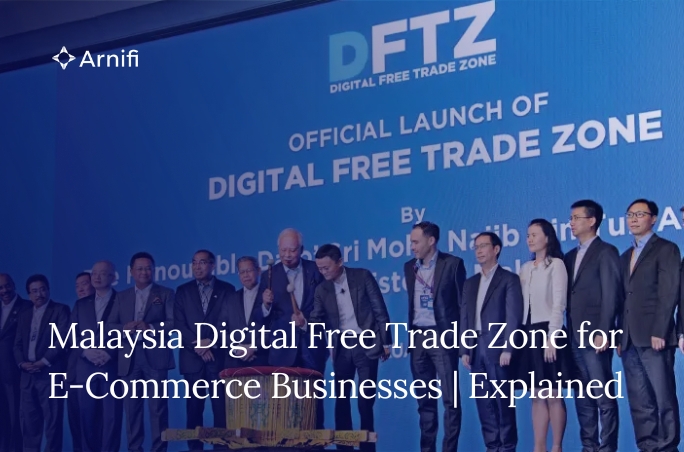
Cross-border e-commerce keeps on reshaping the way businesses find and reach customers across Southeast Asia. As online trade gets louder, so to speak, governments are spending on infrastructure that makes it easier to ship goods faster, reduce customs red tape, and reach international markets. In Malaysia, one of the biggest moves here is the Digital Free Trade Zone (DFTZ).
Table of contents
- Introduction
- What is the Digital Free Trade Zone?
- How does DFTZ Malaysia work?
- What benefits does DFTZ offer e-commerce businesses?
- Who should consider the DFTZ?
- How is DFTZ different from a traditional free zone?
- Does DFTZ support SMEs?
- What should businesses consider before joining?
- How can Arnifi help?
- FAQs
- Conclusion
Introduction
This DFTZ was launched as a joint effort between the Malaysian government, the Malaysia Digital Economy Corporation (MDEC), and Alibaba Group. It was created to push Malaysia’s role as a regional e-commerce hub, not just in name but in practice. The whole idea is to link companies to global marketplaces while also improving logistics and simplifying trade facilitation processes.
For companies selling online, the digital free trade zone in Malaysia gives an ecosystem built to support exports, fulfilment work, and international growth. With competition across ASEAN getting tighter, the DFTZ has turned into a meaningful piece of Malaysia’s broader digital economy plan.
What is the Digital Free Trade Zone?
The digital free trade zone in Malaysia is a niche initiative that blends physical logistics infrastructure with digital trade services to help cross-border e-commerce run more smoothly.
Rather than the usual free trade zones, which mostly centre on manufacturing and warehouse operations, the DFTZ was made with online trade and digital commerce in mind. The objective is basically to help businesses get into overseas markets with less friction, using integrated logistics, customs handling, and e-commerce services.
It also tries to back SMEs, because smaller businesses often struggle to take part in international trade. With digital platforms and more streamlined export processes, the initiative makes global selling feel more accessible.
How does DFTZ Malaysia work?
DFTZ Malaysia runs through a mix of physical and virtual infrastructure. You can think of it as covering three parts:
- E-Fulfilment Hub
- Satellite Services Hub
- E-Services Platform
The physical setup backs warehousing, cargo handling, and real logistics activities. Meanwhile, the digital layer helps businesses coordinate with government agencies, logistics providers, and e-commerce marketplaces. Hence, togetherness is the standout quality here, separating the digital free trade zone in Malaysia from older free zone models.
What benefits does DFTZ offer e-commerce businesses?
For online sellers and exporters, a few benefits tend to stand out right away. These include :
- Faster customs clearance
- Stronger logistics connectivity
- Easier access to global marketplaces
- Better export assistance
- More streamlined trade procedures
- Less day-to-day operational friction
Overall, the initiative is meant to reinforce Malaysia’s position as a regional e-commerce fulfilment hub, while giving businesses the tools to expand abroad. So yes, DFTZ Malaysia is especially relevant for firms that do cross-border sales.
Who should consider the DFTZ?
The digital free trade zone in Malaysia is usually a good fit for businesses involved in things like:
- E-commerce retail
- Marketplace selling
- Cross-border trading
- Consumer goods exports
- Online wholesale distribution
- Logistics and fulfilment services
If a company is aiming for regional expansion across ASEAN, the DFTZ may be valuable, mainly because it focuses heavily on international trade facilitation, not only shipping.
How is DFTZ different from a traditional free zone?
| Feature | Traditional Free Zone | DFTZ Malaysia |
| Main Focus | Manufacturing & Trade | E-Commerce & Digital Trade |
| Logistics Support | Yes | Yes |
| Digital Services | Limited | Extensive |
| Marketplace Integration | No | Yes |
| Cross-Border E-Commerce Focus | Limited | Primary Objective |
When put simply, the digital free trade zone in Malaysia was set up to support digital commerce, so it matches modern online business patterns much better than traditional setups.
Does DFTZ support SMEs?
Yes. One of the core objectives behind DFTZ Malaysia is to help SMEs take part in global e-commerce more effectively, without feeling completely boxed out.
The programme is designed to give smaller businesses access to logistics infrastructure, international marketplaces, and digital trade tools that would otherwise be hard to obtain on their own.
As a result, that SME development focus is still a central thread throughout the digital free trade zone in Malaysia.
What should businesses consider before joining?
Before a business starts operating, it should review key points such as:
- Product category requirements
- Import and export obligations
- Warehousing needs
- Marketplace strategy
- Regulatory compliance requirements
- Long-term expansion plans
Even though DFTZ Malaysia can create strong opportunities, companies still need to confirm that the structure fits their operational needs and commercial targets.
How can Arnifi help?
Expanding into Malaysia’s e-commerce environment is more than just registering a company. Businesses also have to think about licensing requirements, operational design, logistics planning, and regulatory compliance. Hence, Arnifi can help firms review market-entry options, understand free zone possibilities, and set up business structures meant for long-term growth in Malaysia’s changing digital economy.
FAQs
What is the digital free trade zone in Malaysia?
It’s a specialised initiative meant to support cross-border e-commerce using integrated logistics and digital trade services.
What is DFTZ Malaysia?
DFTZ Malaysia is Malaysia’s Digital Free Trade Zone, created to support e-commerce businesses and broader international trade activities.
Who can benefit from the DFTZ?
E-commerce businesses, exporters, marketplace sellers, logistics providers, and SMEs typically benefit from the initiative.
Is DFTZ the same as a traditional free zone?
No. The DFTZ is focused specifically on digital commerce and cross-border e-commerce activities.
Does DFTZ support international expansion?
Yes. The initiative was structured so businesses can reach global markets more efficiently through digital trade infrastructure.
Conclusion
Since cross-border e-commerce keeps growing, the digital free trade zone in Malaysia gives businesses access to infrastructure and services that fit modern international trade. With logistics support, digital integration, and export facilitation, DFTZ Malaysia remains a key platform for companies aiming at regional or global growth. Arnifi helps businesses with the setup requirements and expansion approach so they can maximise opportunities inside Malaysia’s digital economy. If you are looking for a seamless experience from day one, reach out to our professional experts at Arnifi today!
Top UAE Packages


Related Articles

Top UAE Packages
Get in Touch