
India-UAE Investment Corridor: GIFT City, Dual-Hub Structures, and Cross-Border Business Entry

Zahira Shaik
SEO Content Writer
Zahira Shaik is an SEO Content Writer and Published Author specializing in research-based content. She excels at analyzing market trends, regulations, and industry developments… Read more

Tulika Saxena
AVP, Sales & Marketing | IIM Nagpur
Tulika Saxena specializes in business finance, sales strategy, and market positioning. Leads growth and partnerships, ensuring seamless business setup experiences and client success across… Read more



Key Fact: India-UAE bilateral commerce is targeting $200 billion, driven by GIFT City financial integration, Local Currency Settlement (LCS), UPI–AANI digital payment interlinking, and operational expansions from major UAE financial institutions like ADIA, Mashreq, FAB, and ADNIC.
Table of contents
- Introduction
- How India-UAE Investment Relations Have Evolved
- GIFT City: The New Financial Bridge Between India and the UAE
- UAE Financial Institutions Expanding into GIFT City
- India’s Investment Facilitation Presence in the UAE
- Local Currency Settlement and UPI–AANI Integration
- Where New India-UAE Investment Opportunities Are Emerging
- India-UAE Dual-Hub Business Structure
- Step-by-Step Entry Framework for the India-UAE Corridor
- Key Compliance Considerations Before Entering the Corridor
- Common Mistakes Businesses Should Avoid
- Conclusion
- Frequently Asked Questions (FAQs)
- References
Introduction
The economic relationship between India and the United Arab Emirates is no longer just about the historical oil and gold trade; it has now become highly integrated in the sense of having a cross-border financial system. The flow of capital between the two nations is not confined to policy agreements, but includes investments in renewable energy, infrastructure, maritime, food, and fintech sectors. Among many others, a very significant element of this integration is the GIFT City (Gujarat International Finance Tec-City), which functions as a platform through which capital can be invested in India by UAE sovereign wealth funds, institutional and private players using the competitive tax and regulatory system.
Having moved on from being just a commitment to investing, some of the major UAE institutions such as ADIA, Mashreq Bank, FAB, and ADNIC have started setting up their operations in India’s financial market. Such an arrangement helps business organizations, startups, and medium-sized companies to take advantage of practical ways to enter the Indian market, dual hub structures, Local Currency Settlements, and integrated payment rails through the India-UAE corridor.
How India-UAE Investment Relations Have Evolved
While initially focused on energy exports and the exchange of primary goods, the business relationship between India and UAE was officially recognized through the signing of the Comprehensive Economic Partnership Agreement (CEPA) in 2022. CEPA established a framework wherein duties on more than 90% of bilateral goods were reduced, and routes for institutional services and investments were created.
The corridor is now focused on deep supply chain integration, payment interoperability, and infrastructure financing. The following are some of the important milestones that have been reached during this current phase:
- Comprehensive Economic Partnership Agreement (CEPA): Reductions in tariffs and simplified customs procedures have increased mobility for the service sector, enabling financial services, technology companies, and logistics firms to scale in both jurisdictions.
- Local Currency Settlement (LCS) System: Trading parties have the option to settle trades in INR and AED. Settling in local currency eliminates foreign exchange risk, lowers FX transaction costs, and minimizes reliance on third-party currencies such as the US Dollar.
- The $200 Billion Trade and Investment Target: India and the UAE have agreed upon a definitive target to increase non-oil trade volume between the two nations and expand mutual foreign direct investments (FDIs).
- Targeted Infrastructure FDI: Investments by UAE capital are targeted towards important Indian infrastructure projects such as cold chain logistics networks, deep water ports, renewable energy parks, and industrial corridors.
GIFT City: The New Financial Bridge Between India and the UAE
GIFT City IFSC acts as an onshore-offshore jurisdiction for overseas investors and corporate houses in India. The IFSC offers all international financial regulations, no restrictions on foreign exchange for offshore business dealings, and attractive tax benefits, including a 10-year corporate tax holiday and non-levying of GST on IFSC units.
In terms of the India-UAE financial corridor, GIFT City serves as the operational clearinghouse of capital deployment, fund management, and risk mitigation across borders:
- Cross-Border Banking: Multicurrency offshore banking centers facilitate efficient foreign exchange treasury operations and trade finance facilities.
- Investment Funds: Category I, II, and III Alternative Investment Funds (AIFs) within GIFT City offer a means for foreign limited partners (LPs) to invest their money in Indian private equity, venture capital, and real estate without encountering any currency convertibility issues.
- Reinsurance and Capital Markets: Unique insurance and capital markets facilities assist in structuring risks for UAE funds as well as issuance of debt and equity instruments through internationally accepted legal systems.
UAE Financial Institutions Expanding into GIFT City
The maturity of the corridor can be seen through UAE finance professionals creating licensed operations within the GIFT City IFSC, turning theory into reality for the actual trade policy:
- Abu Dhabi Investment Authority (ADIA): The establishment of ADIA in the GIFT City is to enable easier investment in Indian private assets, infrastructural projects, and capital growth vehicles. Being present in the city itself, the institution is a guarantee for international asset managers that want to create investment vehicles through the IFSC.
- Mashreq Bank: Mashreq’s branch within GIFT City IFSC provides special corporate and institutional trade finance, working capital facilities, and cross-border corporate banking solutions that connect the balance sheets of Middle Eastern countries with India.
- First Abu Dhabi Bank (FAB): FAB’s operations within the GIFT City ensure liquidity for cross-border corporate deals, syndication, and multicurrency credits for corporate groups that operate in both markets.
- Abu Dhabi National Insurance Company (ADNIC): ADNIC’s branch within GIFT City IFSC offers specialized insurance services for large-scale infrastructure projects, including marine, energy, commercial property, and political risks insurance.
India’s Investment Facilitation Presence in the UAE
Besides the inward institutionality, Invest India, which is India’s investment promotion and facilitation arm, has set up its office in Dubai to facilitate the work of UAE sovereign wealth funds, family offices, and business entities interested in entering the Indian market.
In addition, the Dubai office helps investors with market research, site selection, quick regulatory clearances, and coordination at the central and state government ministries of India.
Local Currency Settlement and UPI–AANI Integration
In most instances, financial friction in international trade arises from slow clearing and settlement times, FX conversion costs, and transaction costs. The India-UAE corridor handles such financial challenges through technological and central bank integration.
Local Currency Settlement (LCS) Framework
LCS mechanism enables commercial parties to settle their export/import transactions either in INR or AED. Commercial banks of both countries have facilitated this process through direct account linkage between their respective Vostro and Nostro accounts. Through this mechanism, parties can avoid double conversions and spot rate changes in the foreign exchange market.
UPI–AANI Interoperability
Through linking the Unified Payment Interface of India with that of AANI in the UAE, central financial authorities have provided an instantaneous method of making payments across borders through a digital payment system without wire transfer delays and associated costs. Through this interoperability, MSMEs, individuals, and tech entrepreneurs can conduct P2P and B2B transactions at the very moment of need.
Where New India-UAE Investment Opportunities Are Emerging
| Sector | Scope & Key Focus Areas | Potential Business Entry & Subcontracting |
| Renewable Energy & Clean Tech | Large-scale solar power plants, wind farms, green hydrogen production, and Battery Energy Storage Systems (BESS) supporting India’s net-zero transition targets. | UAE energy companies investing equity and partnering with Indian EPCs to develop utility-scale clean energy projects. |
| Infrastructure & Logistics Hubs | Integrated smart city developments, industrial land development, freight corridors, and port connectivity in Special Investment Regions (e.g., Dholera SIR). | Logistics operators establishing automated warehouse parks, distribution centers, and specialized cold storage facilities. |
| Maritime Cooperation | Deepening maritime alignment between India’s Sagarmala initiative and UAE maritime expansion plans across six operational verticals. | Mid-sized firms can engage through: • Port Automation: Supplying IoT sensors, tugboats, and yard software. • Ship Repair & Maintenance: Dry-docking facilities, vessel refits, and marine component manufacturing. • Container Yards: Developing inland container depots (ICDs) and liquid cargo storage tied to rail networks. |
| Energy Security Infrastructure | Midstream and downstream energy assets complementing traditional crude oil trade. | Subcontracting for subsea pipeline engineering, LNG regasification terminals, LPG import facilities, and underground Strategic Petroleum Reserve (SPR) leasing. |
| Food Security & Specialised Food Parks | Agricultural supply chain development backed by the I2U2 framework (India, Israel, UAE, US) to secure Gulf food supply. | Establishing modern food processing plants, climate-controlled logistics, and direct farm-to-port transportation corridors in key farming hubs. |
| Technology & Fintech | Next-generation digital financial tools built on top of interlinked UPI–AANI cross-border payment infrastructure. | Software and fintech providers offering invoice factoring platforms, automated FX hedging tools, and SME trade financing solutions. |
India-UAE Dual-Hub Business Structure
In order to leverage cross-border business activities efficiently, companies around the world leverage a dual hub structure to conduct their business. Under the dual hub model, companies segregate commercial IP, international capital raising, and Indian operations into separate legal structures.
Entity Functions & Jurisdiction Roles
- UAE Entity (ADGM, DIFC, or Onshore Free Zone): Serves as the international/regional holding company. Provides access to the international capital market, favourable corporate laws (such as English Common Law jurisdictions in ADGM/DIFC), no capital gains tax on foreign assets, and easy access to Middle East debt/private equity.
- GIFT City IFSC Entity: Serves as the cross-border treasury, holding company, or specialized finance intermediary. Deals with multi-currency dividends, cross-border debt instruments, and tax-neutral distribution without domestic withholding complications.
- Indian Operating Company (OpCo): Domestic Private Limited Company that performs the manufacturing or services domestically, hires locals, acquires land locally, and arranges domestic logistics.
Key Structuring Considerations
- Tax Residency and Economic Substance: Real economic substance (local management, presence of offices, employees, etc.) is required for both UAE and GIFT City to benefit from the provisions of the India-UAE Double Taxation Avoidance Agreement (DTAA).
- Capital Movement: Corporate structures have to be aligned in terms of dividend flow, transfer pricing, and service level agreements (SLAs) to FEMA/FATCA norms and UAE corporate taxation requirements.
Step-by-Step Entry Framework for the India-UAE Corridor
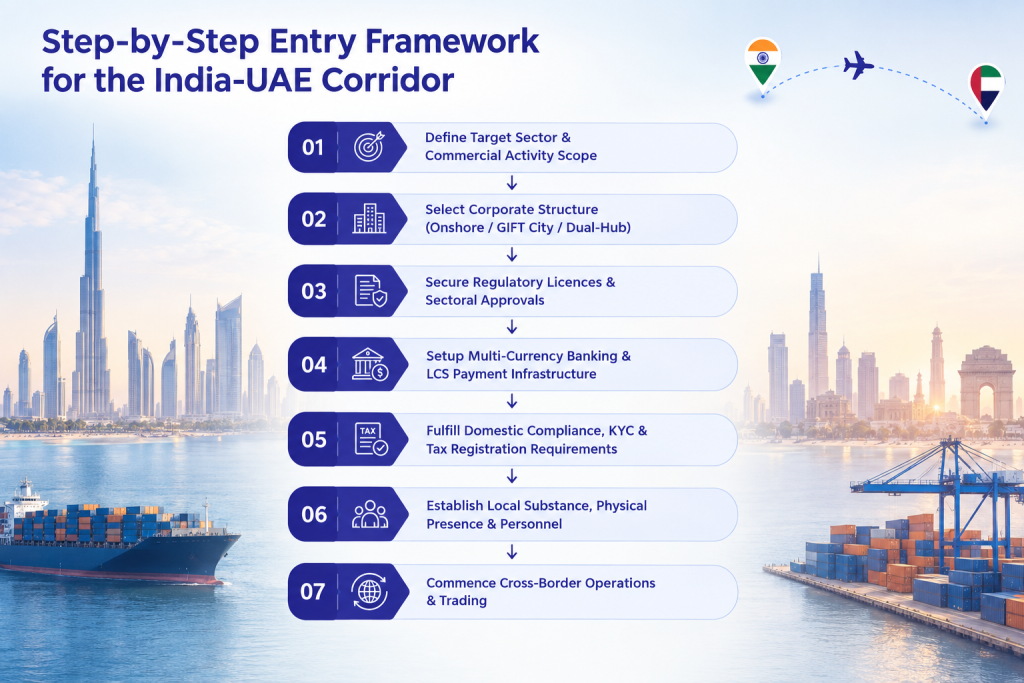
Key Compliance Considerations Before Entering the Corridor
Before utilizing capital, some key legal and regulatory considerations have to be examined by companies:
- Company Incorporation Requirements: Registering companies via the SPICe+ portal in India, the GIFT SEZ authority in India, or UAE Registrar Authorities, such as DET in Dubai, ADGM, or DIFC.
- Sectoral FDI Approvals: To determine whether the planned business operations are part of the “Automatic Route” that requires no prior approval or the “Government Route” as per FDI policy of India.
- IFSCA Regulatory Filing: Getting particular permits for their activities related to finance, banks, or funds within GIFT City from the International Financial Services Centres Authority (IFSCA).
- Bank Account Setup & KYC: Managing rigorous KYC, UBO declarations, as well as Anti-Money Laundering procedures in both UAE and Indian bank accounts.
- Foreign Exchange Guidelines: Compliance with Indian FEMA guidelines during money transfers, equity issuance, or intra-group royalty payments.
Common Mistakes Businesses Should Avoid
- Selecting Structures Prematurely: Setting up sophisticated holding structures in free zones ahead of time before the exact business scope is finalized, leading to unnecessary compliance expenses.
- Assuming GIFT City Replaces Domestic OpCos: Units of GIFT City’s IFSC are set up to handle offshore/cross-border operations. The direct services to domestic Indian clients would usually require a domestic Indian operating company.
- Delaying Bank Account Opening: It takes weeks to complete cross-border onboarding for corporate banking activities and UBO verifications. Opening treasury accounts should be done early in the expansion process.
- Ignoring Economic Substance Requirements: Not hiring resident directors and establishing physical presence in the UAE/GIFT City, making the tax residency status useless.
- Overlooking Sector-Specific Licensing: Initiating infrastructure or energy project activities without obtaining the required environmental clearance certificates and technical operating licenses.
Conclusion
From being the standard form of the commercial business relationship, the India-UAE investment corridor has become an integrated international cross-border investment ecosystem. Due to structural changes like GIFT City IFSC, the Local Currency Settlement mechanism, integration of the UPI-AANI fintech, as well as the involvement of ADIA, FAB, Mashreq, and Invest India, entry barriers into the markets continue to reduce.
It does not matter whether it is about putting sovereign investments in huge infrastructure projects or building a mid-scale engineering project via a dual hub approach. It is important to properly select legal structures, licensing, taxes, and banking rails for the company’s operations.
Frequently Asked Questions (FAQs)
What is the role of GIFT City in India-UAE investment?
It serves as a tax-efficient onshore-offshore financial center that will help UAE companies to conduct multicurrency business transactions and investments without foreign exchange control.
Which UAE banks have branches in GIFT City?
Mashreq Bank and First Abu Dhabi Bank (FAB) run licensed branches in GIFT City IFSC.
What is the India-UAE Local Currency Settlement (LCS) system?
It is a mechanism for conducting cross-border business transactions in Indian Rupees and Dirhams without intermediate conversion into USD.
How does UPI–AANI integration benefit businesses?
Integration of payment systems allows making instant and low-cost digital money transfers from India to UAE bank accounts and vice versa.
What is ADIA’s role in GIFT City?
ADIA invests its private equity and infrastructure funds in India through its operational facility based in GIFT City.
Is Invest India opening an office in Dubai?
Yes, there is a dedicated Dubai office by Invest India which helps Middle Eastern companies get their investments regulated and market entry facilitated.
What sectors are attracting the highest India-UAE investment?
These are renewable energy projects, maritime services, infrastructure logistics services, food security agroparks, and cross-border fintech payment systems.
How can UAE companies invest in India through GIFT City?
UAE-based companies form IFSC-based companies, which then make direct investments in operating companies in Indian rupees using foreign exchange.
Can Indian businesses use GIFT City for UAE-related transactions?
Indian company groups make use of GIFT City-based units to handle foreign treasury operations, international debts, and overseas investments.
What maritime opportunities are emerging between India and the UAE?
These include modernizing port terminals, dry-docking facilities, container logistics yards, and automated maritime operations software solutions.
What are the energy-security opportunities for smaller contractors?
They are subcontracting for regasification plants, subsea pipeline engineering, cryogenic tank servicing, and petroleum strategic reserve components.
How can SMEs participate in India-UAE cross-border trade?
By adopting the LCS mechanism and using UPI-AANI rails to reduce transaction costs and serve as specialized suppliers in the chain.
What should businesses consider before establishing a dual India-UAE structure?
Locations for target markets, costs associated with getting licenses, taxes for the company, transfer pricing, onboarding to banks, and the physical economic substance needed.
References
- International Financial Services Centres Authority (IFSCA)
https://www.ifsca.gov.in - Invest India
https://www.investindia.gov.in - Ministry of Commerce and Industry (Government of India)
https://commerce.gov.in - Reserve Bank of India (RBI)
https://www.rbi.org.in - Central Bank of the United Arab Emirates (CBUAE)
https://www.centralbank.ae
Top UAE Packages
Related Articles



Top UAE Packages
Get in Touch
