
Ultimate Guide to Company Setup in GIFT City India: Unlocking Foreign Trade in 2026

Zahira Shaik
SEO Content Writer
Zahira Shaik is an SEO Content Writer and Published Author specializing in research-based content. She excels at analyzing market trends, regulations, and industry developments… Read more

Tulika Saxena
AVP, Sales & Marketing | IIM Nagpur
Tulika Saxena specializes in business finance, sales strategy, and market positioning. Leads growth and partnerships, ensuring seamless business setup experiences and client success across… Read more



Key Fact: GIFT City IFSC provides a 100% tax exemption for 10 out of 15 years, combined with multi-currency trading outside traditional FEMA restrictions, making it India’s premier gateway for global financial operations and foreign trade.
Table of contents
- Introduction: Understanding GIFT City as India’s Global Financial Gateway
- How GIFT City Facilitates Foreign Trade and Cross-Border Business
- Tax Benefits and Financial Incentives for Businesses in GIFT City
- Company Setup in GIFT City India: Choosing the Right Business Structure
- Step-by-Step Process for Company Setup in GIFT City India
- Setting Up a Fund Management Entity (FME) in GIFT City
- Post-Incorporation Compliance and Operational Requirements
- How Arnifi Helps with Company Setup in GIFT City India
- Conclusion: Building a Global Business Presence Through GIFT City
- Frequently Asked Questions (FAQs)
- References
Introduction: Understanding GIFT City as India’s Global Financial Gateway
The Gujarat International Finance Tec-City (GIFT City) is the first functioning Smart City and International Financial Services Centre (IFSC) of India. It serves as a jurisdictional conduit by merging the cost-effectiveness and talent base of onshore India with the regulatory freedom of offshore global financial centers such as Dubai, Singapore, and London.
What Is GIFT City IFSC?
An International Financial Services Centre (IFSC) is a separate jurisdiction that has been created in India through the International Financial Services Centres Authority (IFSCA) Act, 2019. GIFT City IFSC, located geographically in Gujarat, is considered as a foreign territory for financial and foreign exchange regulations in India.
The Vision of Onshoring Offshore Financial Activities
In the past, corporate organizations of India, along with fund managers, created financial holding structures or investment platforms in offshore jurisdictions such as Mauritius, Singapore, and the Cayman Islands to tap into the global pool of capital. GIFT City was conceptualized for onshoring the financial operations to Indian territory with a healthy and globally competitive environment.
Why Global Businesses Are Exploring GIFT City
Globally operating companies use GIFT City owing to its 100% tax benefits, easy transfer of cross-border funds, simplified single-window regulations, and low-cost infrastructure facilities.
How GIFT City Facilitates Foreign Trade and Cross-Border Business
GIFT City is a paradigm shift in the process of doing business and foreign currency transactions within India.
Deemed Offshore Status and FEMA Framework
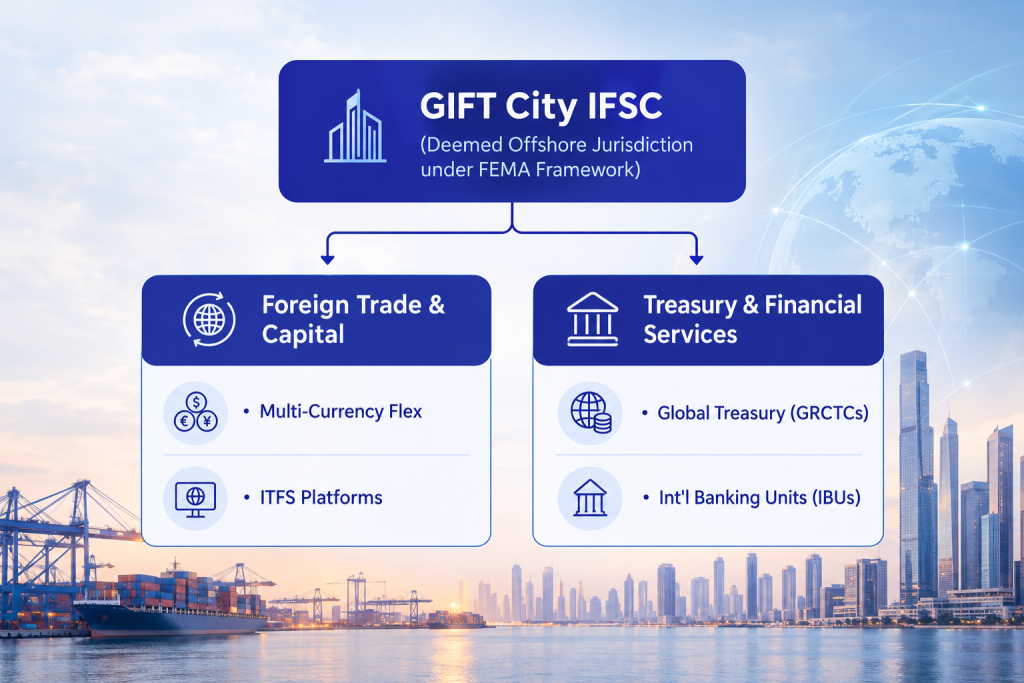
The units set up in the GIFT City IFSC are categorized as “persons resident outside India” as per FEMA. This will enable the business entities to conduct their business operations with the flexibility of an offshore unit with operations in India itself.
Multi-Currency Transactions and Foreign Exchange Flexibility
The entities operating in GIFT City have the freedom to conduct transactions in specified foreign currencies (including USD, EUR, GBP, JPY, and SGD). The normal foreign exchange restrictions that apply to domestic Indian units are not applicable here.
International Trade Finance Services (ITFS) Platforms
The GIFT City offers ITFS platforms to provide trade finance solutions like discounting of export receivables, factoring, and forfaiting solutions to buyers and sellers internationally.
Global and Regional Corporate Treasury Centres (GRCTCs)
The Multinational Corporations (MNCs) can establish GRCTCs in GIFT City in order to manage pools, intra-company loans, cross-border payments, and other risk management techniques at their global subsidiaries without domestic currency conversion restrictions.
Access to International Banking and Capital Markets
Access is provided to International Banking Units (IBUs) and international stock exchanges like India INX and NSE IX, making foreign capital raising and debt issuance easy.
Tax Benefits and Financial Incentives for Businesses in GIFT City
The Indian government is providing a very attractive fiscal package to create GIFT City as an international business hub.
Income Tax Benefits and the 20-Year Tax Holiday Framework
- 100% Tax Holiday: IFSC units are entitled to a 100% income tax holiday for eligible business income for any 10 consecutive years out of a 15-year block.
- Concessional MAT / AMT: Minimum Alternative Tax and Alternative Minimum Tax rates are lowered to 9% of book profits (as opposed to 15% in domestic) for IFSC units, whereas for those who opt under the new tax regime, they are exempted.
GST Benefits for Eligible IFSC and SEZ Transactions
- Zero-Rated Supplies: Supply to IFSC units or SEZ entities will be a zero-rated supply at 0% GST.
- Exemption on Services: Supply in the IFSC or between IFSC units is generally exempt from GST.
Exemptions on Securities Transaction Tax, Commodity Transaction Tax, and Stamp Duty
The transactions carried out in IFSC international stock exchanges will be:
- Securities Transaction Tax (STT)
- Commodity Transaction Tax (CTT)
- Stamp Duty on stock exchange transactions within the IFSC
Customs Duty Benefits on Eligible Imports
The goods and equipment brought into the GIFT SEZ zone for their legitimate use are free from basic customs duties and integrated taxes.
Company Setup in GIFT City India: Choosing the Right Business Structure
Choosing the appropriate corporate vehicle is critical to aligning regulatory compliance with strategic business objectives.
| Entity Structure | Best Suited For | Regulatory Authority | Key Requirement |
| Private / Public Limited Subsidiary | Foreign MNCs, Tech Companies, Holding Companies | ROC & IFSCA | Minimum paid-up capital as per entity vertical |
| Branch Office | Foreign Financial Institutions, Banks, Insurers | IFSCA | Direct extension of parent overseas entity |
| Limited Liability Partnership (LLP) | Professional Services, Consultancy, Advisory | ROC & IFSCA | Flexible profit-sharing; at least 2 partners |
| Fund Management Entity (FME) | Asset Managers, PE/VC Firms, Family Offices | IFSCA | Net worth ranging from $75,000 to $1,000,000+ |
Private and Public Limited Subsidiary Companies
The creation of a subsidiary company under the Companies Act, 2013 (revised for IFSC) results in a separate legal entity having limited liability. This is the preferred form for foreign corporates that wish to have a permanent presence in India.
Branch Office Setup for Foreign Businesses
Foreign corporations may establish a direct Branch Office within GIFT City. In this way, the foreign corporation operates directly in the IFSC through the branch office without incorporating a subsidiary in the IFSC. This will be subject to certain licensing conditions by IFSCA.
Limited Liability Partnership (LLP)
LLPs are entities characterized by limited liability and a flexible internal organizational structure. These are extensively used for corporate structuring, advisory, and non-banking services operations.
Fund Management Entities (FMEs)
If you wish to conduct business in investment funds (AIFs, Mutual Funds, Portfolio Management Services), you must incorporate a legal entity as an FME under IFSCA (Fund Management) Regulations.
Factors to Consider When Selecting an Entity Structure
Consider capital deployment needs, tax obligations of the parent company, liability considerations, and target clientele while determining the legal entity structure.
Step-by-Step Process for Company Setup in GIFT City India
The procedure to set up in GIFT City is in accordance with a sequential dual-approval process, comprising corporate incorporation through MCA and regulatory licensing through IFSCA/SEZ regimes.
1. Assess Business Objectives and Select Structure: Phase 1: Planning.
Analyze the business objectives, tax considerations, and capital needs to choose an appropriate entity (Subsidiary, Branch, or LLP).
2. Identify Office Premises & Obtain PLOA: Phase 1: Infrastructure.
Rent premises (physical or co-working) within the GIFT SEZ territory and get a Provisional Letter of Allotment (PLOA) from the developer.
3. Prepare Documentation & Corporate Incorporation: Phase 2: Entity Legalization.
Prepare the Charter documents (MOA/AOA), get Director Identification Number (DIN) and Digital Signature Certificate (DSC) and submit the incorporation application to MCA (ROC).
4. Submit Regulatory Applications via SWIT Portal: Phase 2: Licensing.
Submit applications through the Single Window IT (SWIT) Portal for IFSCA regulatory registration and SEZ approval.
5. Obtain UAC Approval and Letter of Approval (LOA): Phase 3: Clearances.
Submit the business plan to the Unit Approval Committee (UAC) to obtain the Letter of Approval (LOA) for conducting business within the GIFT SEZ.
6. Complete BLUT, Banking, and Operational Setup: Phase 3: Formalities.
Obtain BLUT, register for GST, and get a foreign currency bank account in an International Banking Unit (IBU).
7. Receive Final Approvals and Commence Business Operations: Phase 4: Launch.
Obtain final commencement certificate from IFSCA and initiate cross-border commercial operations.
Setting Up a Fund Management Entity (FME) in GIFT City
The IFSCA has an innovative and efficient framework available for fund managers wishing to attract international and local investors.
Understanding the FME Regulatory Framework Under IFSCA
As per the IFSCA (Fund Management) Regulations, asset managers register directly as Fund Management Entities (FMEs) without having to go through various layers of domestic regulations. The FMEs are classified into the following major categories:
- Authorised FME: For private pool management and angel funds.
- Registered FME (Non-Retail): For venture capital, private equity, and hedge funds targeting accredited investors.
- Registered FME (Retail): For fund managers offering mutual funds and retail investment schemes.
Alternative Investment Funds (AIFs), Venture Capital Funds (VCFs), and Exchange Traded Funds (ETFs)
FMEs can set up Category I, II, and III AIFs. Benefits include:
- Exemption from domestic co-investment restrictions.
- Flexibility to pool both offshore capital and domestic Indian capital (via the Liberalised Remittance Scheme / ODI routes).
FME Registration and Licensing Requirements
Key eligibility conditions involve:
- Minimum net worth criteria ($75,000 for Authorised FMEs; $500,000 for Registered Non-Retail FMEs; $1,000,000 for Registered Retail FMEs).
- Appointment of a Principal Officer and Compliance Officer meeting key fit-and-proper credentials.
Governance, AML, and Ongoing Compliance Requirements
Robust risk management framework, stringent AML/CFT program, and annual compliance audits are requirements for FMEs.
Post-Incorporation Compliance and Operational Requirements
Incorporating the entity is just the beginning; continuous compliance is required.
Corporate Governance and Regulatory Reporting
Entities have to submit periodical financial statements as well as activity reports to IFSCA, the Development Commissioner (SEZ), and the ROC.
Accounting, Bookkeeping, and Tax Compliance
Foreign currency may be used as an accounting currency by FMEs operating in GIFT City, for keeping their financial records. Annual accounts shall conform to Indian Accounting Standards (Ind AS) or internationally recognized accounting standards.
Corporate Banking and Foreign Currency Accounts
Operations include keeping the Special Non-Resident Rupee (SNRR) accounts along with the main Foreign Currency Accounts (FCAs) at IFSC International Banking Units.
HR, Payroll, and Operational Management
Units need to take care of the local payroll in INR but have the flexibility of compensating their global executives in foreign currency while complying with the laws of India and the SEZ requirements for manpower.
Maintaining Regulatory and SEZ Compliance
Quarterly and annual APRs (performance reports) need to be filed through the SEZ online portal showing NFE (net foreign exchange earnings).
How Arnifi Helps with Company Setup in GIFT City India
Navigating cross-border corporate setup across multiple regulatory bodies requires focused advisory and operational execution. Arnifi provides end-to-end corporate setup services tailored for global enterprises entering GIFT City.
- Business Structure Assessment: Guidance on choosing between Subsidiaries, LLPs, Branches, or FME structures based on tax and operational goals.
- Documentation & Incorporation: Turnkey execution for ROC incorporation, MOA/AOA drafting, and director registrations.
- IFSCA & SEZ Licensing: Complete representation before the Unit Approval Committee (UAC) and processing through the SWIT portal.
- Fund Structuring & Setup: Comprehensive structuring for AIFs, Family Offices, and Fund Management Entities.
- Post-Setup Management: Ongoing retainer support for bookkeeping, foreign currency accounting, tax filing, and SEZ regulatory reporting.
Conclusion: Building a Global Business Presence Through GIFT City
GIFT City presents itself as a generational opportunity for progressive businesses, fund managers, and multinational corporations with the combination of competitive tax breaks and multi-currency cross-border capabilities.
Key Considerations Before Setting Up
- Understand your target market and cross-border payment transactions.
- Align your capital resources with the IFSCA net worth standards.
- Consider your office real estate requirements beforehand to ensure your SEZ allocation.
Simplify Your Setup Journey with Arnifi
Setting up a structure overseas-style within India can be simple. Working with expert corporate consultants guarantees you get the maximum benefit out of your incorporation process right from the start.
Frequently Asked Questions (FAQs)
What is GIFT City IFSC in India?
GIFT City IFSC is a special type of International Financial Services Center situated in Gujarat, India. It works as a hub and is considered an offshore jurisdiction under the FEMA regulation and caters to global financial services, international trade, and investment management operations.
How does company setup in GIFT City India work?
Setting up the company includes choosing a suitable form of business organization, arranging office space in GIFT SEZ, registering the entity with the ROC, and obtaining regulatory clearance from IFSCA through the SWIT portal.
Can foreign companies establish a presence in GIFT City?
Forms of organization include Private/Public Ltd Companies, LLPs, Branch Offices, and other specialized organizations such as FMEs.
What types of business entities can be established in GIFT City?
The list of entities includes Private/Public Limited Companies, Limited Liability Partnerships (LLPs), Branch Offices, and other specialized vehicles such as Fund Management Entities (FMEs).
How does GIFT City facilitate foreign trades and cross-border transactions?
Since the units of GIFT City have been granted the status of “deemed offshore” under the FEMA rules, businesses may make multi-currency contracts for trading and cross-border finance operations bypassing all standard capital control regulations.
What currencies can businesses use for transactions in GIFT City?
Businesses can conduct their operations using freely convertible foreign currencies such as USD, EUR, GBP, JPY, CAD, and AUD.
What are the tax benefits of setting up a company in GIFT City?
Qualifying companies are granted a 100% income tax exemption for 10 out of 15 years, lower MAT/AMT rates, GST exemptions for offshore/SEZ services, and total exemptions for STT, CTT, and stamp duty for IFSC exchange trades.
What is the role of IFSCA in GIFT City company formation?
IFSCA is a regulatory body that regulates financial products, services, and institutions in all the IFSCs in India.
What is the SWIT portal, and how is it used?
The Single Window IT (SWIT) portal is IFSCA’s online platform used by prospective entities to submit consolidated licensing applications, track regulatory clearances, and submit statutory filings.
What documents are required for company setup in GIFT City?
Primary documents include corporate identity records, director KYC, Memorandum and Articles of Association (MOA/AOA), detailed business plan, proof of office allotment (PLOA), and board resolutions.
How long does it take to establish a company in GIFT City?
An end-to-end company setup typically takes between 6 to 10 weeks, depending on the operational complexity and statutory approval cycles.
What is a Fund Management Entity (FME) in GIFT City?
An FME is an entity registered under IFSCA regulations to manage investment pools, venture capital funds, private equity, portfolio management schemes, or retail mutual funds.
Can businesses set up an Alternative Investment Fund (AIF) in GIFT City?
Yes. Managers can establish Category I, II, and III AIFs under the unified IFSCA FME framework to pool both international and domestic capital.
What are the ongoing compliance requirements for GIFT City companies?
Entities must complete regular filings with IFSCA, annual SEZ performance reporting (APR), corporate ROC returns, GST compliance, and maintain books audited under applicable standards.
How can Arnifi help with company incorporation and regulatory compliance in GIFT City?
Arnifi provides complete end-to-end corporate services, including structural advice, ROC incorporation, SWIT portal filings, IFSCA licensing, office allotment assistance, and post-incorporation tax and accounting retainership.
References
- International Financial Services Centres Authority (IFSCA): https://www.ifsca.gov.in
- GIFT SEZ Official Portal: https://www.giftsez.com
- Ministry of Corporate Affairs (MCA): https://www.mca.gov.in
- SEZ Online System: https://www.sezonline-ndml.co.in
Top UAE Packages


Related Articles

Top UAE Packages
Get in Touch