
Ireland ICAV vs Luxembourg SCSp | Choosing Between Two European Fund Structures

Anushka
Content Writer
Anushka Basu is a business content writer specialised in global business market insights. She aims to simplify complex regulatory, financial, and business concepts into… Read more

Tulika Saxena
AVP, Sales & Marketing | IIM Nagpur
Tulika Saxena specializes in business finance, sales strategy, and market positioning. Leads growth and partnerships, ensuring seamless business setup experiences and client success across… Read more


Key Fact: An Irish ICAV is a corporate investment vehicle that can be authorised as a UCITS or alternative investment fund (AIF). A Luxembourg SCSp is a special limited partnership without separate legal personality. The right choice depends on the fund strategy, investor requirements, governance and regulatory obligations.
Table of contents
- Introduction
- What Is an Ireland ICAV?
- What Is a Luxembourg SCSp?
- How Do Ireland ICAV and Luxembourg SCSp Compare?
- Which Structure Offers the Right Governance and Control Model?
- How Do Regulatory Requirements Differ Between Ireland and Luxembourg?
- How Does Tax Treatment Differ Between an Ireland ICAV and Luxembourg SCSp?
- Which Fund Strategies Suit an ICAV or an SCSp?
- What Are the Setup Processes for an Ireland ICAV and Luxembourg SCSp?
- What Costs Should Fund Sponsors Compare?
- How Should You Choose Between an Ireland ICAV and Luxembourg SCSp?
- What Mistakes Should You Avoid When Selecting a European Fund Wrapper?
- How Can Arnifi Help With Ireland ICAV and Luxembourg SCSp Setup?
- FAQs
- Conclusion
- Official References
Introduction
Ireland and Luxembourg are established European fund domiciles, but their investment fund structures serve different needs. An Ireland ICAV follows a corporate model, while a Luxembourg SCSp uses a partnership arrangement. Fund sponsors should compare their legal form, investor rights, regulatory requirements and ongoing costs before choosing a structure for their investment strategy.
What Is an Ireland ICAV?
An Irish Collective Asset-management Vehicle (ICAV) is a corporate structure established specifically for investment funds under the Irish Collective Asset-management Vehicles Act 2015. It can be authorised as a UCITS or an AIF, depending on the intended strategy and applicable requirements.
Key features include:
- Separate legal personality and a corporate governance framework
- Investor participation through shares
- Registration through the Central Bank of Ireland’s ICAV process
- Fund authorisation requirements determined by the applicable UCITS or AIF framework
- Constitutional and fund documents that establish governance and investor rights
An ICAV is a legal vehicle, not a regulatory category in itself. Registration and fund authorisation are distinct processes. Sponsors should establish the intended fund classification before assessing the applicable obligations.
What Is a Luxembourg SCSp?
A société en commandite spéciale (SCSp) is a Luxembourg special limited partnership commonly used for alternative investment structures. It has no separate legal personality, and its operation depends significantly on the partnership agreement.
| Feature | How it works |
| Legal form | Special limited partnership |
| Partners | At least one general partner and one limited partner |
| General partner | Manages the partnership and carries broader liability |
| Limited partners | Generally benefit from limited liability, subject to applicable rules |
| Partnership agreement | Defines contributions, distributions, voting rights and transfers |
| Common applications | Private equity, venture capital, private credit and co-investment |
| Minimum capital | No statutory minimum capital requirement under the general SCSp framework |
The partnership agreement is central to the arrangement. It sets out how partners allocate responsibilities and economic rights. An SCSp is not automatically a regulated fund, however. Its regulatory position depends on its activities and the applicable fund and manager framework.
How Do Ireland ICAV and Luxembourg SCSp Compare?
The primary distinction is corporate governance versus partnership-based structuring. An ICAV issues shares, while an SCSp gives investors partnership interests. Their regulatory treatment also depends on the fund framework selected.
Legal structure and investor participation
An ICAV operates as a corporate investment vehicle with separate legal personality. An SCSp does not have separate legal personality, so sponsors must account for its partnership-based legal arrangements when structuring investments and responsibilities.
Governance and flexibility
An ICAV follows its constitutional documents and applicable fund rules. An SCSp offers considerable contractual flexibility through its partnership agreement, particularly on capital commitments, distributions, and investor voting rights.
Regulatory position
An ICAV may operate as a UCITS or AIF, subject to the relevant authorisation. An SCSp may be used in an alternative investment fund arrangement, but the legal form alone does not determine whether regulatory requirements apply.
Which Structure Offers the Right Governance and Control Model?
The preferred structure depends on how the sponsor wants to allocate control and investor rights. An ICAV may suit a fund seeking a corporate governance model, while an SCSp may appeal to sponsors who want to define more of the relationship between partners through contractual terms.
Before deciding, sponsors should consider:
- Who will make investment and operational decisions?
- How will distributions and carried interest be calculated?
- What voting rights will investors receive?
- How will transfers of shares or partnership interests be handled?
- What protections are required for different investor groups?
The governing documents should reflect the intended arrangement and comply with the relevant legal and regulatory requirements.
How Do Regulatory Requirements Differ Between Ireland and Luxembourg?
| Regulatory consideration | Ireland ICAV | Luxembourg SCSp |
| Registration | Central Bank of Ireland ICAV registration process | Required partnership details filed with the Luxembourg Trade and Companies Register |
| Fund authorisation | Depends on UCITS or AIF classification | Depends on the fund’s legal form, classification and applicable regulatory framework; the SCSp legal form alone does not determine authorisation requirements. |
| Management | Must meet relevant fund management requirements | An AIFM may need authorisation or registration, depending on the applicable rules |
| Ongoing obligations | Reporting, accounting and compliance requirements | Partnership accounting, reporting and applicable compliance requirements |
| Other service providers | Depositary and administration requirements depend on the fund regime | Depositary, audit and administration requirements depend on the applicable rules |
The Central Bank of Ireland separates ICAV registration from fund authorisation. In Luxembourg, an SCSp used in an investment fund arrangement must be assessed alongside the rules governing its manager and activities. A partnership structure does not automatically remove regulatory obligations.
How Does Tax Treatment Differ Between an Ireland ICAV and Luxembourg SCSp?
| Structure / Criteria | Key Tax Feature | Tax Mechanism | Strategic / Compliance Consideration |
| Ireland ICAV | Regulated by the Central Bank of Ireland | Operates under a gross-roll-up tax regime | Exempt from fund-level tax on profits earned for unit holders |
| Ireland ICAV | Exit tax obligations | Exit tax applies upon a chargeable event | Tax exemptions exist for qualified investors meeting declaration rules |
| Luxembourg SCSp | Special Limited Partnership model | Fiscally transparent for direct tax purposes | Income is attributed to partners rather than taxed at the partnership level |
| Luxembourg SCSp | Variable tax outcomes | Actual tax depends on fund activities and partner circumstances | Fiscal transparency does not guarantee automatic tax exemption |
| Cross-Border Evaluation | Comprehensive tax comparison | Analyzes fund, investor, and investment target jurisdictions | Sponsors must assess investor tax residency and treaty access |
| Cross-Border Evaluation | Reporting and withholding rules | Evaluates applicable international tax regulations | Sponsors must manage cross-border reporting and withholding tax risks |
Which Fund Strategies Suit an ICAV or an SCSp?
| Fund strategy | Ireland ICAV considerations | Luxembourg SCSp considerations |
| Private equity | Assess the appropriate AIF framework and governance | Consider capital commitments and distribution arrangements |
| Venture capital | Evaluate investor requirements and fund classification | Consider flexible partnership terms |
| Private credit | Review authorisation and lending-related requirements | Assess partnership arrangements alongside AIFM obligations |
| Liquid investments | Consider whether a UCITS or AIF is appropriate | Determine whether a partnership structure fits the strategy |
| Co-investment | Evaluate corporate governance and investor participation | Consider contractual allocation of rights and investment economics |
The strategy alone does not determine the best structure. Liquidity, investor eligibility, distribution plans and regulatory obligations must also inform the decision.
What Are the Setup Processes for an Ireland ICAV and Luxembourg SCSp?
Both structures require planning, but the documentation and regulatory steps differ. For an ICAV, sponsors must establish the appropriate fund classification and complete the relevant registration and authorisation processes. For an SCSp, the partnership agreement, partner arrangements and required filings are central to formation.
The process generally involves:
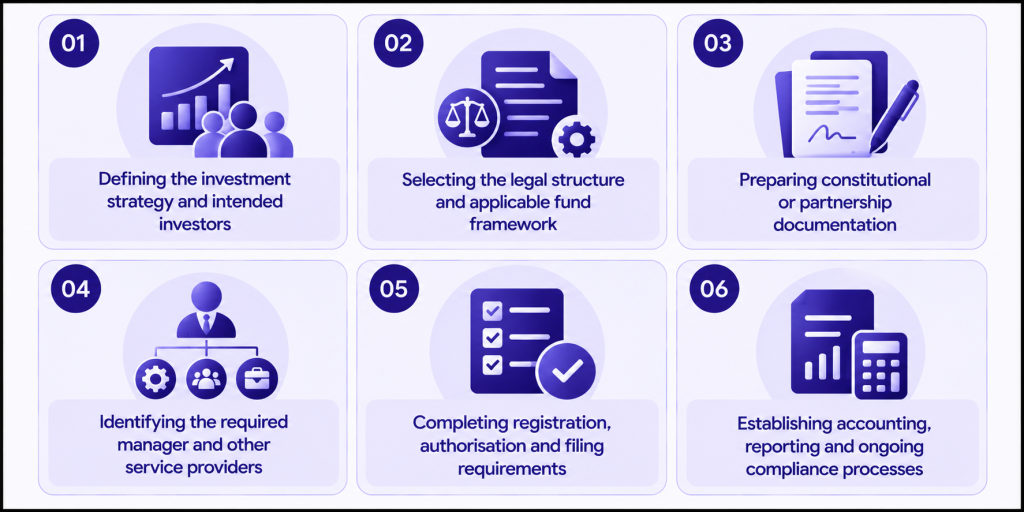
Launch timelines depend on the fund classification, documentation, service-provider arrangements and regulatory review. Neither structure has one universal setup timeline.
What Costs Should Fund Sponsors Compare?
Initial and ongoing expenses
Registration fees are only one part of the total cost. Sponsors should budget for legal documentation, regulatory charges, fund administration, accounting, management fees, tax advice, reporting and investor servicing. Depositary and audit costs may also apply, depending on the structure and regulatory requirements.
What affects the total cost?
Fund complexity, investment strategy, investor numbers, service-provider choices and ongoing compliance requirements can all affect the budget. An SCSp’s contractual flexibility does not guarantee lower costs, and an ICAV’s corporate structure does not automatically make it more expensive.
How Should You Choose Between an Ireland ICAV and Luxembourg SCSp?
| If your priority is… | What to evaluate |
| Corporate fund governance | Whether an ICAV suits the fund type and governance model |
| Partnership-based structuring | Whether an SCSp supports the desired investor arrangements |
| UCITS distribution | Whether an Irish ICAV under the UCITS framework is appropriate |
| Private-market investments | Capital commitments, distributions and investor rights |
| Cross-border investors | Marketing requirements, investor eligibility and tax treatment |
| Operational planning | Service-provider availability and total running costs |
There is no universal winner. The right choice is the structure that meets the fund’s legal, commercial, tax and regulatory needs.
What Mistakes Should You Avoid When Selecting a European Fund Wrapper?
- Treating an ICAV and an SCSp as interchangeable legal forms
- Assuming every ICAV follows the same authorisation route
- Assuming an SCSp is automatically outside fund regulation
- Confusing tax transparency with investor tax exemption
- Overlooking AIFM, depositary, audit and reporting requirements
- Choosing a structure before confirming investor and distribution needs
- Comparing formation fees without considering annual operating expenses
How Can Arnifi Help With Ireland ICAV and Luxembourg SCSp Setup?
Arnifi can coordinate Luxembourg SCSp setup and help sponsors organise formation requirements and relevant service-provider arrangements. Sponsors planning an Ireland ICAV can also assess the structure’s requirements as the corresponding service package is added to Arnifi’s portfolio.
The aim is to help sponsors understand the setup process and identify the requirements that need professional legal, regulatory and tax advice before launch.
FAQs
1. What is the difference between an Ireland ICAV and a Luxembourg SCSp?
An ICAV is a corporate investment vehicle with separate legal personality. An SCSp is a special limited partnership without separate legal personality. Their governance, investor participation and regulatory treatment differ.
2. Is a Luxembourg SCSp a regulated investment fund?
Not automatically. Its regulatory treatment depends on the fund’s activities, classification and the requirements applicable to its manager.
3. Can an Ireland ICAV be used for alternative investment funds?
Yes. An ICAV can be established as an AIF, subject to the applicable authorisation and regulatory requirements. It may also be authorised as a UCITS where the relevant conditions are met.
4. Which structure is more tax-efficient?
Neither is universally more tax-efficient. An Irish investment fund may fall under the gross-roll-up regime, while an SCSp is generally tax-transparent in Luxembourg. The outcome depends on the fund, investors and underlying investments.
5. Which structure is better for private equity and venture capital?
An SCSp may suit sponsors seeking partnership-based capital commitments and flexible distribution arrangements. An ICAV may suit sponsors who prefer a corporate fund vehicle. The decision depends on investor needs and the intended regulatory framework.
Conclusion
An Ireland ICAV provides a corporate investment vehicle, while a Luxembourg SCSp offers a partnership-based structure with contractual flexibility. The right choice depends on governance, investor requirements, tax treatment and regulatory obligations. Sponsors should assess both establishment and ongoing costs before proceeding. Arnifi can coordinate Luxembourg SCSp setup and help sponsors plan for their proposed fund structure.
Official References
Top UAE Packages
Related Articles

Top UAE Packages
Get in Touch
